Urgent Medical Mission Landing Page Template
Mission - Go Where It Hurts is a modular card grid landing page built for medical mission organizations. It combines a full-viewport video hero, a live mission ticker, and a resource-rich content hub to move donors, volunteers, and healthcare professionals from first impression to committed action. The design feels like a field hospital at first light: calm, purposeful, and stripped of anything unnecessary.
by Rocket studio
Quick summary
This landing page template gives medical mission organizations a complete, conversion-ready presence. It opens with a cinematic video hero stamped with the movement hashtag, then flows into a modular card grid packed with field guides, packing checklists, photo essays, and training resources. Every section is structured to carry visitors from inspiration to preparation to action, making the page one of the most focused examples of cause-driven healthcare content available today.
Who this template is for
This template serves organizations and individuals working at the intersection of healthcare and humanitarian work. Whether you represent a structured nonprofit, a faith community, or a network of independent clinicians, this landing page gives you the foundation to communicate your mission statement clearly and turn casual visitors into committed participants.
- Medical professionals such as surgeons, nurses, and dentists who want to find a meaningful deployment in the medical field
- Church coordinators, corporate donors, and pre-med students who need clear path to give, serve, or volunteer
- Nonprofit teams who want to establish authority, explain their vision, and grow their community of supporters
What problem this template solves
Most medical mission organizations struggle with a scattered online presence. A generic homepage rarely explains the mission statement with enough clarity to move someone to act. The page either buries critical resources behind too many clicks or fails to communicate the emotional weight of the work. Creating a landing page that can achieve the overall goal of converting casual readers into committed volunteers or donors requires both emotional storytelling and structural precision.
- Visitors leave quickly when a medical landing page lacks clear calls-to-action and genuine resources above the fold
- Donors and volunteers cannot find the information they need to answer their questions about upcoming missions, treatment options, or logistics
- Organizations miss higher chance opportunities by not offering free, downloadable resources before asking for commitment
What you get with this template
This template delivers a fully structured, single-page content hub designed specifically for the medical business of running mission deployments. Every component is sourced from the original design brief and built for the healthcare nonprofit audience. The page is ready to present your mission and vision statement prominently, while the modular grid lets you write and organize resources by role, region, and deployment type.
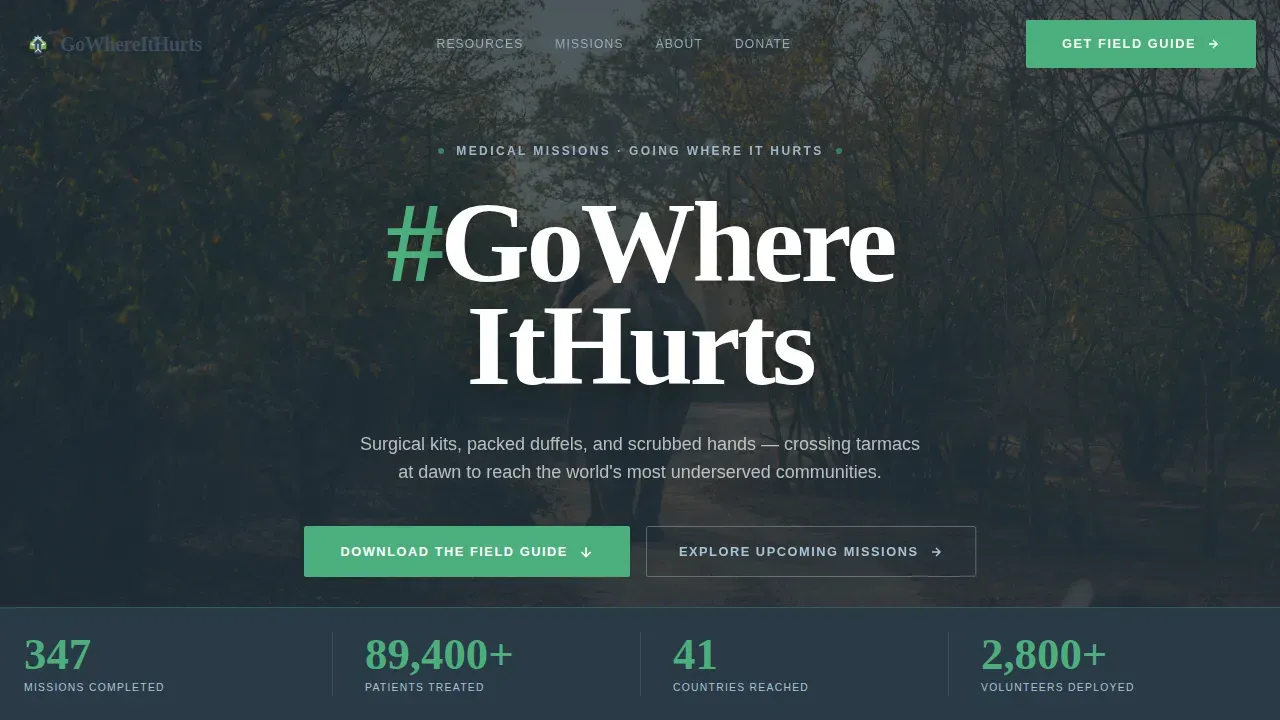
- A full-viewport video hero with massive movement typography and a live mission ticker counting missions, patients, and countries
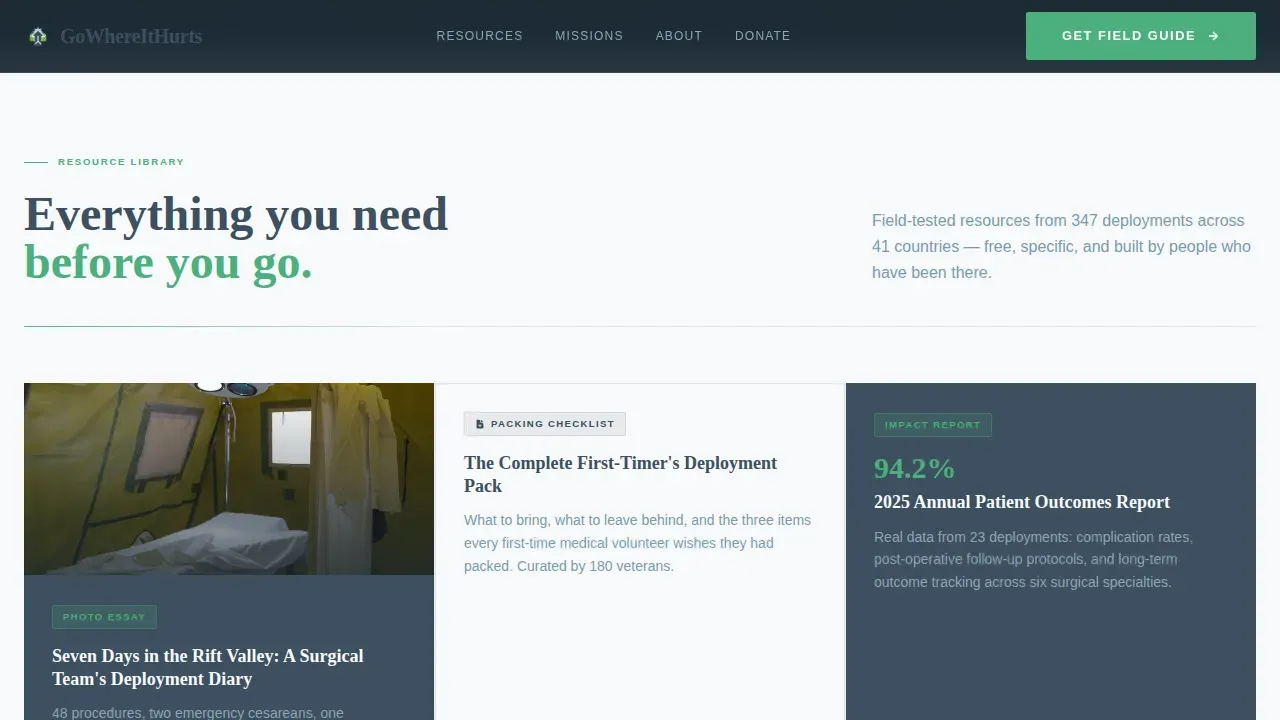
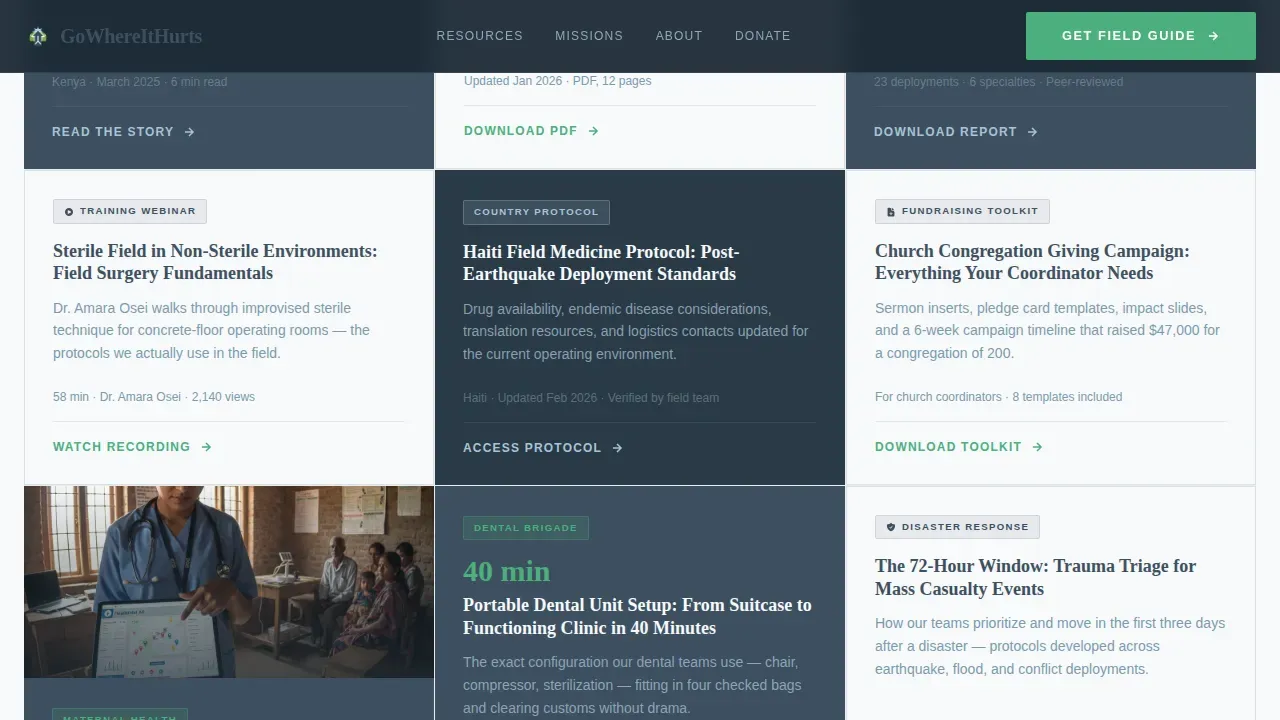
- A modular card grid alternating surgical slate and sterile white backgrounds, filled with field guides, checklists, webinar recordings, photo essays, and impact publications
- A progressive email capture form gated behind "Download the Field Guide," an interactive mission map call-to-action, and a Field Voices testimonial section
Feature list
This landing page template is built around six core capabilities. Each feature is prompt-backed and directly supports the work of a medical mission organization.
Full-Viewport Video Hero with Live Mission Ticker
The hero section fills the entire screen with a slow-motion aerial video of a medical team walking toward a village at golden hour. Bold white typography stamps the movement hashtag at center frame. Beneath the video, a scroll-linked ticker counts missions completed, patients treated, and countries reached in triage green, giving visitors an immediate and specific sense of the organization's reach and impact. Using a high-quality, authentic image or video of your team in action is widely recommended for the hero section of any medical landing page, and this template delivers exactly that.
Modular Alternating Card Grid
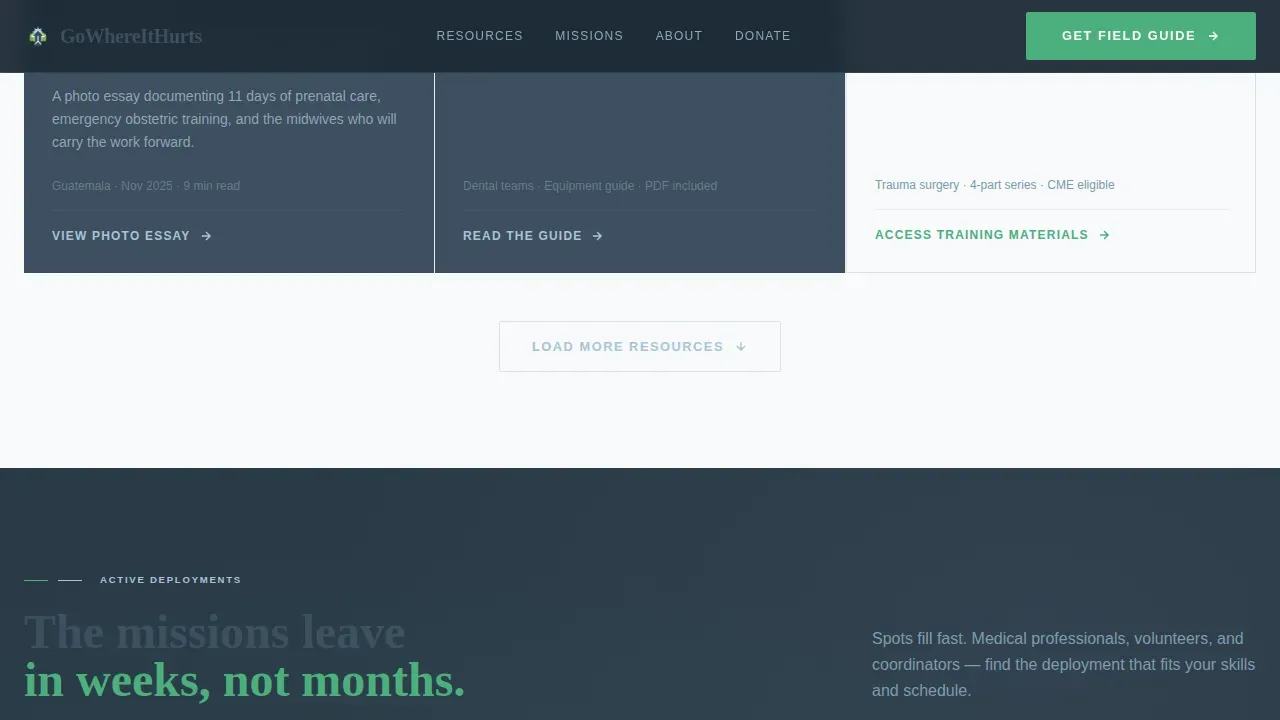
The resource section uses a uniform card grid where each card is a self-contained unit. Cards alternate between surgical slate and sterile white backgrounds, creating a visual rhythm that keeps visitors engaged as they scroll. Each card can hold a field guide, a packing checklist, a downloadable impact report, a training webinar recording, or a photo essay from a past deployment. The layout makes it easy to organize services by type, ensuring doctors, coordinators, and donors each find what they need quickly.
Progressive Email Capture Form
The primary call-to-action is "Download the Field Guide," gated behind a single-field email entry that expands progressively to ask for role and interest area. Roles include medical professional, volunteer, donor, and church coordinator. Interest areas span surgical, maternal health, dental, and disaster response. This approach follows best practice guidance that forms should only ask for essential details to prevent drop-off, while still segmenting the audience for future communication.
Interactive Mission Map Entry Point
A dedicated section links visitors to an interactive map of upcoming deployments. This gives potential volunteers and donors a direct, visual path to understand where the organization is heading next. The section works as a secondary call-to-action, letting visitors explore upcoming missions without committing to the email form first. It provides exactly the kind of clear communication that keeps healthcare professionals and community partners engaged.
Field Voices Testimonial Section
The Field Voices section surfaces testimonials from deployed medics and local community members. Social proof in the form of testimonials from beneficiaries and volunteers validates the organization's efforts and builds genuine trust. Real-life stories create an emotional connection that impact statistics alone cannot accomplish. This section is structured to communicate the human reality of each mission, giving future volunteers and donors a direct, credible answer to the question of whether the work is real.
Healing Space Design System
The entire page uses a unified visual language built around four specific values: surgical slate, predawn sky, sterile white, and triage green. Typography pairs Fraunces serif headlines for gravitas with DM Sans body text for clinical clarity. Triage green is reserved exclusively for buttons, progress indicators, and impact numbers, creating consistent, eye catching signal points throughout the page. Strategic use of white space keeps the layout calm and purposeful, much like the inside of a field hospital tent at first light.
Page sections overview
| Section | Purpose |
|---|---|
| Video Hero | Opens the page with cinematic mission footage, the movement hashtag, and a live ticker |
| Resource Card Grid | Delivers field guides, checklists, webinars, and photo essays in a modular alternating layout |
| Mission Map call to action | Links visitors to an interactive map of upcoming deployments as a secondary conversion path |
| Field Guide Download | Progressive email capture form gated behind a free downloadable resource |
| Field Voices | Testimonials from deployed medics and community members providing social proof |
| Footer | Linear single-row footer with key links and organizational information |
Design & branding system
The visual identity follows a Healing Space theme that makes every element feel intentional. The palette and typography choices reflect the physical environment of field medicine: calm, clear, and stripped of decoration. This design helps the brand communicate practice values without needing a word of explanation.
- Color system: surgical slate (#3D4F5F) for structure, predawn sky (#A8C4D8) for atmosphere, sterile white (#F7F9FB) for content backgrounds, and triage green (#4CAF7D) reserved for buttons, counters, and key numbers
- Typography: Fraunces serif for headlines and DM Sans for body text, creating a balance between emotional weight and clinical readability
- Animation: scroll-linked ticker, card stagger reveals, video hero loop, and marquee elements add life without distraction
Mobile & speed optimization
This template is designed desktop-first with a strong mobile fallback, reflecting the reality that medical professionals often research deployments on desktop while donors and volunteers frequently arrive on mobile. Over 60 percent of web traffic is now mobile, making responsive design a critical requirement for any medical landing page. The layout adapts without losing the visual rhythm that makes the page effective.
- The card grid reflows cleanly on smaller screens so resources remain accessible without horizontal scrolling
- The progressive form expands correctly on mobile, keeping the email capture functional for all device types
- Server Components handle static content delivery while Client Components manage the ticker, form, and animations, keeping the experience responsive across devices
How this template helps you convert
Creating a landing page for a medical mission organization requires both emotional pull and structural logic. This template is built around the principle of earning the click by giving away genuinely useful resources before asking for anything in return. The page guides visitors along a deliberate path from emotional connection to practical preparation to direct action.
- The video hero and live ticker establish immediate credibility, communicating the mission statement visually before a visitor reads a single word, giving the organization a higher chance of keeping that visitor on the page
- The resource card grid delivers free, specific value through field guides, packing lists, country-specific medical protocols, and fundraising toolkits, building trust with donors and potential volunteers before any form appears
- The progressive email capture converts engaged visitors by offering a relevant, useful resource in exchange for minimal information, segmenting the audience by role and interest so future communication stays targeted and effective
Other information about this template
This template is one of the most complete examples of a medical landing page designed specifically for cause-driven healthcare organizations. It can support a range of medical business needs, from explaining available medical services to presenting a full mission and vision statement that captures the organization's beliefs and values. A mission statement outlines the present plan to realize the vision, while a vision statement explains the overall goal of an organization looking into the future. Together, they give visitors the understanding they need to trust and join the mission.
Well-crafted mission and vision statements can inspire people to engage with an organization, and this template gives both a dedicated, prominent place on the page. It is a good idea to give mission and vision statements a dedicated space on any healthcare website, and this design makes that space feel earned rather than formulaic. The template supports the kind of transparency that healthcare consumers expect: a breakdown of how the organization serves patients, what treatment options are available in each deployment, and how donors can see their contributions in action.
From an online visibility standpoint, optimizing medical landing pages for search engines can help drive targeted traffic from potential patients, doctors, and community partners. Good search engine optimization practice means using clear headings, relevant content, and internal links between your resource cards and your homepage or mission map. When your page ranks well in search results, more visitors arrive already interested in what you offer. Google rewards pages that are genuinely useful, and this template is built to be exactly that.
The page also supports education through its resource library. Packing lists, country-specific medical protocols, and training webinar recordings give future volunteers the practical knowledge they need before they arrive in the field. Publications such as downloadable impact reports with real patient outcome data help donors and clients understand how their support creates measurable change. This transparency helps the organization establish authority and build long-term relationships with its community of supporters.
- The mission go where it hurts medical mission organization landing page template is available as a ready-to-use starting point for nonprofit healthcare teams
- The About Us concept is embedded across the page through the Field Voices section and the mission ticker, which together answer the first thing most visitors want to know: who is this organization and does it actually do what it says
- Fifty-two percent of respondents in one study said the first thing they want to see on a website is an About Us page, and this template addresses that intent through authentic visuals and real impact data rather than a separate static page
- The page maintains consistent branding across all sections, ensuring every element from the video hero to the footer reflects the same Healing Space identity
Theme
Healing Space
Creative direction
Movement & Cause
Color system
Slate & Sky
Style
Card Grid (Modular)
Direction
Content/Resource
Page Sections
Full-viewport Video Hero and Live Ticker
Modular Alternating Resource Card Grid
Progressive Email Capture Form
Interactive Mission Map Call-to-action
Field Voices Testimonial Section
Healing Space Visual Identity System
Related questions
Can I use this template without a video for the hero section?
How does the progressive form work for the Field Guide download?
Is this template suitable for a medical practice or clinic, not just a mission organization?
How does this landing page help attract more visitors and donors?
Can I add more resource cards to the grid over time?