Advanced Freelancers Community Reviews & Social Proof Website Template
Caucus is a fundraising landing page template built for freelancer peer advisory boards. It pairs a corkboard-style testimonial hero with a growing masonry grid of real freelancer stories, named donation tiers, and a sticky "Fund a Seat at the Table" call-to-action bar. The design follows a Civic Service theme in a Soft Mist color system, making every donor feel part of a democratic movement worth supporting.
by Rocket studio
Quick summary
Caucus is a single-page fundraising template designed for freelancer peer advisory boards. It opens with a rotated testimonial card pinned to a mist-gray background, then builds momentum through a masonry grid of real freelancer stories and manifesto statements in civic blue. Named donation tiers, an inline credit card form, and a sticky bottom bar work together to convert visitors into funders on their first scroll.
Who this template is for
This template serves anyone who wants to raise money for a freelancer community roundtable. It is built for founders, organizers, and advocates who understand that the ability to make hard business decisions should not depend on whether a freelancer happens to know the right people.
- Organizers launching a peer advisory board who need a fundraising home that builds emotional trust before asking for money.
- Donors and past freelancers with capacity to give who want to see clear evidence that their contribution creates real, measurable access for others.
- Freelancers who want to apply for a board seat and become future advocates for the program.
What problem this template solves
Solo operators carry every business decision alone. A copywriter second-guesses a rate increase at midnight. A developer wonders whether to walk away from a bad client. An illustrator realizes too late that a contract had no kill fee. These are not small problems. They are career-defining moments, and most freelancers face them without a single colleague to call.
Raising money for a peer advisory board should feel as urgent and human as the problem itself. Generic fundraising pages feel cold and institutional. This template solves that gap by leading with voice, not statistics, and by letting the volume of freelancer stories make the case visually before a donation form ever appears.
- It removes the credibility gap by stacking 20-plus testimonial cards in a masonry grid that grows denser as the donor scrolls, demonstrating that the movement is already real and already large.
- It removes friction from giving by naming each tier after what it funds, so a donor knows exactly what their money does before they type a single digit.
- It captures future board applicants on a secondary path without splitting the primary fundraising moment.
What you get with this template
You get a fully structured, single-page fundraising layout that does the heavy persuasion work before any form appears. Every section is purposeful. Every design choice reinforces the civic, democratic feeling of a movement that belongs to everyone who has ever freelanced alone.
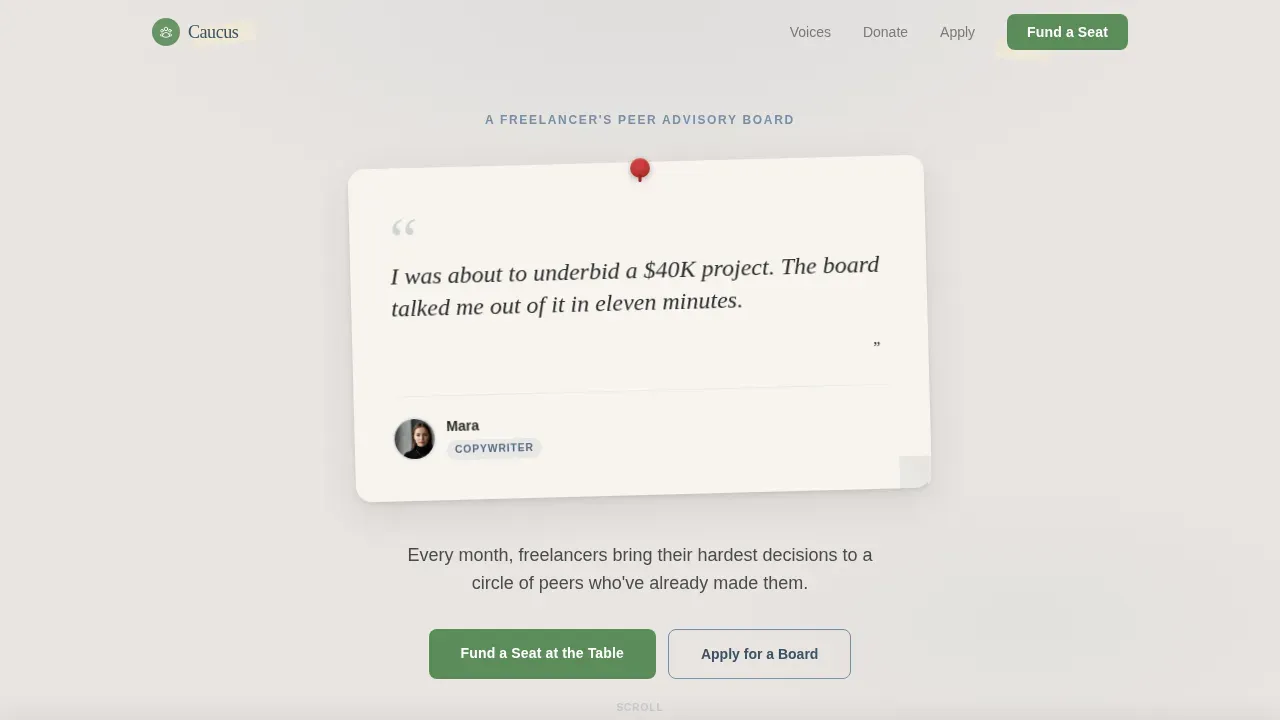
- A hero section built around one oversized, slightly rotated testimonial card on a mist-gray background, with a handwritten-style quote, a small photo, a first name, and a discipline label.
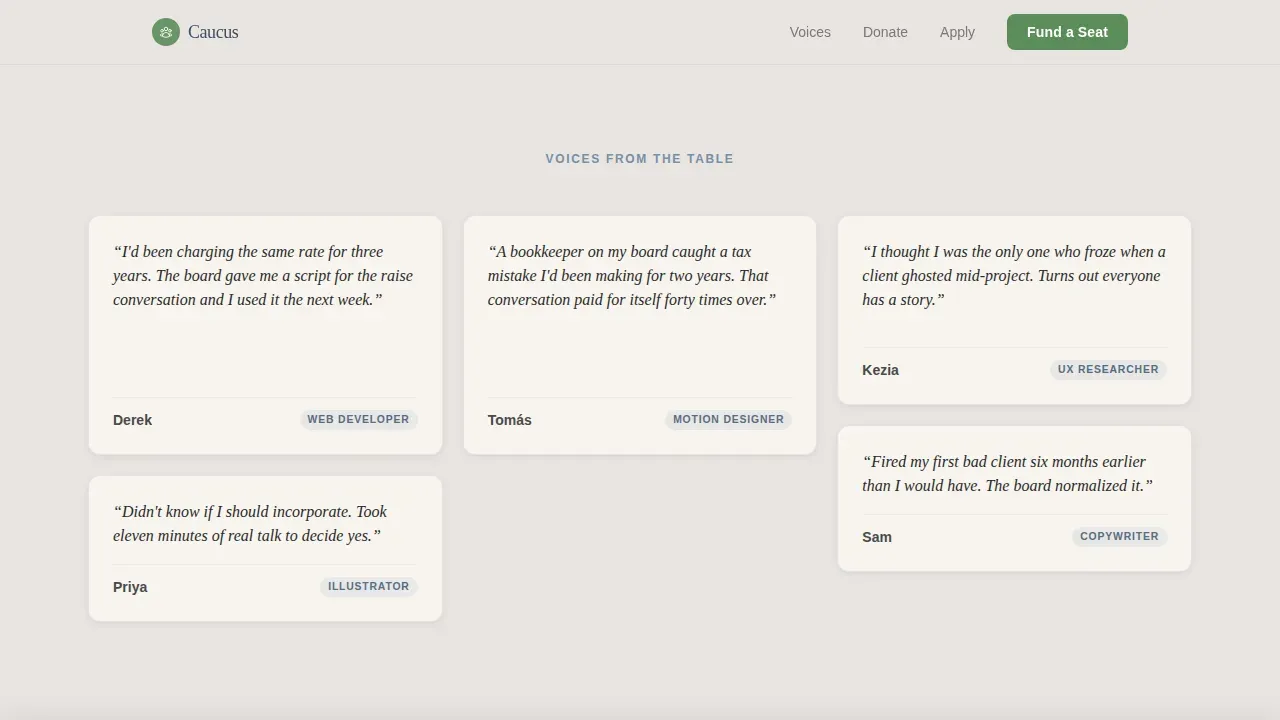
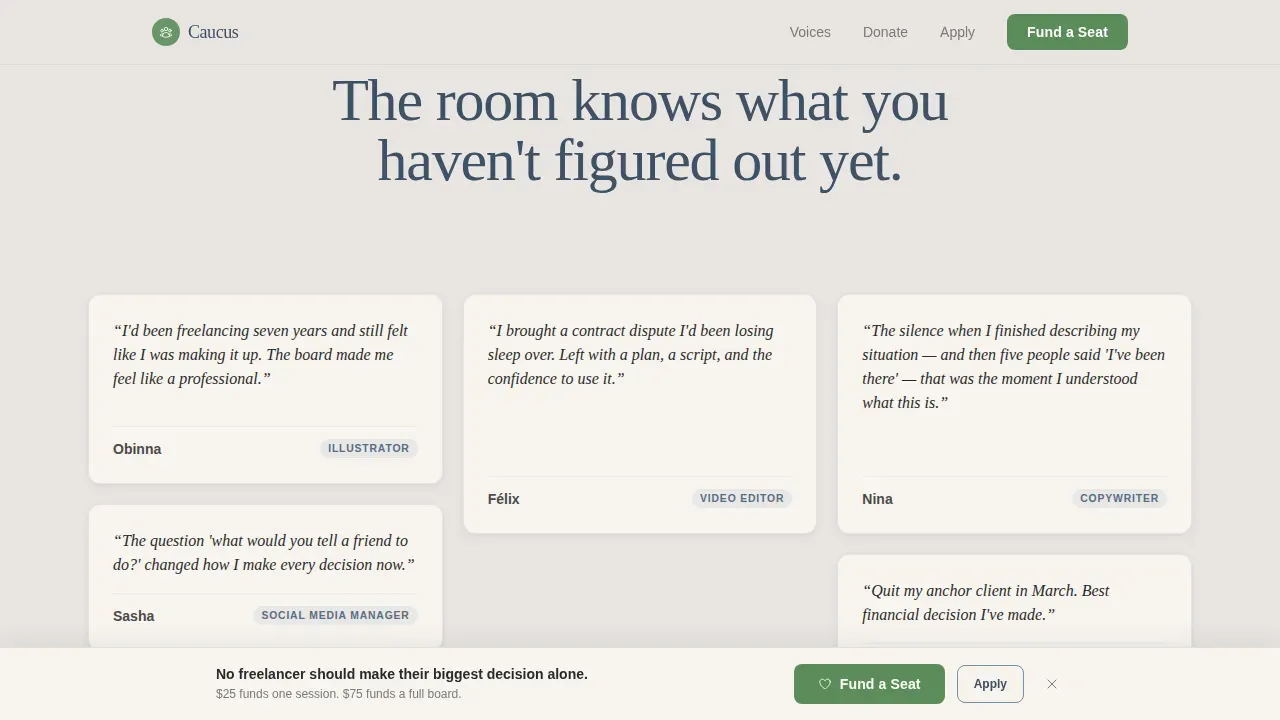
- A masonry grid of dozens of testimonial cards with scroll-reveal stagger animation and civic blue manifesto statements placed between card clusters.
- Named donation tiers at $25, $75, and $200, an inline credit card form that reveals after tier selection, a sticky bottom call-to-action bar, and a secondary "Apply for a Board" path.
Feature list
Here is a closer look at what the template delivers across its core interactive and structural components.
Corkboard Hero Testimonial Card
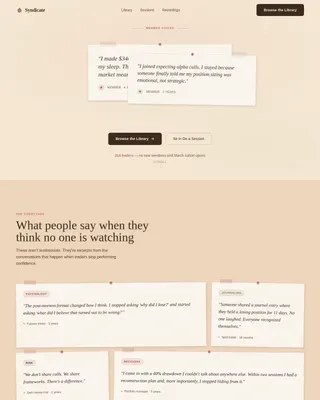
The hero is a single oversized card, slightly rotated as if pinned to a physical board. It carries a handwritten-style quote from a real freelancer, a small photo, a first name, and a discipline. No logo competes with the voice. The card casts a faint shadow on the mist-gray background, giving it a tactile, almost physical presence that pulls readers in before a single scroll.
Masonry Testimonial Grid with Scroll Reveal
Below the hero, a masonry grid builds across the page as the donor scrolls. Cards are staggered and varied in size. Each one features a different freelancer, a different discipline, and a different crisis averted or decision sharpened. The grid grows denser with each cluster, creating a visual argument that this community is already larger than the visitor expected. Scroll-reveal stagger animation brings each card in with a quiet, purposeful rhythm.
Civic Blue Manifesto Statements
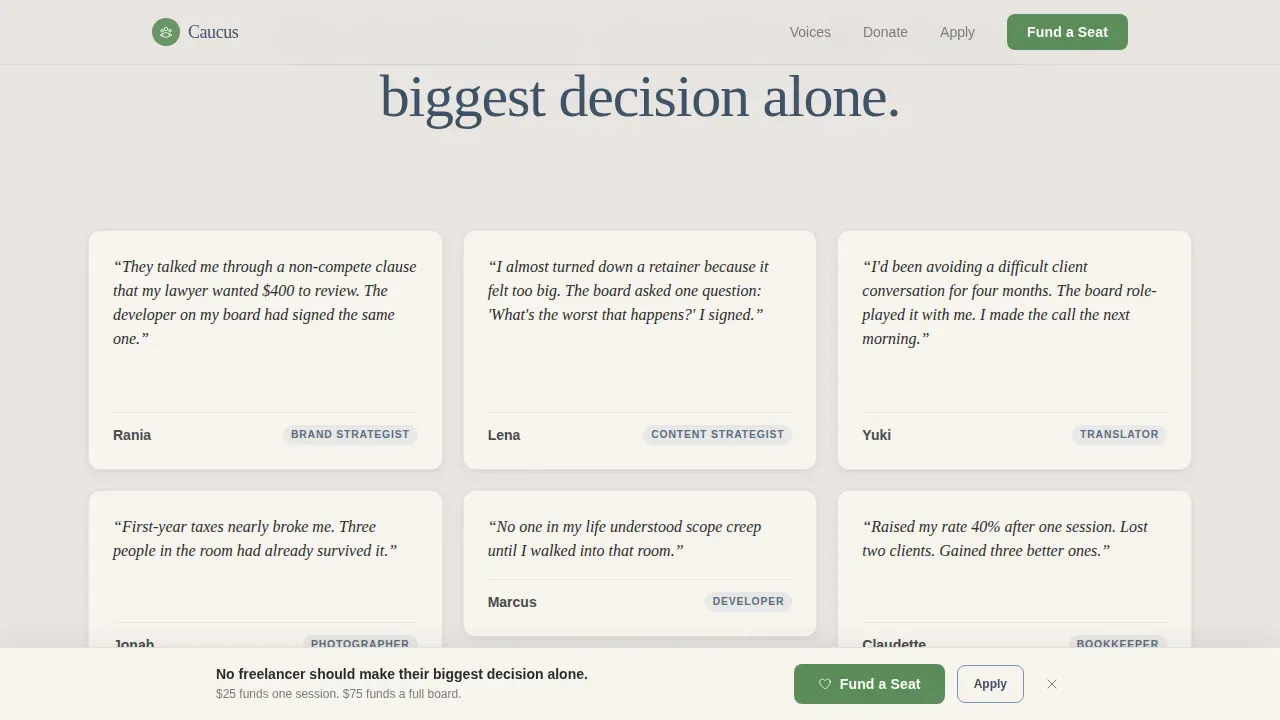
Between clusters of testimonial cards, short manifesto-style statements appear in large civic blue Fraunces type. Lines like "No freelancer should make their biggest decision alone" give the page the tone and visual weight of a public cause rather than a product pitch. They break the grid rhythm intentionally, giving donors a moment to feel the point of what they are reading.
Named Donation Tiers with Inline Form
The donation section presents three named tiers. Twenty-five dollars sponsors one freelancer's first session. Seventy-five dollars funds a full monthly board. Two hundred dollars underwrites a rural or non-English-speaking cohort. Selecting a tier reveals an inline credit card form asking only for amount, name, and email. This keeps the financial commitment clear and the form as short as it can possibly be.
Sticky "Fund a Seat at the Table" Bar
After the third row of testimonial cards, a sticky bottom bar anchors the primary call to action. It stays visible as donors continue scrolling, ensuring that the moment someone is ready to give, the path is never more than one click away. The bar uses the campaign yard-sign green accent color to stand out against the mist-gray and ballot-paper cream palette.
How It Works Panel
A three-panel asymmetric layout explains the roundtable format in plain terms. It shows how a board session works, what a member brings to the table, and what they take away. This section gives context to first-time donors who may be interested in the model but are not yet familiar with peer advisory structures.
Page sections overview
| Section | Purpose |
|---|---|
| Hero Testimonial Card | Opens with one rotated, oversized freelancer quote card to establish voice and credibility immediately |
| Masonry Testimonial Grid | Stacks dozens of freelancer stories in a growing masonry layout to build social proof through visual volume |
| Manifesto Statements | Places civic blue type between card clusters to anchor the emotional and moral argument for funding |
| How It Works | Uses a three-panel asymmetric layout to explain the roundtable format to new donors |
| Impact Stats | Displays civic-styled achievement numbers on ballot-paper cream to reinforce program scale and outcomes |
| Donation Tiers Form | Presents three named tiers and an inline credit card form to convert ready donors without friction |
| Sticky call to action Bar | Anchors the primary call to action in a persistent bottom bar visible after the third card row |
| Footer | Delivers a minimal horizontal footer in the Vercel Horizontal pattern with civic styling |
Design & branding system
The design language is Civic Service. It draws on the aesthetic of a public library on a rainy afternoon: unhurried, democratic, and lit by diffused light that makes every voice feel equally important. Typography uses DM Sans for body text and user interface elements, and Fraunces for manifesto statements and the hero quote, creating a contrast between institutional clarity and handmade warmth.
- Color palette: mist gray (#E8E4E1) for the background, worn ballot-paper cream (#F7F4EF) for secondary panels, muted civic blue (#7A8FA6) for manifesto statements and structural accents, and campaign yard-sign green (#5B8C5A) used deliberately on buttons and donation tier selections only.
- The hero card uses a slight rotation and a faint drop shadow to feel physical, like something pinned to a corkboard rather than rendered on a screen.
- Animation is set at a medium level: scroll-reveal stagger on testimonial cards, rotation on the hero card, and a smooth reveal for the inline credit card form after tier selection.
Mobile & speed optimization
The template is designed desktop-first to honor the masonry grid layout, which requires horizontal space to demonstrate the volume of freelancer stories. On smaller screens, the layout adapts so that the emotional journey of scrolling through cards remains intact even without the full grid width.
- The masonry grid collapses gracefully on mobile, maintaining the staggered card rhythm in a single-column format that still communicates scale.
- The sticky bottom call-to-action bar is optimized for thumb reach on mobile, keeping the donation path accessible at all screen sizes.
- Server Components handle the static testimonial grid for fast initial rendering, while the interactive donation form runs as a Client Component to support tier selection and inline form reveal without slowing the page load.
How this template helps you convert
This template is engineered around a specific donor psychology: show proof first, ask second. Every structural decision is designed to move a visitor from emotional recognition to financial commitment in a single uninterrupted scroll.
- The hero card triggers immediate identification. A freelancer reading "I was about to underbid a $40K project. The board talked me out of it in eleven minutes." does not need to be persuaded that the program matters. They already know it. A donor who has ever hired a freelancer understands the same stakes from the other side. The first card does more persuasion work than a full paragraph of program description ever could.
- The masonry grid converts curiosity into conviction. As the donor scrolls and the grid grows denser, the visual experience communicates scale without a single statistic. The manifesto statements between clusters give the movement a name and a moral frame. By the time the sticky donation bar appears, the case has already been made.
- Named tiers remove the friction of abstraction. Donors do not give to percentages or vague operating costs. They give to a specific freelancer's first session, a specific monthly board, a specific underserved cohort. Naming each tier after what it funds turns a financial transaction into a direct act of support.
Other information about this template
This template draws on a creative direction and visual language that has parallels across arts, education, and civic communications contexts. Understanding those parallels helps teams think about how to populate the masonry grid with stories that will resonate with the widest range of donors.
Freelance careers span a wide array of disciplines. The grid works best when it includes voices from across the spectrum: copywriters, developers, illustrators, bookkeepers, and beyond. The more varied the stories, the stronger the visual argument. A professor of communications at a university might recognize the board format from academic faculty governance. A director of marketing at a cultural organization might connect it to the strategic planning processes they have led inside institutions.
The program's reach connects to the broader history of peer learning and mutual aid across America. Peer advisory models have served professionals in business, the arts, journalism, and public relations for many years. The idea that no one should navigate a major career decision alone is not new. What Caucus does is make that model accessible to freelancers, who have historically been excluded from the organizational resources and collegial support that salaried employees take for granted.
Donors who come from backgrounds in education, the performing arts, fine arts, journalism, or public relations will recognize the dynamics at play. A former professor, a dance company's executive director, or a school communications director will all have personal experience of what it means to work inside a structure that provides colleagues, guidance, and institutional knowledge. Funding Caucus is a way to extend that experience to the people who opted out of traditional employment to build something of their own.
The template's Civic Service aesthetic also speaks to audiences who care about racial equity and access. Named tiers that explicitly fund rural and non-English-speaking cohorts signal that the program takes inclusion seriously as a matter of program design, not just aspiration. This matters to donors who have led or participated in equity-focused giving programs, whether through a community foundation, a university development department, or a college alumni network.
The template is built to support outreach to a wide range of potential funders, including:
- Individual donors from freelance backgrounds who want to give back and create positive impact for the next generation of solo operators.
- Cultural organizations and arts institutions that support independent creative professionals as part of their broader community development mission.
- Foundations and giving programs focused on economic innovation and financial independence for workers in the creative and knowledge economies.
- Programs connected to university alumni networks, school communications departments, and professional organizations that serve students and current students transitioning into freelance careers.
The caucus fund the freelancer peer advisory board landing page template is ready to use as built. Teams can populate the testimonial grid with real stories from their own boards, update the donation tier amounts to match their program's actual cost structure, and adjust the manifesto statements to reflect their specific mission language. The template's components are organized so that each section can be edited independently without disrupting the overall layout or animation sequence.
Theme
Civic Service
Creative direction
Movement & Cause
Color system
Soft Mist
Direction
Donation/Fundraising
Page Sections
Rotated Corkboard Hero Card
Masonry Testimonial Grid
Civic Blue Manifesto Statements
Named Donation Tiers with Inline Form
Sticky Fund a Seat Call to Action Bar
How It Works Three-panel Layout
Related questions
Who is the primary audience for this fundraising landing page?
Can this template work for a freelance peer advisory program outside the United States?
How does the secondary Apply for a Board path work without splitting the donation moment?
Is the masonry grid layout suitable for mobile users?
How many testimonial cards are included in the template?