Climate & Environmental Monitoring Advanced Professional Website Template
Census is a wildlife population tracker landing page template built for scientific credibility and lead generation. It uses a modular card grid layout to present population data, survey coverage, and detection metrics as proof-first scroll points. Designed for state wildlife agencies, conservation organizations, and academic researchers, it leads every visitor straight to the results before asking for a commitment.
by Rocket studio
Quick summary
Census is a single-page, card grid landing page template built for wildlife population tracking platforms. It opens with an aerial seasonal photograph and a delayed data overlay, then guides visitors through modular proof cards, a methodology strip, client-type clusters, and a dual-path conversion form. Every section earns trust before asking for action.
Who this template is for
This template is built for science-driven teams whose work carries regulatory or institutional weight. If your platform produces population models, compliance datasets, or peer-reviewed survey outputs, Census is designed around your audience's expectations.
- State wildlife agency biologists filing Endangered Species Act (ESA) compliance reports
- Conservation non-profit staff defending habitat corridors before review boards
- Graduate researchers cleaning mark-recapture data before thesis submission deadlines
What problem this template solves
Most environmental data platforms lead with feature lists and technology claims. That approach fails with biologists, agency reviewers, and academics who need to audit outputs before they trust a tool. Census flips that order entirely.
- Visitors see real population counts, trend lines, and confidence intervals before reading a single sentence of pitch copy
- The scroll path groups cards by use case so each audience segment finds their most relevant proof points quickly
- Two conversion paths serve both ready buyers and skeptical reviewers, reducing the friction that kills high-consideration sign-ups
What you get with this template
Census delivers a fully structured, single-page layout with every section purpose-built for a data-first audience. The design system and section sequence work together to move a cautious professional from arrival to form submission.
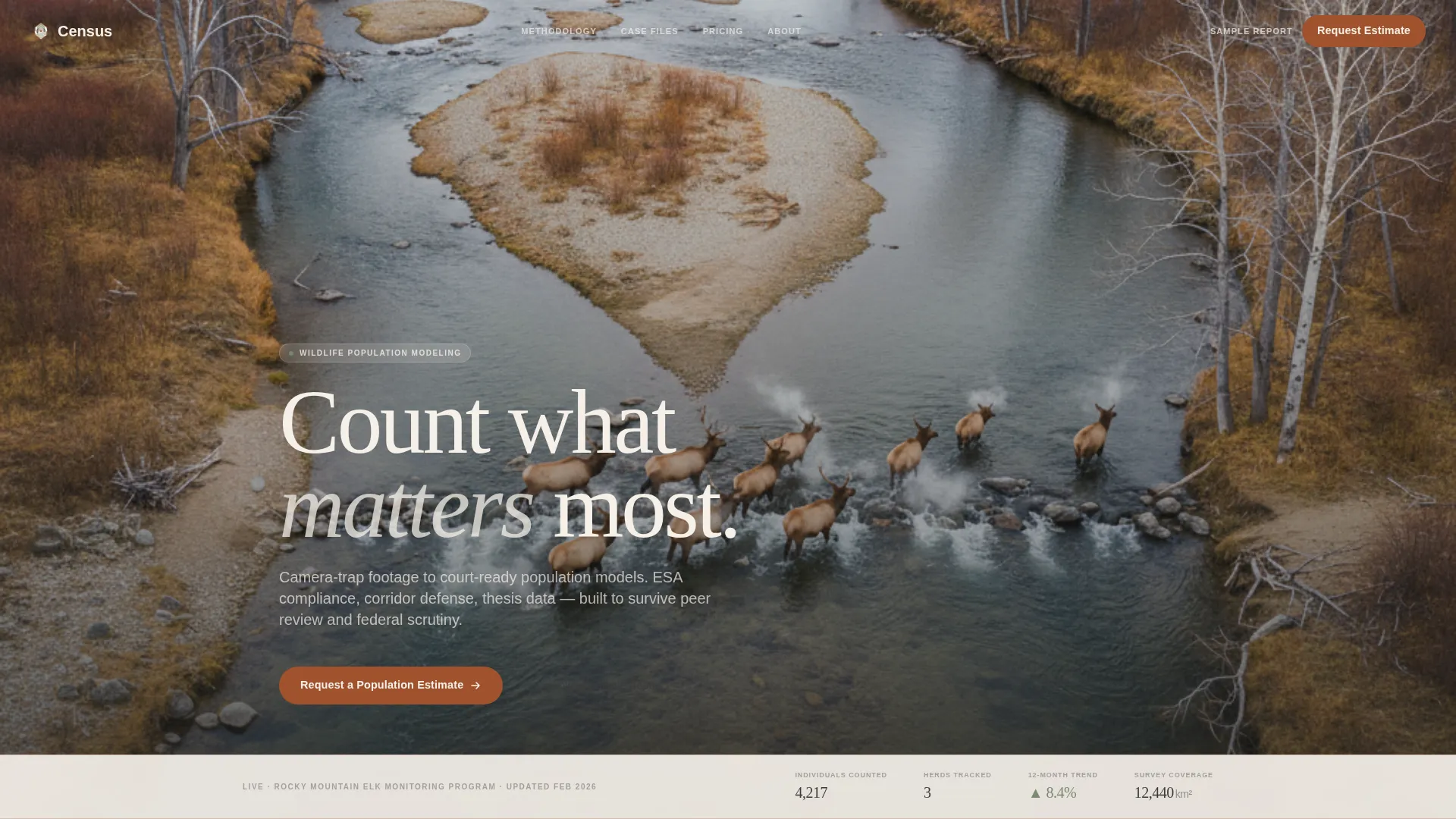
- A hero section with seasonal aerial imagery and a timed parchment data overlay band showing live-style population figures
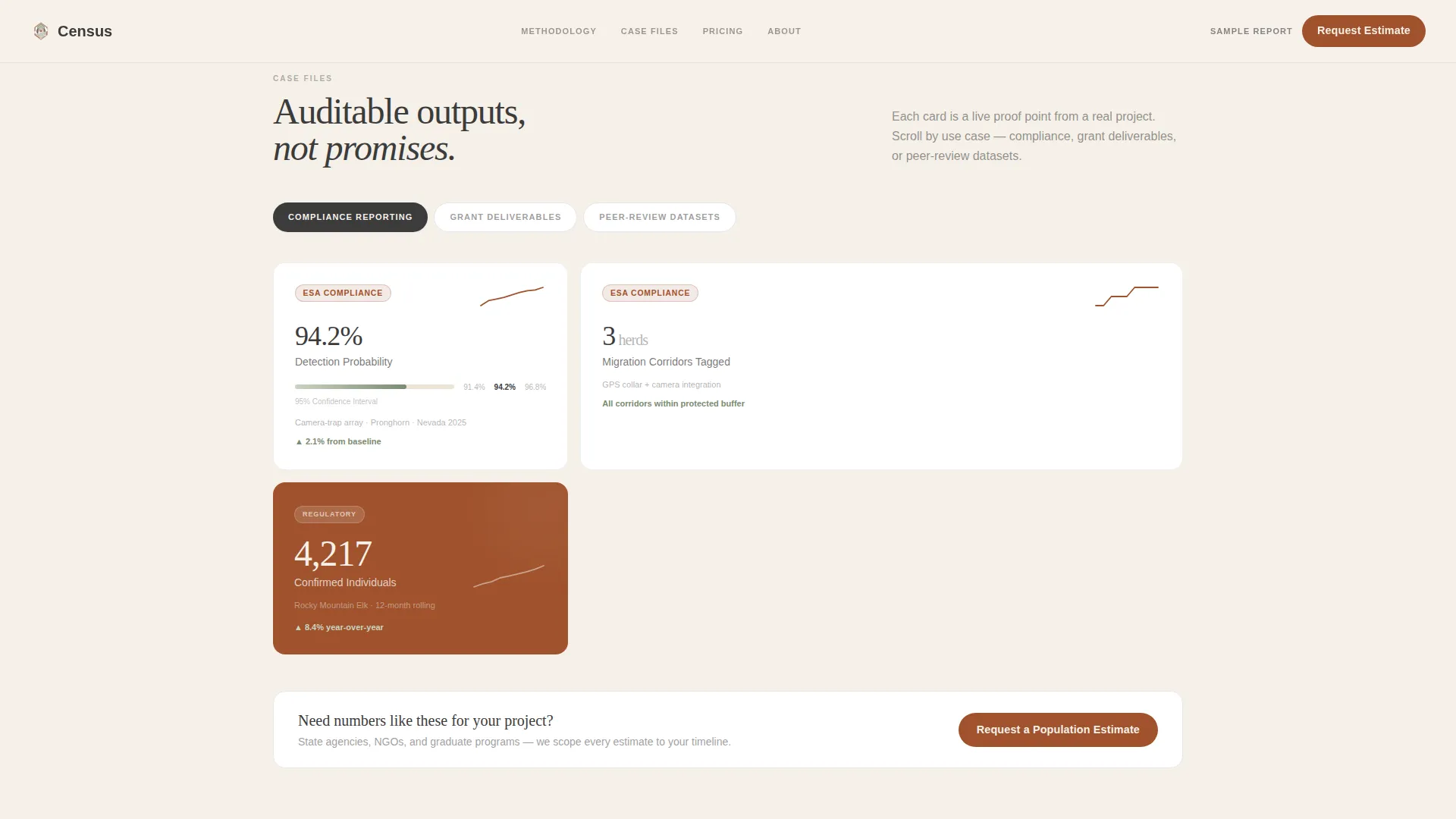
- A modular stats card grid clustered by compliance, grant, and academic use cases, each card displaying a spark-line trend or confidence interval
- A methodology strip, client-type cluster section, a multi-step lead capture form, and a single-field sample report download modal
Feature list
This template includes purpose-built components grounded in the source brief. Each one serves a specific function in the trust-to-conversion flow.
Delayed Data Overlay Hero
The hero loads a wide seasonal photograph first. After two seconds, a translucent parchment band fades in showing population count, herd number, and a 12-month trend percentage. Visitors see output proof before they read a headline.
Modular Stats Card Grid
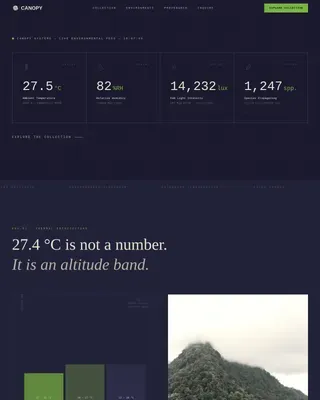
Each card is a standalone data proof point. Cards display species counts with spark-line SVG trends, survey coverage in square kilometers, or detection probability confidence intervals. The grid clusters cards by use case: compliance reporting, grant deliverables, and peer-review datasets.
Methodology Strip
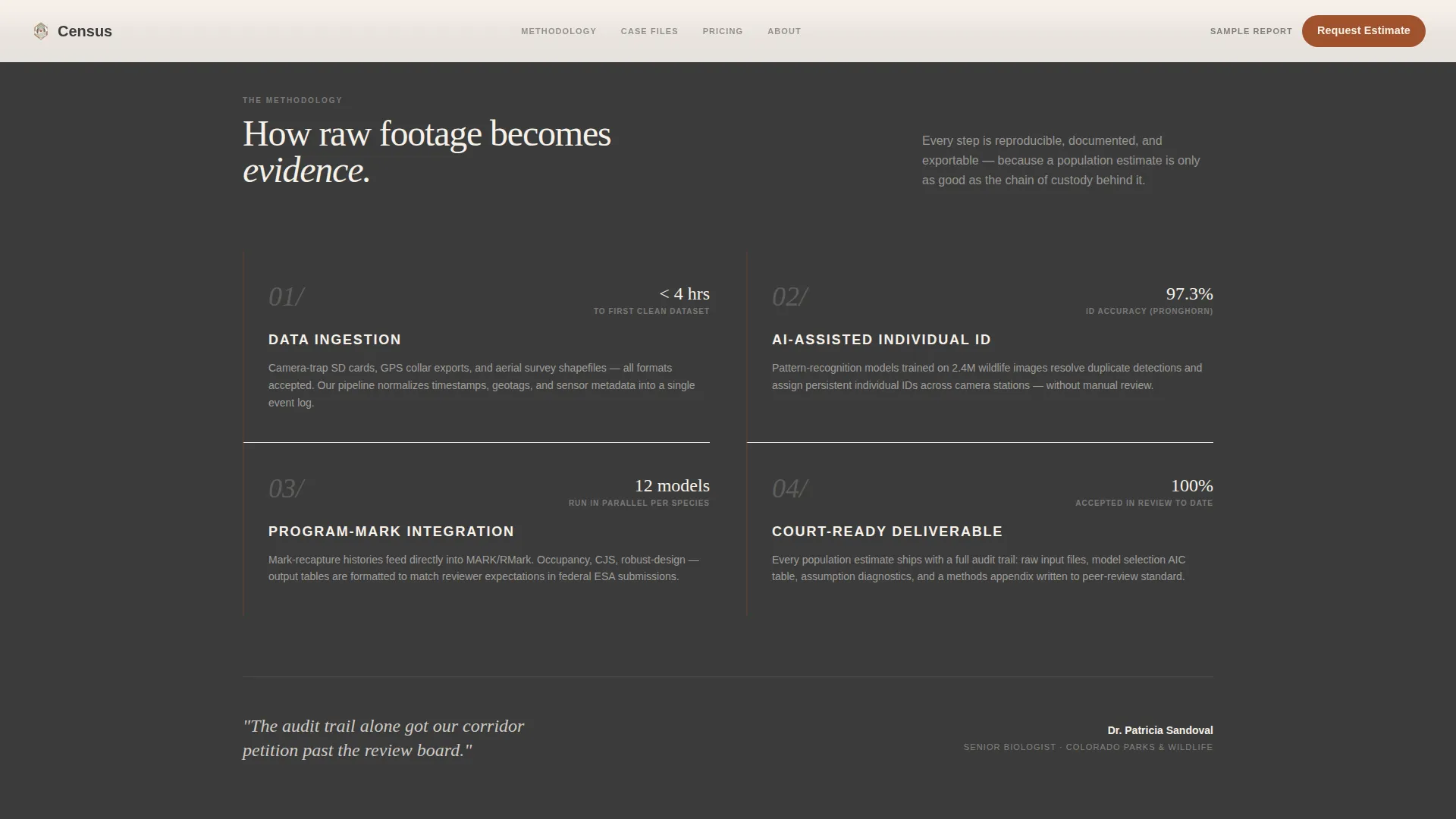
A dedicated horizontal strip explains how raw camera-trap footage and field survey data become court-ready population models. It gives skeptical agency reviewers and journal-minded researchers a clear view of the process behind the numbers.
Client-Type Cluster Section
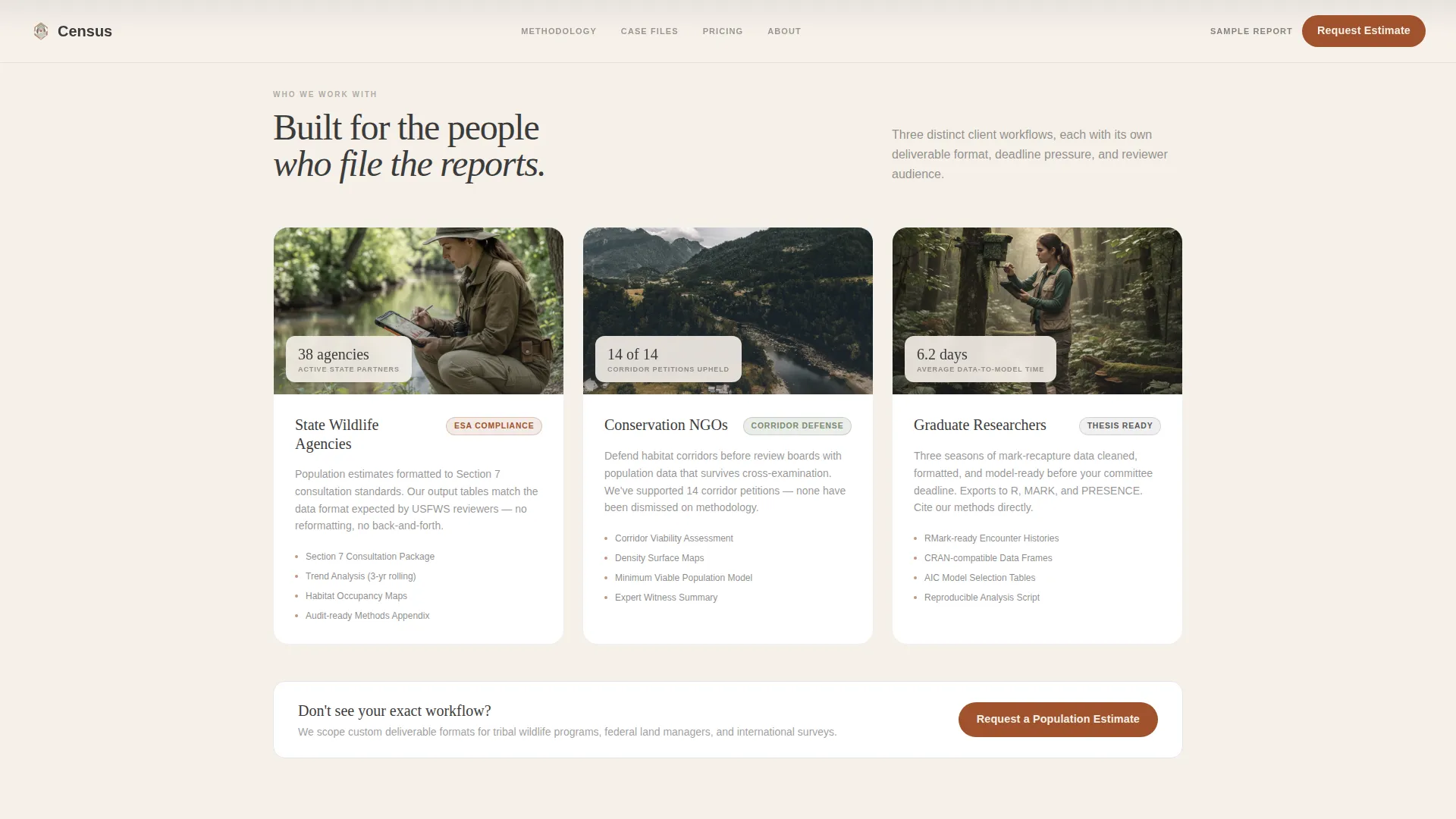
Three ideal client profile (ICP) cards organize the page around agency, non-governmental organization (NGO), and academic buyer types. A tab switcher lets visitors jump directly to the case files most relevant to their project type.
Dual-Path Conversion Form
The primary call to action is a multi-step form: species or taxa of interest, survey region, project type, and timeline. A secondary path offers a one-field email capture that delivers a redacted sample PDF report, giving skeptics a way to verify methodology before committing.
Service Utility Design System
The Parchment and Rust color palette, Fraunces serif display type, and DM Sans body font combine to create a field notebook aesthetic. Scroll reveal animations, card hover states, and spark-line SVGs add interactivity without undermining the platform's scientific tone.
Page sections overview
| Section | Purpose |
|---|---|
| Hero aerial image | Opens with seasonal elk crossing photo and delayed population data overlay |
| Stats card grid | Displays modular proof cards clustered by compliance, grant, and academic use cases |
| Methodology strip | Shows how raw survey footage becomes defensible population evidence |
| Client type clusters | Separates agency, NGO, and academic use cases into tabbed ICP cards |
| Lead capture form | Multi-step "Request a Population Estimate" form with project-type routing |
| Sample report download | Single-field email capture delivering a redacted PDF for pre-commitment review |
| Footer | Linear single-row footer pattern |
Design & branding system
The visual identity follows a Service Utility theme. The palette evokes a steel equipment case left open at dawn: functional, weather-beaten, and trusted because it has been tested in the field.
- Colors: sun-bleached parchment (#F5F0E8) as the base, oxidized iron rust (#A0522D) for primary actions, charcoal graphite (#3B3B3B) for data type, and muted sage (#7A8B6F) for secondary tags and status indicators
- Typography: Fraunces serif for display headings to convey scientific gravitas, DM Sans for body copy and data labels to keep numbers clean and readable
- Animation approach: medium intensity with a delayed hero overlay, scroll reveal on cards, spark-line SVG rendering, and card hover states throughout the grid
Mobile & speed optimization
The template is built desktop-first, reflecting the primary audience of agency biologists working on workstations. It remains fully responsive for mobile and tablet viewing.
- Static sections use Server Components to reduce load overhead for content-heavy proof cards
- Interactive elements including the card grid, tab switcher, and multi-step form use Client Components to keep interactivity smooth without blocking the initial page render
How this template helps you convert
Census is structured around a Stats-First Impact creative direction. Every scroll decision is designed to reduce skepticism before presenting a form.
- The hero data overlay delivers a population estimate proof point in the first two seconds, before any marketing copy appears, setting the platform's credibility immediately
- Card clusters organized by use case make each visitor feel the content is directly relevant to their project type, increasing the likelihood they reach a call-to-action row
- The dual conversion path captures both high-intent visitors ready to request an estimate and cautious reviewers who need to verify methodology first, covering the full range of buyer readiness
Other information about this template
Census is localized for English-language audiences using United States dollar (USD) pricing references and United States date format conventions. It is suitable for Environmental Software as a Service (SaaS) platforms, scientific data products, and business-to-government (B2G) or nonprofit-facing tools in the climate and environmental monitoring space.
- The template is categorized under Agriculture and Environment, with a subcategory alignment to Climate and Environmental Monitoring
- The card grid (modular) layout style supports easy content updates as new species datasets, survey regions, or seasonal results become available
- The design and section structure can support a wildlife population tracker product aimed at federal, state, or academic procurement audiences
Theme
Service Utility
Creative direction
Stats-First Impact
Color system
Parchment & Rust
Style
Card Grid (Modular)
Direction
Lead Generation
Page Sections
Delayed Hero Data Overlay
Modular Stats Card Grid
Methodology Strip
Client-type Cluster Section
Dual-path Conversion Form
Service Utility Visual System
Related questions
What type of platform is Census built for?
Who are the three main audience types this landing page targets?
What are the two conversion paths on this landing page?
Can the modular card grid be updated as new survey data becomes available?
What does the hero section show when the page first loads?