Sustainable & Green Architecture Directory Website Template
Certify is a masonry-layout landing page template built for green building and LEED certification consultancies. It combines a field-notebook aesthetic with high-motion interactions to guide facility directors, developers, and architecture firms from first scroll to a gated Credit Roadmap download. Every section earns trust before asking for a conversion.
by Rocket studio
Quick summary
Certify is a single-page masonry template designed for sustainability consultancies that help buildings achieve LEED and green building certification. It tells an origin story through polaroid-style photography, cascading methodology cards, a difficulty-ranked certification timeline, and a resource library that gates a Credit Roadmap PDF behind a three-field form.
Who this template is for
This template is built for professional services firms in the green building and sustainable architecture space. It suits consultancies that need to demonstrate deep LEED expertise before asking a prospect to take the next step.
- Sustainability consultancies translating mechanical and envelope specifications into LEED credit language
- Facility directors, real estate developers, and architecture firms looking for a partner to meet carbon mandates or ESG requirements
- Independent LEED consultants who want a content-rich landing page that earns trust before gating a resource
What problem this template solves
Most green building consultancy pages list services and stop there. They do not show methodology, proof of work, or usable knowledge. Prospects arrive with real pressure, a carbon mandate deadline, an investor requiring ESG documentation, an RFP they cannot afford to lose, and they leave without enough confidence to act.
- Visitors cannot assess expertise from a simple service list alone
- Gated resources feel like toll booths when there is no preceding value
- Consultancies with genuine depth have no structured way to demonstrate it visually
What you get with this template
You get a fully structured, desktop-first landing page with high interactivity and a deliberate narrative arc. Every section is purpose-built to move a skeptical professional visitor toward a form submission.
- A polaroid-style animated hero, an origin story section, masonry methodology cards, a certifications timeline, and a torn-edge resource library
- A gated three-field form capturing email, building type, and target rating level to deliver the Credit Roadmap PDF
- An ungated masonry blog feed of short case narratives, each ending with a contextual micro-call-to-action
Feature list
This template ships with a concentrated set of interactive and visual components drawn directly from the brief. Each one serves a specific role in the conversion narrative.
Floating Polaroid Hero
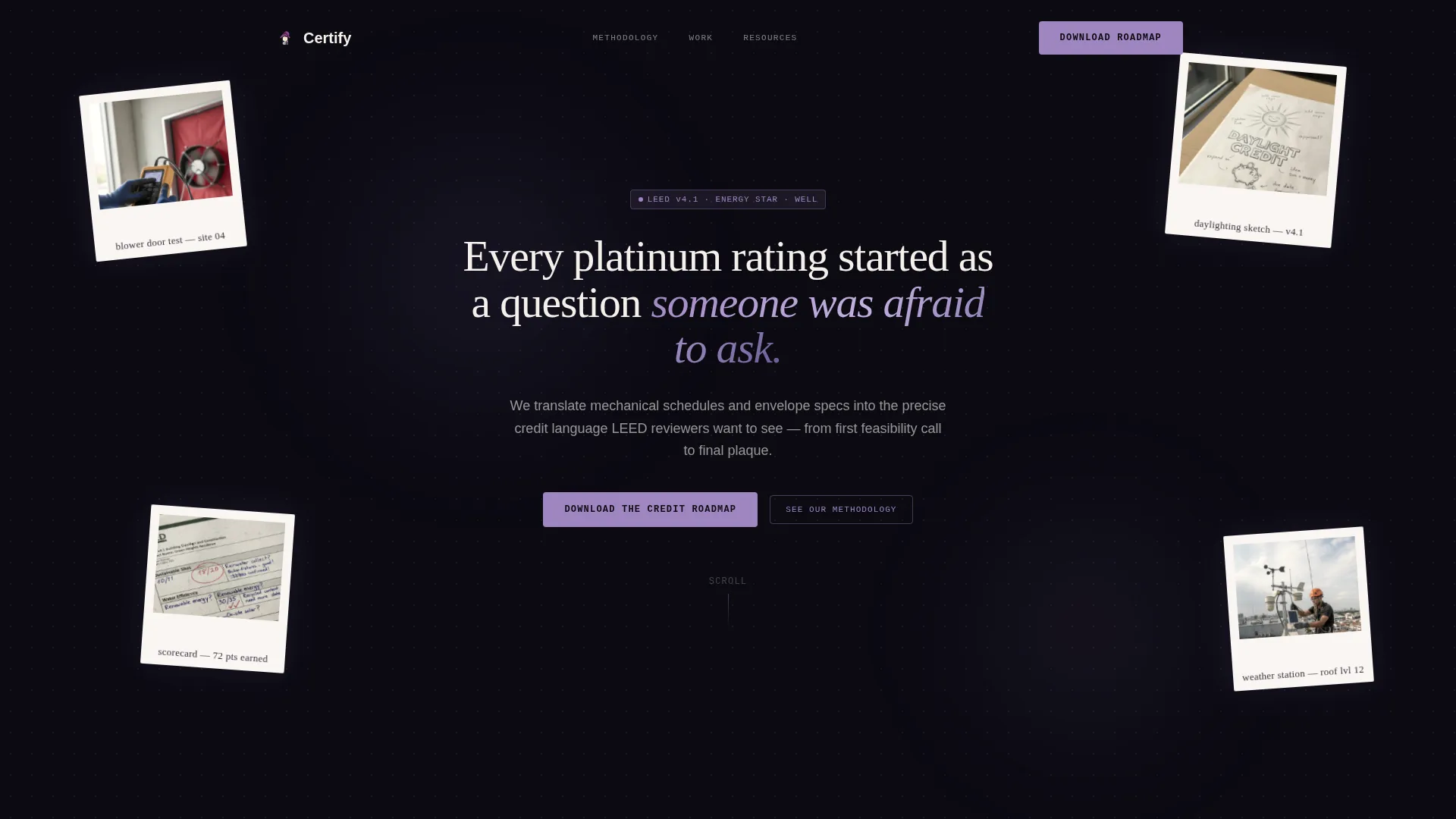
The header places polaroid-style snapshots of real certification moments across a void-black field. Photos rotate gently and cast soft violet shadows. No two page loads look identical, giving the hero a live, hand-assembled quality.
Masonry Methodology Cards
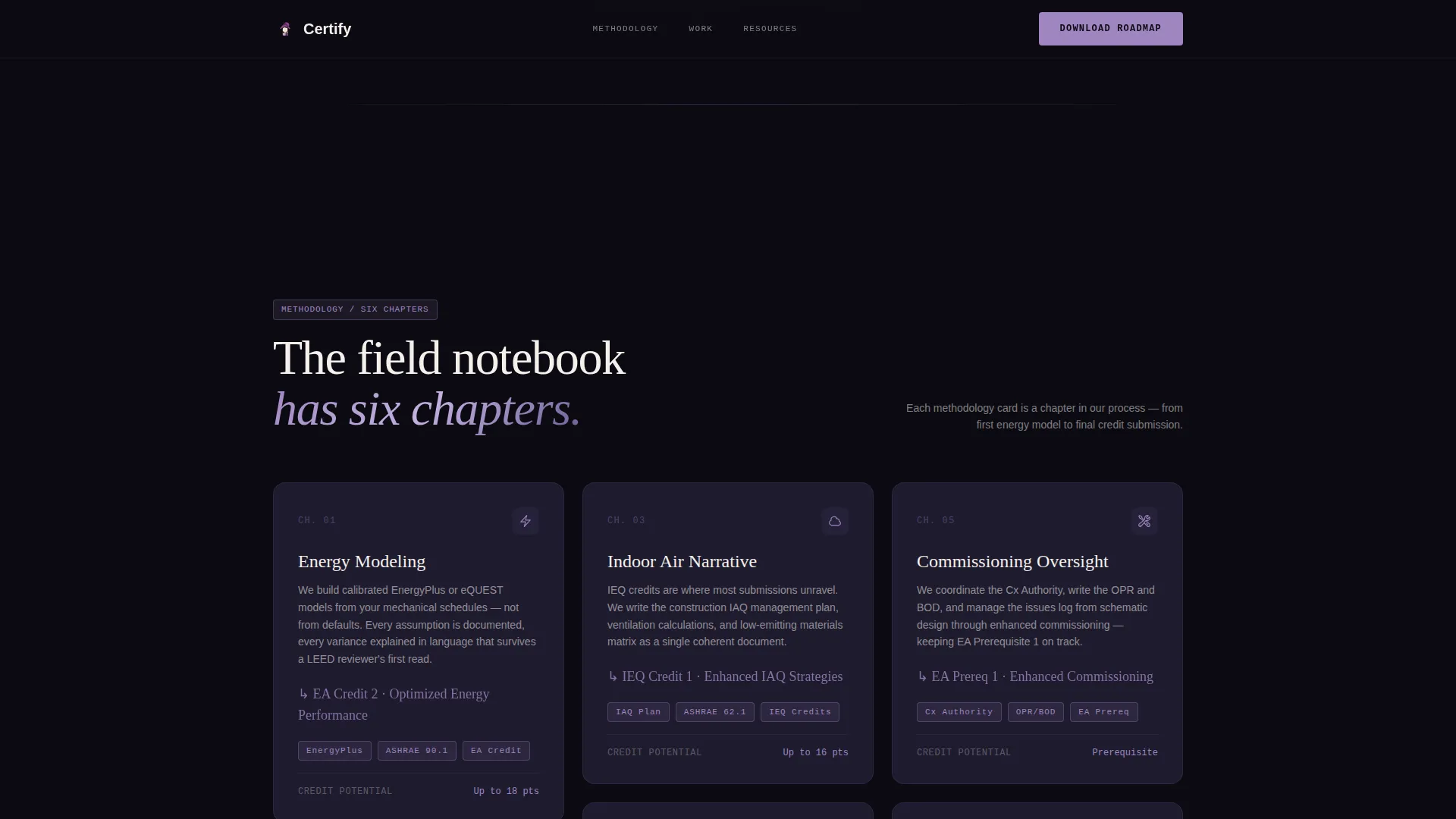
Methodology topics, Energy Modeling, Water Budget, Indoor Air Quality narrative, and Materials Disclosure, cascade in a masonry layout. Each card carries handwritten-style violet annotations, reinforcing the field-notebook aesthetic and signaling genuine process depth.
Difficulty-Ranked Certification Timeline
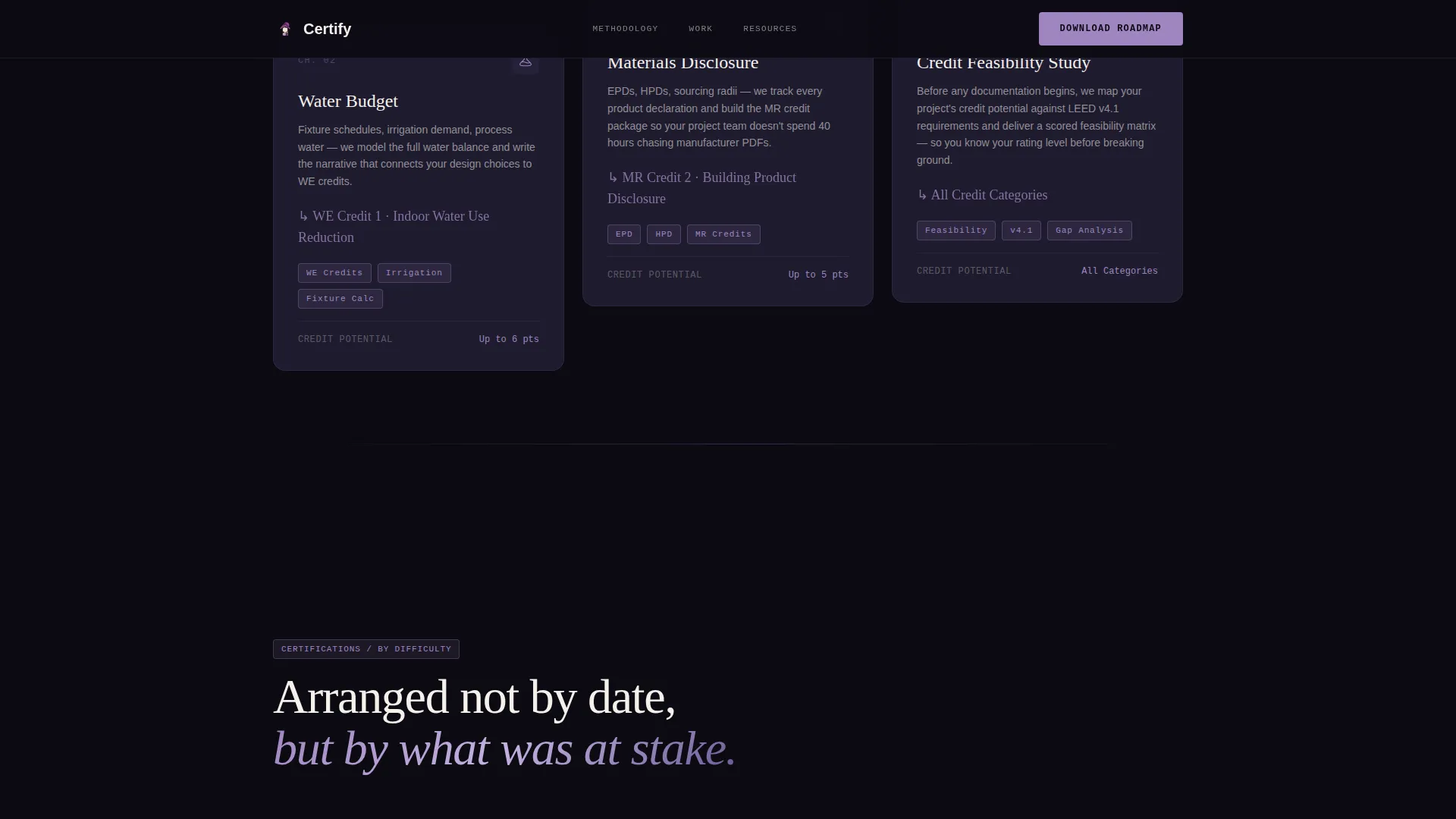
The certifications timeline is sorted by difficulty and stakes rather than by date. This reframing positions each entry as proof of increasing capability, making the timeline a more compelling trust signal than a simple chronological list.
Flip-Preview Resource Library
Downloadable resources appear as torn-edge paper cards. Each card can be flipped to preview its contents before the visitor commits to the gated form. This lowers friction and makes the Credit Roadmap download feel like a natural next step.
Gated Credit Roadmap Form
A three-field form captures email address, building type (new construction, existing building, or interior), and target LEED rating level. The form gates a comprehensive LEED v4.1 credit checklist PDF and is built as a client-side component with GSAP scroll-reveal animation.
Ungated Case Narrative Feed
A masonry blog-style feed presents short project case narratives. Each narrative ends with a contextual "Get This Credit Checklist" micro-call-to-action, creating a secondary conversion path for visitors not yet ready for the main form.
Page sections overview
| Section | Purpose |
|---|---|
| Hero with polaroids | Establish authority and tone immediately |
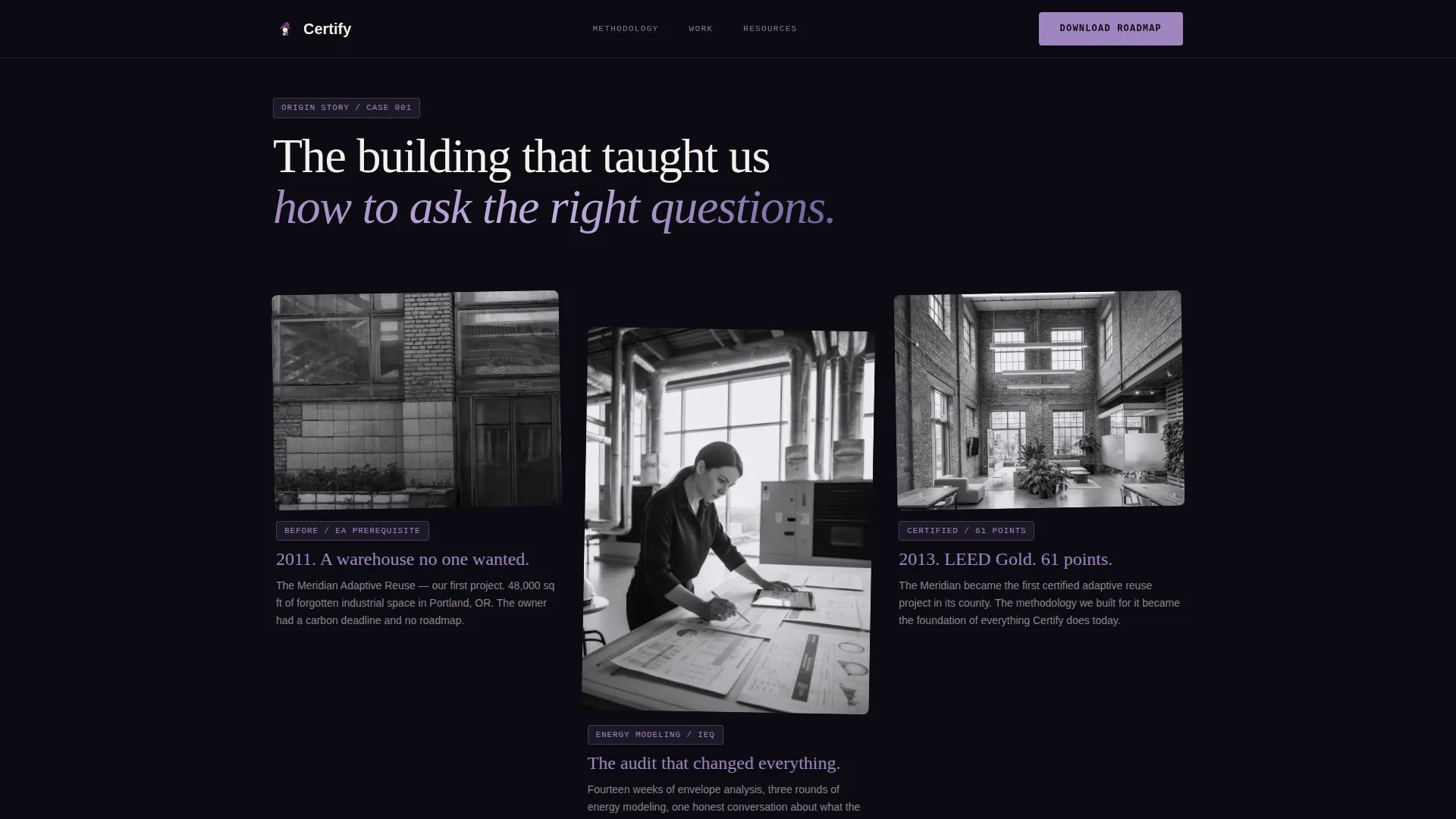
| Origin story | Build trust through the founding project narrative |
| Methodology cards | Demonstrate process depth across four credit domains |
| Certifications timeline | Show proof of work ranked by difficulty |
| Resource library | Surface downloadable tools as torn-edge paper cards |
| Gated form | Capture leads via the Credit Roadmap download |
| Case narrative feed | Provide ungated value with contextual micro-calls to action |
| Footer | Single-row linear link and contact row |
Design & branding system
The visual identity follows an Ink and Paper theme built on a Void and Violet color system. The palette reads like a notarized document: authoritative, analog, and quietly striking.
- Colors: deep archive black (#0B0A12), muted violet ink (#6B5B95), aged cotton paper (#F5F0EB), and registrar's violet (#9F86C0) reserved for links, hover states, and interactive tags
- Typography: DM Serif Display for headings, IBM Plex Mono for annotations and labels, Plus Jakarta Sans for body text
- Animations run at high fidelity using GSAP for scroll reveals, masonry stagger, polaroid hover states, and card flip interactions
Mobile & speed optimization
The template is designed desktop-first to match how facility directors and developers typically review materials on workstations. Full mobile support is included so the page remains usable on any device.
- Static sections use Server Components to keep initial load weight low
- Hero animation and the gated form run as Client Components for interactive fidelity
- The masonry layout and card-flip interactions are fully responsive across screen sizes
How this template helps you convert
Every scroll delivers usable knowledge before asking for anything in return. This sequencing makes the gated resource feel like a logical conclusion rather than an interruption.
- The ungated case narrative feed and methodology cards give visitors immediate value, building enough credibility that the Credit Roadmap form feels like the obvious next step.
- The flip-preview resource library lets visitors see what they are getting before submitting the form, reducing hesitation and increasing the quality of leads who do convert.
Other information about this template
This template is part of the Architecture and Design category under the Sustainable and Green Architecture subcategory, with a niche focus on LEED and green building certification. It is well suited to consultancies working within the LEED v4.1 framework.
- The template style is Masonry and Pinterest layout, with creative direction following an Origin Story narrative arc
- The header concept is Floating Photos on a void-black field, and the landing page direction is Content and Resource conversion
- The footer uses a Pattern 1 linear single-row layout for a clean, uncluttered close
- Localization is set for English (United States) with imperial units and USD pricing implied throughout
Theme
Ink & Paper
Creative direction
Origin Story
Color system
Void & Violet
Style
Masonry/Pinterest
Direction
Content/Resource
Page Sections
Floating Polaroid Hero Section
Masonry Methodology Card Layout
Difficulty-ranked Certification Timeline
Flip-preview Resource Library
Three-field Gated Lead Form
Ungated Case Narrative Feed
Related questions
Who is this landing page template designed for?
What does the gated form collect and what does the visitor receive?
What animation and interaction features are built into this template?
Does the template include an ungated conversion path?
Is this template suitable for mobile users?