Packaging Manufacturing Advanced Pricing Website Template
Certify is a lead generation landing page template built for packaging quality testing labs. It uses a zigzag case study layout to walk visitors through real testing scenarios, from compression and burst testing to full distribution simulation. The design communicates authority instantly, helping labs convert packaging engineers, procurement managers, and contract packagers into qualified test submissions.
by Rocket studio
Quick summary
Certify is a single-page template designed for packaging quality testing labs. It pairs a full-screen video header with alternating case study sections that each tell a complete testing story. The Navy Authority color system and compliance-forward visual language make every section feel credible. Two conversion paths capture both ready-to-test clients and visitors still scoping work.
Who this template is for
This template is built for packaging testing labs that need to communicate technical authority fast. It speaks directly to the buyers who arrive already knowing what they need and just want to verify that your lab has seen their exact problem before.
- Packaging engineers at fast-moving consumer goods companies working toward retail deadlines
- Procurement managers at pharmaceutical firms needing recognized testing standard documentation
- Contract packagers responding to new specification requirements added to a purchase order
What problem this template solves
Most packaging lab websites read like a list of equipment. They name machines without telling the story of what those machines have actually proven. Visitors who arrive with a specific failure mode, a tight deadline, or a retailer compliance requirement need to see that your lab understands their pressure, not just your process.
- Visitors leave before converting because the page never demonstrates real testing outcomes
- Technical buyers distrust vague claims and need specific protocol names, standard numbers, and measurable results
- Labs lose leads from visitors who are still scoping because there is no lower-commitment conversion path available
What you get with this template
The template delivers a structured, single-page layout that moves a technical buyer from first impression to form submission in one focused scroll. Every section is purposeful and prompt-designed to reduce friction for high-stakes buyers.
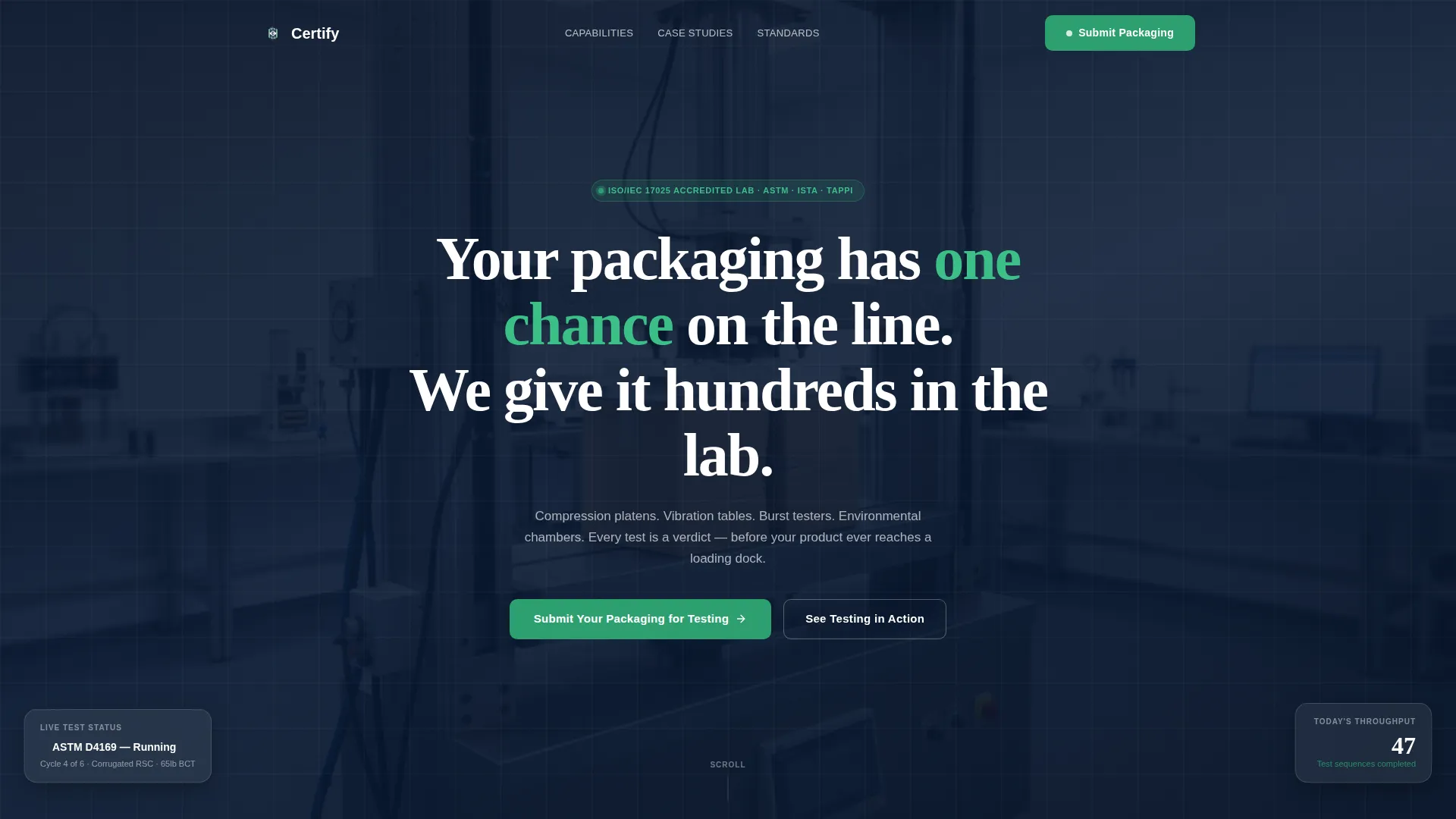
- A full-screen video background header with a fade-in headline and ambient lab atmosphere
- Zigzag alternating sections that each present a client problem, a named test protocol, and a measurable result
- A dual conversion system with a primary test submission form and a secondary gated PDF download
Feature list
A focused paragraph introduces the features below. The Certify template is built around one idea: technical credibility that converts. Every feature exists to close the gap between a visitor who is curious and a client who submits their packaging for testing.
Full-Screen Video Background Header
The header uses a slow, deliberate video montage shot inside the lab. Footage includes a compression tester closing on corrugated board, a digital readout climbing toward a failure threshold, gloved hands positioning a sealed tray, and a thermal chamber door sealing shut. The headline fades in over the footage with no music, only ambient machine sound, setting an authoritative tone from the first second.
Zigzag Case Study Layout
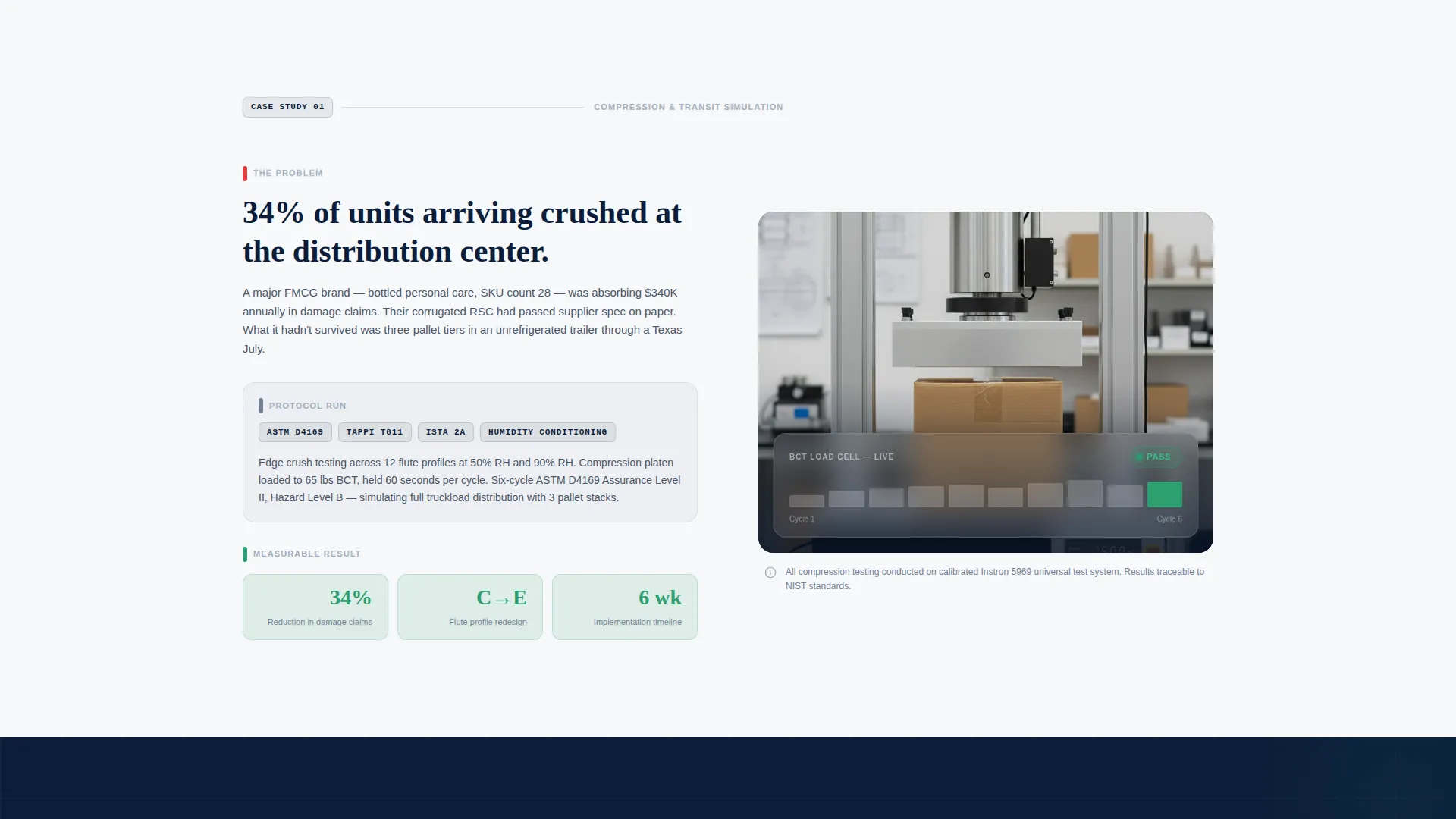
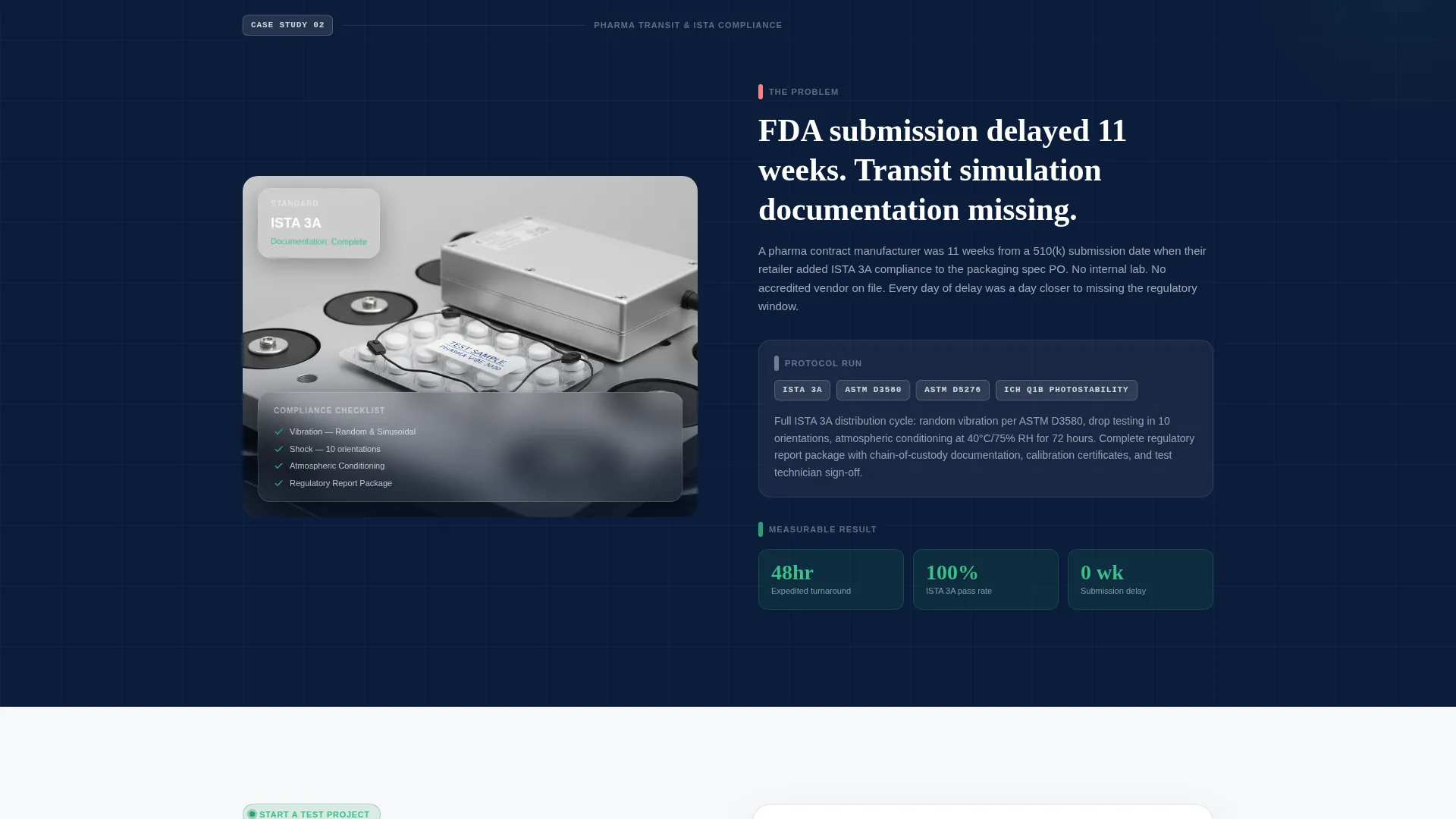
Each alternating section pairs narrative text on one side with testing imagery on the other. The left panel describes the client's incoming problem, the specific protocol run, and the measurable outcome. The right panel shows machines mid-cycle, data curves, or before-and-after package conditions. Sections escalate from basic compression through environmental conditioning to full distribution simulation.
Dual Conversion Path System
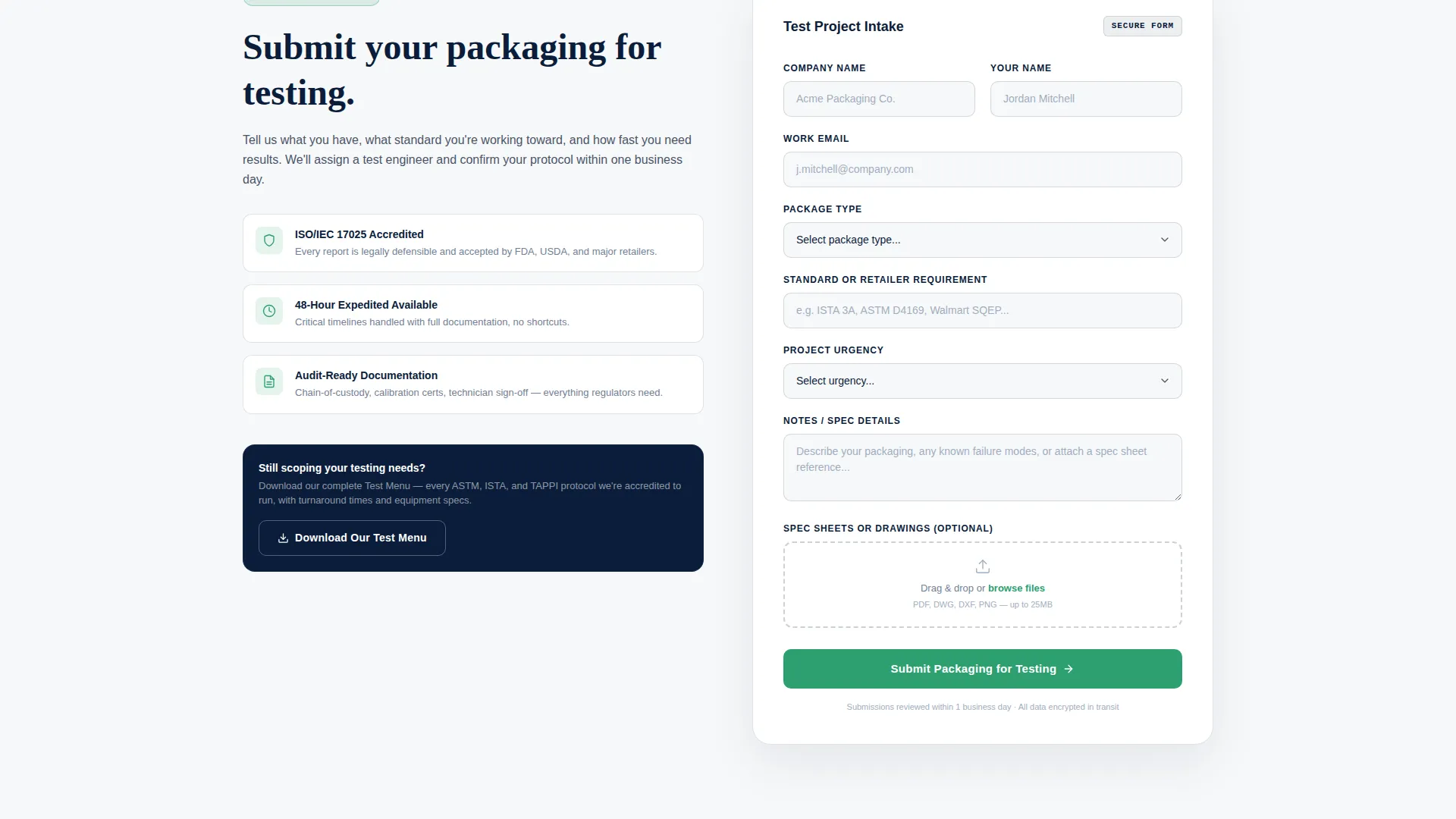
The primary call to action, "Submit Your Packaging for Testing," appears after the second case study and anchors in a sticky bottom bar from that point forward. The secondary path, "Download Our Test Menu," captures email from visitors still evaluating options by gating a PDF catalog of every accredited protocol the lab runs.
Structured Lead Capture Form
The test submission form collects four specific inputs: package type (corrugated, flexible, rigid, or temperature-controlled), the relevant standard or retailer requirement, project urgency level (routine, expedited, or critical), and a file upload field for spec sheets or technical drawings.
Compliance-Forward Visual Signals
Compliance green is applied to pass indicators, call-to-action buttons, and trust badges throughout the page. This color choice is deliberate: it reads like a lab report, clean enough to review under fluorescent light and authoritative enough to accompany a regulatory filing.
Escalating Specificity Narrative
The page earns trust by using real test names, recognized standard numbers such as ASTM D4169, ISTA 2A, ISTA 3A, and TAPPI T811, and real outcome metrics like a 34 percent reduction in damage claims. This language signals to technical buyers that the lab already speaks their language.
Page sections overview
| Section | Purpose |
|---|---|
| Video Header | Establish lab authority and set the tone with ambient footage and a fade-in headline |
| Case Study One | Present a basic compression testing story with client context and measurable outcome |
| Case Study Two | Escalate to transit simulation with specific protocol names and result data |
| Primary call to action Block | Introduce the test submission form after the second case study |
| Case Study Three | Demonstrate full distribution simulation capability for complex packaging scenarios |
| Sticky Bottom Bar | Keep the primary call to action anchored in view from the second case study onward |
| Secondary call to action Block | Offer the gated Test Menu PDF download for visitors still in the scoping phase |
| Lead Capture Form | Collect package type, standard reference, urgency, and file upload from ready buyers |
Design & branding system
The Navy Authority color system is built to feel like a lab report cover: serious, structured, and immediately trustworthy. Every color has a functional role, not just a decorative one.
- Deep command navy (#0B1D3A) for primary backgrounds, institutional steel (#4A5568) for body text and secondary surfaces, and clinical white (#F7F8FA) for content panels
- Compliance green (#2D9F6F) reserved for pass indicators, call-to-action elements, and trust badges to signal positive outcomes
- Service Utility theme typography and layout keep the page dense with information but easy to scan, prioritizing function over decoration
Mobile & speed optimization
The Certify template is structured to deliver a clear experience on smaller screens without sacrificing the technical depth that makes it credible to expert buyers. The zigzag layout adapts to a stacked single-column flow on mobile, keeping case study text and imagery readable in sequence.
- The sticky bottom bar keeps the primary call to action reachable on any screen size without interrupting the reading flow
- The form fields are sized and spaced for straightforward input on touch devices, including the file upload for spec sheets
How this template helps you convert
The page is engineered for two types of buyers: those ready to submit a package today and those still figuring out which tests they need. Both paths are served without forcing a choice.
- The sticky "Submit Your Packaging for Testing" bar keeps the primary conversion action visible throughout the scroll, reducing the chance a ready buyer has to hunt for the next step.
- The "Download Our Test Menu" gate captures email from visitors still scoping, turning a low-commitment visit into a qualified lead for follow-up.
Other information about this template
This section covers additional context about the template's positioning, use case fit, and the types of testing language embedded across the page layout.
- The template references testing standards by name throughout the copy structure, including ASTM D4169 for distribution cycle simulation, ISTA 2A and ISTA 3A for packaged-product testing, and TAPPI T811 for edge crush resistance measurement
- The case study narrative structure is designed to reflect real packaging failure scenarios, such as crushed units arriving at a distribution center, failed transit simulation results, and retailer rejection events
- The page is categorized under Manufacturing and Industrial, with a specific focus on the Packaging Manufacturing subcategory and the Packaging Quality Testing Lab niche
- The template style is Zigzag or Alternating, the header concept is Full-Screen Video Background, the creative direction is Case Study Narrative, and the theme is Service Utility
- The lead generation direction means every section builds toward a submission or a download, with no purely decorative sections included in the layout
Theme
Service Utility
Creative direction
Case Study Narrative
Color system
Navy Authority
Style
Zigzag/Alternating
Direction
Lead Generation
Page Sections
Full-screen Video Background Header
Zigzag Case Study Layout
Dual Conversion Path System
Structured Test Submission Form
Compliance-forward Visual Signals
Escalating Specificity Narrative
Related questions
Who is the primary audience for this template?
Can I customize the testing standards and protocols shown on the page?
What information does the lead capture form collect?
Is there a conversion path for visitors who are not ready to submit a package?
What does the sticky bottom bar do on this landing page?