Medical Device OEM Supplier Landing Page Template
The Certify template is a zigzag landing page built for cleanroom-grade medical device OEM suppliers. It guides procurement professionals through a supplier audit simulation experience, presenting certifications, cleanroom specifications, and vertically integrated capabilities in a structured comparison format. Every section is designed to turn a skeptical VP-level buyer into a qualified lead before they ever pick up the phone.
by Rocket studio
Quick summary
The Certify template is a single-page, audit-simulation landing page for a medical device OEM supplier operating under one ISO 13485 roof. It covers titanium machining, PEEK injection molding, cleanroom assembly, and validated packaging. The layout uses alternating zigzag sections, a sticky call-to-action bar, and a side-by-side comparison table to help procurement leads evaluate this supplier against a typical contract manufacturer with confidence.
Who this template is for
This template is purpose-built for B2B industrial and medical device manufacturing service providers that need to convert technically sophisticated buyers. It speaks directly to professionals who evaluate suppliers on documented quality systems, regulatory standing, and production traceability rather than on brand recognition alone.
- VP-level supply chain and procurement leads at mid-cap medtech firms who need a single, audit-ready supplier
- Quality engineers managing multiple vendors across time zones and struggling to maintain consistent documentation
- Startup founders who have received 510(k) clearance and need to scale production from fifty to fifty thousand units without requalifying
What problem this template solves
Supplier management is an integral part of a medical device manufacturer's quality management system (QMS), and it is mandated by QMS regulations around the world. Finding a supplier whose documentation, cleanroom standards, and regulatory compliance are already green-checked is exceptionally rare. Most landing pages for contract manufacturers fail to provide the depth of evidence that a quality-focused buyer needs to justify adding a new name to the Approved Suppliers List.
- Procurement leads arrive skeptical; they have been burned by missed device history record (DHR) deadlines and slow corrective action responses
- Managing four vendors across three time zones inflates costs, creates documentation gaps, and introduces contamination risk in the supply chain
- Generic supplier websites bury the compliance proof that risk-averse buyers need to see immediately
What you get with this template
This template gives you a complete, production-ready landing page structured as a supplier qualification walkthrough. Every section is grounded in the kind of auditable evidence that medical device manufacturers expect to see before a purchasing decision is made. The layout balances technical authority with clear, trust-building evidence at every scroll depth.
- A zigzag layout with a hero section, certifications bar, three alternating audit blocks, a twelve-line comparison table, and an audit inquiry form
- A sticky call-to-action bar carrying "Audit Our Facility" and a secondary "Download Capability Matrix" link that persists across all scroll positions
- A structured audit form requesting company name, device classification, annual unit volume, and a free-text field for the buyer's biggest pain point with their current supplier
Feature list
This template includes the following built-in design and content features.
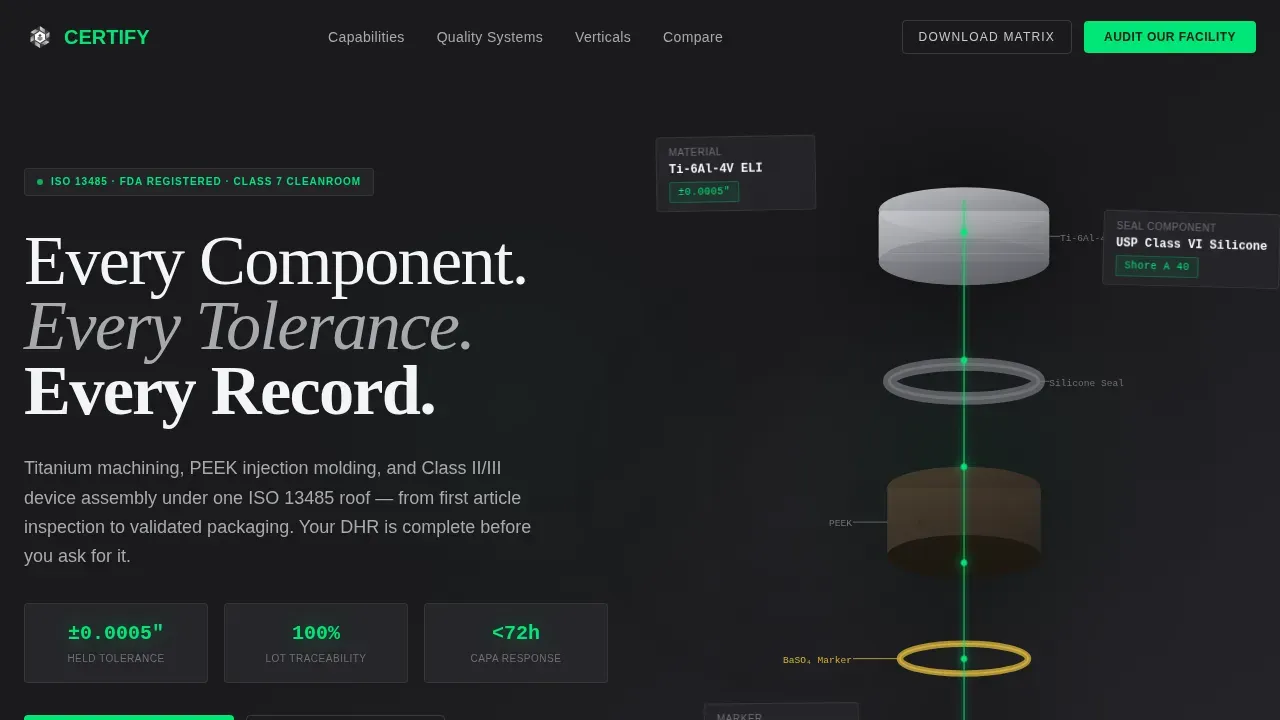
Exploded View Hero Section
The hero opens with a technical SVG illustration of a multi-component medical device assembly, detonated along its central axis. Every floating part carries material callouts such as Ti-6Al-4V and USP Class VI silicone, plus tolerance annotations at plus or minus 0.0005 inches. A single inspection-laser green line traces the assembly sequence across a deep graphite background, setting the engineering tone immediately.
Zigzag Audit Block Layout
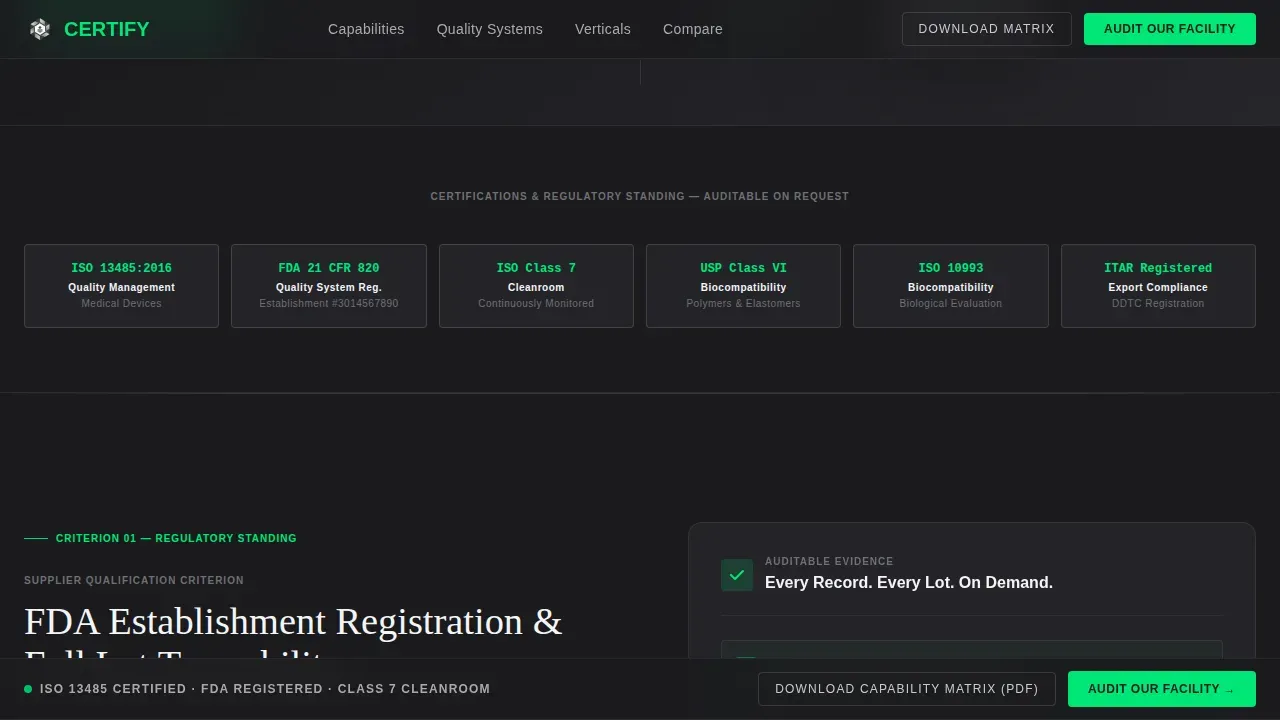
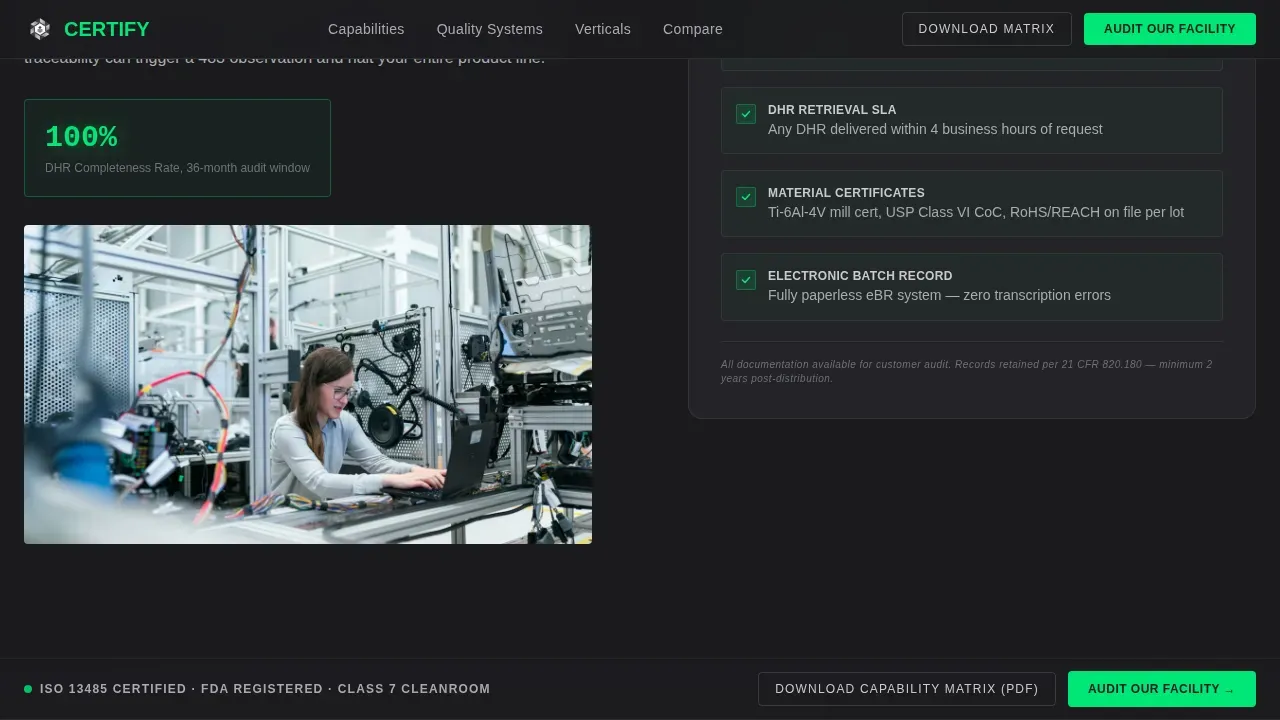
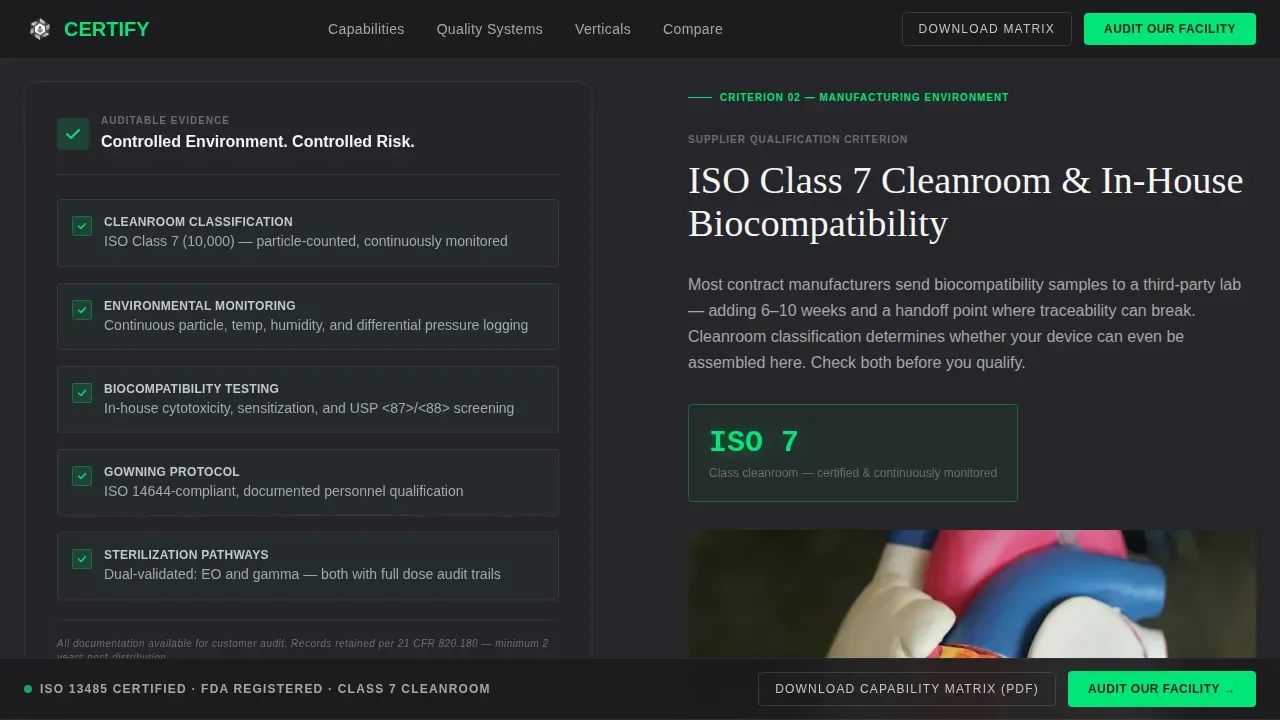
Three alternating content blocks each present a supplier qualification criterion on one side and auditable evidence on the other. The scroll progression is deliberate: early blocks address table-stakes certifications like FDA registration and lot traceability, middle blocks surface differentiators such as in-house biocompatibility testing and dual-validated sterilization pathways, and the final block presents exclusive capabilities including vertically integrated tool-making and a dedicated regulatory liaison assigned per program.
Twelve-Line Comparison Table
A two-column table contrasts a typical contract manufacturer against this supplier across twelve line items, including lead time, corrective and preventive action (CAPA) response window, lot traceability depth, and engineering change order turnaround. Green checkmarks appear on the supplier's side; gray dashes appear on the competitor's side. This format makes the evaluation implicit and immediate for any buyer already familiar with supplier audits.
Sticky Call-to-Action Bar
A persistent bar sits at the top of the viewport throughout the entire page. It carries the primary call to action "Audit Our Facility" alongside a secondary link to download the Capability Matrix in PDF format. This ensures that the conversion path remains visible regardless of where the visitor is in their review of the content.
Audit Inquiry Form
The form captures four fields: company name, device classification via a Class I, Class II, or Class III dropdown, annual unit volume range, and a free-text field labeled "Biggest Pain With Your Current Supplier." This structure mirrors the intake process a quality engineer would expect from an audit-ready supplier, lowering friction and increasing submission quality.
Carbon Fiber Visual Identity
The full color system uses deep graphite at hex code 1B1B1E for primary backgrounds, machined aluminum at A8A9AD for secondary panels, clinical white at F4F5F7 for content fields, and inspection-laser green at 00E676 exclusively for pass-state indicators, call-to-action buttons, and compliance checkmarks. The Industrial Raw theme runs throughout every surface, reinforcing the cleanroom precision narrative.
Page sections overview
| Section | Purpose |
|---|---|
| Hero: Exploded View | Establish engineering authority with annotated device assembly illustration and laser-line animation |
| Certifications Bar | Display ISO 13485, FDA Establishment Registration, Class 7 Cleanroom, USP Class VI, and ITAR badges |
| Zigzag Block 1 | Present FDA registration status and lot traceability as auditable criterion-plus-evidence pairs |
| Zigzag Block 2 | Showcase cleanroom classification and in-house biocompatibility as mid-tier differentiators |
| Zigzag Block 3 | Highlight vertical tool integration and dedicated regulatory liaison as exclusive capabilities |
| Comparison Table | Compare twelve line items between a typical contract manufacturer and this supplier |
| Audit Inquiry Form | Capture qualified leads with company, device class, volume, and pain-point fields |
| Footer | Single-row linear footer with navigation and contact essentials |
Design & branding system
The visual identity follows an Industrial Raw theme that draws its authority from the precision manufacturing environment it represents. Every design decision reinforces the feeling of stepping onto a production floor where every surface is stainless and every tolerance is documented.
- Color system: deep graphite (#1B1B1E) for backgrounds, machined aluminum (#A8A9AD) for panels, clinical white (#F4F5F7) for content fields, and inspection-laser green (#00E676) reserved exclusively for pass states and calls to action
- Typography: DM Sans for interface body copy and Fraunces for editorial headlines, creating a contrast between engineering precision and human readability
- Motion and interactivity: GSAP ScrollTrigger stagger reveals, SVG laser-line draw animation, floating annotation card parallax, and cursor tilt on the hero section
Mobile & speed optimization
The template is built desktop-first, reflecting the reality that VP-level procurement professionals and quality engineers typically review complex, form-heavy supplier documentation on desktop environments. The cleanroom design and layout choices prioritize large-screen readability and side-by-side comparison legibility.
- Server Components handle all static content sections to keep initial load fast and layout stable
- Client Components are isolated to the hero animation and audit form, limiting JavaScript execution to where interactivity is genuinely needed
- The sticky call-to-action bar is lightweight by design, ensuring it does not interfere with scroll performance on any screen size
How this template helps you convert
A high-converting landing page for an OEM supplier of cleanroom-grade medical devices must balance technical authority with trust-building social proof. This template is engineered around that principle. Every structural choice reduces buyer hesitation and moves a qualified visitor toward submitting the audit form.
- The checklist-and-audit creative direction makes the visitor feel they are already halfway through a real supplier qualification exercise, lowering psychological resistance and increasing form completion intent
- The comparison table makes the cost of staying with a typical contract manufacturer visible and concrete, turning a passive reader into an active evaluator
- The sticky "Audit Our Facility" call to action ensures the conversion path is never more than one click away, regardless of how deep the visitor scrolls into the compliance evidence
Other information about this template
This template is part of a broader set of resources designed to help medical device manufacturers and compliance-focused service providers create credible, conversion-ready digital presences. It reflects the importance of presenting supplier credentials in a format that mirrors the actual purchasing and qualification workflows used across the industry.
Understanding cleanroom design is central to what this template communicates. A cleanroom is a controlled environment designed to maintain low levels of airborne particulates, pollutants, and contaminants. Clean rooms used in medical device manufacturing must comply with international standards such as ISO 14644-1 and Good Manufacturing Practices (GMP compliance). Classification of clean rooms is based on the maximum allowable particle count per cubic foot or cubic meter of air, as defined by ISO standards. For example, a Class 7 cleanroom, also referenced as a Class 10,000 cleanroom, permits no more than 10,000 particles of 0.5 microns per cubic foot of air. Cleanrooms are classified using particle counts that determine which devices can legally be manufactured within them.
The cleanroom design represented in this template reflects several critical engineering realities. High efficiency particulate air (HEPA) filters are essential components of any compliant cleanroom. HEPA filter systems remove airborne particles efficiently and are required to maintain controlled air quality across all production environments. The air change rate in clean rooms is typically between 20 and 40 changes per hour. Airflow in cleanrooms is often designed to create a plug-flow effect to minimize contamination risks. Airborne particulates are the primary contamination risk, with personnel being the single largest source. Human error is responsible for approximately 80 percent of cleanroom contamination, which is why cleanroom garments, gowning procedures, and airlocks are essential controls.
Supplier management is mandated by quality management system (QMS) regulations globally. In the United States, supplier management is part of the FDA's Quality System Regulations (QSR), specifically CFR 21 Part 820.50, Subpart E, Purchasing Controls. Each manufacturer must establish and maintain procedures to ensure that all purchased products and services conform to specified requirements. The organization must document procedures to ensure purchased product conforms to specified purchasing information, and supplier performance must be monitored on an ongoing basis. Good supplier management is one of the fundamental methods for preventing failure of your product. It also reduces costs and helps teams find solutions to complex logistics problems. An onboarding audit is a means of verifying the answers to a supplier questionnaire, and you must qualify suppliers before adding them to your Approved Suppliers List (ASL). You can outsource the work, but you cannot outsource the responsibility.
The certify cleanroom grade medical device oem supplier landing page template is also informed by best practices for the medical device certification process. This template ensures compliance with international standards such as ISO 13485 and FDA regulations. Using it can streamline the documentation, testing, and approval processes required to bring a medical device to market. The template includes predefined sections for risk management documentation, which is critical for ISO 14971 compliance. It helps organizations avoid common pitfalls such as incomplete data or missed deadlines. The template is ideal for medical device manufacturers, regulatory affairs specialists, quality assurance teams, and project managers involved in the certification process. It can reduce errors, ensure compliance, and accelerate time-to-market for life-saving medical devices.
Additional notes for teams evaluating this template:
- The Medical Device Single Audit Program (MDSAP) was created to streamline auditing for companies placing medical devices on the market in multiple jurisdictions; the MDSAP model combines ISO 13485 and FDA QSR requirements for supplier management
- Cleanroom certification involves a series of tests to ensure a cleanroom operates at its required class; environmental monitoring must include controls for temperature, humidity, and pressure differentials
- Clean rooms do not eliminate contamination; they control it to an acceptable level through continuous monitoring of airborne particles, airflow, and particle counts
- Microbial growth is a contamination risk in cleanroom environments, and cleanroom design must address both particulate contamination and biological contamination sources
- The importance of ISO standards such as ISO 13485:2016 and ISO 14644-1 cannot be overstated; these certifications should be prominently displayed to confirm a supplier's ability to meet complex regulatory requirements
- This template can also support positioning for companies serving other industries where clean environments and contamination control are critical, such as semiconductor fabrication or pharmaceutical production
Theme
Industrial Raw
Creative direction
Checklist & Audit
Color system
Carbon Fiber
Style
Zigzag/Alternating
Direction
Comparison/Versus
Page Sections
Exploded View Hero with Annotation Cards
Zigzag Audit-block Layout
Twelve-line Supplier Comparison Table
Persistent Sticky Call-to-action Bar
Structured Audit Inquiry Form
Carbon Fiber Color System and Industrial Raw Styling
Related questions
Who is the primary audience for this template?
What sections are included in this template?
Does this template support Class II and Class III device suppliers?
How does the comparison table work?
Can this template be adapted for suppliers serving international markets?