Clinical Researcher Career Advanced Professional Website Template
Cite is a single-page clinical researcher landing page built for serious academic and medical professionals. A masonry card grid displays publications, trial affiliations, conference talks, and collaborator links in one shareable digital identity. The Ink and Paper visual theme, a centered serif headline, and a sticky collaboration call to action turn credibility into measurable outreach for principal investigators.
by Rocket studio
Quick summary
Cite condenses a clinical researcher's full professional record into one polished landing page. A masonry card grid surfaces publications, trial affiliations, conference appearances, and collaborator links side by side. Warm parchment tones and a centered serif headline create instant authority. A sticky "Propose a Collaboration" bar drives targeted outreach from the right visitors.
Who this template is for
This template is built for clinical researchers who need a fast, credible digital presence that speaks directly to a professional audience. It serves researchers who receive frequent inbound outreach and need to qualify visitors before a conversation starts.
- Principal investigators building a shareable profile for pharma and academic outreach
- Clinical researchers seeking multi-site trial collaborations with other trialists
- Academic professionals who want grant review panelists to assess credibility at a glance
What problem this template solves
A researcher's record is often scattered across journal databases, institutional directories, and PDF curricula vitae. Visitors in a hurry, a medical-science liaison with ten names to vet or a grant panelist scanning in thirty seconds, cannot piece that together quickly. This template solves that fragmentation problem.
- No single page currently connects publications, trial phase status, and collaborator reach in one view
- Generic portfolio templates lack the domain-specific fields that clinical audiences need to see
- Standard contact forms do not pre-qualify collaboration intent before a request lands in an inbox
What you get with this template
You get a fully structured single-page layout that organizes every dimension of a researcher's professional identity into scannable, interactive cards. The layout is ready to populate with real data and present to high-intent professional visitors.
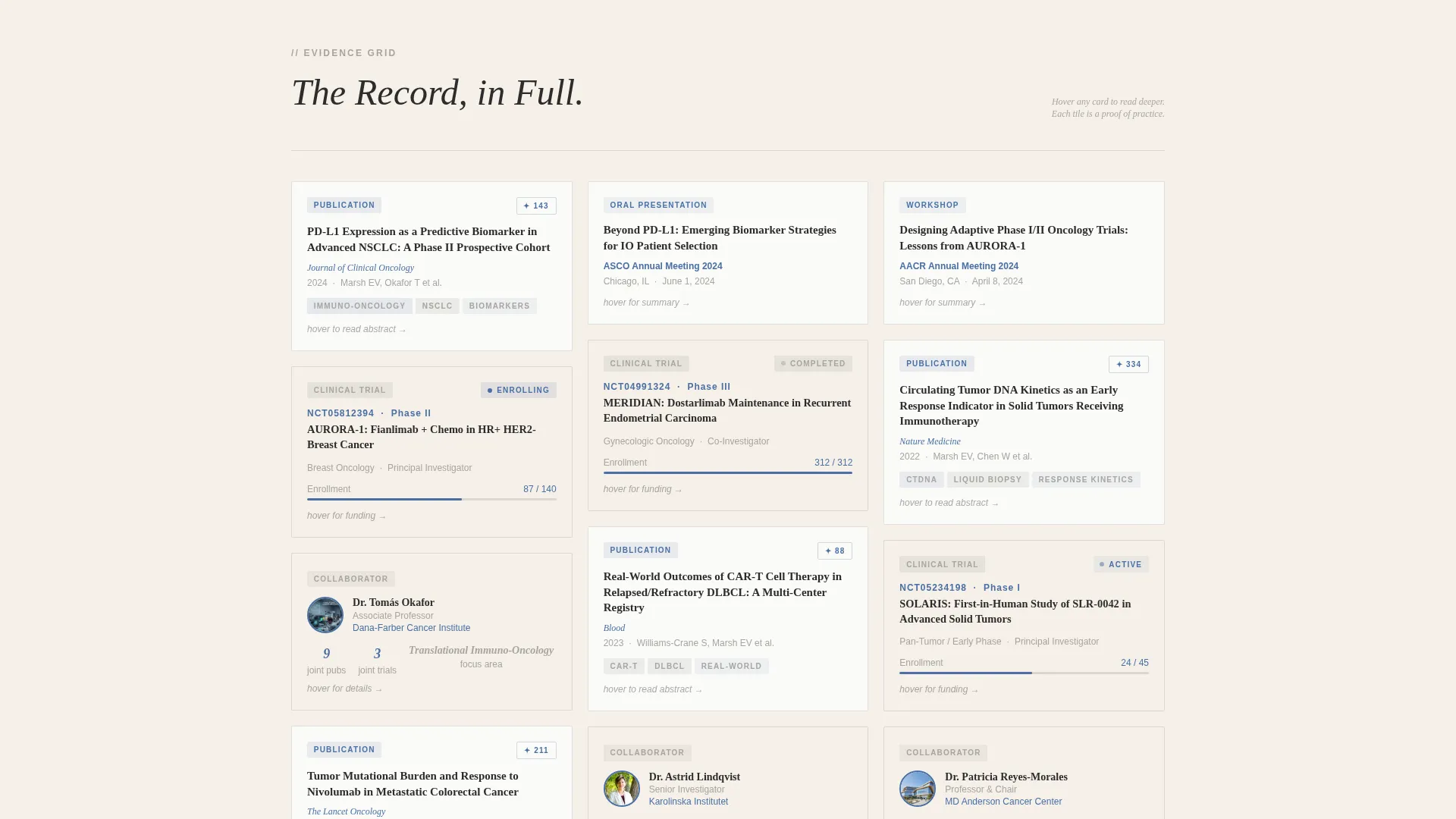
- A masonry grid with card types for papers, trials, conference talks, and collaborator nodes
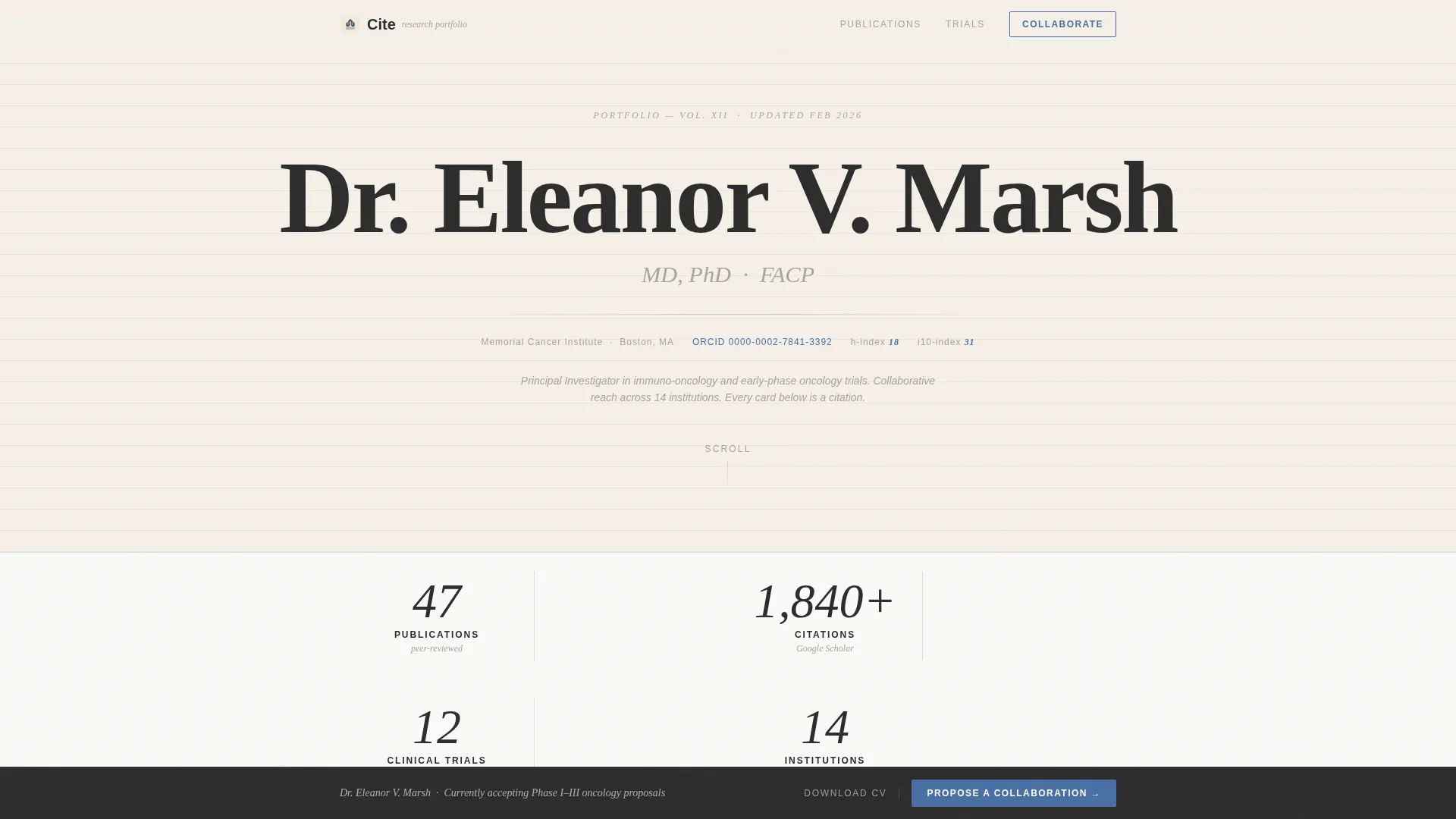
- A giant centered serif headline header showing name, institution, ORCID identifier, and h-index
- A sticky bottom bar with a "Propose a Collaboration" call to action and a secondary "Download CV as PDF" link
Feature list
This template is built around a tightly considered set of features drawn directly from the researcher networking use case.
Masonry Card Grid Layout
The core of the page is a masonry grid where cards vary in height like index cards pinned to a corkboard. Each card represents one facet: a published paper with journal name and citation count, a clinical trial with phase and enrollment status, a conference talk with venue and date, or a collaborator node linking to another profile. The layout accumulates evidence rather than narrating chronologically.
Hover-Reveal Card Interactions
Each card in the grid supports a hover state that flips the card to show deeper content. Abstracts, co-author lists, and funding sources are revealed on the reverse side. This keeps the primary grid clean while rewarding visitors who engage more deeply.
Giant Centered Serif Header
The header places the researcher's full name in a large, high-contrast serif typeface on a clean parchment background. Below the name, a single lighter-graphite line displays institutional affiliation, ORCID identifier, and h-index as a handwritten annotation. There is no portrait photograph; the typography carries the full weight of presence.
Sticky Collaboration call to action Bar
A sticky bottom bar appears after three scroll-depths and anchors the primary call to action throughout the page. It pairs a "Propose a Collaboration" button with a secondary "Download CV as PDF" link for visitors who prefer a passive first step.
Structured Collaboration Request Form
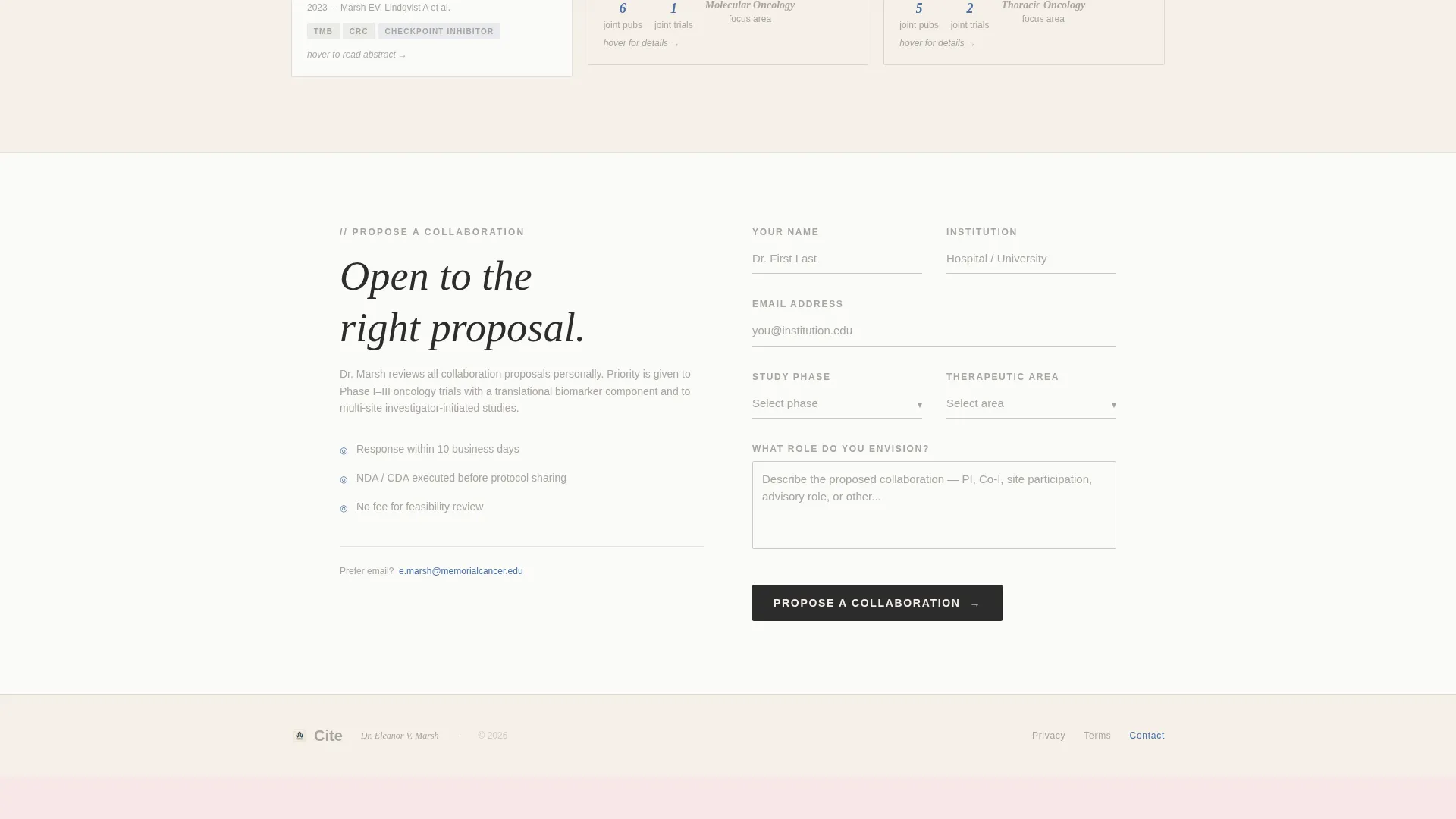
The collaboration form is sequenced deliberately. It collects the proposer's name and institution first, then study phase and therapeutic area via dropdowns, then a free-text field labeled "What role do you envision?" This order respects the professional context and filters casual requests naturally.
Ink and Paper Visual Theme
The Cloud Canvas color system uses warm parchment, graphite ink, soft pencil gray, and a single ruling-line blue reserved for hyperlinks, citation counts, and interactive hover states. Backgrounds alternate between parchment and a near-white ivory. Every instance of blue signals something clickable or countable.
Page sections overview
| Section | Purpose |
|---|---|
| Centered Name Header | Establishes researcher identity and key credentials |
| Publication Cards | Displays journal papers with citation counts |
| Clinical Trial Cards | Shows trial phase and enrollment status |
| Conference Talk Cards | Lists speaking engagements with venue and date |
| Collaborator Node Cards | Links to co-investigator profiles |
| Sticky call to action Bar | Anchors collaboration and CV download actions |
| Collaboration Request Form | Qualifies inbound collaboration proposals |
Design & branding system
The visual system is built on the Ink and Paper theme, which references the tactile feel of a printed journal offprint. Every color decision is purposeful and restrained, keeping the researcher's record the center of attention.
- Warm parchment (#F5F0E8) and near-white ivory (#FAFAF7) alternate as backgrounds; graphite ink (#2C2C2C) carries all body text
- Ruling-line blue (#4A6FA5) appears only on hyperlinks, citation counts, and hover states, so every blue element signals interactivity
- Typography uses a high-contrast serif for the headline and a complementary weight for card body text, giving the page a scholarly print quality
Mobile & speed optimization
The masonry layout is designed to reflow cleanly across screen sizes so researchers can share a single link regardless of where a visitor opens it. A medical-science liaison reviewing profiles between meetings on a phone gets the same credibility signal as a desktop reader.
- Card grid columns adjust to narrower viewports so content remains readable without horizontal scrolling
- The sticky call to action bar is sized and positioned for comfortable thumb reach on mobile screens
- Hover interactions on touch devices translate to tap-to-reveal so card backs remain accessible
How this template helps you convert
The page is engineered for one conversion goal: receiving qualified collaboration proposals from the right people. The masonry grid does the credentialing work before the call to action ever appears.
- The grid builds trust progressively as visitors scroll, so by the time the sticky bar appears, the researcher's qualifications have already answered every standard vetting question a liaison or co-investigator would ask.
- The structured form filters intent at the point of contact by asking for study phase, therapeutic area, and a described role, which means every submission arrives with enough context to act on immediately.
Other information about this template
This template sits within the Personal and Resume category, specifically the Clinical Researcher Career subcategory and the Clinical Researcher Networking Bio niche. It is a strong fit for researchers building a shareable profile on a platform that serves academic and clinical professionals.
- The template style is Masonry and Pinterest layout, making it visually distinctive compared to standard vertical-scroll portfolio pages
- The creative direction follows a Creator Spotlight approach, where accumulated evidence across cards builds a cumulative argument for the researcher's credibility
- The header concept is Giant Headline Centered, a deliberate choice that treats typography as professional presence in the absence of a photograph
- The landing page direction is Lead Generation, with both the sticky call to action and the structured form oriented toward producing actionable collaboration proposals

Theme
Ink & Paper
Creative direction
Creator Spotlight
Color system
Cloud Canvas
Style
Masonry/Pinterest
Direction
Lead Generation
Page Sections
Masonry Card Grid Layout
Hover-reveal Card Interactions
Giant Centered Serif Header
Sticky Collaboration Call to Action Bar
Structured Collaboration Request Form
Ink and Paper Visual Theme
Related questions
Can I use this template without a photograph?
What types of cards does the masonry grid support?
How does the collaboration form qualify inbound requests?
When does the sticky call to action bar appear on the page?
Is this template suitable for sharing with grant review panels?