Neurosurgeon Reviews Website Template
Codex is a split-screen neurosurgery billing and insurance landing page built for private-practice neurosurgeons, billing coordinators, and office managers. It presents prior authorization workflows, denial-reason breakdowns, and CPT code guidance in a clean, organized layout, pairing scrollable educational content with attributed testimonials from practicing neurosurgery professionals.
by Rocket studio
Quick summary
Codex is a single-page billing and insurance resource designed for neurosurgery practices. It translates complex prior authorization rules, CPT code disputes, and claim denial patterns into clear, navigable content. The layout uses a 50/50 split screen, placing educational reference material on the left and rotating testimonials on the right, making it both a teaching tool and a trust builder.
Who this template is for
This template is built for the people inside a neurosurgery practice who deal with payer rules every day. It speaks directly to the operational and clinical billing challenges unique to neurosurgery, not general medical billing.
- Private-practice neurosurgeons managing claim denials on craniotomies and spinal fusions
- Billing coordinators who need a reliable single reference for payer-specific CPT code rules
- Office managers decoding prior authorization requirements for high-complexity procedures
What problem this template solves
Neurosurgery billing is one of the most documentation-heavy specialties in medicine. Prior authorization for procedures like spinal fusions, the correct use of modifier-25, and payer-specific rules for CPT codes such as 61510 create constant friction between the practice and reimbursement. There is no single, trusted reference that consolidates all of this, until now.
- Claim denials pile up when staff must interpret conflicting payer rules without a clear guide
- Billing coordinators lose hours chasing authorization steps that should follow a defined sequence
- Neurosurgeons spend time on appeals that could have been avoided with upfront code clarity
What you get with this template
The template delivers a fully structured, content-ready landing page that functions as an authoritative billing reference. Every section has a specific job, and the layout keeps visitors reading and scrolling toward the download offer.
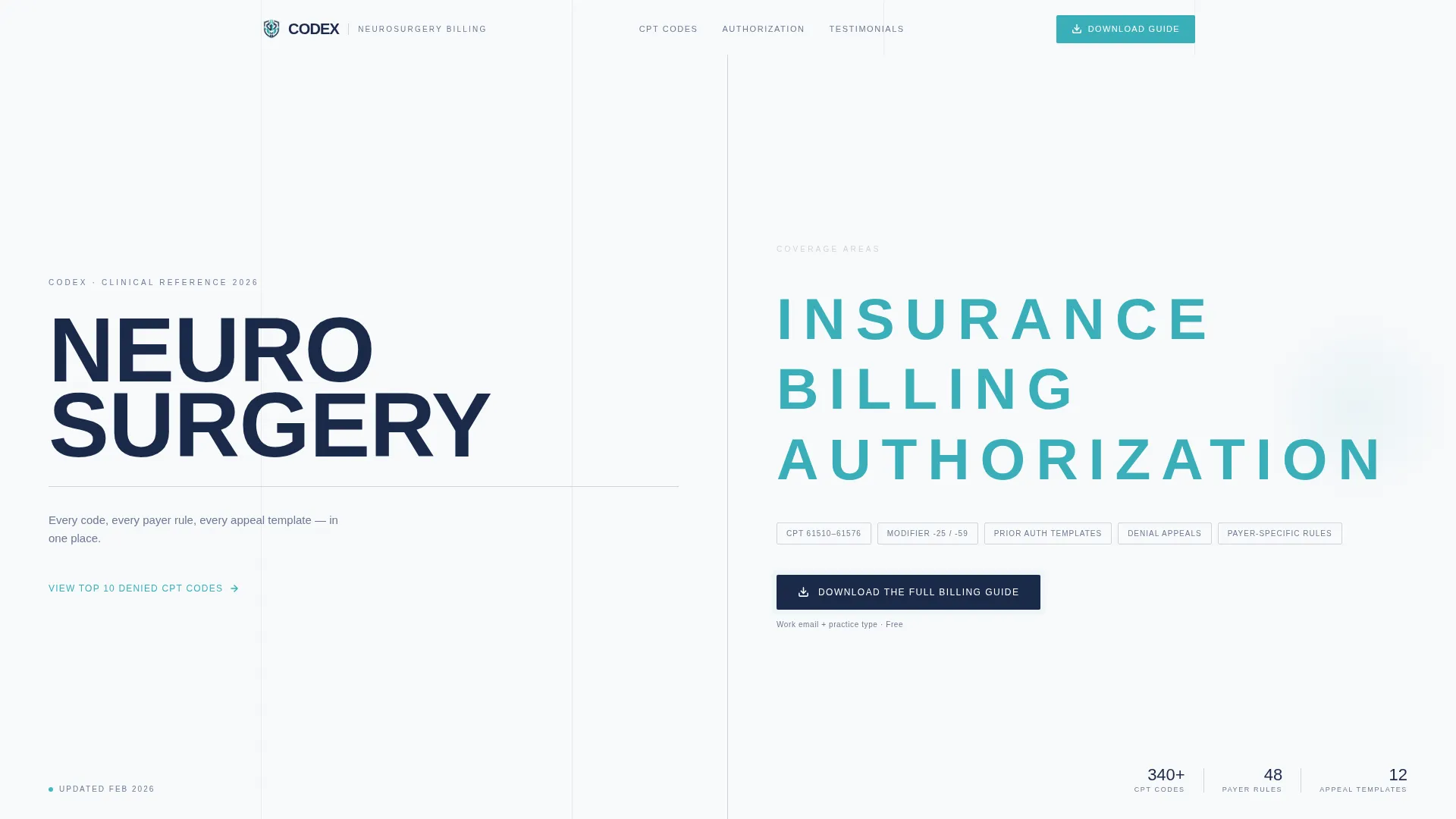
- A hero section with a stacked typographic tower announcing the page's purpose immediately
- A scrollable split-screen layout pairing reference content with social proof testimonials
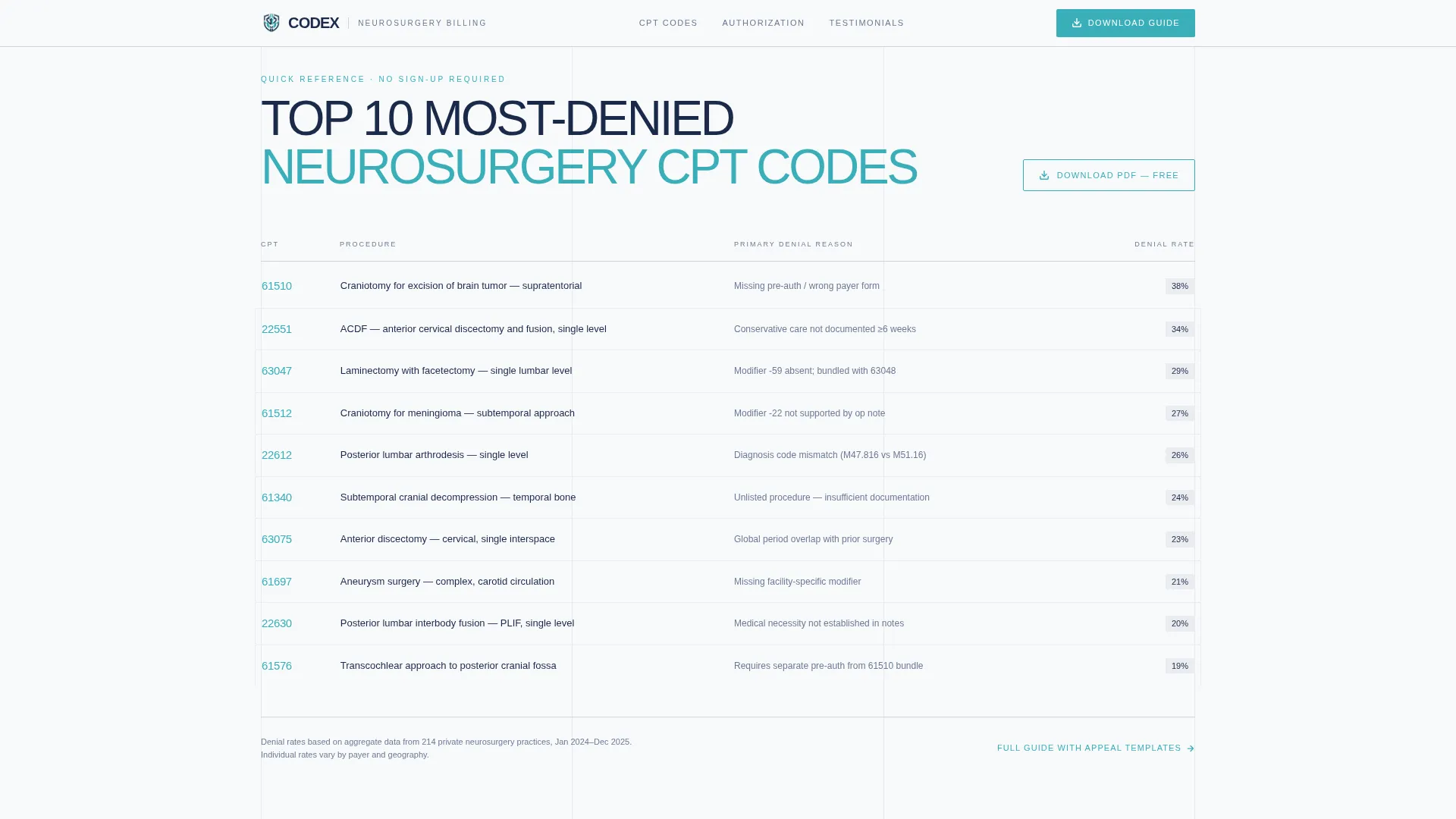
- Two conversion paths: a gated full billing guide download and an ungated quick-reference PDF
Feature list
This template ships with six core features drawn directly from the project brief. Each one serves the billing coordinator, office manager, or neurosurgeon who lands on the page.
Stacked Type Tower Hero
The hero uses ultra-condensed navy type to fill the left half of the viewport with the word NEUROSURGERY. The right half stacks INSURANCE, BILLING, and AUTHORIZATION in teal, each word arriving one beat after the last. A single supporting sentence runs below in light gray. The typography alone communicates authority before any body copy is read.
Split-Screen Scrollable Layout
The 50/50 split screen keeps educational content, authorization checklists, denial breakdowns, modifier guides, anchored to the left panel as visitors scroll. The right panel surfaces the testimonial mosaic. Both panels remain in constant conversation, so readers absorb proof and information simultaneously.
Testimonial Mosaic with Specialty Tags
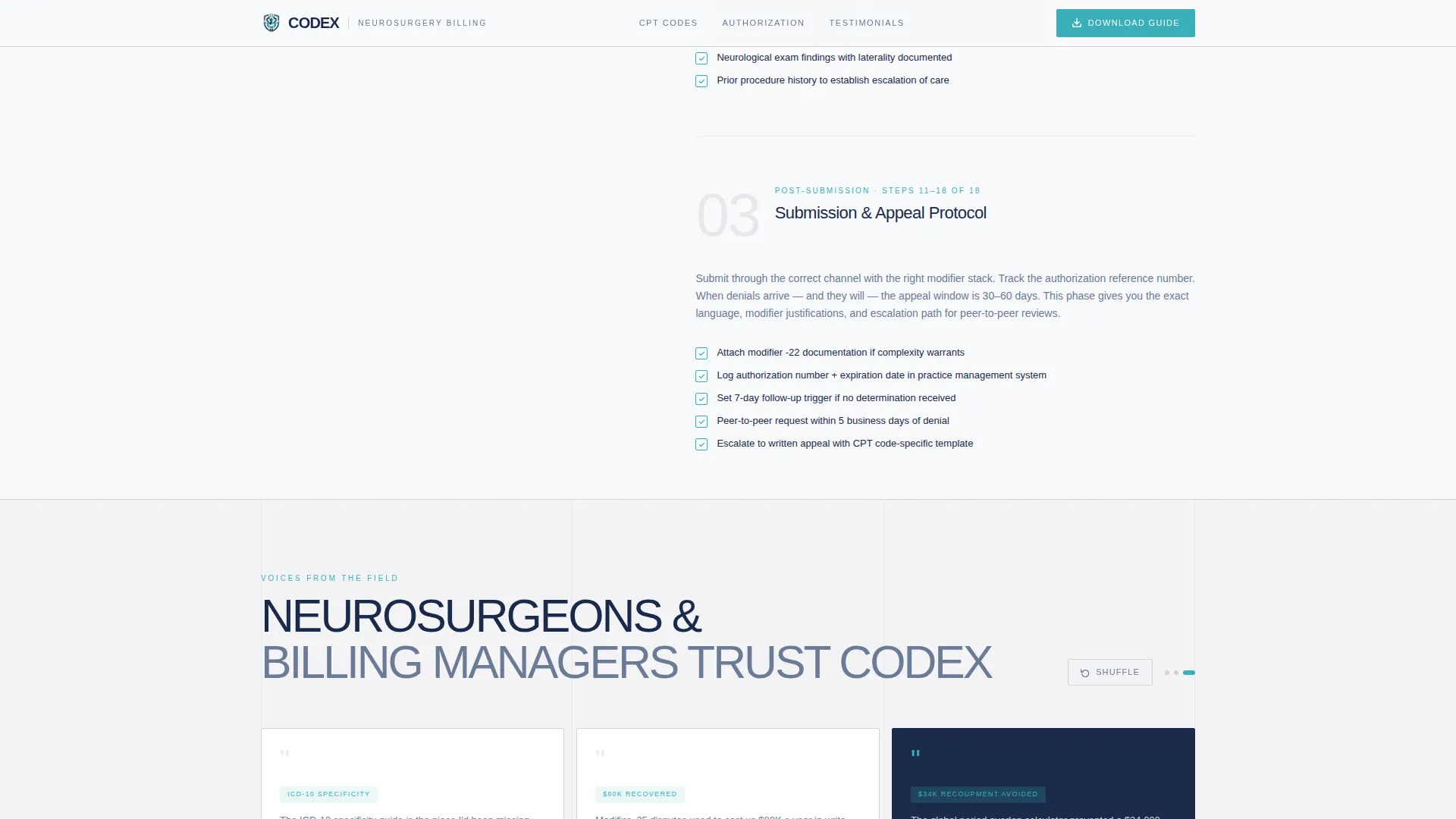
Rotating quote tiles from neurosurgeons and billing managers populate the right panel. Each tile carries a specialty tag and practice size, helping readers find a voice that matches their own situation. The mosaic subtly rearranges at each section break to signal breadth of trust across practice types.
Authorization Workflow with Scroll-Linked Steps
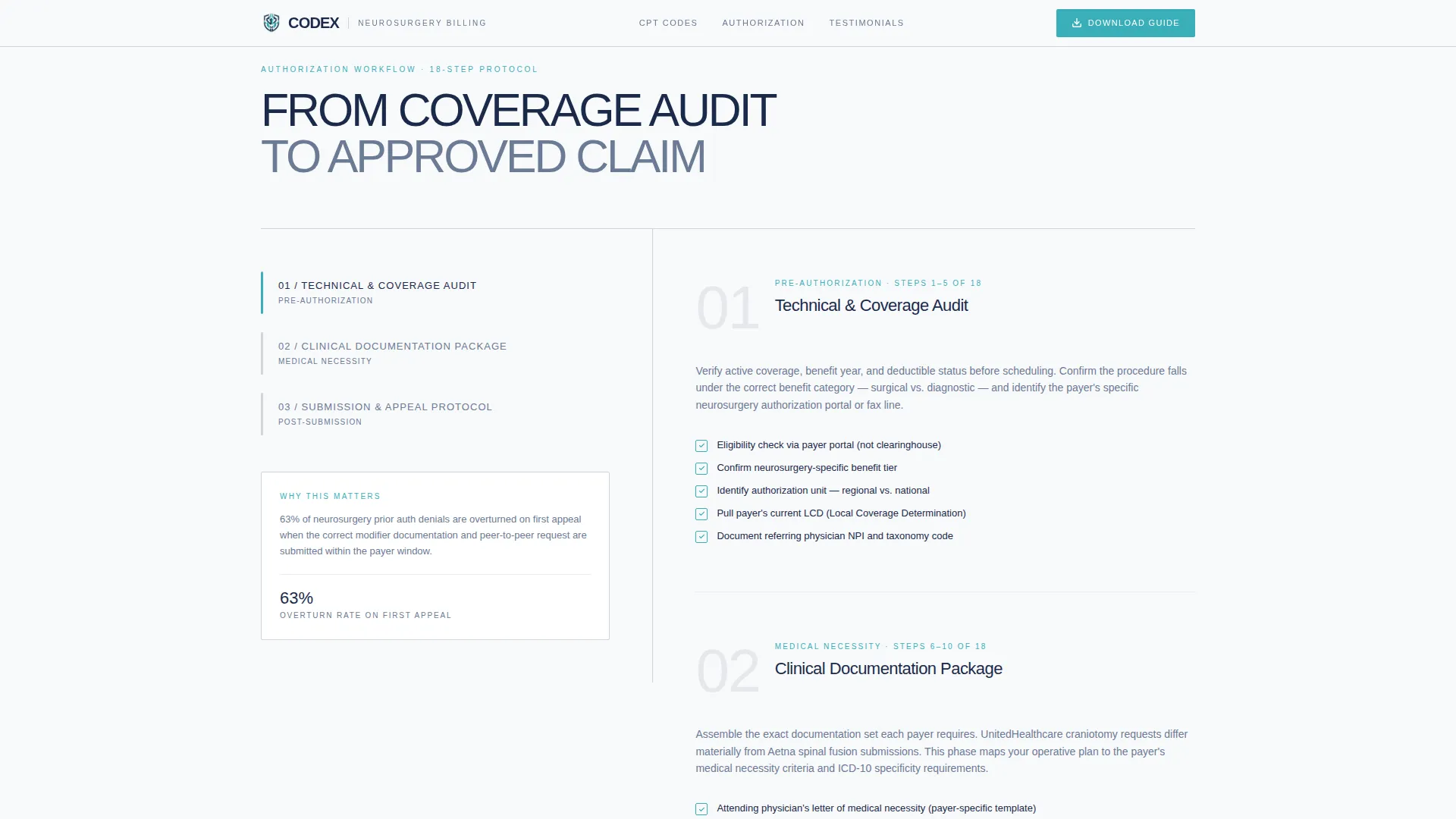
A three-phase authorization workflow is presented as a sticky panel with scroll-linked step activation. Each phase unlocks as the visitor scrolls, making the sequence feel like a guided walkthrough rather than a static checklist. This format reinforces the "perfectly organized binder" experience described in the design brief.
Dual Conversion Path
The midpoint and footer both carry the primary call to action: "Download the Full Billing Guide," gated behind a two-field form collecting work email and practice type. A secondary ungated path offers a quick-reference PDF of the ten most-denied neurosurgery CPT codes, no form required. The ungated path builds goodwill before asking for the deeper commitment.
FAQ-Style Accordion Sections
Denial-reason breakdowns and modifier guides are presented in accordion-style expandable blocks. This keeps the page scannable and avoids wall-of-text fatigue. Visitors can jump to the specific code or rule they need without scrolling past content that does not apply to them.
Page sections overview
| Section | Purpose |
|---|---|
| Hero Tower | Establish authority and topic immediately |
| Quick Reference PDF | Ungated CPT code download for instant goodwill |
| Authorization Workflow | Three-phase scroll-linked prior auth guide |
| Testimonial Mosaic | Rotating attributed quotes with practice tags |
| Billing Guide Download | Gated two-field form for full resource |
| Footer | Horizontal flow with secondary navigation |
Design & branding system
The visual identity follows an Educational Guide theme using an Arctic White color system. The palette is deliberately clinical and distraction-free, built to match the environment where it will be used, a practice workstation or office desk, not a consumer device.
- Clinical white (#F8F9FB) and instrument-steel gray (#D0D4DA) carry all backgrounds
- Deep cranial navy (#1B2A4A) handles all headlines and body text for sharp contrast
- Surgical-light teal (#3AAFB9) is reserved for links, active states, and download buttons only
Mobile & speed optimization
The template is built desktop-first, reflecting the clinical workstation context where billing coordinators and office managers will primarily use it. Responsive mobile behavior is included so the page remains functional on any device.
- Sticky split panels and scroll-linked animations are designed for larger desktop viewports first
- Server Components handle static content sections to keep JavaScript usage minimal
- Mosaic tile rearrangement and word-stagger reveal effects use lightweight scroll-event triggers
How this template helps you convert
The conversion strategy is built on demonstrated value before any ask. Visitors read real, scrollable content before encountering a form, making the download feel like the natural next step.
- The ungated quick-reference PDF removes friction early and proves the quality of the full guide before any commitment is required.
- The midpoint gated form appears after the authorization workflow section, when the visitor has already absorbed enough value to trust the offer.
Other information about this template
This template is built specifically for the United States healthcare billing context. Date formats follow MM/DD/YYYY and all currency references use USD. It is localized for American payer rules and CPT code conventions.
- Typography uses DM Sans for ultra-condensed headings and Manrope for body text
- Animation intensity is set to medium: word-stagger reveals, scroll-linked step activation, and mosaic tile rearrangement are all included
- The footer follows a horizontal flow pattern consistent with a clean, professional practice resource page
- The two-field gated form collects work email and practice type (solo, group, or hospital-employed) only
Theme
Educational Guide
Creative direction
Testimonial Mosaic
Color system
Arctic White
Style
Split Screen (50/50)
Direction
Content/Resource
Page Sections
Stacked Type Tower Hero
Split-screen Scrollable Layout
Testimonial Mosaic with Practice Tags
Three-phase Authorization Workflow
Dual Conversion Path Design
Faq-style Accordion Sections
Related questions
Who is this landing page template designed for?
What are the two conversion paths included in this template?
Does this template include editable content or only the page layout?
Can the testimonial mosaic be updated with real practice quotes?
Is this template suitable for a hospital-employed neurosurgery department?