Institutional Knowledge Capture Recruitment Landing Page Template
Codex is a recruitment landing page template built for a culture documentation platform that captures institutional knowledge before it walks out the door. The template uses a zigzag Problem→Solution Arc, a multi-step hero form that acts as a live product demo, and an Educational Guide visual style to attract engineers, designers, and content strategists who value knowledge-driven work environments.
by Rocket studio
Quick summary
Codex is a single-page recruitment template designed for a business that helps teams capture institutional knowledge before experienced employees leave. The page uses a zigzag alternating layout, a three-step interactive hero form that doubles as a product demo, and a field-notebook visual identity to earn candidate trust and drive applications to open roles.
Who this template is for
This template is built for founders, People Ops leads, and engineering managers who understand the cost of undocumented knowledge. It speaks directly to candidates who want to join a team that treats knowledge seriously, and it positions the company as a thoughtful, intelligent place to do meaningful work.
- Engineers, designers, and content strategists who want a work environment where institutional knowledge is respected and preserved
- Hiring teams responsible for attracting talent to a culture documentation platform
- Founders scaling past fifty employees who recognize that undocumented process is a high priority business risk
What problem this template solves
Most people building recruitment pages face the same core challenge: a generic career page cannot communicate what makes a company's knowledge culture genuinely different. When experienced employees leave, the key facts they carry rarely make it into any documentation system. The result is a workforce that repeats the same mistakes, loses decision context, and struggles to onboard new hires efficiently. Documenting institutional knowledge can save companies millions of dollars in productivity losses, yet most pages give candidates no real sense of how the company actually thinks.
- Candidates cannot feel a company's knowledge philosophy from a standard job post, so the page fails to attract the right talent
- Teams waste hours each week answering the same onboarding questions because process knowledge was never written down
- Engineering managers watch senior developers leave with undocumented decision history that can never be fully recovered
What you get with this template
You get a fully structured, single-page recruitment layout designed around the philosophy that documentation is a form of institutional respect. Every section exists to do a specific job: the hero form earns engagement before the visitor has scrolled, the zigzag arc builds urgency through escalating knowledge-loss scenarios, and the team profiles prove the company's culture philosophy from the inside out. The template gives your team a ready-to-use foundation to create a page that converts thoughtful candidates.
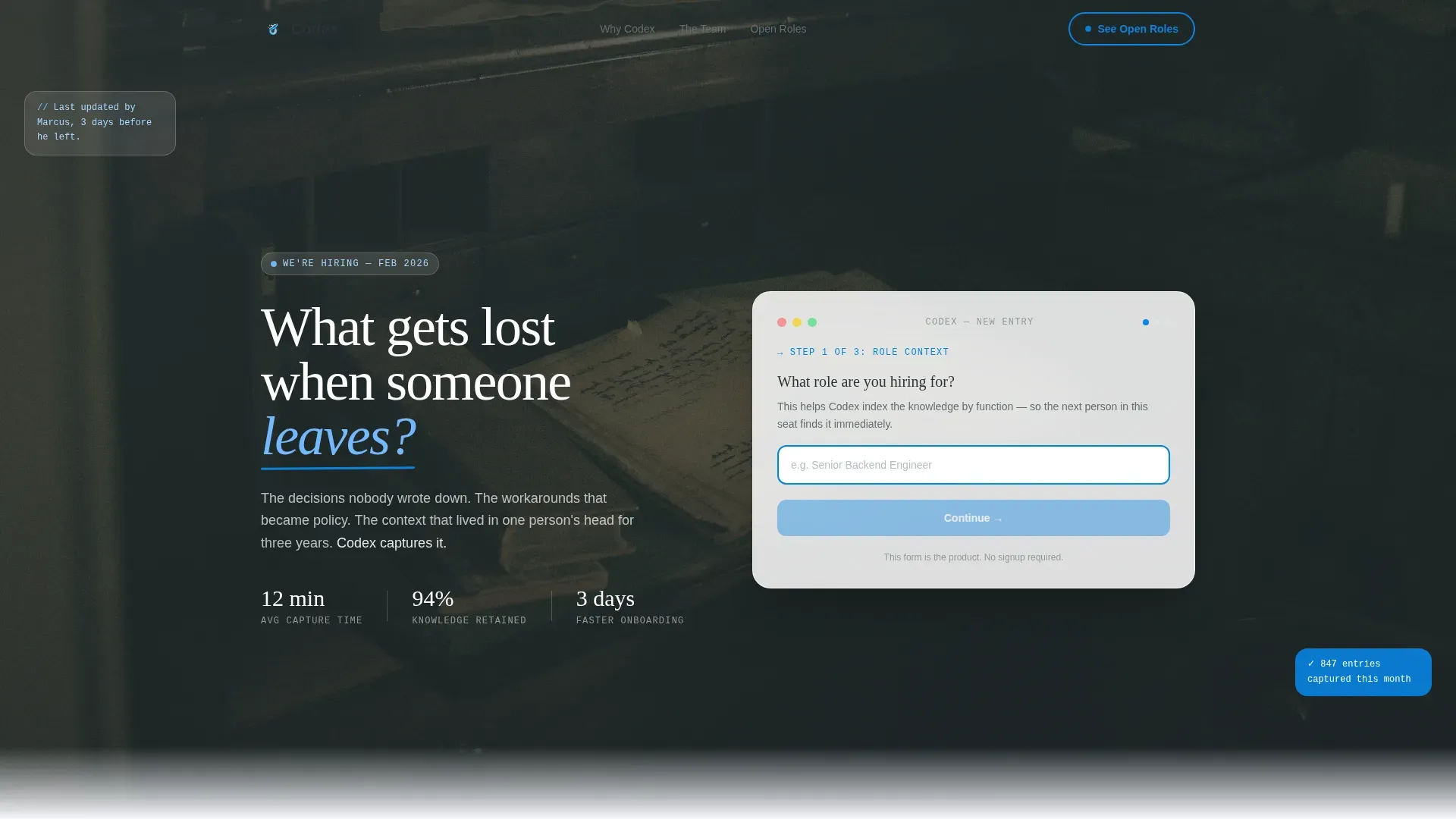
- A three-step interactive hero form that lets visitors experience the Codex product concept before they read a single line of body copy
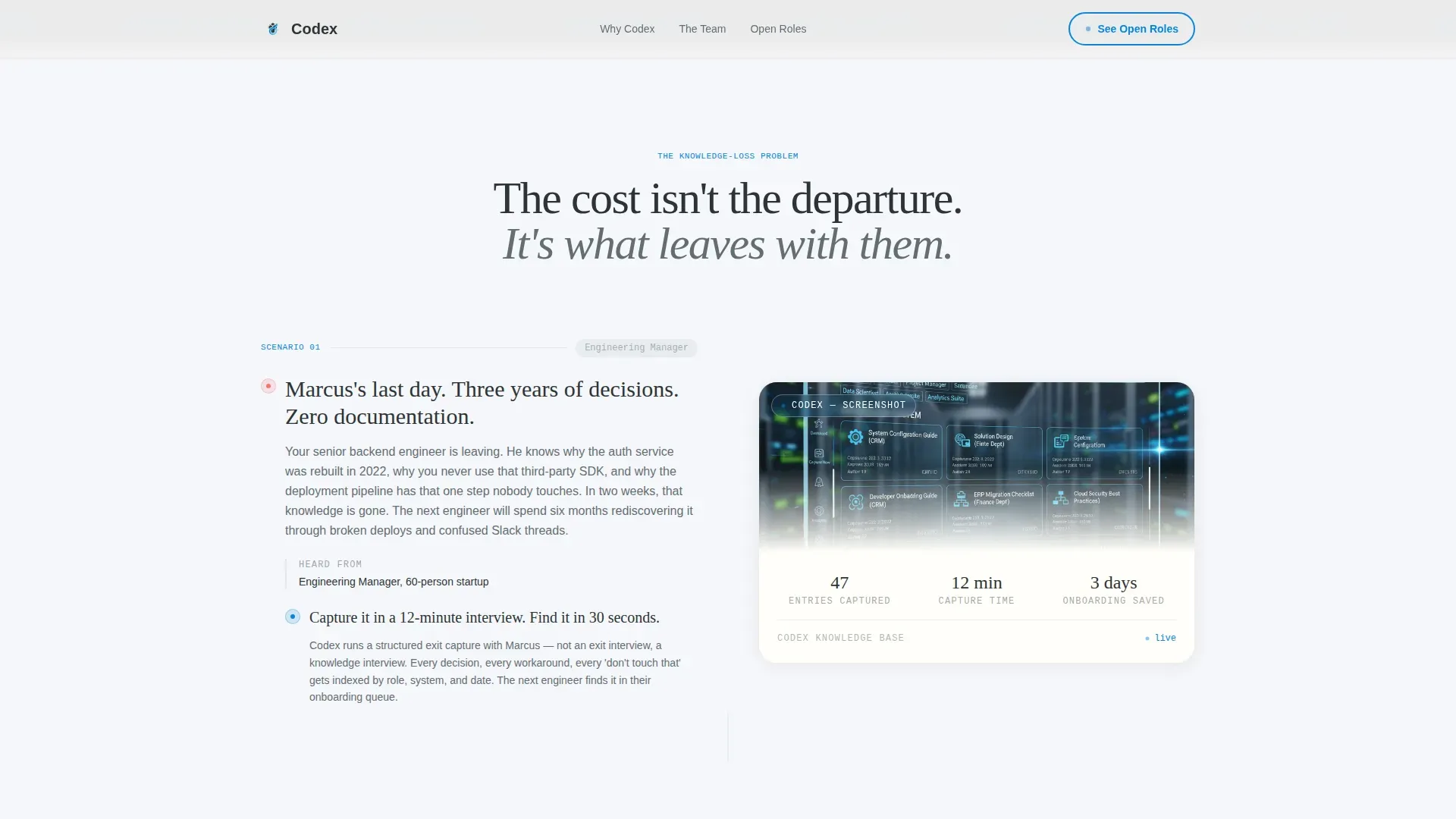
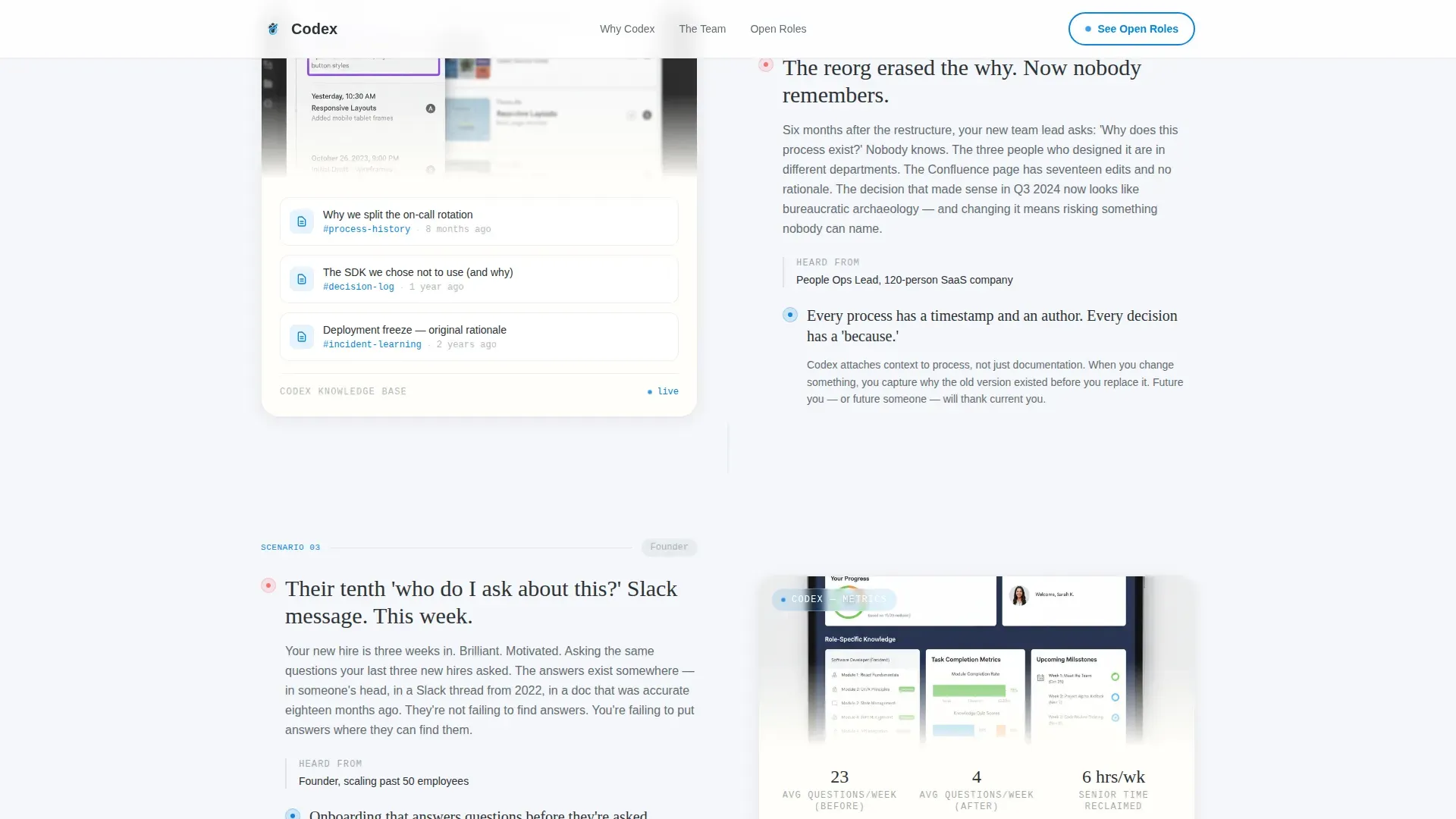
- Three alternating Problem→Solution section pairs that escalate from individual confusion to organizational amnesia, each pairing a knowledge-loss scenario with a Codex solution visual
- A team profile section formatted as actual culture documentation entries, a role-selector conversion section, and a sticky navigation call to action
Feature list
This template is built around six purposeful components. Each one serves the recruitment goal and the knowledge-documentation philosophy simultaneously.
Interactive Multi-Step Hero Form
The header is a three-step form that functions as the product demo. Step one asks the visitor what role they are hiring for. Step two asks for the one thing only their team knows. Step three reveals a simulated culture document page built from their answers. Before the visitor scrolls, they have already used Codex. This approach saves hours of explanation and makes the value proposition viscerally clear in seconds.
Zigzag Problem→Solution Arc
Three alternating content pairs drive the scroll in a left-right rhythm. Each left-side text block presents a specific knowledge-loss scenario: a senior engineer's last day, a reorg that erases context, a new hire's tenth question in a week. Each right side shows the Codex solution as a product screenshot or animation. The escalating structure helps visitors recognize their own pain and decide whether they want to fix it from the inside.
Team Profile Culture Doc Section
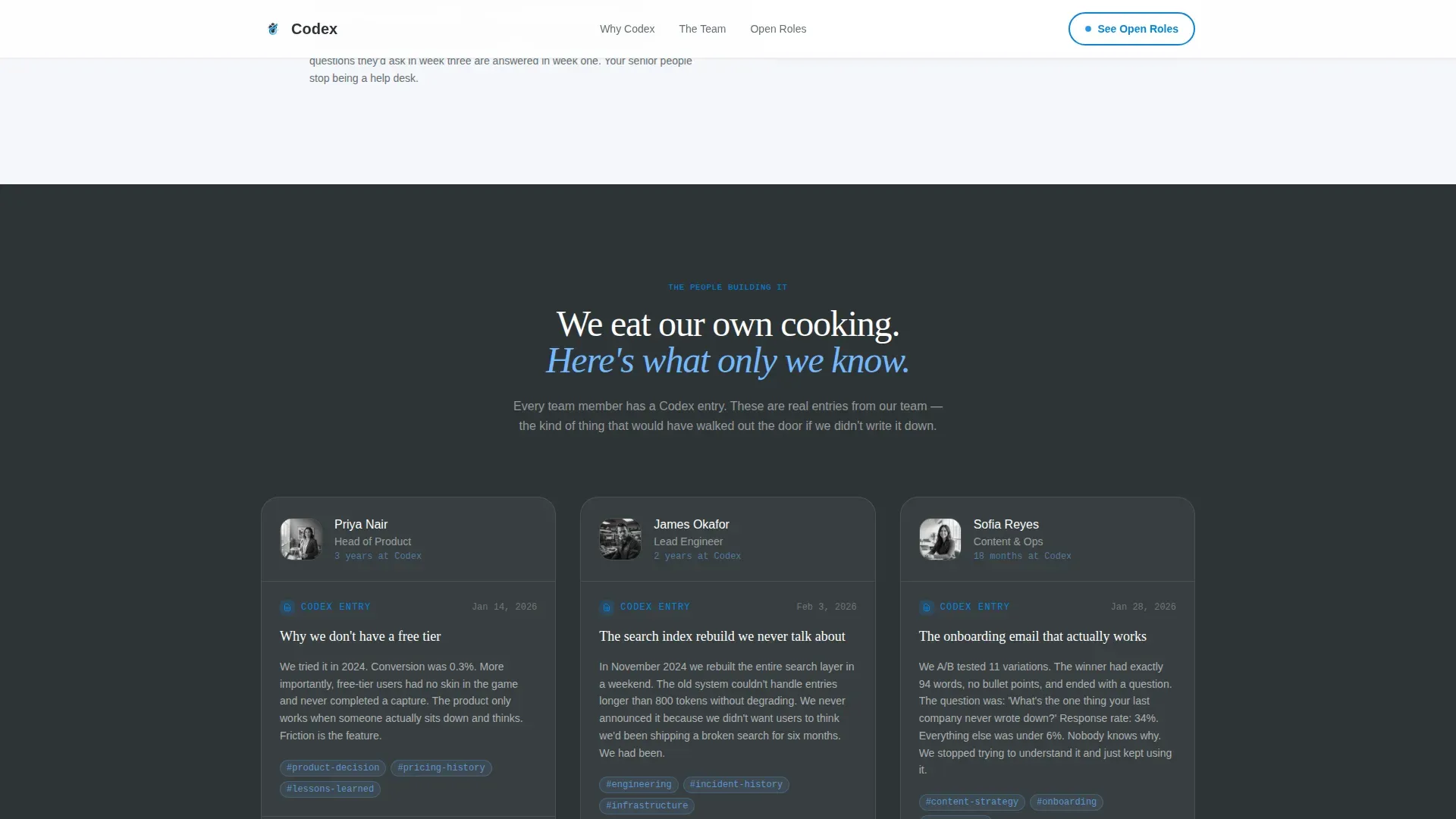
Three current team members are profiled in the format of actual Codex knowledge entries, each revealing the "thing only they know." This section acts as social proof and serves as a brief description of the company's internal philosophy. Employee testimonials in product format are far more convincing than generic quotes, and they help candidates understand the real work environment before they apply for any job.
Sticky Navigation Call to Action
A secondary call to action labeled "See Open Roles" remains visible in the navigation bar as candidates explore the page. The sticky element uses contrasting signal blue against the chalkboard slate background to stay visible without interrupting the reading flow. Sticky calls to action keep conversion accessible at every scroll depth, which matters especially when the page carries dense knowledge-focused content.
Role-Selector Conversion Section
The primary call to action, "Build This With Us," leads to a role-selector page covering engineering, design, and content positions. Detailed job descriptions with clear information about roles, responsibilities, and requirements help candidates self-select and arrive at the application form already aligned with expectations. The section sets candidate expectations clearly and honestly.
Educational Guide Visual System
The full page is designed around a field-notebook aesthetic using Fraunces serif headlines, DM Sans body type, and JetBrains Mono for code labels and system text. GSAP scroll reveals and staggered animation bring each section to life as the visitor reads. The visual system creates intellectual weight paired with the lightness of finally understanding something, which is the emotional state the recruitment page is designed to produce.
Page sections overview
| Section | Purpose |
|---|---|
| Hero Form Demo | Three-step interactive form that acts as the live product introduction |
| Problem Arc One | Senior engineer departure scenario paired with Codex knowledge capture solution |
| Problem Arc Two | Reorg context erasure scenario paired with structured documentation visual |
| Problem Arc Three | New hire confusion scenario paired with searchable knowledge module solution |
| Team Profile Entries | Three current team members profiled in actual Codex culture doc format |
| Open Roles call to action | Role-selector section with primary "Build This With Us" conversion action |
| Footer Row | Linear single-row footer with key links and minimal navigation |
Design & branding system
The visual identity follows an Educational Guide theme. The palette reads like a clear morning on a university quad: serious stone buildings under an optimistic sky. Every color choice reinforces intellectual credibility while keeping the page warm enough to feel like a place where people actually want to work.
- Color system uses deep chalkboard slate (#2D3436) for backgrounds, worn graphite (#636E72) for secondary text, open-sky blue (#74B9FF) for structural accents, cloud-white (#DFE6E9) for breathing room, and signal blue (#0984E3) for interactive highlights and calls to action
- Typography combines Fraunces serif for headlines, DM Sans for body writing, and JetBrains Mono for code labels and system-style text, creating a layered reading hierarchy that feels like a well-annotated field notebook
- Brand guidelines built into the template keep visual consistency across all sections without requiring custom design work from the hiring team
Mobile & speed optimization
The template is built desktop-first, reflecting the reality that knowledge workers typically review role pages from a desk. However, mobile optimization is necessary for recruitment pages targeting senior experts who browse on mobile devices, and the layout adapts cleanly to smaller screens without losing the structured knowledge-doc aesthetic.
- Responsive layout ensures the zigzag alternating structure reflows into a single column on mobile, preserving the problem-escalation narrative without breaking visual rhythm
- The multi-step hero form is optimized for touch interaction so that candidates on mobile can complete all three steps without friction, keeping the demo experience intact across devices
How this template helps you convert
The page is engineered to earn conviction before asking for a click. Each section builds on the previous one, moving the visitor from recognition to urgency to desire. The conversion strategy is layered and deliberate.
- The hero form creates immediate product understanding by letting candidates experience Codex firsthand, which connects the job opportunity to a tangible, intelligent tool they can picture themselves building
- The zigzag arc escalates the emotional stakes from individual confusion to organizational amnesia, making each solution feel more obvious and more urgent, so the "Build This With Us" call to action arrives at exactly the right moment of conviction
- The team profile section proves the culture philosophy is real by documenting actual team knowledge in the product's own format, giving candidates the confidence that the company practices what it asks others to adopt
Other information about this template
This template is designed to work alongside modern development and documentation workflows. Several practical details are worth noting for teams evaluating it across multiple projects or extended use cases.
- Teams using AI tools for development will find the template's structure compatible with generative AI assisted builds; the component layout is predictable enough that AI can help extend or adapt sections without breaking the visual system
- Developers working with claude code or similar AI coding assistants will find the template's code organized by section and task, making it straightforward to request targeted changes or add new functionality to a specific block
- The multi-step form uses a context window approach: each step narrows the visitor's focus and feeds their prior answer into the next prompt, which mirrors the way AI driven knowledge tools capture and organize data progressively
- Automation is built into the template's animation system: GSAP handles scroll reveals and form transitions so the page responds to user behavior without requiring manual trigger logic from the development team
- The template is not a desktop app; it is a web-based landing page built for deployment in a standard browser environment
- Compliance officers and legal reviewers will find the page free of speculative performance claims, ensuring the published page stays honest about what the product does
- The template avoids spam filters by keeping form fields focused on genuine qualification questions rather than mass-capture inputs, which aligns with smart lead form best practices for expert recruitment
- Teams running the page across multiple projects can adapt the color tokens and typography settings to reflect updated brand guidelines without restructuring the layout
- The notion of knowledge as infrastructure is expressed visually throughout the template, reinforcing that institutional knowledge is not a nice-to-have but a critical business asset worth protecting
- The template saves hours of custom design work by providing a complete, opinionated layout that teams can deploy, adapt, and iterate on immediately
Theme
Educational Guide
Creative direction
Problem→Solution Arc
Color system
Slate & Sky
Style
Zigzag/Alternating
Direction
Recruitment/Hiring
Page Sections
Interactive Three-step Hero Form
Zigzag Problem-to-solution Layout
Culture Doc Team Profiles
Sticky Role Navigation Call to Action
Role-selector Conversion Section
Educational Guide Visual System
Related questions
What kind of company is this template designed for?
Does the hero form connect to a real back-end system?
Can I adapt this template for multiple open roles?
How does the zigzag structure support recruitment goals?
Is this template suitable for mobile candidates?