Modern Architecture Landing Page Template
A full-width landing page built for heritage and restoration architecture practices. It opens with a breathtaking golden-hour photograph, then leads visitors straight into an interactive Heritage Project Estimator. Case study triptychs, craft detail photography, and two clear conversion paths work together to turn curious building owners into qualified enquiries.
by Rocket studio
Quick summary
This landing page template is designed for conservation architecture practices working with listed and historic buildings. It combines an immersive photo header, an interactive project estimator, and a layered case study narrative to build trust quickly. Two conversion paths capture both ready-to-commission clients and earlier-stage prospects who still need guidance.
Who this template is for
This template suits practices whose work requires explanation before a client will commit. It is built specifically for professionals advising on the repair and conservation of protected historic structures.
- Conservation and heritage architecture practices taking on listed building projects
- Practices whose clients include parish councils, private listed building owners, and estate trusts
- Firms that need to educate prospective clients on consent requirements before a first meeting
What problem this template solves
Most architecture practice pages lead with credentials. That approach fails heritage clients, who arrive anxious about enforcement notices, repair costs, and unfamiliar consent processes. This template earns trust first by giving visitors something immediately useful.
- Prospective clients often do not know what a condition survey, a conservation plan, or Listed Building Consent actually involves
- Without early clarity on scope and likely cost, owners delay enquiring and let damage worsen
- A static portfolio page cannot reassure a worried parish treasurer the way a personalised fee estimate can
What you get with this template
The template delivers a complete single-page flow structured around the full client journey, from first curiosity through to a submitted enquiry. Every section is designed to carry the visitor forward without pressure.
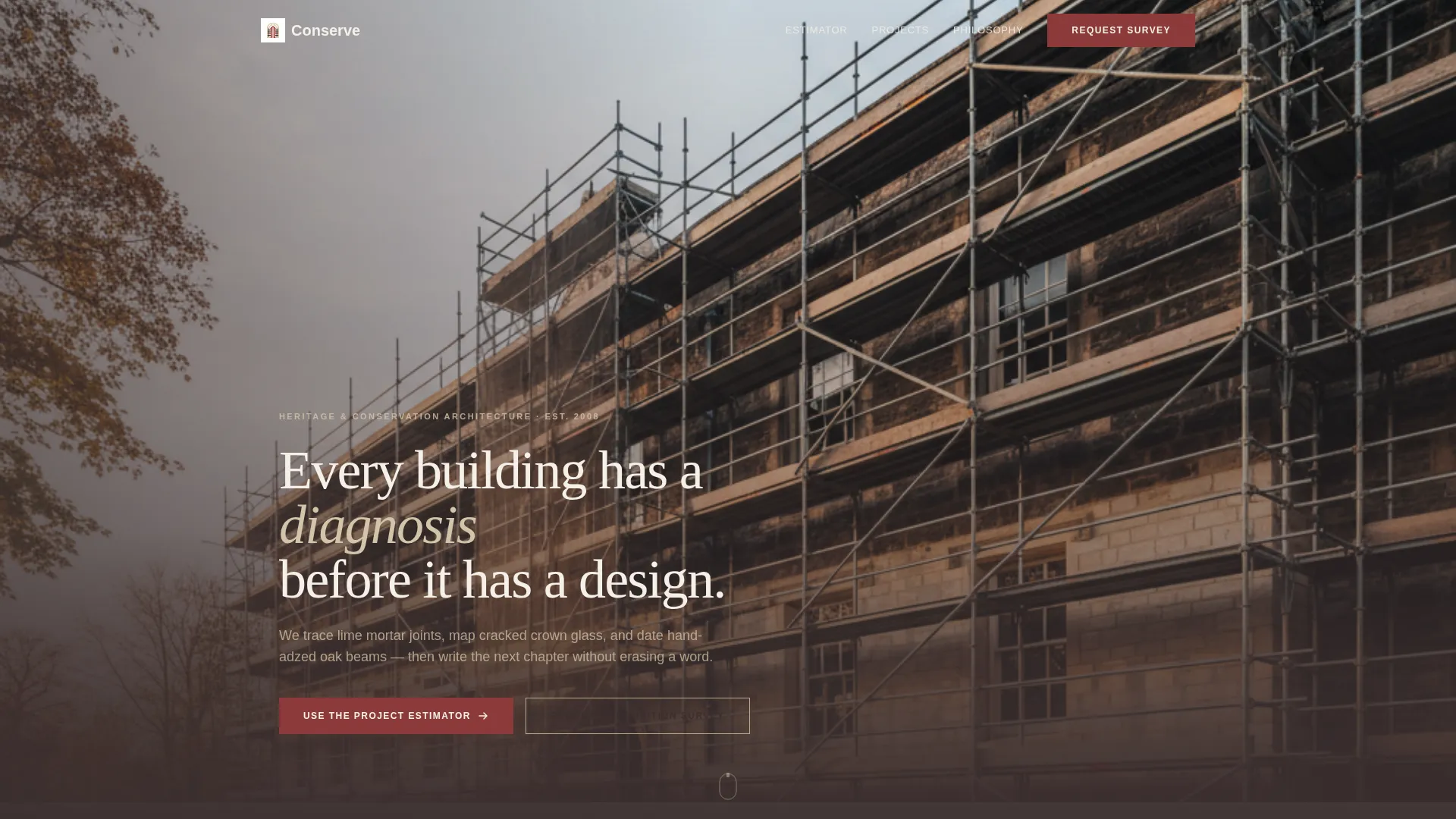
- A full-bleed golden-hour hero section with a single fade-in headline that sets the practice's philosophy immediately
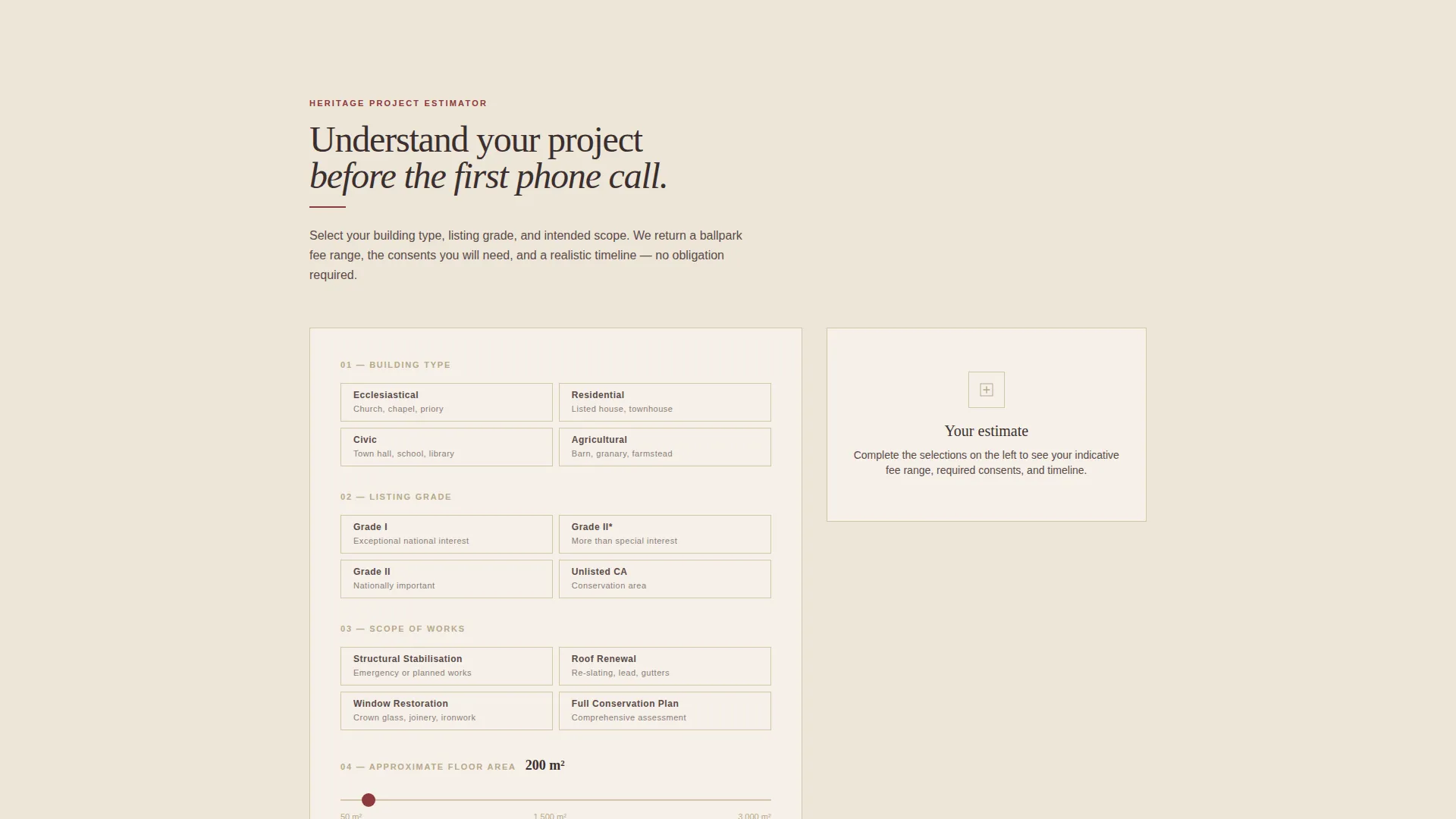
- An interactive Heritage Project Estimator that produces a ballpark fee range, likely consents required, and a typical project timeline based on visitor inputs
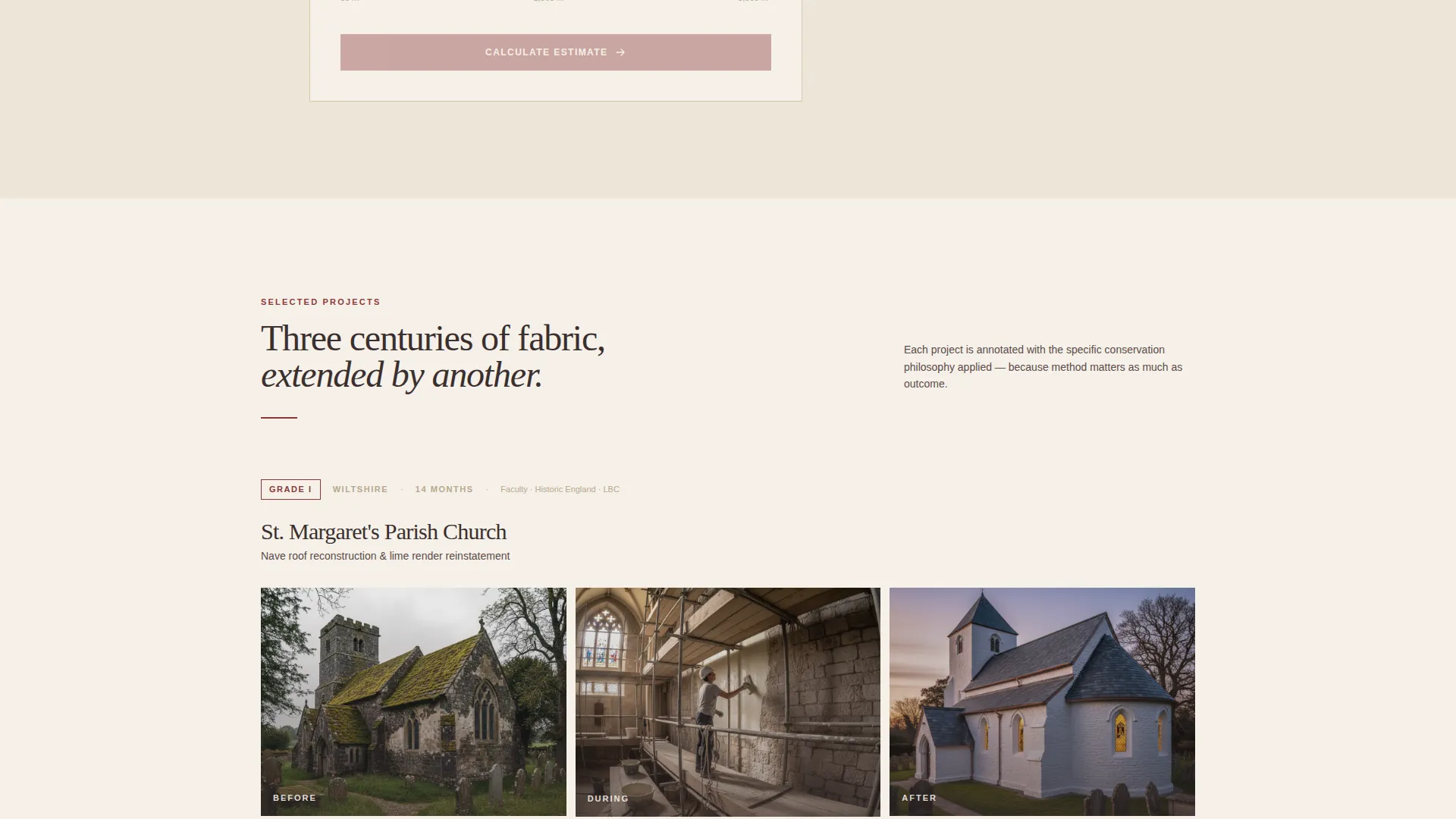
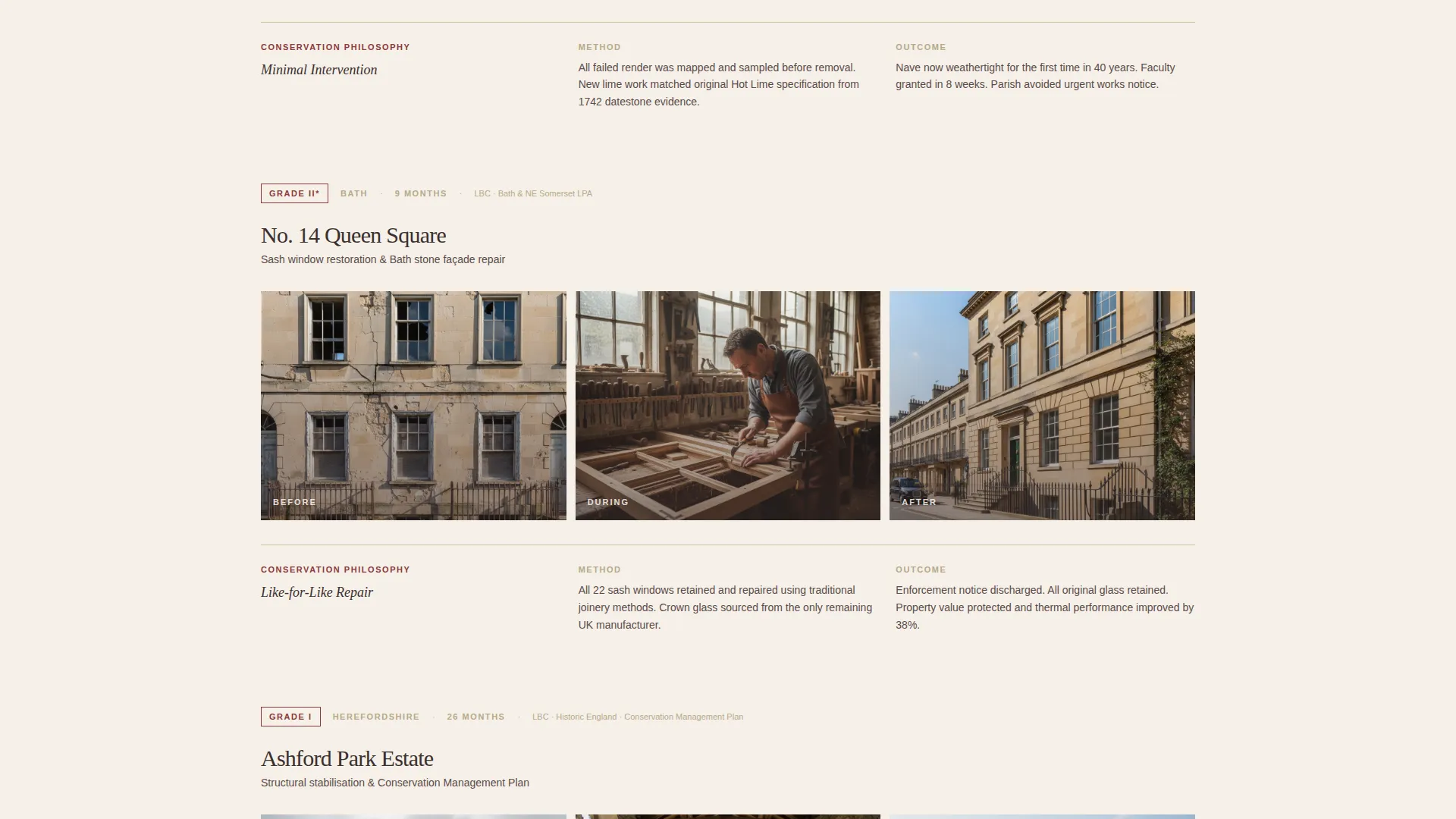
- Before-during-after case study triptychs annotated with specific conservation philosophies, supported by full-width and detail craft photography
- A dual conversion system: a primary "Request a Condition Survey" form and a secondary email-gated guide download for earlier-stage visitors
Feature list
This section covers the core functional and design components built into the template.
Interactive Heritage Project Estimator
Visitors select building type, listing grade, project scope, and approximate square meterage. The tool returns a ballpark fee range, the consents likely required, and a typical project timeline. It does the trust-building work before any sales conversation begins.
Full-Bleed Hero with Fade-In Headline
The header uses a single breathtaking photograph of a partially scaffolded historic building at golden hour. After a held breath of no text, one line fades in: "Every building has a diagnosis before it has a design." The composition frames the scaffold as care, not damage.
Before-During-After Case Study Triptychs
Each case study unfolds as a three-part visual sequence annotated with the specific conservation philosophy applied: minimal intervention, like-for-like repair, or reversibility. Visitors follow the complete arc from diagnosis to completed stewardship.
Dual Conversion Path System
The primary call to action, "Request a Condition Survey", appears after the estimator results and again at the page base. A secondary path offers a downloadable Listed Building Consent guide gated behind an email address, capturing prospects who are not yet ready to commission.
Craft Detail Photography Sections
Full-width landscape photographs alternate with tight close-up shots of conservation craft: hand-thrown lime render, crown glass being fitted, and pegged timber joints. This visual rhythm reinforces the practice's technical depth without a single word of explanation.
Condition Survey Enquiry Form
The contact form captures building address, listing grade (pre-filled when the estimator has been used), a brief description of the concern, and an optional photograph upload for visible damage. Every field is purposeful and low-friction.
Page sections overview
| Section | Purpose |
|---|---|
| Full-Bleed Hero | Sets atmosphere and philosophy with a single fade-in headline |
| Heritage Project Estimator | Delivers personalised scope, fee, and timeline estimates |
| Case Study Triptychs | Shows the full conservation arc across real projects |
| Craft Photography Strips | Demonstrates technical skill through close-up detail imagery |
| Conservation Philosophy Notes | Explains minimal intervention, reversibility, and like-for-like repair |
| Condition Survey Form | Primary lead capture with address, grade, and photo upload |
| Consent Guide Download | Secondary email-gated path for earlier-stage visitors |
Design & branding system
The visual identity follows an Atelier Studio theme built around a Warm Stone colour palette. Every colour choice references the physical materials of conservation work itself, creating an atmosphere that feels deliberate and unhurried.
- Aged Bath limestone (#D4C5A9), deep oak shadow (#3B2F2F), and lime wash white (#F5F0E8) form the primary palette, evoking a conservation workshop where measured drawings sit beside linseed oil tins
- Heritage red oxide (#8B3A3A) is reserved strictly for interactive elements and accent lines, giving calls to action visual authority without disrupting the calm of the surrounding palette
- The split-screen layout and spatial architectural creative direction keep proportions generous, letting photography breathe and typography settle at a reading pace that matches the deliberate nature of the work
Mobile & speed optimization
The template is structured so that its most important conversion tool, the Heritage Project Estimator, is fully usable on a small screen without pinching or horizontal scrolling. The layout reflows cleanly across breakpoints.
- The split-screen sections adapt to a single-column stacked layout on mobile, preserving the visual hierarchy of photograph above annotation text
- The condition survey form, including the optional photo upload field, is designed for thumb-friendly interaction on a phone screen
How this template helps you convert
The page is built around the insight that heritage clients need to understand their situation before they will take action. Conversion is earned through usefulness, not pressure.
- The Heritage Project Estimator captures attention immediately after the hero and creates a personalised result that makes the visitor feel seen; by the time they read their projected timeline, they have mentally begun the project and the "Request a Condition Survey" call to action arrives at exactly the right moment.
- The dual conversion path means no visitor leaves empty-handed: those ready to commission submit a survey request, while those still weighing up the process download the Listed Building Consent guide and leave their email address for a later conversation.
Other information about this template
This template is designed for conservation architecture practices operating in the United Kingdom context, where Listed Building Consent and related planning obligations are central to most project scopes. The content structure reflects how this specific client journey unfolds.
- The template is categorised under Real Estate and Property, Architecture and Design Firm, making it suitable for practices marketing heritage conservation services alongside or instead of new-build work
- The Atelier Studio theme and Warm Stone colour system are matched specifically to the brand expectations of a practice working with historic fabric, distinguishing it clearly from the cooler, more minimal aesthetics common in contemporary architecture marketing
- The page is a single-page landing format, meaning all content is accessible in one continuous scroll without navigation to separate pages
- The estimator input fields cover four building type categories: ecclesiastical, residential, civic, and agricultural, reflecting the range of clients described in the brief including parish councils and estate trusts
Theme
Atelier Studio
Creative direction
Spatial & Architectural
Color system
Warm Stone
Style
Split Screen (50/50)
Direction
Lead Generation
Page Sections
Interactive Heritage Project Estimator
Full-bleed Hero with Fade-in Headline
Before-during-after Case Study Triptychs
Dual Conversion Path System
Craft Detail Photography Sections
Pre-filled Condition Survey Form
Related questions
Can I customise the estimator inputs for my specific project types?
Does the template include the Listed Building Consent guide content?
Is this template suitable if I work only with residential listed buildings?
Can I add more case study triptychs beyond the default layout?
What listing grade options are included in the estimator by default?