Engineers Accountability Group Landing Page Template
Commit is a masonry-style landing page template built for a private weekly accountability circle where engineers and developers publicly declare what they will ship. Designed with a Desert Rose color palette and a full-screen video hero, it drives a single conversion goal: getting stuck engineers to click through and claim their seat in the group.
by Rocket studio
Quick summary
Commit is a single-page landing page template designed for an engineers and developers accountability group. It uses a masonry testimonial wall, a full-screen video hero with a typewriter terminal animation, and a persistent floating call-to-action button to move visitors toward one outcome: clicking through to apply for membership. The Desert Rose color system keeps the design raw, warm, and intentionally anti-corporate.
Who this template is for
This template is built for founders, community organizers, and engineering leads who run or plan to run a structured accountability group for technical builders. It speaks directly to the people who would join such a group, which means the design and copy serve a technically literate, self-aware audience. Engineering managers looking to support side-project momentum, indie hackers tired of stalling, and staff engineers whose personal projects stall quietly will all recognize themselves in this page.
If you are building a community product around accountability in software engineering, this template gives you a ready-made conversion surface. It is opinionated, focused, and built to filter in motivated applicants while filtering out passive observers.
- Senior backend developers, indie hackers, and staff engineers with stalled side projects
- Community builders and engineering managers launching a structured weekly accountability program
- Tech leads and product managers who want a dedicated landing page for an accountability cohort or peer group
What problem this template solves
Most accountability communities fail at the landing page stage. They either look too generic to earn trust from a skeptical engineering audience, or they try to explain too much and lose the visitor before the call-to-action lands. Engineers are busy, and they have seen enough corporate project management tool dashboards to be immediately suspicious of anything that feels like another status tracker dressed up as a community.
This template solves the credibility and conversion problem in one move. The full-screen video hero, the typewriter terminal message, and the emotional progression of the masonry testimonial wall do the heavy lifting. Visitors do not need to read a wall of marketing text. They feel the point before they finish scrolling.
- Converts a skeptical engineering audience without relying on generic feature lists or inflated promises
- Guides visitors through an emotional arc from quiet frustration to breakthrough momentum, making the application click feel inevitable
- Removes friction from the conversion path by eliminating on-page forms and routing serious applicants directly to a short membership application
What you get with this template
This template delivers a complete, opinionated landing page structure with every section pre-built and every interaction considered. You are not starting from a blank canvas. You are starting from a page that already knows its audience, already has a visual hierarchy, and already has a plan for how to move a hesitant engineer toward the call-to-action.
The template includes pre-designed sections that map directly to the emotional journey of a stuck engineer visiting for the first time. It also includes clear documentation of the color system, type hierarchy, and animation intent so that customizing the template does not require re-designing from scratch.
- A full-screen video hero section with typewriter terminal animation and subtitle fade-in
- A scrollable masonry testimonial wall with staggered cards organized by emotional escalation
- A persistent floating call-to-action button, a How It Works section, a social pressure proof section, and a footer in a horizontal flow layout
Feature list
This section covers the core capabilities built into the Commit template. Every feature listed here is drawn directly from the template brief and reflects what the design actually delivers.
Full-Screen Video Hero with Typewriter Animation
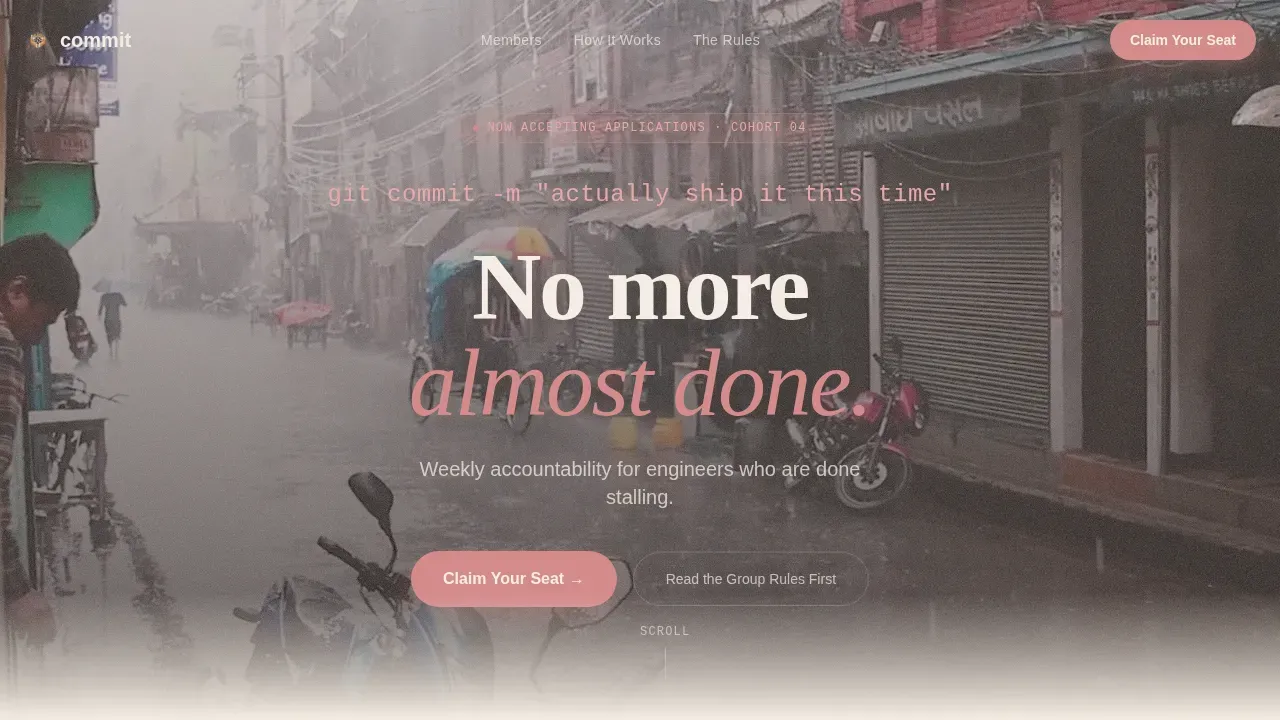
The hero section opens with a slow aerial drone video of cracked desert terrain at golden hour. After four seconds, a monospaced terminal line types itself onto the screen: git commit -m "actually ship it this time". A subtitle fades in beneath it. This sequence sets the tone immediately and gives the engineering audience a clear signal that this page was built for them, not for a generic project management audience. The video includes a poster fallback for environments where autoplay is unavailable.
Masonry Testimonial Wall
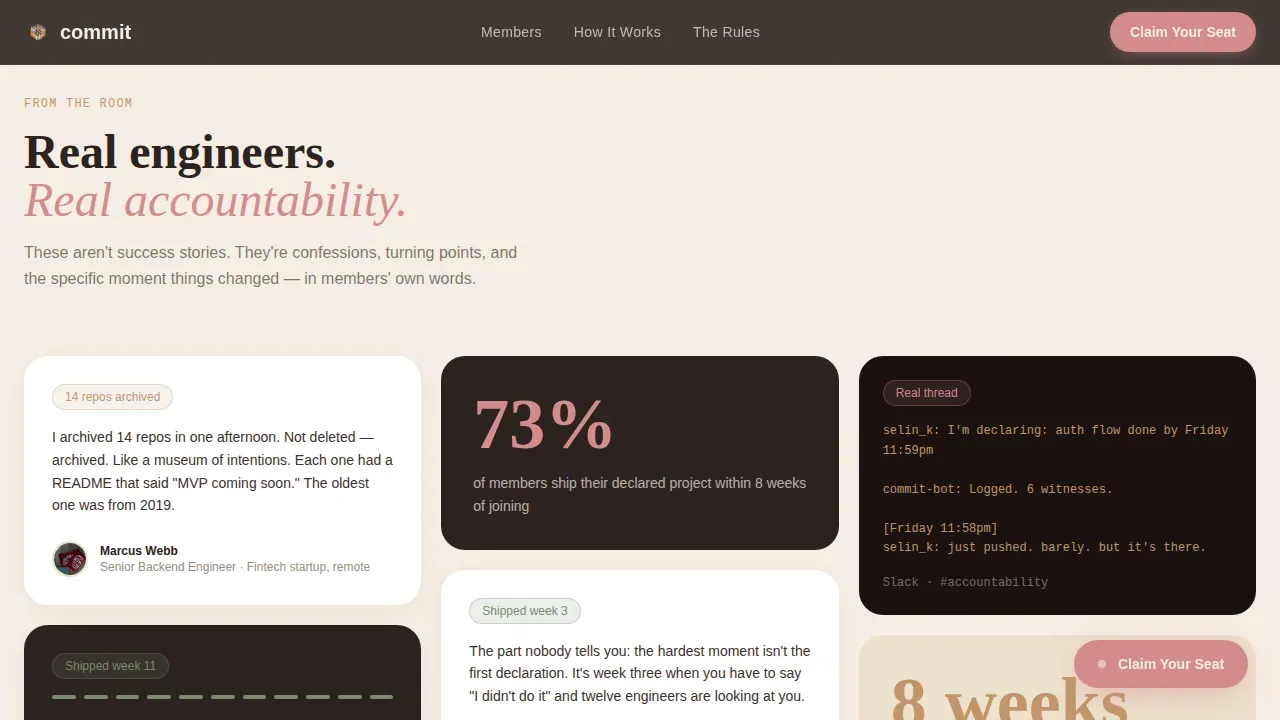
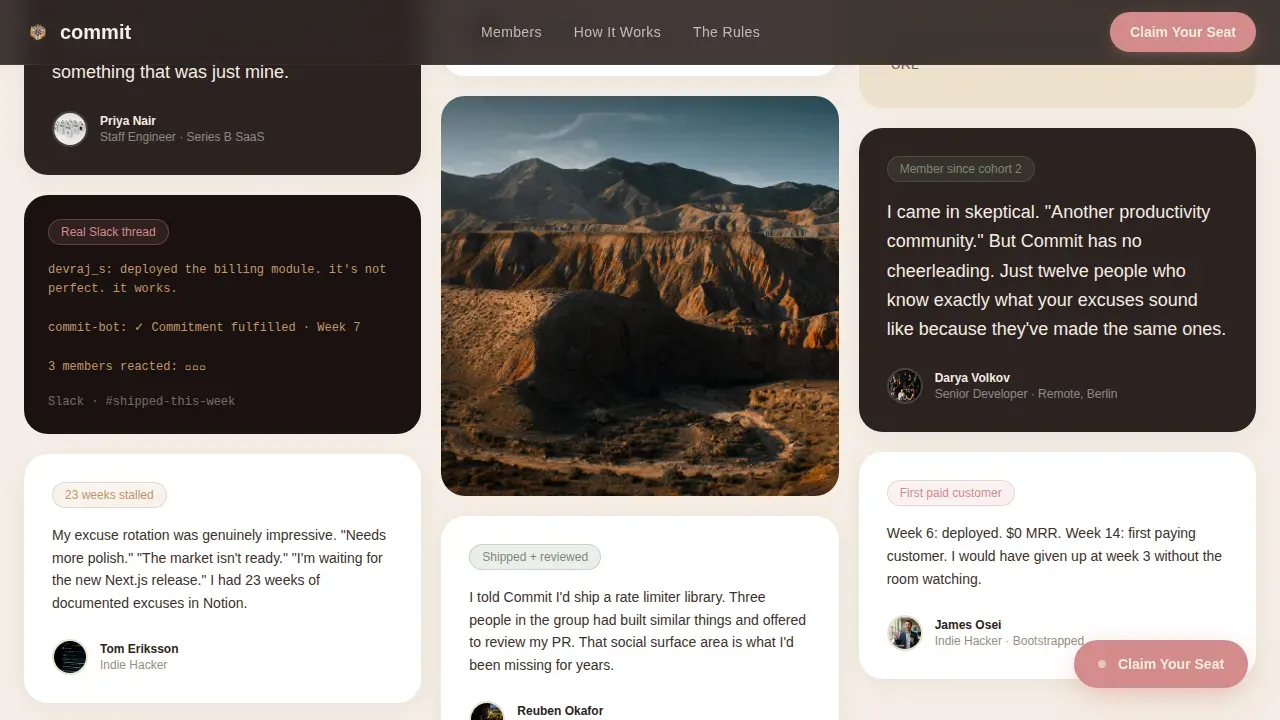
The core of the page is a living wall of staggered masonry cards, each one a real member story told in a distinct format. Cards vary in size and content type: short written confessions, Slack screenshot cards, and short vertical video testimonials. The grid is organized by emotional escalation, moving from quiet frustration at the top to breakthrough momentum at the bottom. This means the scroll itself functions as persuasion, not just navigation.
Persistent Floating Call-to-Action Button
After the first scroll depth, a bloom pink floating button labeled "Claim Your Seat" appears and stays visible throughout the rest of the page. This ensures the primary conversion action is always one click away, regardless of where the visitor is in the scroll. The button links off-page to a short membership application asking for a GitHub profile, a current stuck project, and one sentence on why the applicant stalled.
How It Works Section with Asymmetric Layout
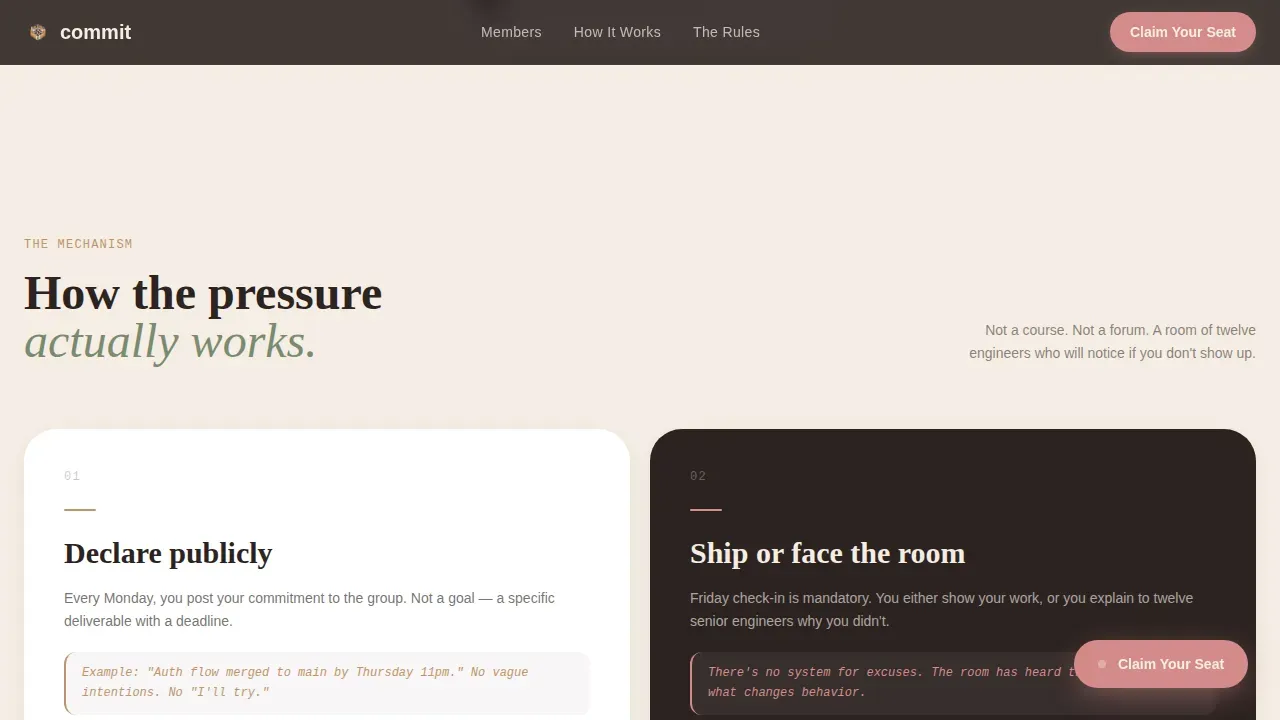
Rather than a standard numbered list, this section uses an asymmetric layout to present the commitment mechanics. The workflow follows a clear structure: commit on Monday, track progress on Wednesday, and demo on Friday. This Define, Review, Demo flow gives potential members a concrete picture of what participation looks like week to week without overwhelming them with process detail.
Social Pressure Proof Section
The Reckoning section makes the social consequences of not shipping explicit. This is intentional and important. For an accountability group, the mechanism of social pressure is the core value proposition. The section surfaces what happens when a team member does not deliver on their public commitment, making the stakes clear to anyone considering joining. This transparency builds trust with the right audience and filters out anyone looking for a passive community.
Secondary Path to Group Rules
A secondary call-to-action links visitors to a manifesto-style page describing the group rules. This path exists to address a specific user need: some engineers want to understand the culture and expectations before applying. The secondary path respects that need while also functioning as a filter, separating applicants who want active pressure from those looking for a low-stakes forum.
Page sections overview
| Section | Purpose |
|---|---|
| Full-Screen Video Hero | Opens with drone footage and typewriter terminal animation to establish tone and trust immediately |
| Masonry Testimonial Wall | Displays real member stories as staggered cards, escalating emotionally from frustration to breakthrough |
| How It Works | Explains the weekly commitment mechanics using an asymmetric layout instead of a generic numbered list |
| The Reckoning | Shows what happens when a commitment is missed, making the social accountability mechanism explicit |
| Claim Your Seat call to action | Persistent floating button and dedicated call-to-action section routing visitors to the membership application |
| Footer | Horizontal flow layout providing secondary navigation and the Group Rules link |
Design & branding system
The Commit template uses a Desert Rose color system that feels like a desert garden after rare rain: warm, exposed, and alive in unexpected places. The palette is intentionally anti-corporate. Every color choice reinforces the idea that this is a community built on honesty and exposure, not polished dashboards and status theater.
Typography is split across three typefaces, each assigned a specific role. JetBrains Mono carries all terminal and code elements, including the hero typewriter animation. DM Sans handles body copy for readability at scale. Fraunces brings editorial weight to section headings, giving the page a feeling of considered craft rather than template-default text.
- Desert Rose palette: bleached sky (#F5EDE3) as the dominant background, sandstone (#C2956B) and cracked earth charcoal (#2C2321) anchoring masonry cards, bloom pink (#D48B8B) for active states and hover interactions, and sage brush (#7A8B6F) marking completed commitments
- Type system: JetBrains Mono for terminal elements, DM Sans for body, Fraunces for editorial headings
- Animation intent: typewriter effect on the hero, scroll-reveal masonry card entries, parallax on the video background, and hover states on all testimonial cards
Mobile & speed optimization
The template is designed desktop-first, which reflects the reality of how the primary audience, engineers on laptops, will encounter the page. The masonry grid, the full-screen video hero, and the floating call-to-action button are all tuned for a large-screen experience. Mobile fallback is included and functional, ensuring the page remains usable for visitors arriving on smaller screens without sacrificing the core conversion flow.
The video hero uses a poster image fallback so that the above-the-fold experience remains visually complete even when the video cannot autoplay. Images in the masonry grid are lazy-loaded. Scroll-reveal animations use IntersectionObserver to trigger card entries only when they enter the viewport, keeping the initial page load clean and the interaction layer responsive.
- Desktop-first masonry grid with a solid mobile fallback that preserves the testimonial wall and floating call-to-action
- Lazy-loaded masonry images and IntersectionObserver-driven scroll-reveal animations for card entries
- Video hero with poster fallback to maintain a complete above-the-fold visual even when autoplay is restricted
How this template helps you convert
The Commit template is built around a single conversion goal: getting the right engineer to click "Claim Your Seat" and submit a membership application. Every design decision on the page serves that goal. The emotional arc of the masonry wall, the specificity of the terminal hero, and the secondary Group Rules path all work together to create a page that qualifies and converts simultaneously.
Progress visibility is central to the template's persuasive logic. When visitors can see real member progress, read confessions from engineers who faced the same stalling challenges, and understand the clear expectations of participation, they can make an informed decision quickly. The page does not try to convince everyone. It tries to make the right person feel immediately seen.
- The full-screen video hero and typewriter animation establish credibility and tone within seconds, qualifying the right audience before they read a single word of body copy
- The masonry testimonial wall builds trust through social proof organized by emotional escalation, moving the visitor from recognition to motivation as they scroll
- The persistent floating call-to-action button ensures the conversion action is always available and always visible, reducing the distance between intent and click to a single tap
Other information about this template
The Commit template sits at the intersection of several overlapping needs in the software engineering community. Beyond the immediate accountability group use case, the template structure and content architecture reflect a broader set of principles around how engineering teams communicate progress, manage commitments, and create cultures of shipping.
The core commitment workflow built into the How It Works section, Commit on Monday, track on Wednesday, demo on Friday, mirrors best practices that product managers and engineering managers use in structured sprint environments. This gives the template relevance not just for indie accountability circles but also for internal team programs at tech companies looking to improve productivity and make engineering work more visible across the organization.
Weekly reports and status updates are a recurring pain point for most companies. Engineering managers often face the challenge of keeping the whole team aligned without turning every week into a series of status meetings that drain focus. The Commit template's design philosophy, making commitments public and consequences real, addresses that pain point in a direct and honest way. It creates a rhythm that keeps team members on the same page without relying on recurring meetings or automated workflows that nobody reads.
The template also speaks to the challenges of maintaining alignment between engineering work and business goals. Most projects drift not because engineers are lazy but because there is no social mechanism to surface potential roadblocks before they become blockers. Public commitment changes that. When a developer declares their goal in front of the whole team, potential roadblocks become visible early. Engineering managers and product managers can intervene before a stalled project turns into a missed deadline.
For teams at big tech companies and for small teams bootstrapping their first product, the structure is the same: make project status visible, create clear expectations, and assign responsibilities in a way that everyone can see and hold each other to. The template reflects that philosophy in every section. The Reckoning section in particular makes it clear that there is no such thing as a commitment without consequences in this circle.
The template also supports use cases where clear documentation of engineering work is important to stakeholders outside the immediate engineering team. Product managers, tech leads, and even customers who are waiting on deliverables benefit when project progress is tracked in a format that creates clear next steps and key achievements that the whole team can reference. This template can support that kind of visibility by giving the accountability group a public-facing presence that reinforces the group's commitment culture to anyone who visits the page.
For engineering managers at companies of any team size, the template provides a ready-made surface for launching an internal or external accountability program. It is designed to work for small teams of four or five engineers as well as larger cohorts. The project size does not change the core mechanics. The commitment is still public, the review still happens weekly, and the outcome is still a shipped project or a visible reason why it did not ship.
New engineers joining a team often struggle to find their footing on the org chart of accountability. They are unsure how to surface blockers, how to make their work visible, or how to talk about project status with engineering managers and product managers without it feeling like a performance review. The Commit template's design philosophy gives new hires a clear framework: commit publicly, track honestly, and demo what you built. That structure gives new engineers a safe and clear way to participate in a culture of continuous improvement from day one.
For indie hackers and solopreneurs who are building software toward product market fit, the social pressure of a structured accountability circle often makes the difference between an idea that ships and an idea that dies in a git repository. The template reflects that reality. It does not pretend that building software in isolation is easy or that motivation alone is enough. It offers social consequence as the missing ingredient. The design, the copy, and the conversion flow all reinforce that message.
- The template is a single landing page, not a multi-page website, and routes all conversion traffic to an off-page membership application
- It is designed for community builders, engineering managers, and tech leads launching accountability programs in any context, from big tech internal cohorts to indie developer circles
- The Desert Rose color system and editorial typography make this template visually distinctive in a category where most pages rely on flat design and corporate blue palettes
- The secondary Group Rules path is a built-in qualifier that filters applicants by intent before they reach the application, reducing low-quality submissions and keeping the community standards high
- The template can be adapted for weekly reports, status updates, and team commitment tracking use cases beyond the original accountability group context, as long as the core masonry and floating call-to-action structure is preserved
Theme
Nature-Inspired
Creative direction
Testimonial Mosaic
Color system
Desert Rose
Style
Masonry/Pinterest
Direction
Click-Through
Page Sections
Full-screen Video Hero with Terminal Typewriter
Emotional Escalation Masonry Testimonial Wall
Persistent Floating Bloom Pink Call to Action Button
Asymmetric How It Works Section
Social Pressure Proof Section
Secondary Group Rules Filter Path
Related questions
Who is the primary audience for this template?
Does the landing page include a sign-up form?
Can the masonry testimonial wall be customized with real member stories?
What weekly commitment workflow does this template support?
Is this template suitable for internal team accountability programs?