SaaS Consulting Professional Website Template
Comply is a single-column landing page template built for SaaS sustainability consultancies. It uses a Legal Shield visual identity, a structured scroll flow alternating consultant profiles with case-study cards, and three precisely placed calls to action that route visitors to a dedicated scheduling page. The design builds authority through credentials, specificity, and stillness rather than motion or flash.
by Rocket studio
Quick summary
Comply is a high-authority landing page template designed for SaaS compliance consultancies navigating ESG reporting mandates, carbon disclosure laws, and greenwashing litigation. The single-column scroll flow pairs senior consultant profiles with anonymized case-study cards, building trust through accumulated evidence. Three frictionless calls to action route visitors to a scheduling page without any on-page form fields.
Who this template is for
This template is built for consultancies that sell expertise, not software. It suits professionals who need a page that feels earned rather than assembled.
- Sustainability consultancies advising mid-market SaaS firms on Scope 3 emissions and carbon disclosure obligations
- Independent compliance practices led by former auditors, policy drafters, or cloud infrastructure specialists
- Boutique advisory teams preparing clients for ESG reporting mandates and board-level sustainability frameworks
What problem this template solves
Many consultancy pages look like product pages. They lead with features, hide the people, and offer no proof before asking for a meeting. That mismatch costs trust immediately with a VP-level buyer.
- Compliance buyers need to see credentials and case outcomes before they will consider booking a call
- A generic template cannot communicate the difference between a dashboard tool and a team of senior advisors
- Without a structured scroll rhythm, the accumulated weight of expertise never lands with the right force
What you get with this template
You get a complete, single-column landing page layout designed to convert authority-driven professional service buyers. Every section is deliberately sequenced to build the argument before the ask.
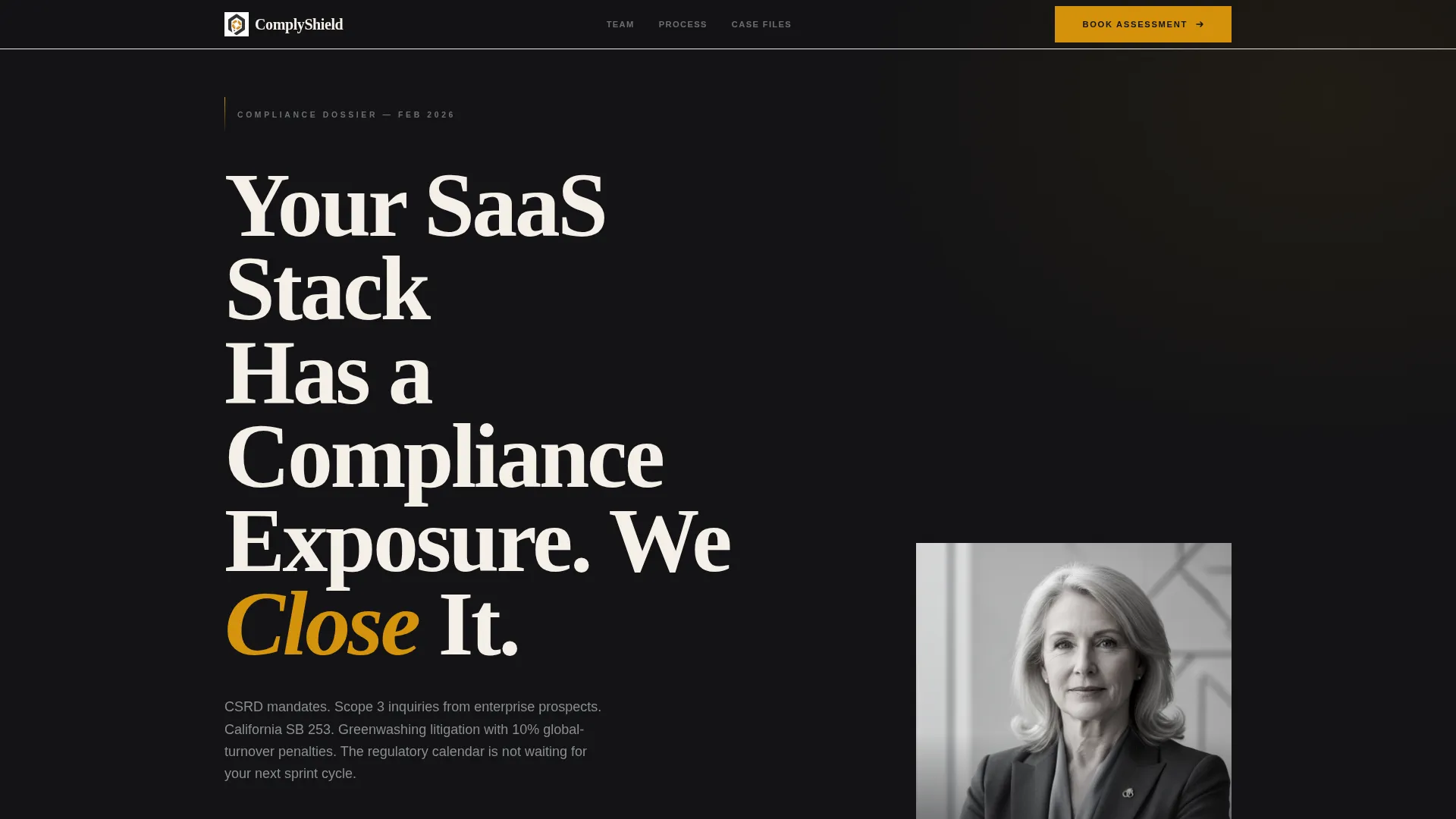
- A giant flush-left headline section with a portrait placement and an amber-highlighted keyword for instant positioning
- An alternating scroll flow of consultant profile cards and anonymized case-study evidence blocks
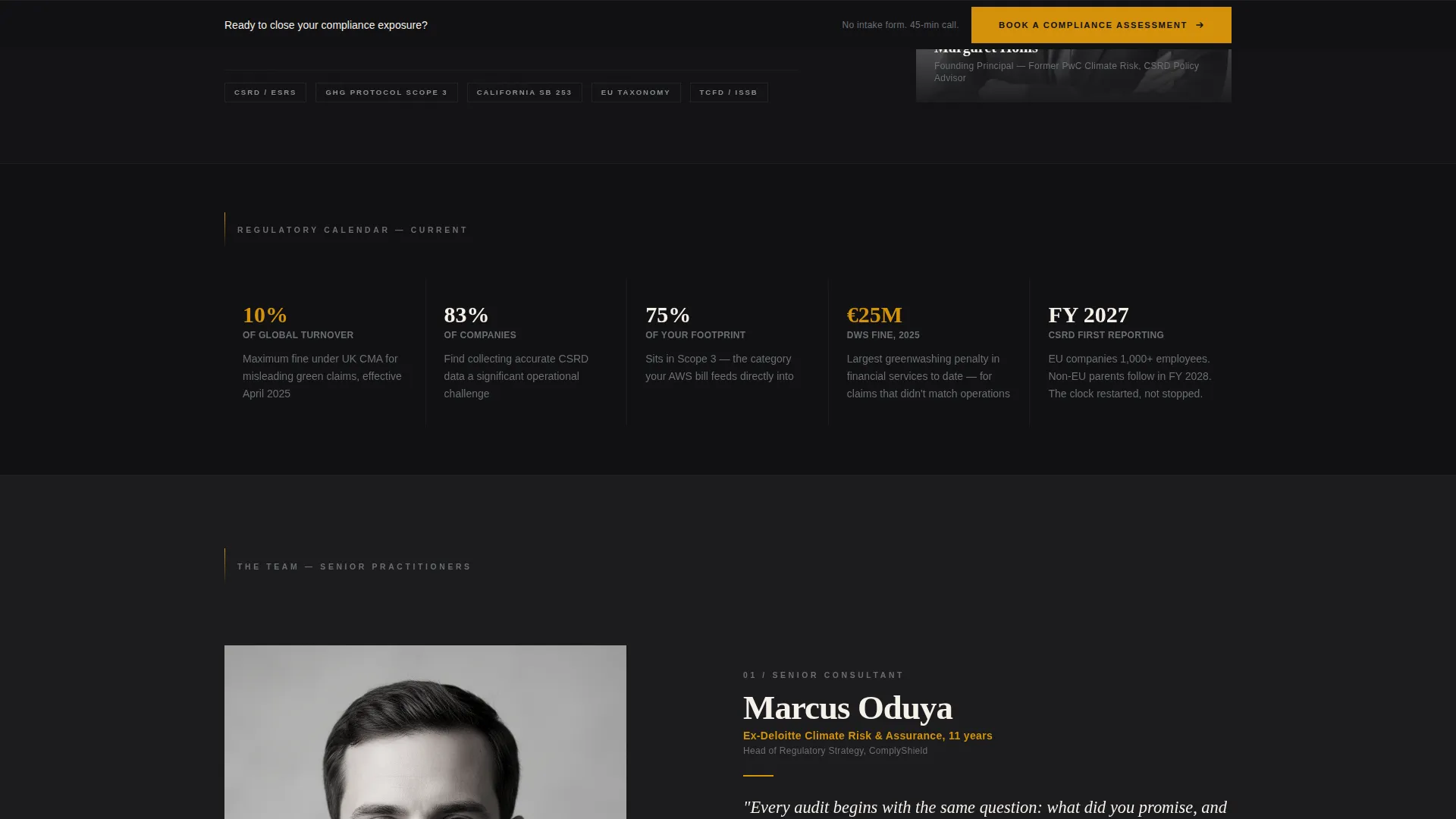
- Three strategically placed calls to action, including a persistent bottom bar that activates after 60 percent scroll depth
Feature list
This template is built around a small number of high-impact structural decisions. Each one is described below.
Giant Headline with Portrait Layout
The header pairs enormous, serifed flush-left type with a still portrait of the founding principal on the right. The headline reads "Your SaaS Stack Has a Compliance Exposure. We Close It." with the word "Close" rendered in amber. No animation. The confidence is communicated through stillness and proportion.
Alternating Consultant and Case Study Scroll Flow
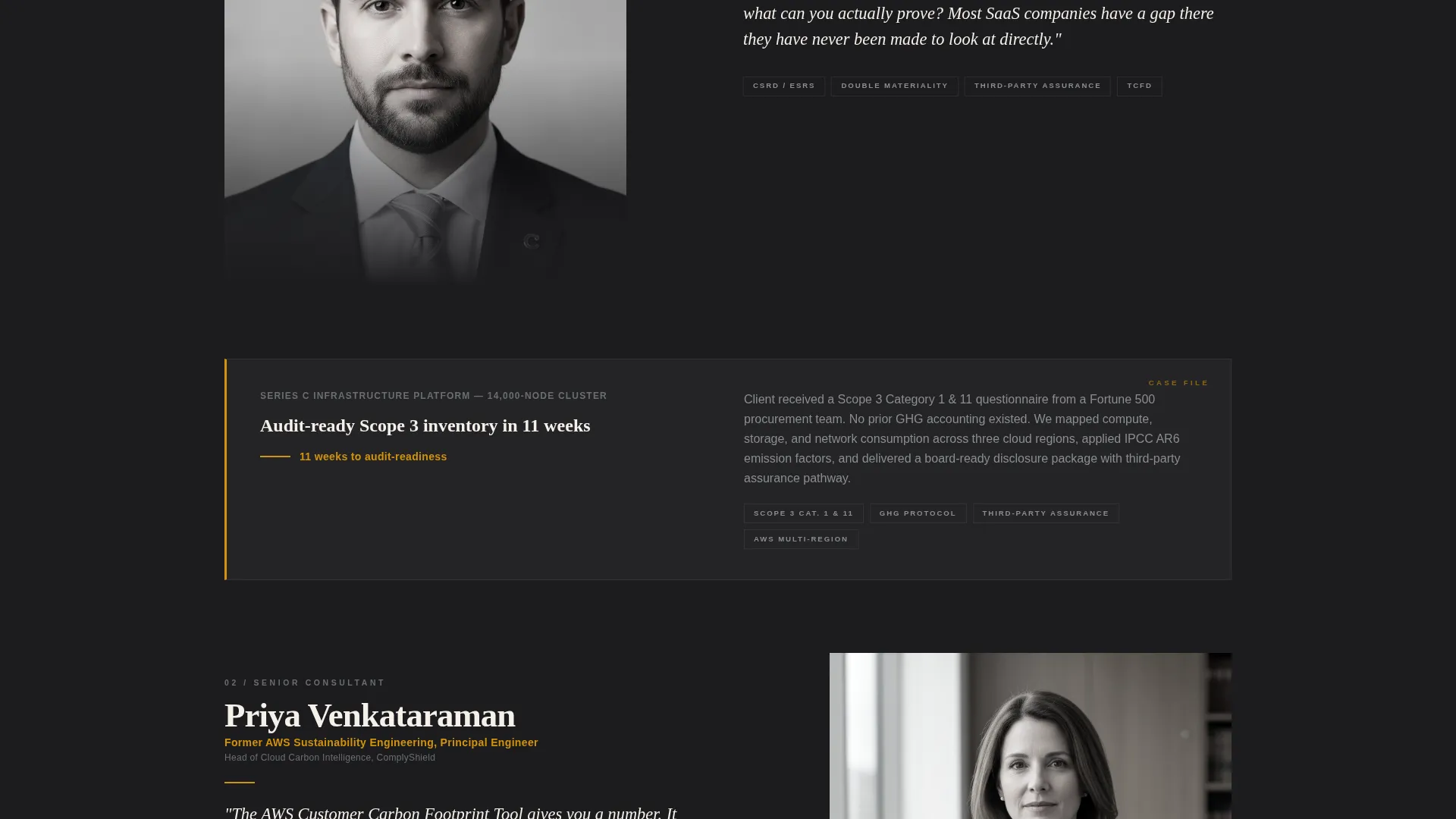
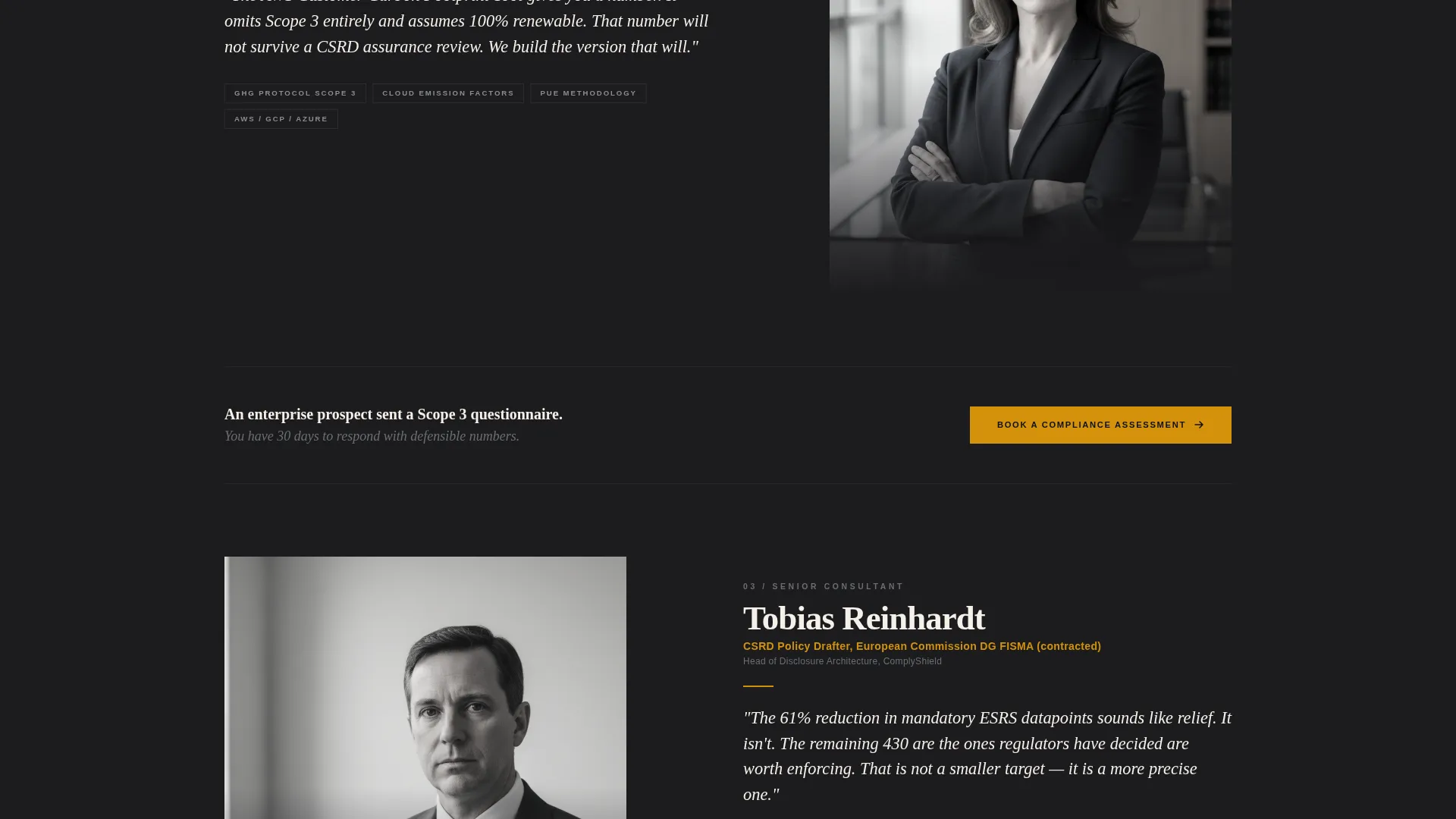
As the visitor scrolls, senior consultants are introduced one by one. Each profile includes a name, a former role such as ex-Big Four auditor or former AWS sustainability engineer, and a single sentence of compliance philosophy in their own voice. Between portraits, short case-study cards appear with anonymized but specific outcomes.
Three-Point Call to Action Placement
The primary call to action, "Book a Compliance Assessment," appears first beneath the header, again after the third consultant profile, and finally as a persistent bottom bar triggered at 60 percent scroll depth. Each instance routes to a dedicated scheduling page. There are no form fields on the landing page itself.
Legal Shield Color System
The palette is built around deep litigation charcoal as the primary background, warm amber for calls to action and pull-quotes, deposition paper tones for content blocks, and steel clause gray for body text. Amber is used sparingly, appearing on no more than two elements per viewport, so it always reads as a signal rather than a decorative choice.
Serifed Authority Typography
The template uses large serifed type for headlines to reinforce the legal and advisory tone. This typographic choice distinguishes the page from SaaS product templates that default to geometric sans-serif. The visual language says senior partner, not startup founder.
Case Study Evidence Cards
Between consultant profiles, short anonymized case-study cards provide specific proof. Details like "Series C infrastructure platform, 14,000-node cluster, audit-ready in 11 weeks" ground the consultancy's claims in real outcomes. These cards carry the evidentiary weight that moves a skeptical compliance buyer toward booking.
Page sections overview
| Section | Purpose |
|---|---|
| Header Headline Block | Positions the consultancy and frames the core compliance exposure problem |
| Founding Principal Portrait | Establishes immediate human authority and practitioner credibility |
| First call to action Placement | Captures early-intent visitors before the scroll narrative begins |
| Consultant Profile One | Introduces the first senior advisor with role history and philosophy |
| Case Study Card One | Delivers anonymized proof of outcome after the first profile |
| Consultant Profile Two | Deepens the team's expertise with a second advisor introduction |
| Case Study Card Two | Adds a second evidence point between human faces |
| Consultant Profile Three | Completes the core team introduction sequence |
| Second call to action Placement | Re-engages visitors who have absorbed three profiles of expertise |
| Additional Team Profiles | Extends the scroll narrative for consultancies with larger teams |
| Persistent Bottom Bar | Activates at 60 percent scroll depth as a low-friction booking prompt |
Design & branding system
The visual identity follows a Legal Shield theme. Every color and typographic decision reinforces the after-hours law office atmosphere described in the brief.
- Deep litigation charcoal (#1C1C1E) covers the primary background; warm briefcase leather amber (#D4920B) is reserved for calls to action and pull-quotes; deposition paper (#F5F0E8) backgrounds content blocks; steel clause gray (#6B6E73) carries body text
- Amber is restricted to no more than two visible elements per viewport at any time, preserving its role as a deliberate signal rather than a decorative wash
- Serifed headline type and still, desaturated portrait photography work together to project the weight and authority of a senior advisory practice
Mobile & speed optimization
The single-column layout adapts naturally to smaller screens. The scroll-based narrative structure works well on mobile because it mirrors the way people naturally consume long-form content on a phone.
- The alternating profile-and-case-study rhythm remains intact on mobile without requiring horizontal scrolling or grid collapse adjustments
- The persistent bottom bar call to action is positioned to remain accessible on touch screens without obscuring the primary content area
- Still portrait photography with no animation reduces visual complexity and keeps load behavior predictable across connection speeds
How this template helps you convert
This template converts by replacing the typical "contact us" page dynamic with a structured argument. The visitor does not need to be persuaded to act; they need to feel certain before they click.
- The scroll sequence earns trust incrementally, so by the third consultant profile the buyer's question has shifted from "Do I need this?" to "Can they fit us in?"
- Three non-intrusive call to action placements catch visitors at different stages of conviction without using pop-ups, countdown timers, or pressure tactics
- Routing directly to a scheduling page removes the friction of a multi-field inquiry form and keeps the premium, high-trust positioning consistent through the conversion moment
Other information about this template
This template is designed to work for a consultancy operating in the SaaS compliance and ESG advisory space. It reflects the specific buyer psychology of VP-level compliance officers and sustainability leads who are evaluating a firm, not a product.
- The page type is a click-through landing page. The conversion goal is a single action: booking an assessment via an external scheduling page
- The template style follows a single-column flow with a Legal Shield theme, using the Charcoal and Amber color system described in the design brief
- The creative direction is Team and People. The template is built around the argument that expertise is embodied in individuals, not platforms
- This template is well-suited for a SaaS compliance consultant, ESG advisory firm, or sustainability reporting practice that needs to present a senior team and a track record before asking for a meeting
Theme
Legal Shield
Creative direction
Case Study Narrative
Color system
Plum Executive
Style
Split Screen (50/50)
Direction
Booking/Scheduling
Page Sections
Giant Headline with Portrait Layout
Alternating Consultant and Case Study Scroll
Three-point Call to Action Placement Strategy
Legal Shield Color System
Serifed Authority Typography
Anonymized Case Study Evidence Cards
Related questions
Is there a contact form on this landing page?
Can I add more consultant profiles beyond the default layout?
Does the amber color appear throughout the whole page?
Is this template suitable for a solo compliance practitioner?
What makes the case study cards effective for compliance buyers?