Renewables Cable & Connector Landing Page Template
Conduit is a dashboard-style landing page template built for cable and connector manufacturers supplying the renewable energy sector. It opens with a live metrics header showcasing real specification data, then guides procurement managers and project engineers through product category bays, technical diagrams, and a gated spec library download, all wrapped in a command-center navy visual system.
by Rocket studio
Quick summary
Conduit is a precision-engineered landing page template for renewable energy cable and connector suppliers. It leads with hard specification data, 48,000-plus SKUs, 1,500V DC max rated voltage, IP68/IP69K ingress protection, and 142 countries shipped, then walks visitors through product categories, cross-section diagrams, and a gated full spec library. Every section earns the next click.
Who this template is for
This template is built for manufacturers and industrial suppliers operating in the renewable energy components space. It speaks directly to the technical buyers who evaluate products by spec sheets, not marketing copy.
- Procurement managers at engineering, procurement, and construction (EPC) firms who need voltage ratings and certifications at a glance
- Renewable energy project engineers specifying cable runs for solar, wind, storage, or electric vehicle infrastructure projects
- Operations and maintenance directors sourcing replacement connectors for offshore or remote installations on tight schedules
What problem this template solves
Technical buyers distrust landing pages that lead with lifestyle photography and vague claims. They arrive with a specific voltage rating, temperature tolerance, or ingress protection class in mind. A page that buries specification data behind brochure copy loses them in seconds.
- Product data is hidden or requires multiple clicks to find, slowing down cross-referencing under time pressure
- Generic supplier pages fail to signal the depth and reliability of an industrial-grade catalog
- Conversion paths are either too aggressive or entirely absent for buyers who need to verify before they commit
What you get with this template
You get a full single-page layout structured like a technical field case: every component is labeled, ordered, and immediately accessible. The template combines a data-grid header, product category modules, scroll-triggered cross-section diagrams, and a two-path conversion system in one cohesive build.
- A full-width stats header displaying real specification metrics inside individual amber-accented cards
- Four product category bays (Solar Cables, Wind Harnesses, Storage Connectors, EV Infrastructure) rendered as data-grid modules with visible ratings and certification icons
- A gated "Download Full Spec Library" form and ungated per-product "Get PDF" buttons for progressive lead capture
Feature list
This template ships with six core functional components, each designed to serve a specific role in the buyer journey from first impression to conversion.
Live Stats Metrics Header
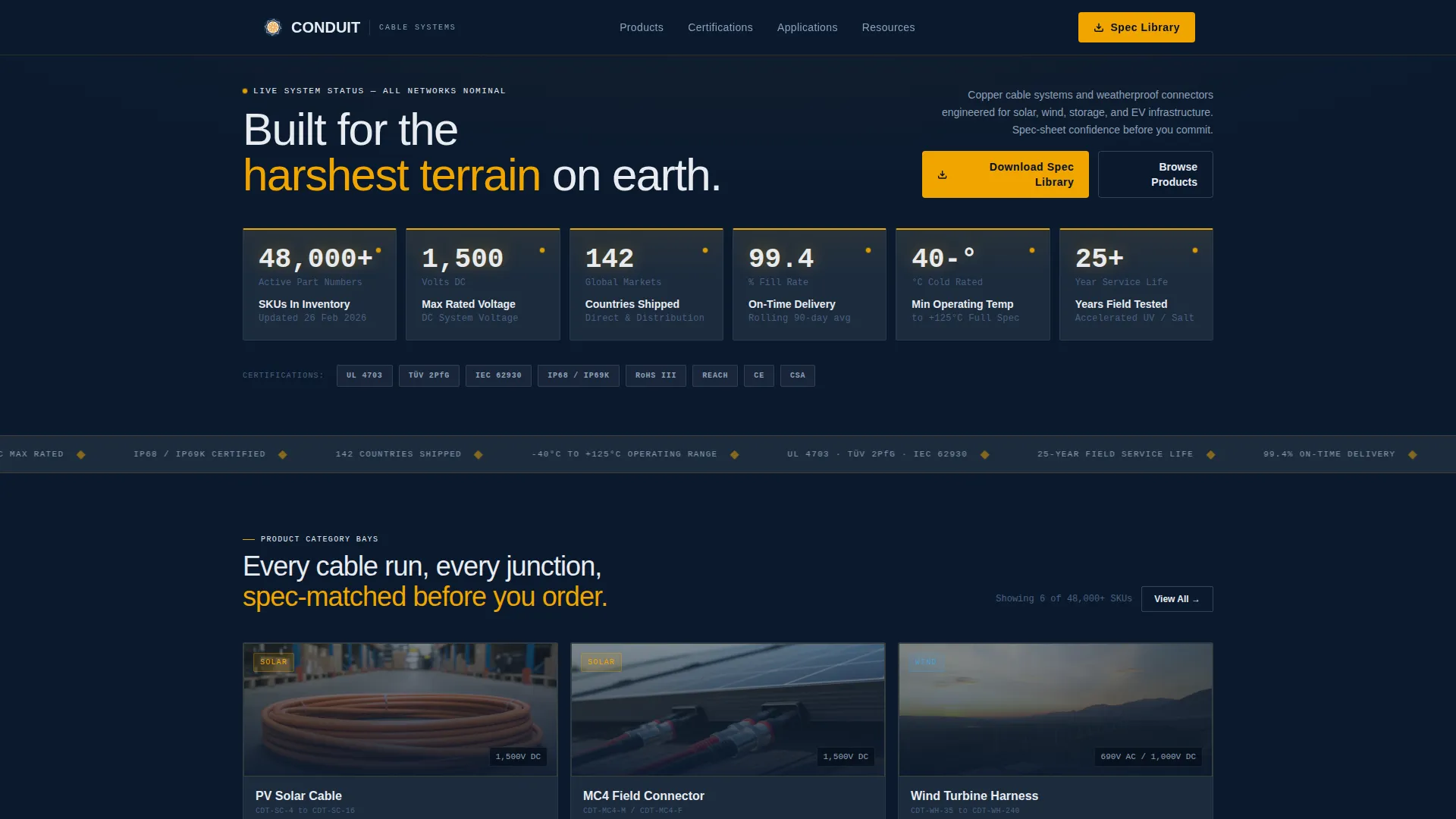
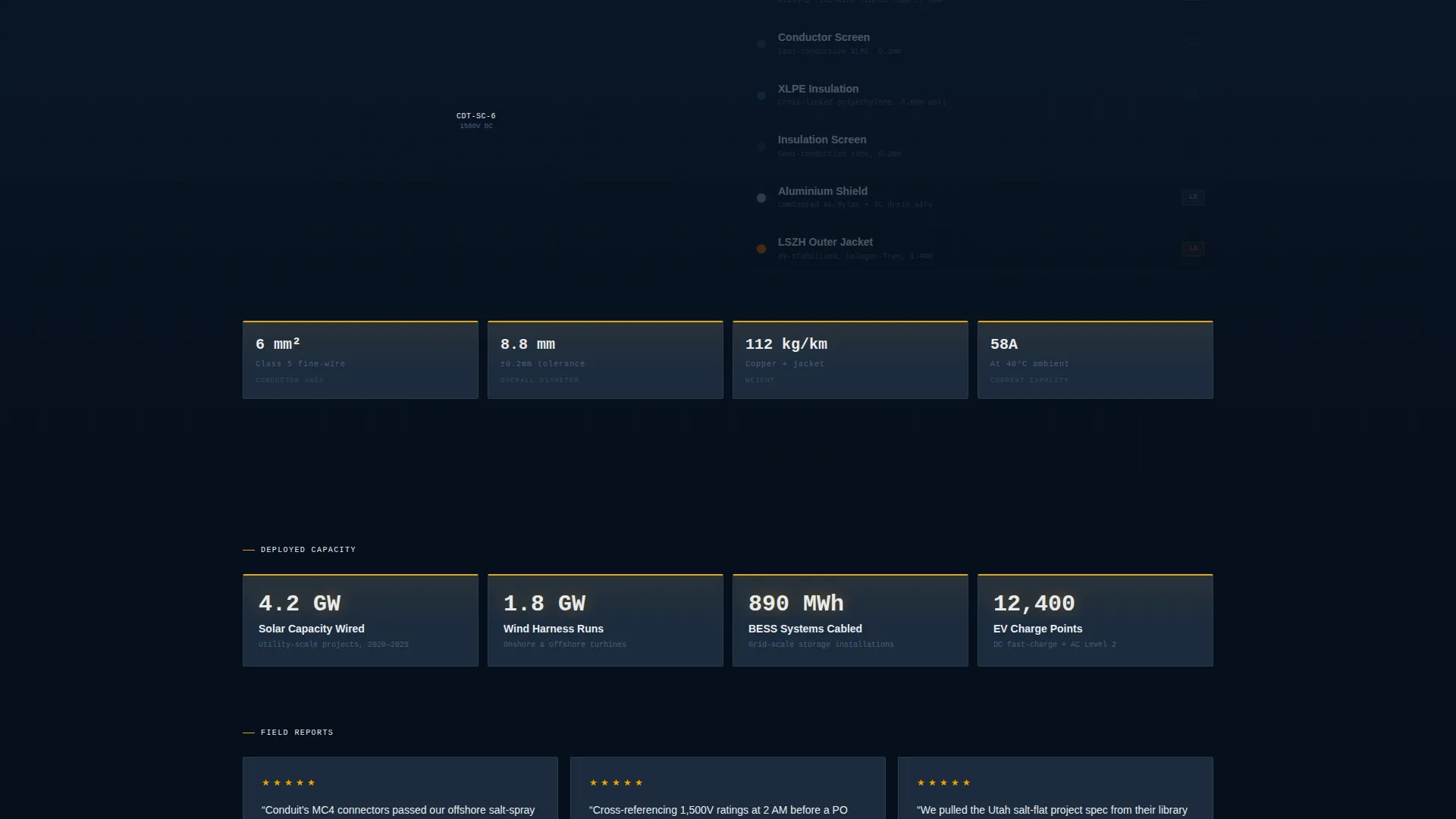
A full-width data grid opens the page with real specification numbers: 48,000-plus SKUs, 1,500V DC max rated voltage, IP68 and IP69K ingress protection ratings, 142 countries shipped, and UL, TÜV, and IEC certification badges. Each metric sits inside its own card with a thin amber rule at the top, set in a monospaced typeface against deep navy. No photography, no illustration, just data that signals authority immediately.
Product Category Bay Grid
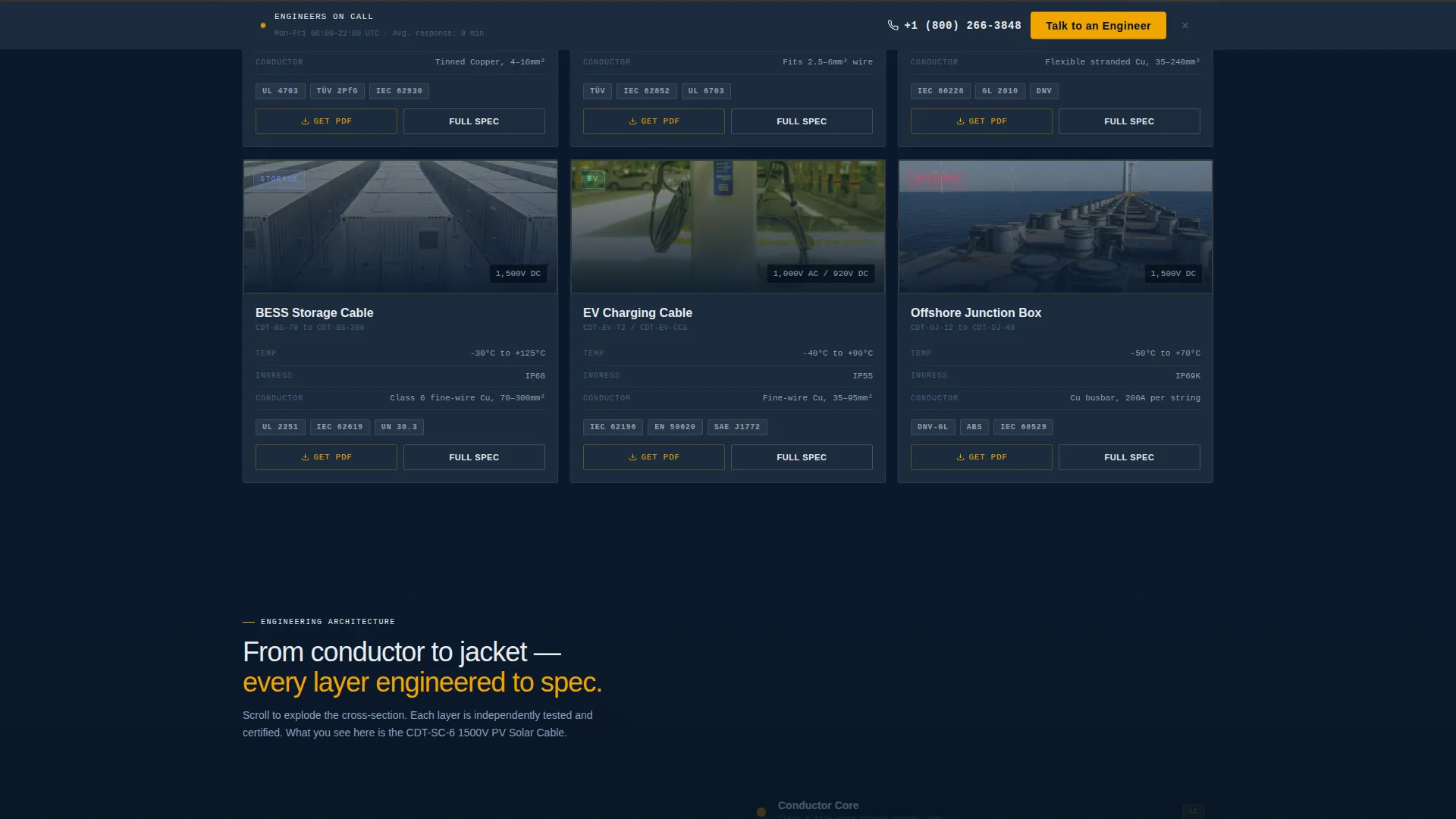
Four product bays, Solar Cables, Wind Harnesses, Storage Connectors, and EV Infrastructure, are each rendered as a data-grid module. Each module surfaces a product thumbnail, voltage range, temperature rating, and certification icons without requiring a click. Procurement teams can cross-reference categories at a glance before going deeper.
Scroll-Triggered Cross-Section Diagrams
As visitors scroll deeper into the page, cross-section diagrams expand outward to reveal conductor gauge, insulation layers, and shielding construction. This transforms raw specification data into visual technical architecture. The interaction moves the visitor from warehouse-level overview to engineering-lab detail naturally.
Dual Conversion Path System
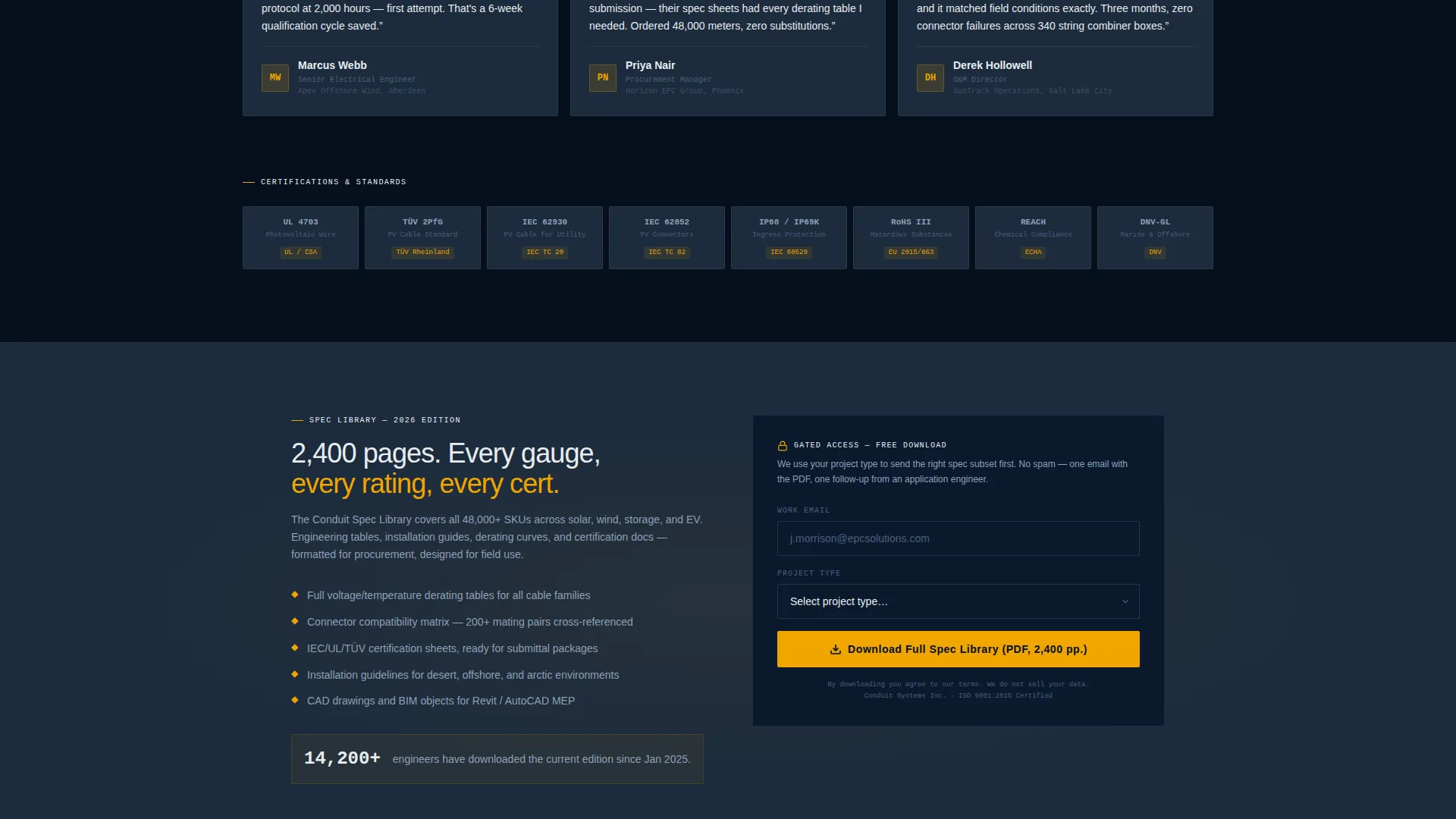
The primary call to action, "Download Full Spec Library," is gated behind a two-field form requiring a work email and project type selection (solar, wind, storage, EV, or hybrid). Ungated "Get PDF" buttons on every product card feed a progressive profiling pixel. Both paths capture intent at different stages of the buying decision.
Sticky Engineer Contact Bar
A sticky bottom bar appears after the visitor has scrolled 40 percent of the page. It surfaces two options: "Talk to an Engineer" and a direct phone number. This keeps a high-intent conversion path visible throughout the deeper specification sections without interrupting the reading flow.
Ambient Navy Depth System
The page uses a graduated visual depth cue as visitors scroll. The ambient navy darkens slightly section by section, and amber accents multiply as complexity increases. This spatial and architectural approach gives each zone, from product overview to test-chamber-level detail, a distinct visual weight without needing separate pages.
Page sections overview
| Section | Purpose |
|---|---|
| Stats Metrics Header | Display key specification numbers and certifications upfront |
| Product Category Bays | Browse Solar, Wind, Storage, and EV product modules |
| Cross-Section Diagrams | Visualize conductor, insulation, and shielding architecture |
| Spec Library Download | Gate the full catalog behind a two-field email form |
| Per-Product PDF Buttons | Offer ungated data sheets on every product card |
| Sticky Contact Bar | Surface engineer contact and phone after 40% scroll |
Design & branding system
The visual identity follows a Navy Authority color system designed to feel like a grid-scale battery control room at dusk. Dark surfaces carry the data; amber accents signal what matters most. Typography is monospaced for all specification numbers, keeping every figure legible at a glance.
- Core palette: command-center navy (#0B1A2E), gunmetal panel (#1C2B3D), signal white (#E8ECF1) for data text, and high-voltage amber (#F0A500) for live metrics, hover states, and download icons
- Certification badges (UL, TÜV, IEC) are rendered as small monochrome icons inside the header grid, maintaining visual restraint
- The Dashboard Pro theme drives a data-grid layout throughout, with thin amber card rules and deep navy backgrounds replacing all decorative elements
Mobile & speed optimization
The dashboard layout is structured for clarity on any screen size. Specification cards and product bays reflow cleanly so technical buyers can reference data on a tablet in the field or on a phone between site inspections.
- Data-grid modules stack vertically on smaller screens, keeping voltage ranges, temperature ratings, and certification icons visible without horizontal scrolling
- The sticky contact bar remains accessible at the bottom of the viewport across all device sizes, preserving the engineer contact path on mobile
- Monospaced specification text is sized to remain readable without zooming, even on compact device screens
How this template helps you convert
The template is designed around a trust-first conversion sequence. It proves specification depth before it asks for anything, so the download request feels earned rather than premature.
- The metrics header leads with hard numbers and certification badges, giving procurement managers immediate evidence of catalog depth and compliance range before they read a single line of copy.
- The dual conversion path separates high-intent buyers (who fill out the spec library form) from early-stage researchers (who download individual PDFs), letting both groups self-qualify at their own pace.
- The sticky "Talk to an Engineer" bar keeps a direct human contact option visible once a visitor has seen enough specification data to have a real question, capturing intent at the moment it peaks.
Other information about this template
This template is built for the intersection of industrial manufacturing and renewable energy components, specifically targeting cable and connector suppliers whose buyers evaluate products through technical documentation rather than marketing narratives.
- The template style is Dashboard and Data Grid, paired with the Dashboard Pro theme and a Spatial and Architectural creative direction
- The landing page direction is Content and Resource hub, meaning the page earns conversions by demonstrating catalog depth first
- The header concept is Stats and Metrics, replacing hero imagery with a full-width live data panel
- The color system, Navy Authority, is purpose-built for industrial command-center environments where data legibility and visual authority matter more than decoration
- The template is suited to manufacturers shipping to 142 countries with multilingual procurement teams who rely on standardized certification markings
Theme
Dashboard Pro
Creative direction
Spatial & Architectural
Color system
Navy Authority
Style
Dashboard/Data Grid
Direction
Content/Resource
Page Sections
Live Stats Metrics Header
Product Category Bay Grid
Scroll-triggered Cross-section Diagrams
Dual Conversion Path System
Sticky Engineer Contact Bar
Ambient Navy Depth System
Related questions
Who is this landing page template designed for?
What specification data does the template display in the header?
How does the conversion system work?
Can the product category bays be adapted to different product lines?
What triggers the sticky contact bar?