Aircraft Structural Parts Manufacturer Website Template
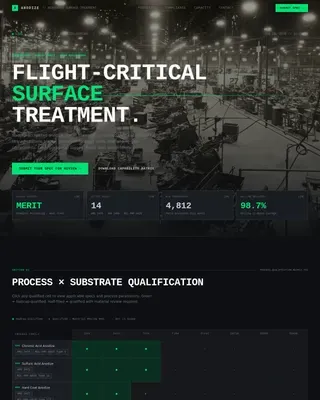
Airframe is a hub-and-spoke landing page template built for aircraft structural parts manufacturers. It leads with cinematic 5-axis mill footage, real-time counting stats, and bento-style dashboard cards that turn procurement data into a shortlist argument. Every scroll stop adds another qualification checkpoint, moving aerospace engineering buyers toward a confident "Request Capability Review."
by Rocket studio
Quick summary
Airframe is a precision-focused landing page template for aerospace structural parts manufacturers. It combines a Stats-First design direction with a Monochrome Steel visual identity, creating pages that feel less like marketing and more like a CMM readout. Procurement engineers get hard data first, then context, then a clear path to submit an RFQ package.
Who this template is for
This template is designed for B2B aerospace manufacturers who need to qualify new vendor relationships and win long-term frame agreements. It speaks directly to decision-makers who evaluate suppliers on evidence, not emotion.
- Tier-one aerostructure procurement engineers qualifying new aircraft parts vendors
- Original equipment manufacturer program managers reviewing machining capabilities and certifications
- Maintenance, Repair, and Overhaul sourcing teams sourcing aircraft-on-ground replacement parts under tight deadlines
What problem this template solves
Most aircraft structural parts suppliers lose qualified leads because their pages bury capability data under generic marketing language. Procurement engineers need a procurement case, not a brochure. This template builds that case section by section.
- No clear hierarchy between certification data, materials, and capacity leaves visitors guessing
- Slow, cluttered pages cost time for engineering teams who are evaluating multiple vendors at once
- Generic contact forms fail to qualify whether a visitor is an engineering lead or a procurement lead
What you get with this template
You get a full anchor-navigated landing page structured as a hub-and-spoke model. Each spoke section opens with a single arresting metric and expands into deeper supporting evidence. The design is desktop-first with a mobile fallback, allowing the team to reach procurement visitors on any of their devices.
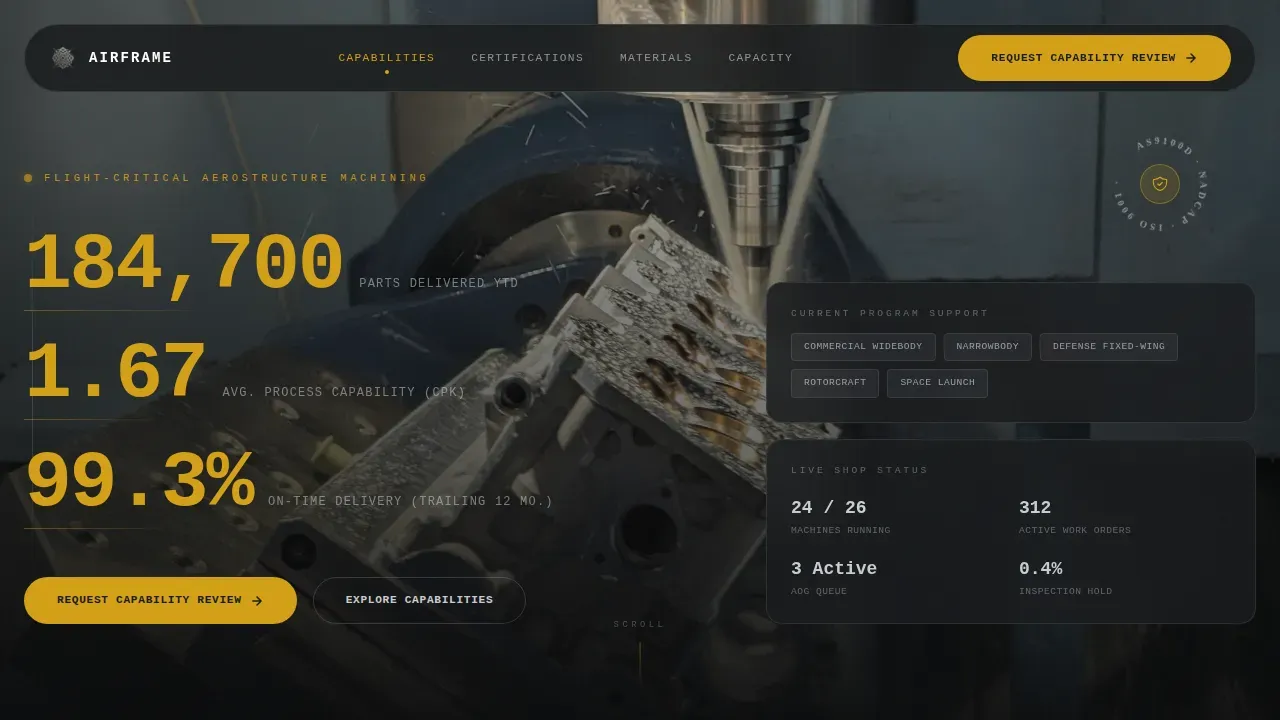
- Cinematic hero section with a 5-axis mill background and three count-up stats: parts delivered, average Cpk tolerance index, and on-time delivery percentage
- Five anchor-linked content spokes covering Capabilities, Certifications, Materials, Capacity, and a primary RFQ form with drag-and-drop file upload
- A secondary gated PDF path that qualifies visitors by role title before a sales call is ever scheduled
Feature list
This template ships with a precise set of design and layout components built for aerospace industrial content. Each feature is grounded in the project brief and serves a specific procurement audience need.
Stats-First Hero with Count-Up Animation
The hero section opens with a slow dolly shot over a 5-axis mill mid-cut. Three live-updating stats fade in sequence using GSAP ScrollTrigger count-up animation: parts delivered this year, average Cpk positional tolerance, and on-time delivery percentage. The numbers function as the headline, allowing the aircraft footage to carry the visual authority.
Bento Dashboard Card Layout
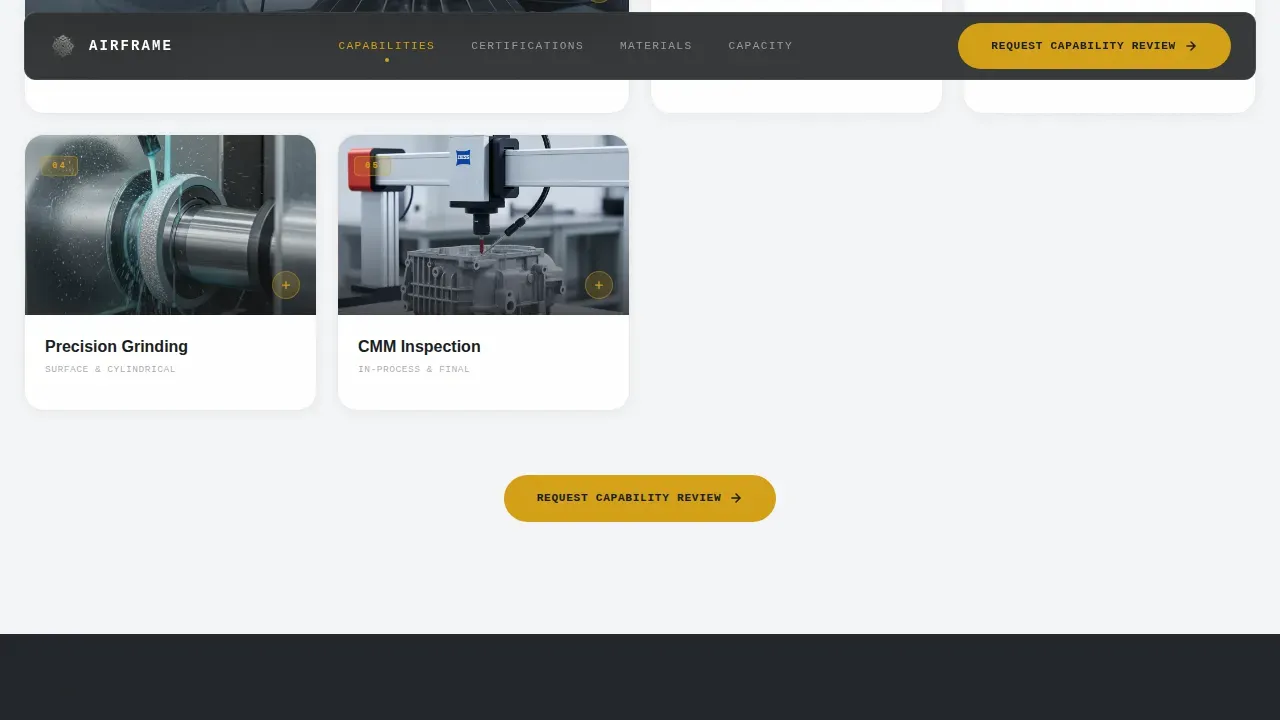
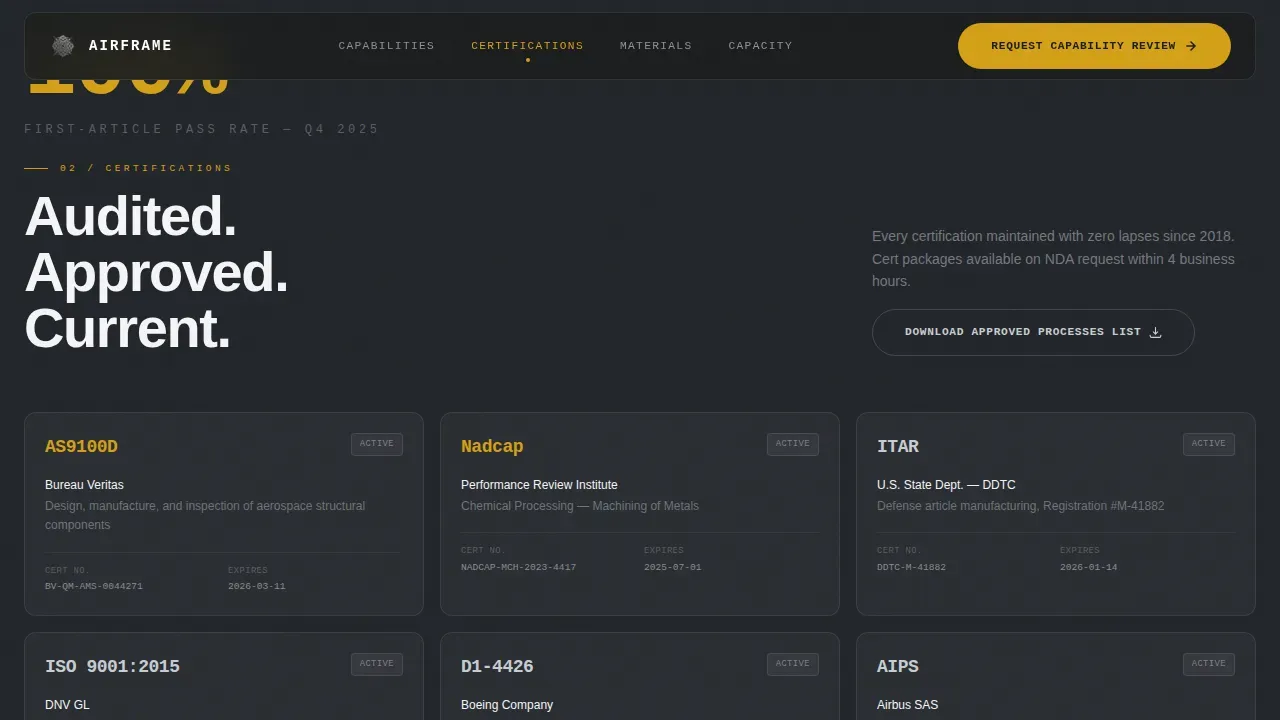
Each capability spoke uses expandable bento-style dashboard cards. Cards open on click to reveal deeper evidence including Nadcap and AS9100 certification scan previews, material mill cert details, and Gantt-style lead-time comparisons. This model keeps the design scannable while rewarding engineers who want more information.
Sticky Anchor Navigation
A persistent sticky navigation bar links directly to each spoke section: Capabilities, Certifications, Materials, and Capacity. The primary call to action, "Request Capability Review," anchors both inside the sticky nav and at the close of every spoke section, so visitors never have to scroll back to convert.
Dual-Path Lead Capture
The primary RFQ form captures company name, program platform via dropdown (commercial widebody, narrowbody, defense, rotorcraft, space launch), annual estimated volume, and a drag-and-drop field for RFQ packages or STEP files. A secondary path gates a downloadable approved processes PDF behind email and role title, helping the team pre-qualify engineering versus procurement leads.
Monochrome Steel Design System
The full design is built on a four-color Monochrome Steel palette: gunmetal (#3B3F45), machined-surface silver (#C8CDD3), inspection-light white (#F4F5F7), and spec-callout amber (#D4A017). Typography uses DM Sans at weights 400, 700, and 900 for body and headlines, with IBM Plex Mono set for all data, specs, and certification callouts.
Material Matrix and Traceability Section
The Materials spoke displays a structured matrix covering Ti-6Al-4V, 7075-T73, Inconel 718, and 15-5PH stainless. Each entry links to mill cert traceability details, reinforcing the quality assurance depth that aerospace engineering buyers expect from a long-term supplier.
Page sections overview
| Section | Purpose |
|---|---|
| Cinematic Hero | Display count-up stats and 5-axis mill footage |
| Sticky Anchor Nav | Link to all spokes and surface primary call to action |
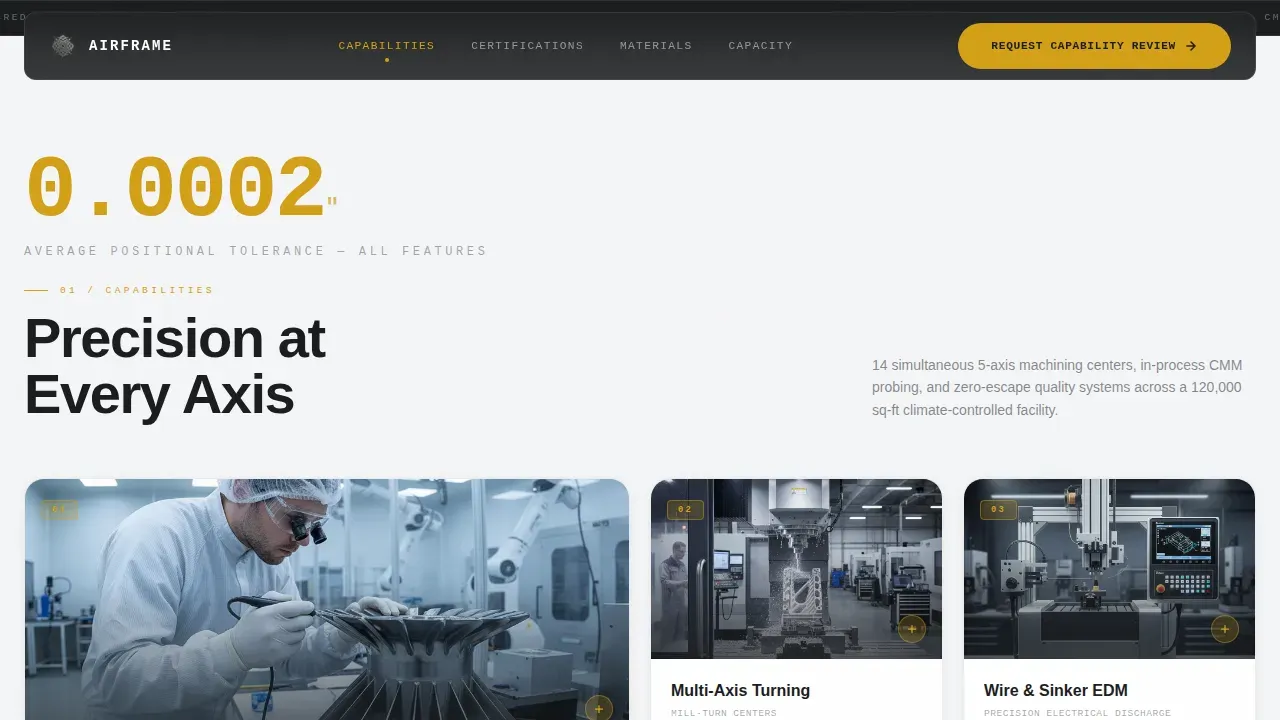
| Capabilities Spoke | Showcase 5-axis milling, EDM, turning with tolerance metric |
| Certifications Spoke | Display Nadcap, AS9100 cert cards with scan previews |
| Materials Spoke | Present material matrix and mill cert traceability |
| Capacity Spoke | Show Gantt lead-time comparison and AOG 72-hour path |
| RFQ Form Section | Capture company, program, volume, and STEP file upload |
| PDF Gate Modal | Qualify leads by role before delivering approved processes list |
| Linear Footer | Single-row footer with copyright and essential links |
Design & branding system
The design system follows a Dashboard Pro theme built around a CMM readout aesthetic. There is no warmth or decorative styling. Every color and typeface choice reinforces precision and authority in the aircraft structural parts space.
- Gunmetal (#3B3F45) sets the primary background tone across all dashboard card components
- Amber (#D4A017) is reserved strictly for critical data callouts, certification badges, and call-to-action buttons, allowing key information to stand apart
- IBM Plex Mono handles all spec values, tolerance figures, and real time stat displays, while DM Sans carries body content at multiple weights for clear visual hierarchy
Mobile & speed optimization
The template is desktop-first by design, matching how procurement engineers access vendor pages on workstations. A mobile fallback layout is included so the page remains functional and readable across all devices, including phone screens.
- Scroll-triggered animations and count-up stats use GSAP ScrollTrigger with client-side rendering to keep static content fast while preserving interactive performance
- Server Components handle static layout sections, allowing the build to separate heavy animation logic from the core content load
- The scannable layout structure, short paragraphs, and bold metric callouts help visitors on smaller devices move through content quickly without losing context
How this template helps you convert
Procurement engineers do not browse; they evaluate. This template is structured to build a complete vendor qualification case before the visitor ever reaches the form. Every design and content decision serves that conversion model.
- Each spoke section opens with a single arresting metric such as "0.0002 inch average positional tolerance" or "100% first-article pass rate," setting credibility before any paragraph text appears and keeping visitors engaged long enough to reach the RFQ form.
- The dual-path lead capture system lets the team separate engineering inquiries from procurement inquiries at the point of access, creating a more efficient qualification workflow and reducing unqualified discovery calls.
Other information about this template
This template is designed for teams who want to set up a high-performance aerospace vendor page without building from scratch. No-code tools and AI-assisted platforms make it possible for non-developers to create and deploy pages like this while still maintaining the technical depth that aircraft structural parts buyers expect.
- AI tools can assist in generating content variations and helping teams optimize individual sections based on visitor feedback and heatmap data, making it faster to iterate on pages over time
- Analytics insights and A/B testing allow teams to compare design changes across different versions and determine which model of the page performs better for their specific program mix
- Platforms that offer drag-and-drop editors make creating personalized landing pages easy, and this template is structured to work within those environments, saving significant build time
- The approved processes PDF gate is designed with rights management in mind, ensuring that gated content access is tied to a verified role, which also supports copyright protection for proprietary process documentation
- Teams expanding into Asia or managing programs across multiple regions can adapt the template content and materials matrix to reflect regional supplier qualification standards while keeping the core design intact
- Envato offers a catalogue of aircraft templates for broader exploration, and platforms like SmileTemplates.com provide aerospace brochure templates if teams want to compare design approaches across the industry
Theme
Dashboard Pro
Creative direction
Stats-First Impact
Color system
Monochrome Steel
Style
Hub & Spoke (Anchor Nav)
Direction
Partnership/B2B
Page Sections
Stats-first Hero with Count-up Animation
Bento Dashboard Card Layout
Sticky Anchor Navigation
Dual-path Lead Capture System
Material Matrix with Traceability
Monochrome Steel Design System
Related questions
Can this template be adapted for different aircraft program types?
Does the template include real certification documents?
How does the gated PDF path work?
Is this template suitable for MRO suppliers with urgent AOG requirements?
What design changes can I make to match my brand?