Intellectual Property Privacy Policy Website Template
Counsel is an authoritative open source legal compliance landing page template built for legal practices serving tech companies. It combines a manifesto-style hero, a plain-language license comparison table, sequential case study narratives, and two conversion forms into a single, desktop-first layout styled in deep documentary black, warm parchment, and redline red.
by Rocket studio
Quick summary
Counsel is a single-page legal compliance template designed for open source counsel practices. It opens with a manifesto header set in large serif typography, moves through a structured license comparison table, and escalates through three anonymized case studies before presenting two gated conversion paths. The template is built for B2B legal services that need to demonstrate expertise before asking for a commitment.
Who this template is for
This template is built for legal professionals and practices that serve the tech industry on open source compliance matters. It suits teams whose clients arrive with urgent, high-stakes problems and need to feel understood before they trust anyone enough to fill out a form.
- Open source legal counsel practices serving CTOs at growth-stage startups
- Solo practitioners or small firms handling cease-and-desist responses and contributor license agreement drafting
- Foundation board counsel and legal teams advising on mergers and acquisitions due diligence involving software licensing
What problem this template solves
Most legal service pages lead with credentials. This one leads with clarity. The problem is that technical founders and engineering leads do not hire lawyers the way general counsel does. They need to see the thinking before they trust the thinker.
- Visitors arrive without enough context to feel the urgency of their own compliance gap
- Generic legal service pages fail to distinguish open source expertise from standard intellectual property practice
- Conversion forms placed too early collect low-intent leads who have not yet understood the stakes
What you get with this template
You get a full single-page layout structured to earn trust incrementally before presenting any call to action. Every section is sequenced to move the visitor from curiosity to recognition to action.
- A manifesto hero section with large serif typography, a redline rule, and no imagery
- A six-dimension license comparison table covering GPL, MIT, Apache 2.0, and AGPL in plain language
- Three sequential case study blocks with crisis, analysis, and resolution columns, escalating from a compliance letter to eight-figure acquisition fallout
- A gated compliance checklist form placed after the first case study, requiring only an email address
- A secondary license audit form requesting repository URL, primary license, and team size
Feature list
Manifesto Hero Typography
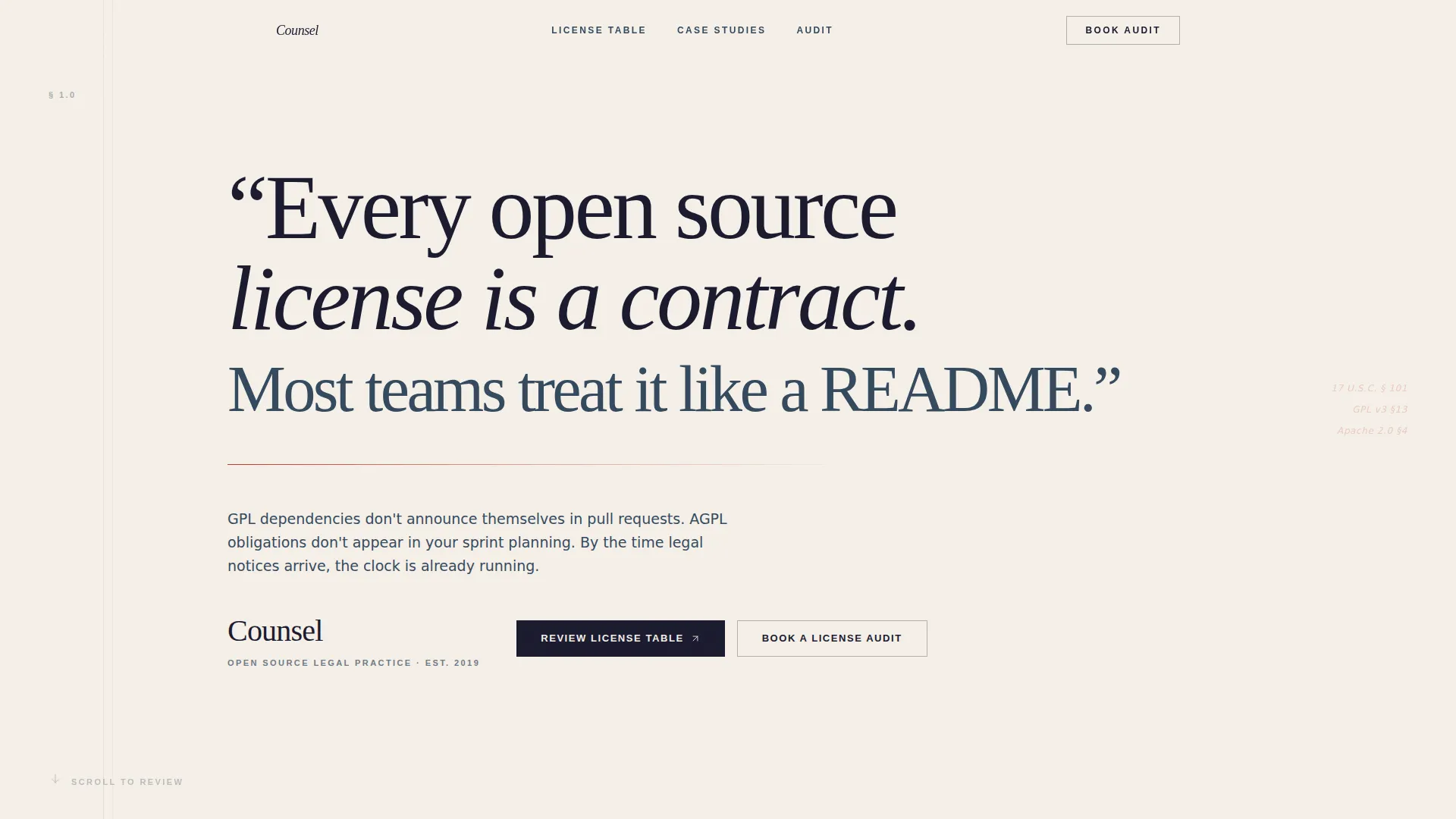
The hero fills the viewport with a single declarative statement set in a large Fraunces serif typeface on a warm parchment background. A thin redline-red rule separates the manifesto from the firm name below it. There is no logo, no illustration, and no imagery. The typography carries the entire authority of the opening.
Plain-Language License Comparison Table
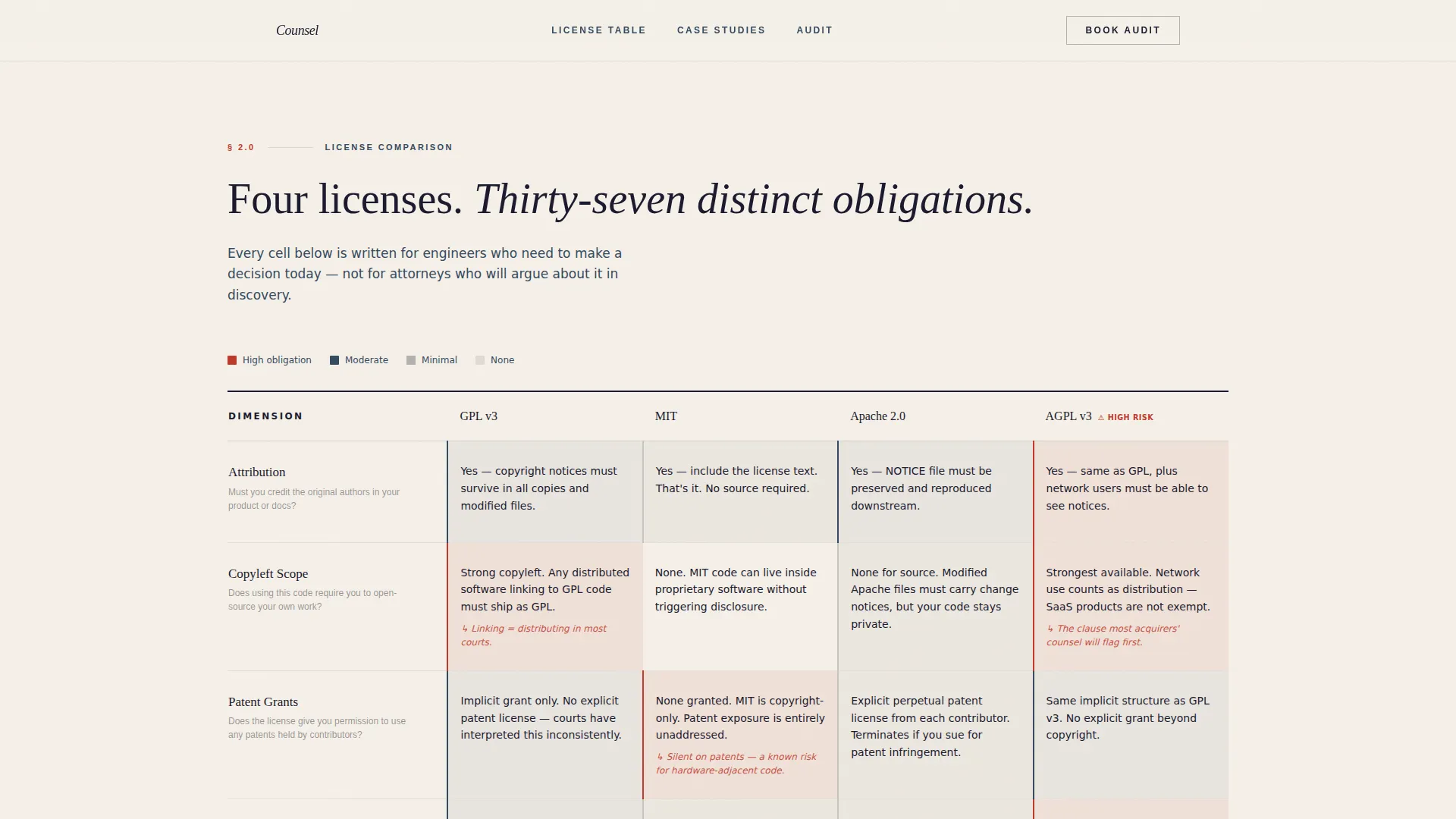
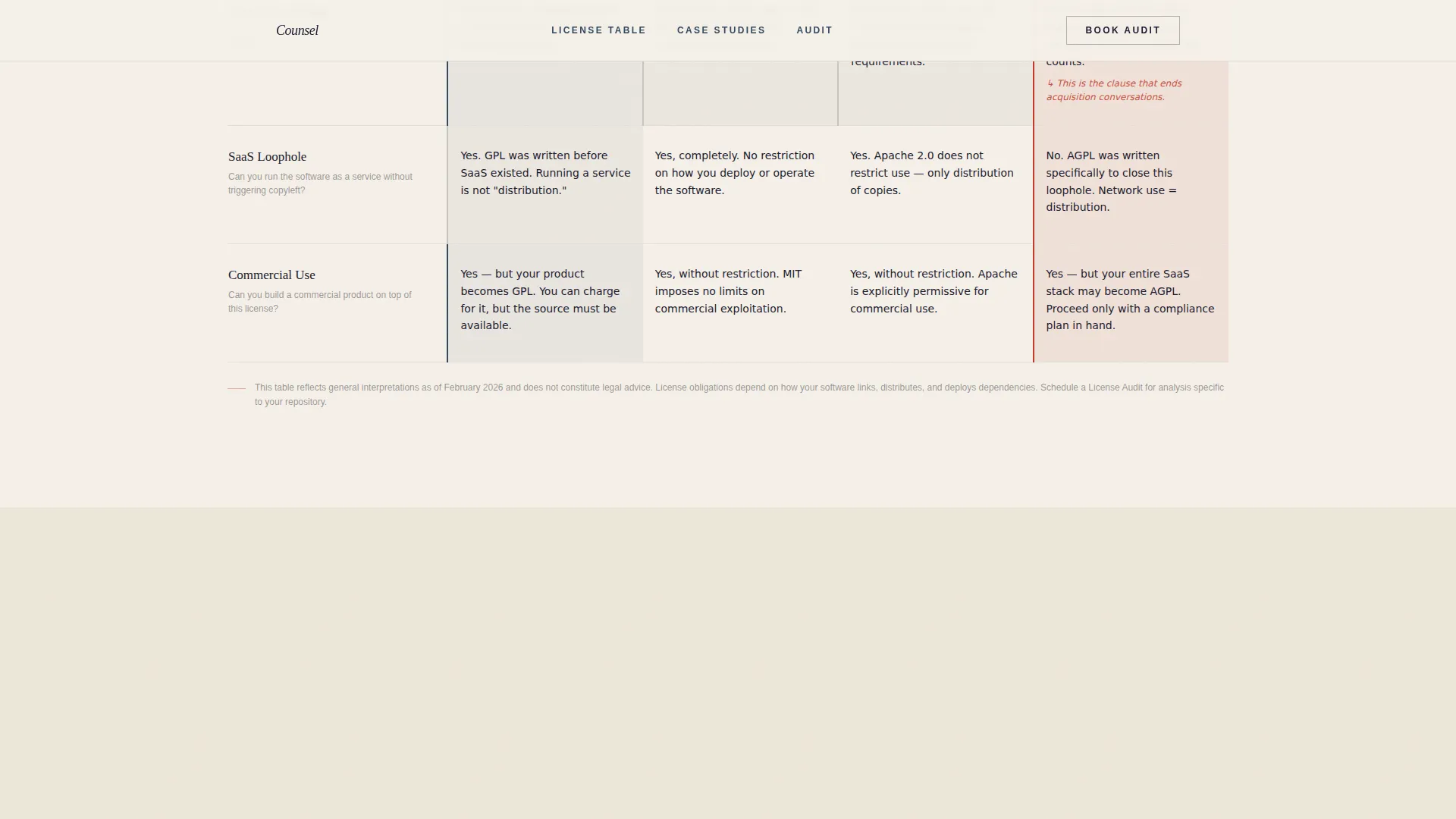
A structured comparison table contrasts GPL, MIT, Apache 2.0, and the GNU Affero General Public License (AGPL) across six obligation dimensions: attribution, copyleft scope, patent grants, distribution triggers, and more. Each cell is written in plain language so a chief technology officer (CTO) can read it without a legal dictionary. Rows include hover interactions for readability.
Sequential Case Study Narratives
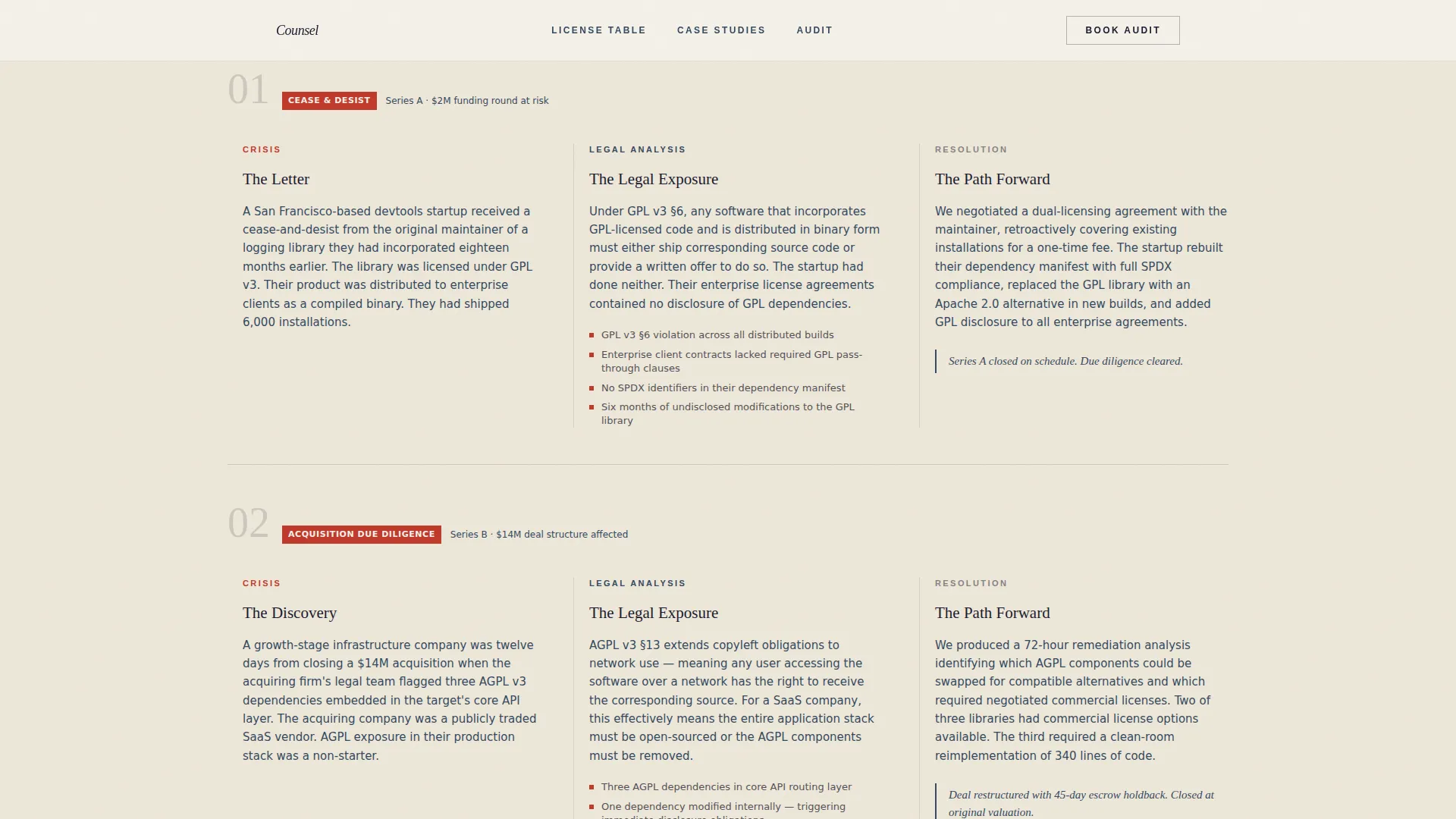
Three anonymized case study blocks unfold in order, each structured across three columns: the crisis, the legal analysis, and the resolution. Stakes escalate with each story, from a cease-and-desist letter to a failed acquisition due diligence to eight-figure merger and acquisition (M&A) fallout. The sequencing makes each next section feel necessary before it arrives.
Gated Compliance Checklist Capture
After the first case study, a single-field email input appears to gate a downloadable compliance checklist. The placement is deliberate. By that point, visitors have seen one real problem analyzed and resolved, making the checklist feel immediately relevant rather than promotional.
License Audit Conversion Form
A secondary conversion path offers a license audit booking. The short form asks for a repository URL, primary license type, and team size. This path serves visitors who are ready to act rather than learn, giving the page two distinct exit points for different levels of intent.
Civic Service Visual Theme
The layout draws on a hardbound legal volume aesthetic throughout. Fraunces handles all display headings and the manifesto statement. DM Sans handles body text and form labels. Scroll-triggered fade-in animations and staggered table row reveals add motion without distraction.
Page sections overview
| Section | Purpose |
|---|---|
| Manifesto Hero | Opens with a single declarative statement in large serif type to establish authority immediately |
| License Comparison Table | Contrasts GPL, MIT, Apache 2.0, and AGPL across six plain-language obligation dimensions |
| Case Study One | Presents a cease-and-desist crisis, its legal analysis, and the resolution in three columns |
| Checklist Email Gate | Captures email address after Case Study One to deliver a gated compliance checklist PDF |
| Case Study Two | Escalates to an acquisition due diligence failure with structured analysis and outcome |
| Case Study Three | Resolves at eight-figure M&A stakes, making the audit form feel urgent and timely |
| License Audit Form | Collects repository URL, primary license, and team size to book a license audit |
| Minimal Footer | Closes the page with a developer-minimal footer pattern |
Design & branding system
The visual identity follows a Civic Service theme built on an Ink and Paper color system. Every design choice reinforces the feeling of a freshly printed legal brief on heavy cotton stock. There is no decorative imagery anywhere on the page.
- Colors: documentary black (#1A1A2E) for primary text, warm parchment (#F5F0E8) for backgrounds, redline markup red (#C0392B) for rules and accent elements, and statute-margin blue (#34495E) for secondary text and table borders
- Typography: Fraunces serif for all display headings and the manifesto statement; DM Sans for body copy, form labels, and interface elements
- Scroll animations: fade-in-up on scroll entry, staggered table row reveals, and case study column reveal on progression
Mobile & speed optimization
The template is designed desktop-first. CTOs and legal teams reviewing during active due diligence typically work from large screens with multiple windows open. The layout prioritizes long-form readability at desktop widths.
- Static content sections use server components to minimize JavaScript overhead on initial load
- Form interactions and smooth scroll anchors use minimal JavaScript to keep the page responsive
- Table and case study layouts are structured for clear readability at standard desktop viewport widths
How this template helps you convert
The template is built around a deliberate sequencing principle: demonstrate competence before asking for anything. Every layout decision supports that sequence.
- The manifesto hero filters for the right visitor in the first five seconds, so only people with a real compliance concern keep reading
- The license comparison table gives visitors something immediately useful, which builds goodwill and positions the practice as a working expert rather than a vendor
- Two distinct conversion forms at different depths of the page capture both early-intent and late-intent visitors without forcing either group through the wrong path
Other information about this template
This template is best suited for practices that can populate the case study blocks with real anonymized engagements. The stronger and more specific those narratives are, the more effective the conversion sequence becomes. The template supports a US legal context with English copy and USD framing, but the structure adapts to other jurisdictions with copy changes only.
- The footer follows a minimal developer-style pattern consistent with the GitHub developer minimal aesthetic, keeping the close of the page clean and uncluttered
- The gated checklist is intended to be a real downloadable PDF that the practice prepares separately; the template provides the email capture mechanism and layout placement
- Scroll anchor links enable smooth navigation between the manifesto, the comparison table, the case studies, and the forms for visitors who want to jump between sections
Theme
Civic Service
Creative direction
Case Study Narrative
Color system
Ink & Paper
Style
Comparison Table
Direction
Content/Resource
Page Sections
Manifesto Hero with Serif Typography
Plain-language License Comparison Table
Escalating Case Study Sequence
Gated Compliance Checklist Form
License Audit Booking Form
Civic Service Visual Identity
Related questions
Who is this template designed for?
Does the template include the case study content?
Why are there two separate conversion forms?
Can this template be adapted for legal practices outside the United States?
Is a logo required in the header?