Legal PR Agency Landing Page Template
Counsel is a single-page landing page template built for elite legal PR agencies. It uses an Ink & Paper aesthetic with overlapping document-style panels, a commanding serif headline, and a gallery-scroll case study layout. The page positions the agency as authoritative and discreet, guiding qualified prospects toward a waitlist request form with minimal friction.
by Rocket studio
Quick summary
Counsel is a landing page template designed for a legal public relations agency operating at the highest levels of litigation, regulatory defense, and reputational strategy. The design conveys authority through editorial typography, layered panel compositions, and a controlled, almost redacted visual voice. The page closes with a waitlist form that requests a confidence call, not a sales pitch.
Who this template is for
This template serves PR firms and communications consultants who advise legal professionals on high-stakes media narratives. It is built for practitioners whose clients expect discretion, not visibility.
- Legal PR agencies managing media strategy for major litigation or regulatory matters
- Communications advisors embedded with Am Law 100 firms, general counsel offices, or white-collar defense practices
- Boutique reputation management firms positioning themselves as appointment-only, high-discretion service providers
What problem this template solves
Most agency landing pages oversell and underdeliver. They list services, show client logos, and ask for a demo. That approach fails when the audience is a managing partner or general counsel who values confidentiality above all else. This template solves the trust problem by designing discretion into every section.
- It signals competence without disclosing clients, using implied case studies rather than named references
- It replaces the standard lead form with a structured waitlist that demonstrates capacity scarcity
- It positions the agency as the one doing the selecting, not the one seeking the sale
What you get with this template
This template delivers a fully structured single-page layout that tells a coherent story from headline to form, with no filler sections and no generic service blocks. Every section has a defined role.
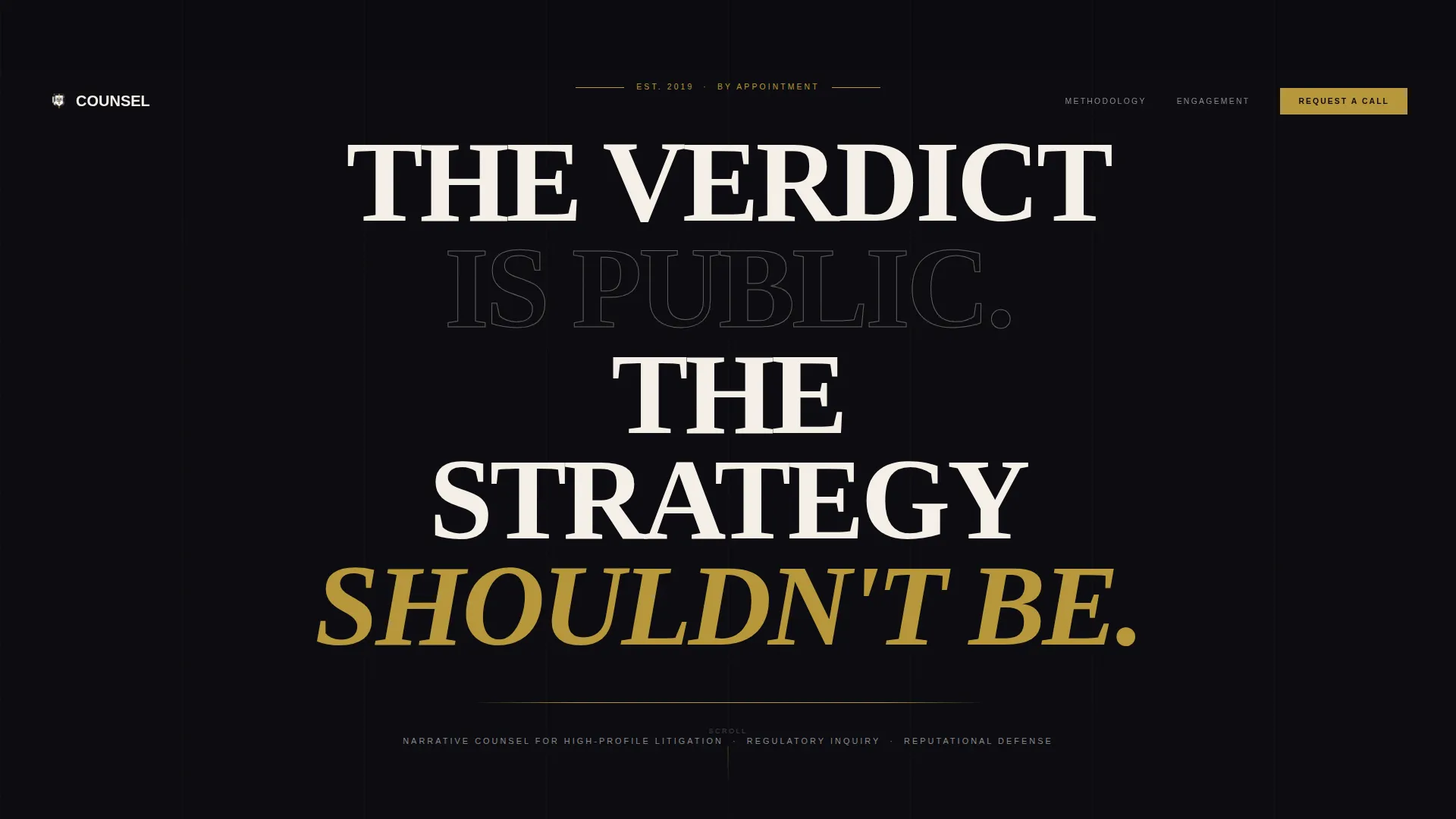
- A viewport-commanding centered headline in oversized serif type set against a deep obsidian background
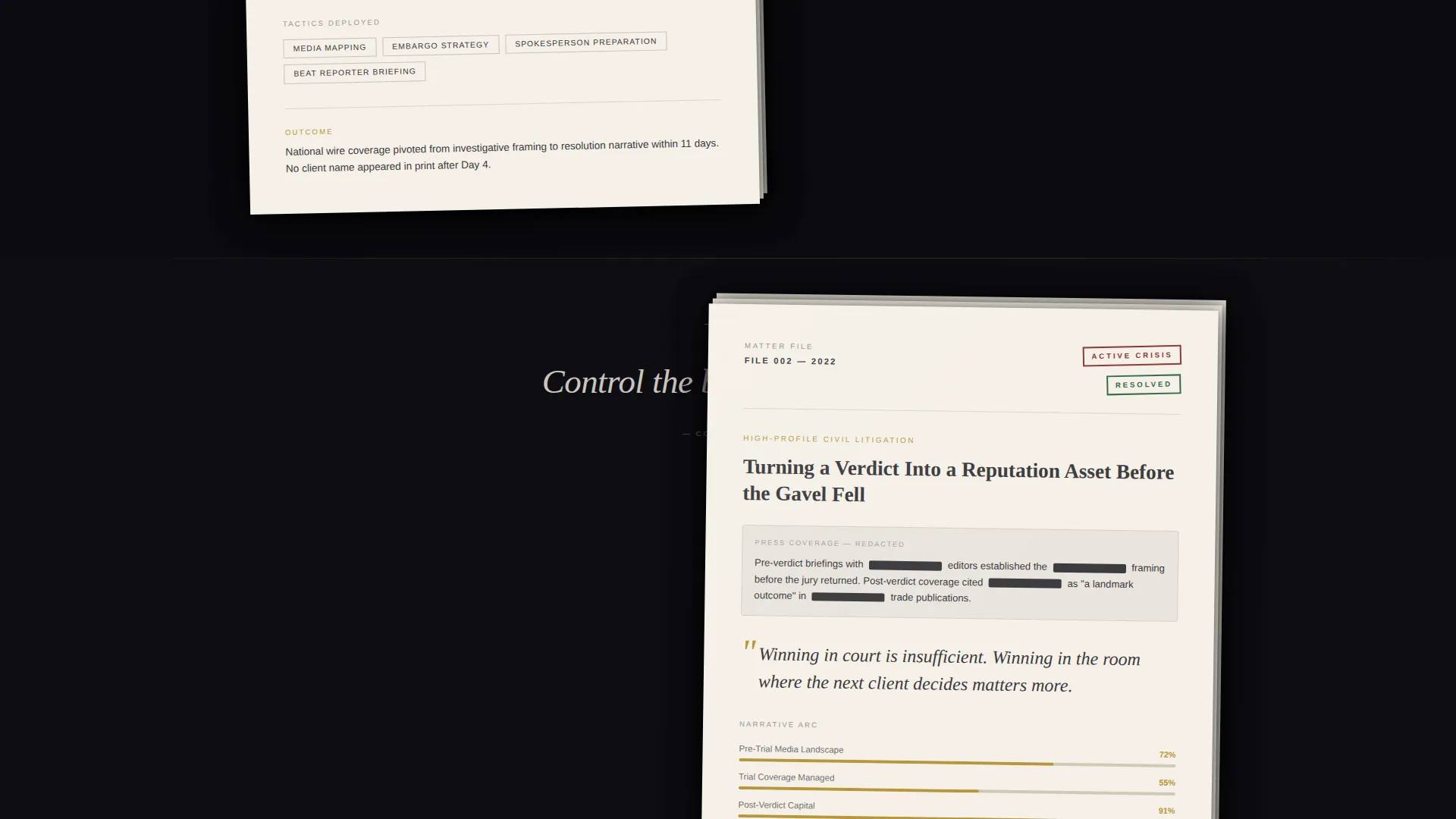
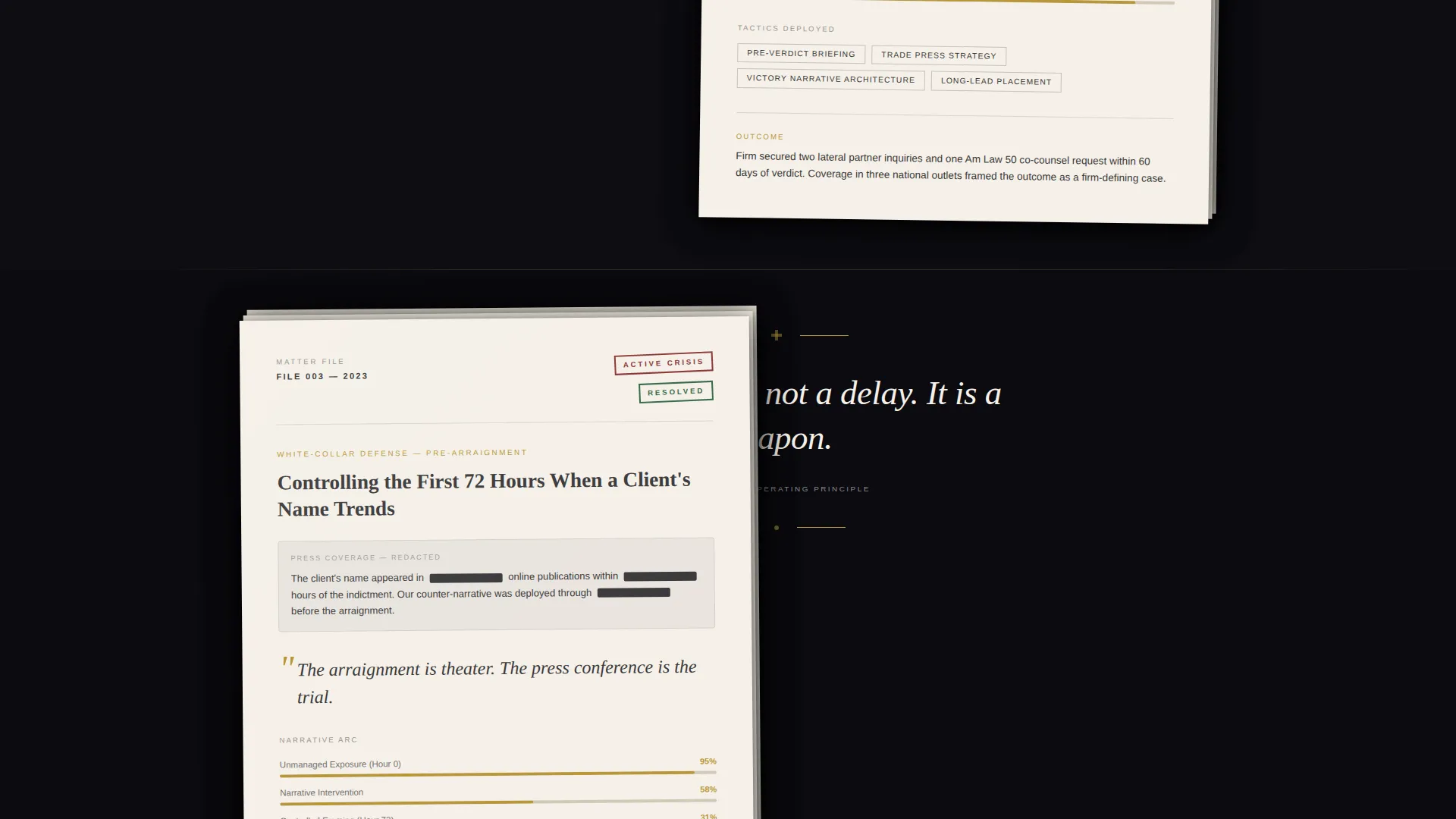
- A gallery-scroll case study section where layered panels reveal methodology across litigation, regulatory, and crisis contexts
- A scarcity-framed waitlist form with an email field, matter-type dropdown, and a media-status toggle
Feature list
This template is built around a tightly integrated set of visual and structural features, each one derived from the editorial design brief.
Giant Centered Headline Block
The header contains no image and no motion. A single enormous serif headline sits centered on an obsidian background in parchment cream type. A thin gold rule separates it from a small-caps founding line below. The effect is immediate and authoritative.
Overlapping Layered Panel Layout
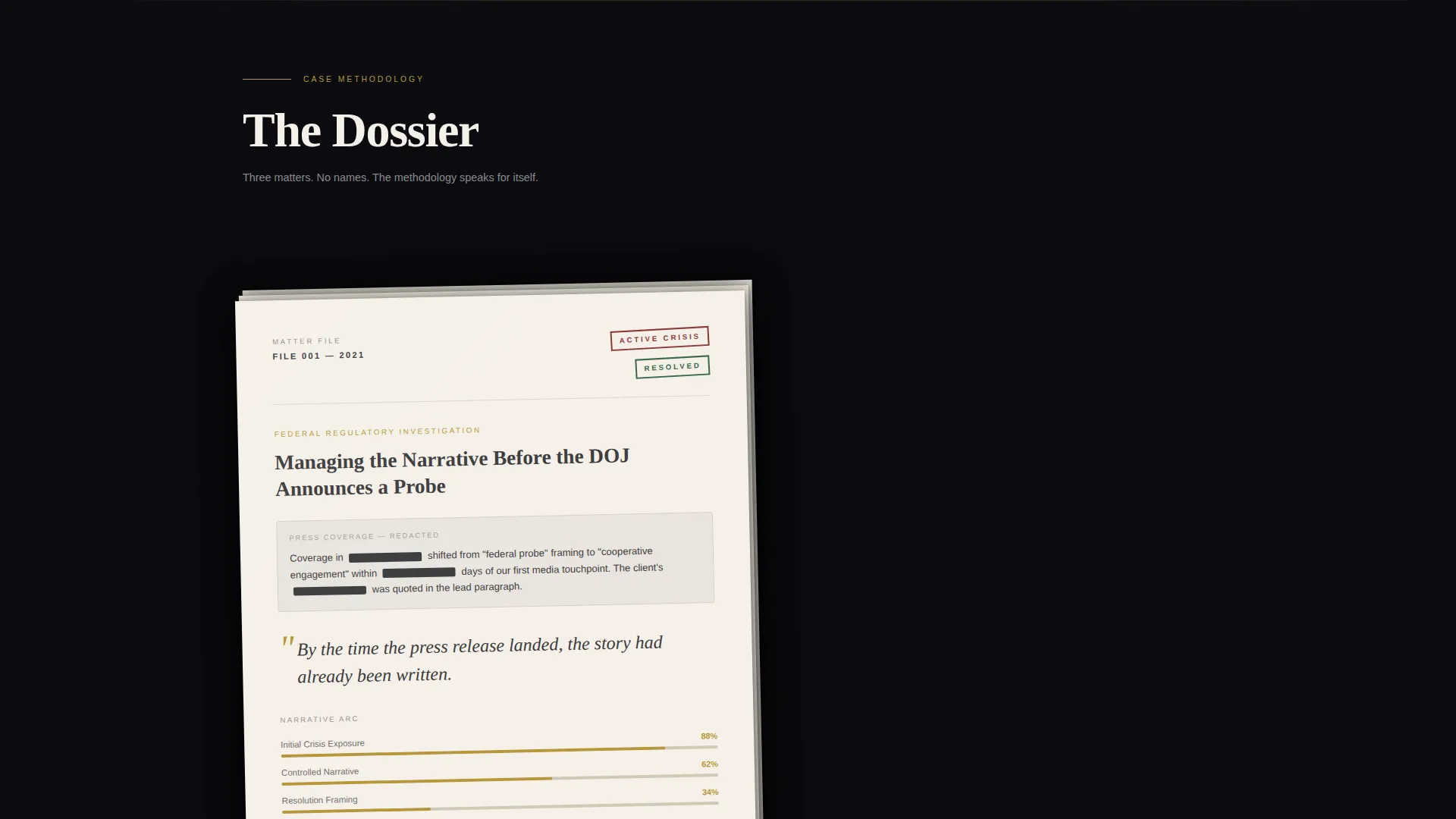
Content panels are stacked with visible drop shadows, offset slightly to suggest a dossier on a counsel table. As the visitor scrolls, panels slide over one another, creating a physical sense of leafing through documents. This is the core structural metaphor of the template.
Gallery Walk Case Study Sections
Each case study panel is composed of layered elements: redacted press clippings, pull quotes from earned coverage, and timeline cards showing narrative shift from crisis to resolution. The cases grow progressively higher in implied stakes, building tension without ever naming a client.
Gold-Accented Interstitial Cards
Between case studies, single-line principles appear on gold-accented cards. These read like marginalia from a senior partner's notebook: brief, confident, and exact. They reinforce methodology between moments of implied evidence.
Structured Waitlist Request Form
Near the bottom of the page, a gold-bordered card holds a single email input, a dropdown for matter type (litigation, regulatory, reputational, or crisis), and a toggle indicating whether the matter is currently in media. No firm name is collected on the page. A line above the form reads that the agency does not discuss its clients.
Scarcity-Framed Capacity Signal
The page states that the agency opens its roster to three new engagements per quarter. This is structural scarcity, not a countdown timer. It communicates selectivity through a factual constraint, which is far more persuasive to a sophisticated audience than artificial urgency.
Page sections overview
| Section | Purpose |
|---|---|
| Obsidian Headline Block | Sets authority and tone immediately with oversized serif type and a gold rule |
| Gold Rule Subline | Anchors the founding context in small caps beneath the headline |
| Methodology Introduction | Introduces the agency's approach before the case gallery begins |
| Case Study Panel One | Presents the first layered dossier panel with press clippings and timeline |
| Interstitial Principle Card | Carries a single strategic principle between case study panels |
| Case Study Panel Two | Escalates implied stakes with a second layered narrative panel |
| Interstitial Principle Card | Carries a second strategic principle before the final case panel |
| Case Study Panel Three | Delivers the highest-stakes implied case with decisive outcome framing |
| Waitlist Request Form | Collects matter type and media status via a gold-bordered card |
| Discretion Statement Line | Reinforces confidentiality directly above the form submission area |
Design & branding system
The visual identity follows an Ink & Paper theme built around an Obsidian and Gold color system. Every element is chosen to feel like printed matter of consequence rather than a digital product page.
- Colors: deep obsidian black (#0B0B0F) as the base, parchment ivory (#F5F0E8) for floating content cards, tarnished gold (#B8973A) on accent lines and hover states, and muted charcoal (#3A3A3C) for body text on light surfaces
- Typography: oversized serif for headlines, small caps for institutional lines, and consistent kerning that treats type as a structural element rather than decoration
- Layout language: layered panels with visible shadows mimic stacked documents on a desk, and the overall scroll experience mirrors leafing through a physical dossier
Mobile & speed optimization
The template is structured for a clean single-column reflow on smaller screens, preserving the editorial hierarchy without requiring the layered offset effect to function at full scale. The design intent holds even when panels stack vertically rather than overlap.
- The giant headline scales proportionally so the typographic impact is retained on mobile viewports
- The waitlist form, including the dropdown and toggle, is designed to remain fully usable in a single-column layout
- Heavy visual metaphors like the layered dossier panels are built to degrade gracefully so the content hierarchy is never lost
How this template helps you convert
This template converts by earning trust before asking for anything. The sequence is deliberate: authority first, methodology second, scarcity third, request last.
- The headline and case gallery build credibility through implied expertise, so the visitor arrives at the form already convinced of relevance
- The structural scarcity signal (three engagements per quarter) reframes the form as an application rather than a contact request, raising the perceived value of a response
Other information about this template
This template is categorized under Portfolio and Agency, with a specific focus on legal marketing and agency presentation. It is well suited to any firm that needs to project seniority, selectivity, and quiet authority to a professional audience.
- The template style is Overlap and Layered, making it distinctive in a category where most agency pages use flat, grid-based layouts
- The creative direction follows a Gallery Walk pattern, which is particularly effective for firms that cannot disclose client names but want to demonstrate the arc of their work
- The Ink and Paper theme and Obsidian and Gold color system are consistent across every section, creating a unified visual argument rather than a collection of modules
- The Waitlist and Coming Soon page direction means the template is optimized for pre-launch positioning, selective intake announcements, or quarterly roster openings
Theme
Ink & Paper
Creative direction
Gallery Walk
Color system
Obsidian & Gold
Style
Overlap/Layered
Direction
Waitlist/Coming Soon
Page Sections
Giant Centered Serif Headline
Overlapping Layered Panel Scroll
Gallery Walk Case Study Sections
Gold-accented Principle Cards
Structured Waitlist Request Form
Structural Scarcity Capacity Signal
Related questions
Can I use this template without disclosing client names?
What is the purpose of the matter-type dropdown in the form?
Is this template suitable for a solo practitioner or only a full agency?
Can the interstitial principle cards be customized?
Does the page collect firm or client names before the call?