Authentic Tunisian Catering Landing Page Template
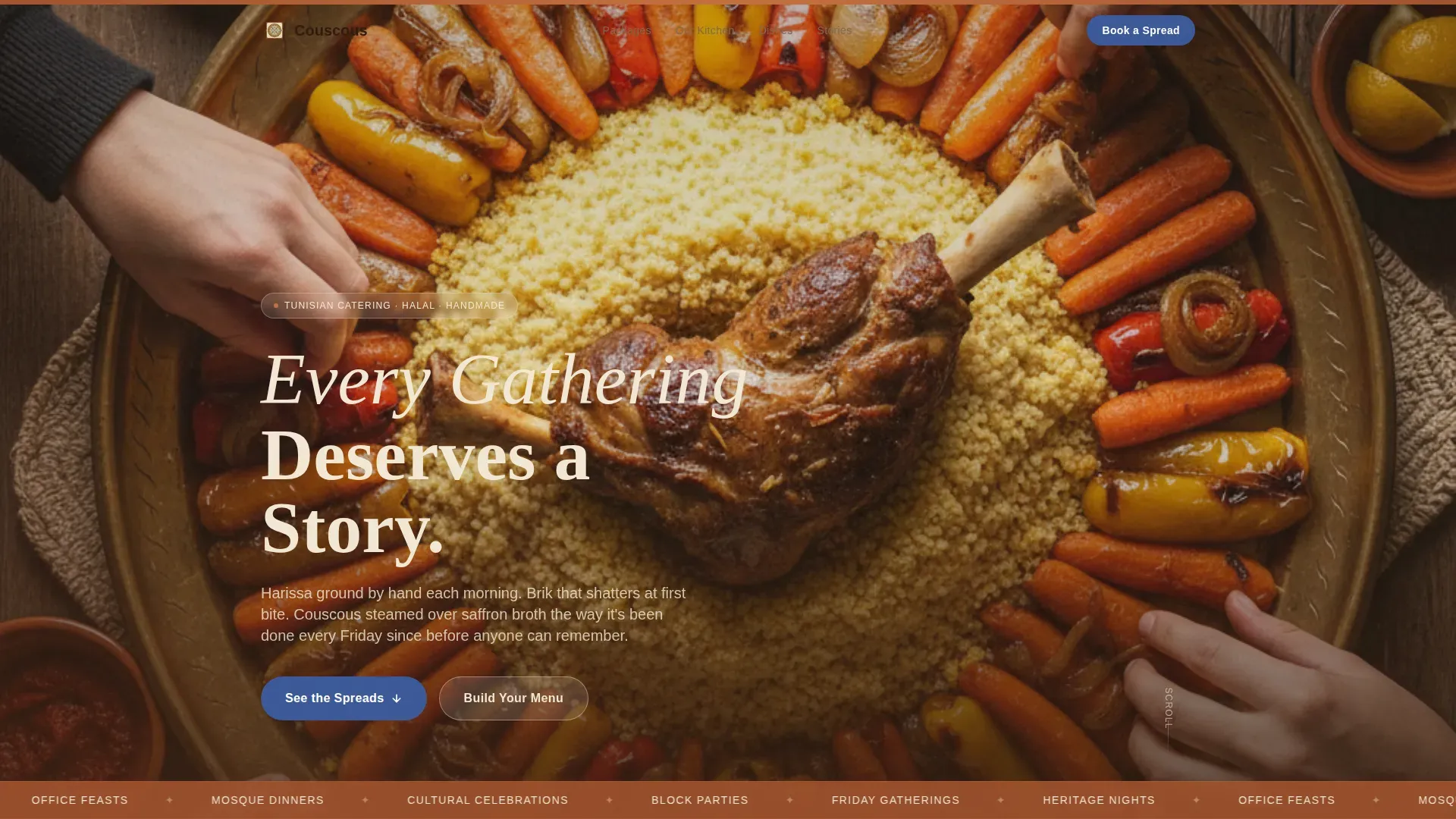
The Couscous template is a modular card-grid landing page built for authentic Tunisian catering services. It leads with a full-bleed overhead photo of a loaded brass siniya tray, moves visitors through staggered package cards, and closes every card with an inline booking form. The Neo-Retro parchment and rust palette, zellige-inspired geometry, and community-first storytelling make each scroll feel like a walk through a warm North African courtyard.
by Rocket studio
Quick summary
Couscous is a ready-to-use landing page template designed for Tunisian catering businesses that want to turn community interest into confirmed bookings. It pairs a full-bleed hero photo with a staggered modular card grid, inline booking forms, and a custom menu builder. The result is a page that shows the food first, the community second, and the form only after visitors have already imagined the table.
Who this template is for
This template is built for anyone who needs to present authentic Tunisian cuisine to local audiences and convert that interest into real event bookings. It fits community-facing food businesses that serve warm, cooked meals at scale and want a landing page that reflects the depth of their craft.
- Block party organizers, mosque community dinner planners, and office managers booking catering for group events
- University cultural associations and heritage night coordinators looking for a cuisine with a story
- Tunisian and broader North African food entrepreneurs who want a page that matches the value of what they cook and serve
What problem this template solves
Most catering landing pages show a static menu and a phone number. That approach leaves potential clients cold. This template solves the gap between a beautiful dish and a confirmed booking by making the food the centerpiece of every view on the page.
- Visitors have no clear way to picture the meal at their event, so this template places high-quality food imagery and package cards front and center, making the experience immediate
- Generic catering pages do not communicate cultural authenticity, so this template uses visual storytelling rooted in Tunisian cuisine to add credibility and emotional pull
- Booking friction is high when forms are buried, so each package card includes its own inline form, reducing the time needed to go from interest to commitment
What you get with this template
You get a fully structured, single-page layout built around modular catering package cards. Every section is pre-designed and ready to populate with your own couscous dishes, photos, and community context. No guesswork is needed on layout or conversion flow.
- A full-bleed hero section with an overhead photo composition, headline, and scroll call-to-action
- Four staggered modular package cards, each with its own inline "Book This Spread" form collecting event date, guest count, and delivery zone
- A philosophy section, a visual signature-dish tray, a community testimonial block, a custom menu builder, and a sticky bottom bar with a secondary conversion path
Feature list
This section covers the core capabilities built into the template as described in the project brief. Each feature is designed to add value at a specific moment in the visitor's journey through the page.
Full-Bleed Hero with Overhead Food Photography
The hero section opens with a full-width overhead shot of a loaded brass siniya tray. Couscous is mounded high with lamb shank, roasted vegetables, and small bowls of harissa, preserved lemon, and mechouia salad. Hands reach in from the edges of the frame as if the meal has just been set down. The composition makes the food feel immediate and communal before a single word is read.
Staggered Modular Package Card Grid
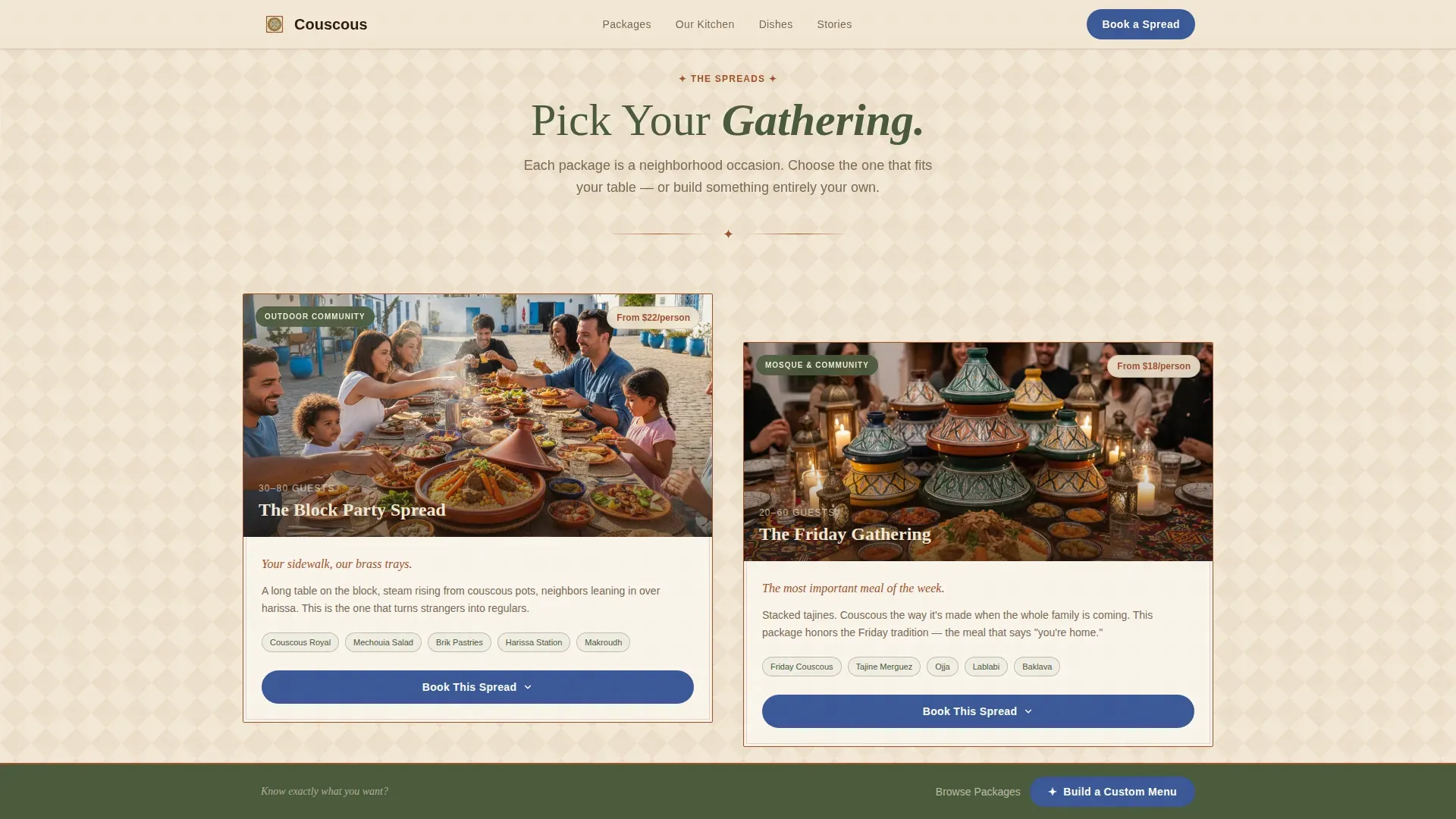
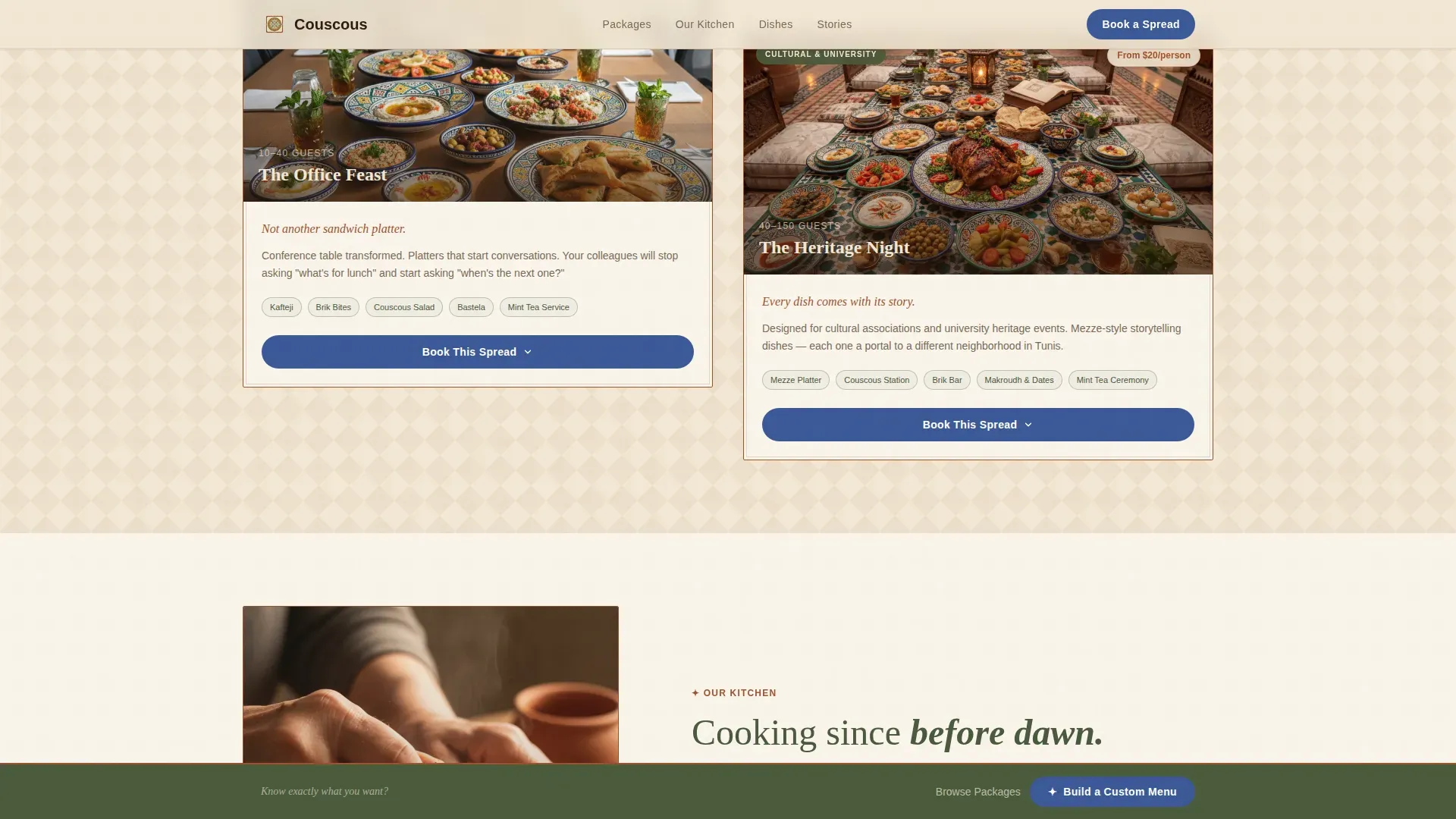
Four catering package cards are arranged in a staggered grid that grows in size and ambition as the visitor scrolls. Each card frames a different community occasion: "The Block Party Spread," "The Friday Gathering," "The Office Feast," and "The Heritage Night." Cards reveal with scroll animations, making the page feel less like a menu and more like a map of gatherings. Each card is self-contained and has its own inline booking form.
Inline Per-Card Booking Forms
Every package card includes a compact inline form that expands on click. The form collects event date, guest count, and neighborhood or delivery zone. This removes the need to navigate away from the card, ensuring the visitor stays in context while making their booking decision. The expand and collapse animation keeps the page clean between interactions.
Custom Menu Builder with Visual Tray
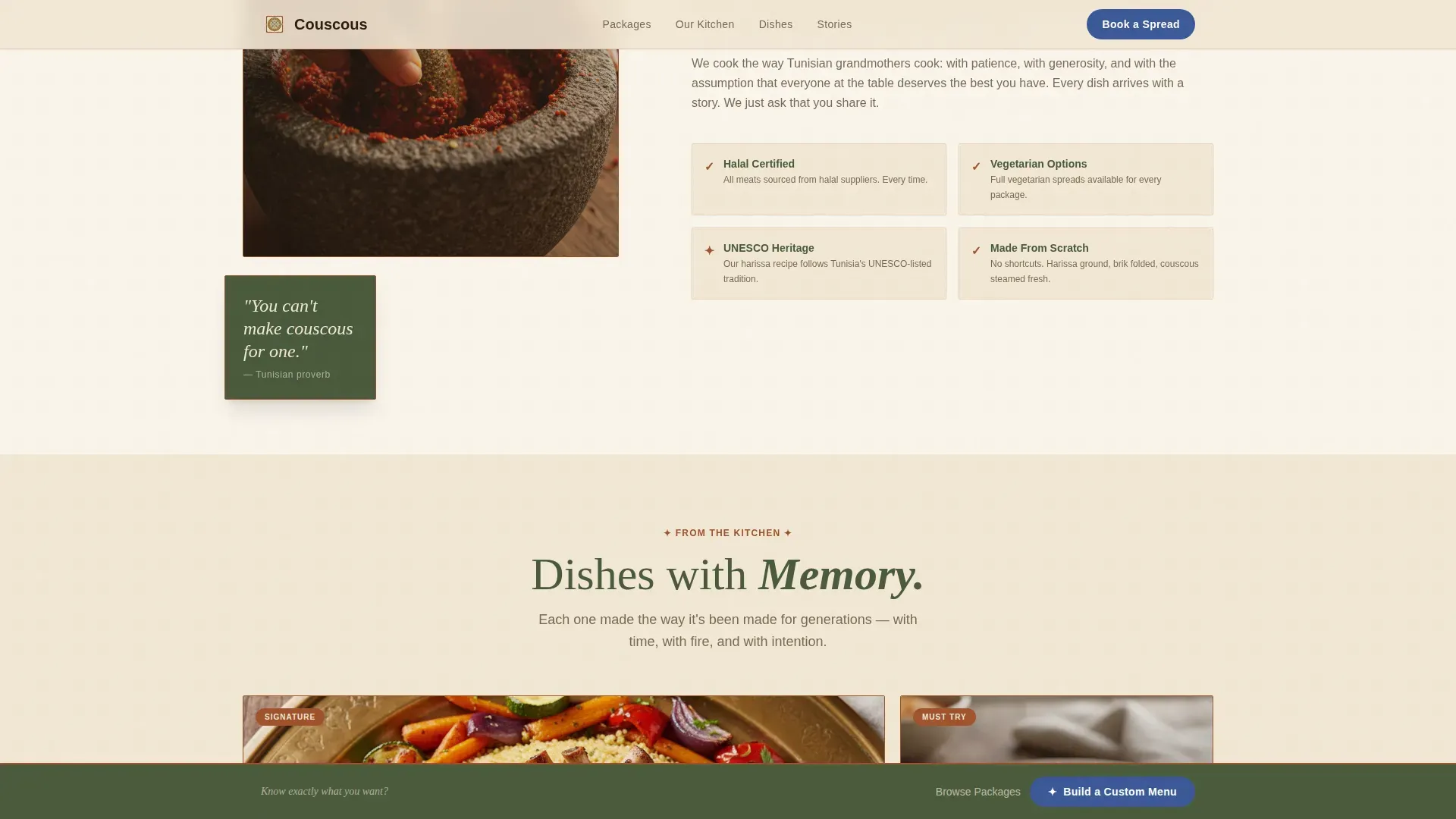
A sticky bottom bar anchors a secondary conversion path labeled "Build a Custom Menu." Clicking it opens a guided dish selector where visitors toggle individual Tunisian dishes, such as ojja, kafteji, and makroudh, onto a visual tray that fills as each item is chosen. The animation connects the act of choosing with the feeling of preparing a real meal.
Philosophy and Story Section
A dedicated section tells the grandmother's kitchen narrative: harissa ground by hand each morning, brik pastry cooked fresh and shattering at first bite. This section adds trust by communicating handmade credentials. It is the emotional center of the page, placed after the package cards to reward visitors who are already engaged.
Community Testimonial Block
Neighborhood client testimonials are displayed with names and event types. Social proof from real community members, such as block party hosts and mosque dinner planners, adds credibility and helps new visitors picture their own event on the page. Including testimonials is one of the most effective ways to bring undecided visitors closer to booking.
Page sections overview
| Section | Purpose |
|---|---|
| Hero Full-Bleed | Opens with overhead brass tray photo, headline, and scroll call-to-action |
| Packages Card Grid | Four staggered package cards with per-card inline booking forms |
| Story Philosophy | Grandmother's kitchen narrative, handmade credentials, halal and vegetarian context |
| Signature Dishes | Visual tray showcase of core couscous dishes and sides |
| Community Proof | Neighborhood client testimonials with names and event types |
| Footer Arc Split | Logo and tagline on left, navigation links on right |
Design & branding system
The visual identity follows a Neo-Retro direction that feels like a hand-painted ceramic plate found in a Tunis medina. Warm earth tones are covered in the parchment and rust palette, punctuated by the sharp geometry of zellige mosaic patterns. Fraunces serif display type and DM Sans body type create a contrast between heritage warmth and modern clarity.
- Color system: sun-bleached parchment (#F2E8D5) backgrounds, terracotta rust (#A0522D) card borders and accents, deep olive (#4A5A3C) headings, and faded indigo (#3B5998) for interactive buttons and calls-to-action
- Texture and pattern: parchment grain covered in backgrounds, zellige tile geometry framing cards, thin rust border lines that evoke hand-painted ceramic plates
- Typography pairing: Fraunces for display headings (warm, editorial, rooted in tradition) and DM Sans for body text and form labels (clear, readable, modern)
Mobile & speed optimization
Community organizers most often book events from their phones, so the template is built mobile-first from the ground up. The card grid reflows naturally for smaller screens, and inline forms remain easy to tap and complete on a phone without zooming or scrolling horizontally.
- Staggered card layout adapts to single-column mobile view, ensuring each package card is fully readable and bookable on a small screen
- Sticky bottom bar stays anchored on mobile, giving phone users a persistent path to the custom menu builder at any point during their view of the page
- Scroll animations and card reveal effects are designed to remain smooth and purposeful on mobile devices, adding visual interest without adding friction
How this template helps you convert
The page earns the booking by following a deliberate order. Food appears first, community context appears second, and the form appears only after the visitor has already imagined the table. Every design decision is in service of that sequence.
- High-quality food imagery in the hero and signature dish sections creates immediate appetite and sets the taste of what is being offered before any pricing or package detail is shown, making the value of the service felt rather than just stated
- Each package card is a self-contained conversion unit with its own inline form, so visitors can book the specific spread that matches their occasion without leaving the card or navigating to a separate page
- The sticky bottom bar and custom menu builder provide a secondary path for visitors who are not ready to commit to a package but want to explore individual dishes, ensuring no visitor leaves without a meaningful next step
Other information about this template
This template documents a specific intersection of catering category, visual design, and conversion structure. It is worth reading the following context before you download and customize.
- Tunisian cuisine developed across centuries of civilizations passing through the country: Berbers, Romans, Muslims, Ottomans, and then influence from France and Italy. That layered history gives the cuisine depth and makes it a natural centerpiece for a culturally rich landing page.
- Couscous is derived from semolina and is the main traditional dish of Tunisia. It is cooked and served differently across regions: with fish along the coast, and with lamb or chicken in the south and west. The recipe varies, and that regional variety is a selling point worth surfacing in your card copy.
- Authentic Tunisian couscous is cooked and served with meat, vegetables, and chickpeas. The color ranges from orange to red depending on the amount of meat broth and harissa added. That colorful appearance is exactly the kind of visual detail that reads beautifully in food photography and helps each package card stand out.
- Brik, one of the signature dishes cooked in this cuisine, is made by wrapping pastry dough around fillings including potatoes, eggs, and tuna. Lablabi is a chickpea soup flavored with garlic and cumin. Masfouf is a sweet couscous dish covered in butter and sugar, often adorned with dates. Mloukhia is a lamb or beef stew cooked in a sauce of dried mallow and olive oil, taking at least six hours to prepare.
- The cuisine is heavily based on olive oil, spices, tomatoes, seafood, and meat. These ingredients give every dish a warm mediterranean character that connects Tunisia to the broader Mediterranean cuisine tradition shared with Morocco, Algeria, and parts of southern France.
- This template is positioned as the couscous authentic tunisian catering landing page template for services operating in North African food niches across US neighborhood geographies such as Brooklyn, Chicago, and Detroit cultural communities.
- The moroccan catering market shares many of the same community-driven occasions and mediterranean flavors, making this template useful for cross-cultural catering brands that serve both Tunisian and Moroccan menus.
- Download the template, swap in your own photos and package names, update the inline form destination, and you are ready to launch. The modular card structure makes it straightforward to add or remove a card if your catering service offers more or fewer package tiers.
- Social media connect links are included in the footer, giving visitors a way to view your wider catering world beyond the landing page and helping you build ongoing community presence across platforms.
Theme
Neo-Retro
Creative direction
Local & Neighborhood
Color system
Parchment & Rust
Style
Card Grid (Modular)
Direction
Marketplace/Multi
Page Sections
Full-bleed Hero with Brass Tray Photography
Staggered Modular Package Card Grid
Per-card Inline Booking Forms
Custom Menu Builder with Visual Dish Tray
Philosophy and Community Story Section
Neighborhood Testimonial Block
Related questions
Can I add or remove catering package cards from the grid?
How does the inline booking form on each card work?
Is the custom menu builder included in this template?
Does the template include a section for client testimonials?
What makes this template a good fit for a Tunisian catering service specifically?