Regulatory & Licensing Professional Website Template
The Boards landing page template is built for medical regulatory bodies that need to establish institutional authority and move visitors toward donating. It combines a data-driven zigzag layout, an animated icon grid header, and a three-step inline donation form. Every section tells one chapter of the board's work, from licensing volume through disciplinary hearings, so the scroll reads like a compelling annual report.
by Rocket studio
Quick summary
This template gives a medical board a single-page fundraising presence that carries the weight of public trust. The layout presents verified data, escalating stakes, and clear giving levels so every visitor understands exactly why their support matters. It is designed for regulatory organizations that protect health and need donor funding to keep doing it well.
Who this template is for
State medical boards and similar regulatory bodies serve a wide range of visitors in a single session. Some are refreshing a license status page at midnight. Others are preparing documents for a credentialing review. This template is built to serve all of them without losing its primary fundraising focus.
- Philanthropic donors, hospital administrators, and health care foundations looking to fund regulatory infrastructure that protects patient care
- Credentialing coordinators and health care professionals who need quick access to board data and license status while also encountering the donation path
- Legislators, public members, and policy researchers who follow physician discipline data and want a clear report of the board's mission
What problem this template solves
Medical board websites often suffer from a split identity. They try to serve physicians seeking a license application update, the public checking complaint history, and major donors all at once, and they end up serving none of them well. The result is cluttered navigation, buried certification data, and a donation ask that feels like an afterthought.
- The template separates the fundraising narrative from routine services without removing either, so physicians can still access the eligibility requirements they need while donors receive a focused data story
- Regulatory organizations struggle to show the real cost of their work. This layout surfaces concrete data, such as investigation timelines and licensing volume, so the funding gap feels real rather than abstract
- Most boards lack a structured giving path. The three-step inline donation form and sticky bottom bar resolve that by making it easy to submit a contribution at exactly the moment a visitor is most moved by the data they just read
What you get with this template
The template ships as a complete, single-page fundraising layout designed around the board's annual report rhythm. Every section is a self-contained data story, and every story ends with a clear reason to give. The design keeps health care authority visible in every block.
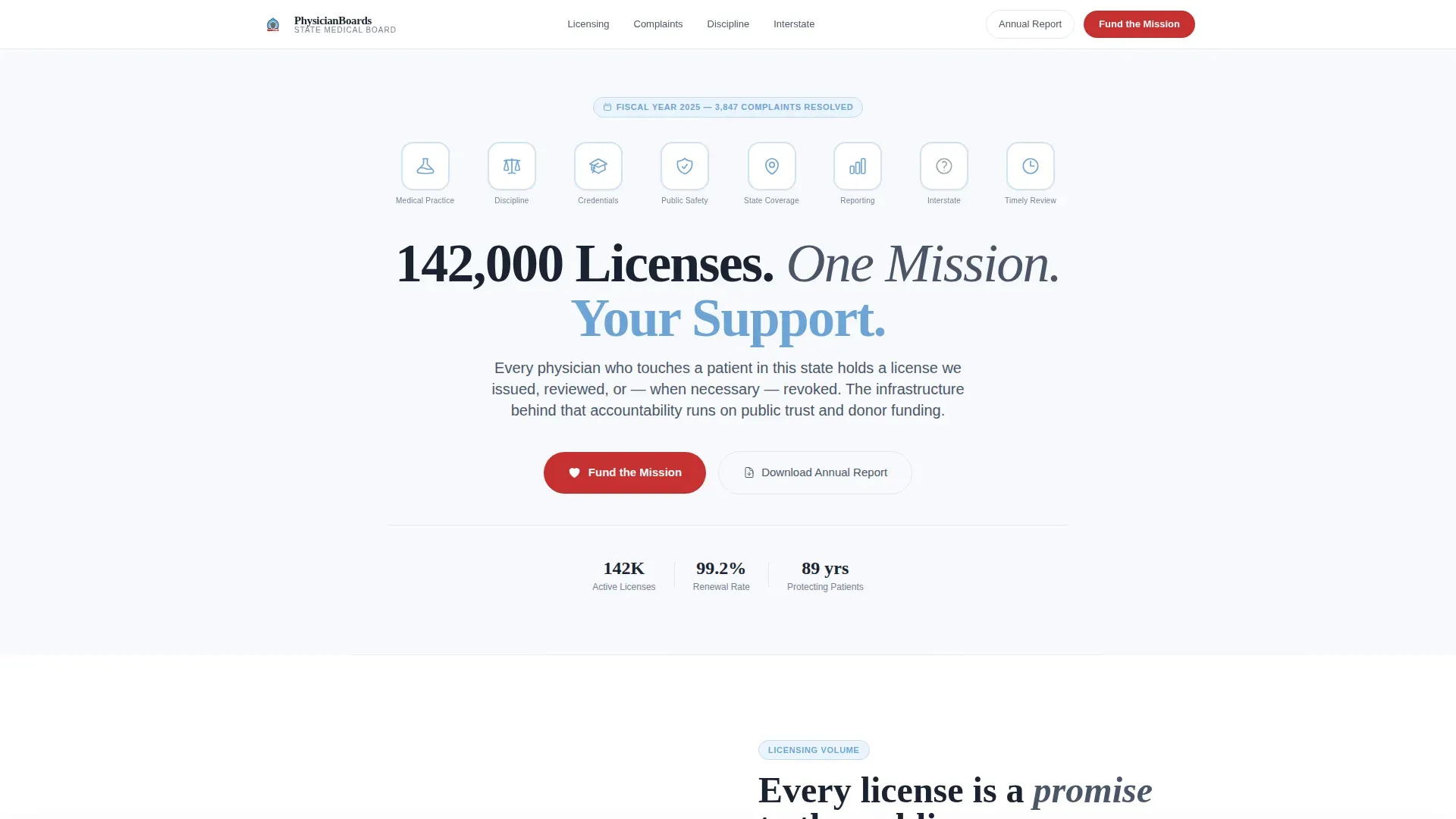
- An animated icon grid header with eight line icons representing the board's reach, a bold headline referencing 142,000 licenses, and a primary "Fund the Mission" call to action in mission red
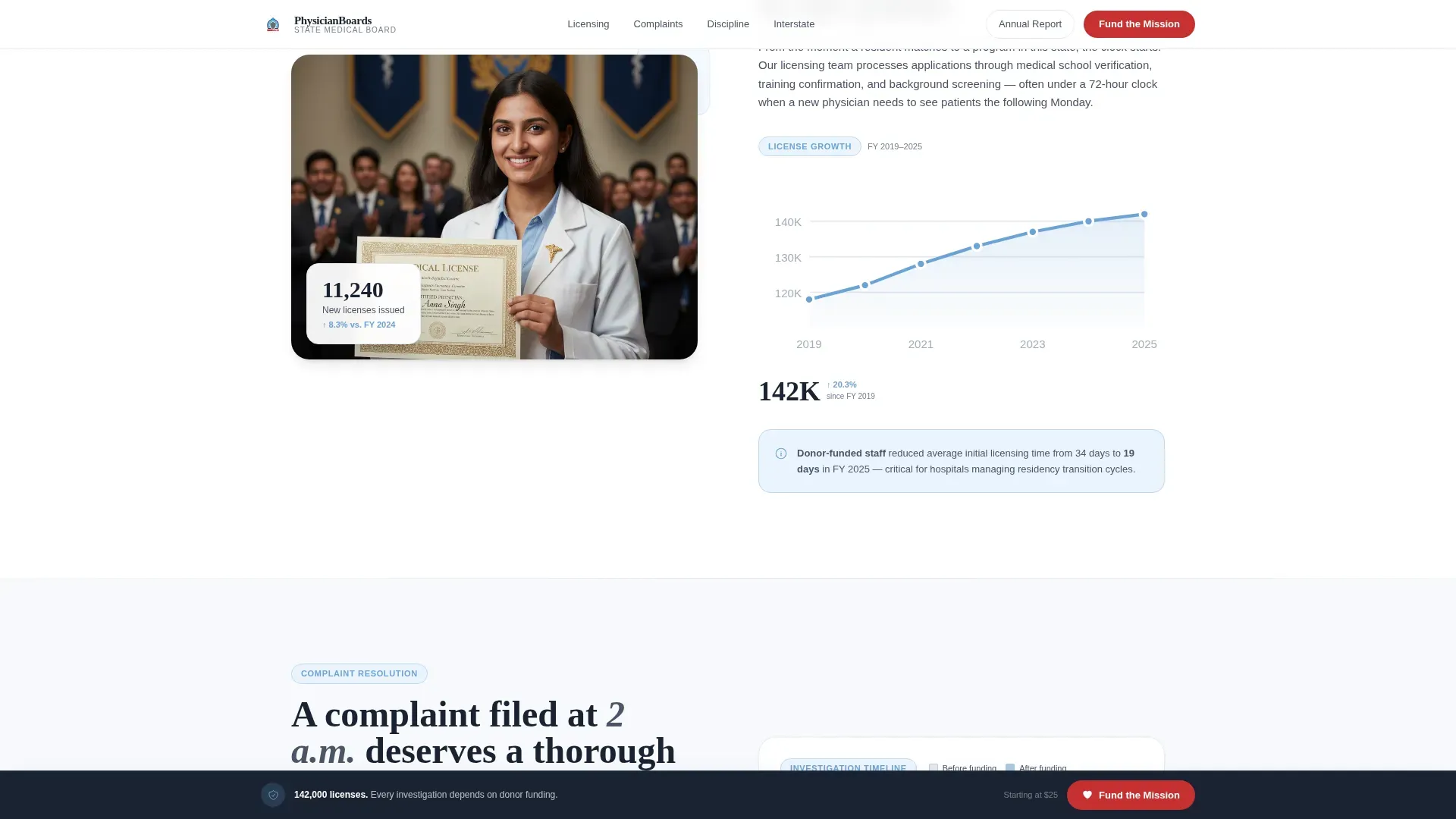
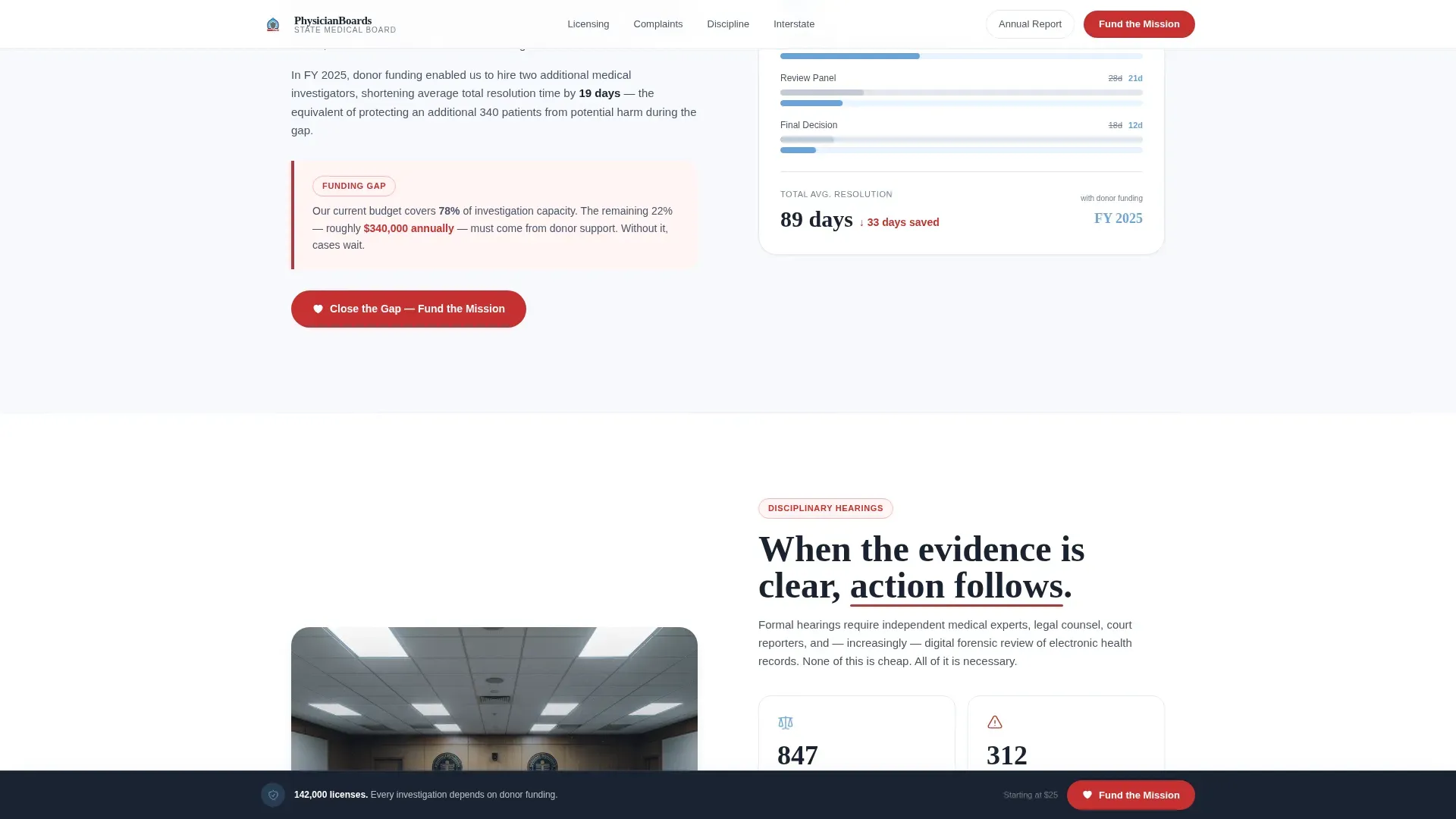
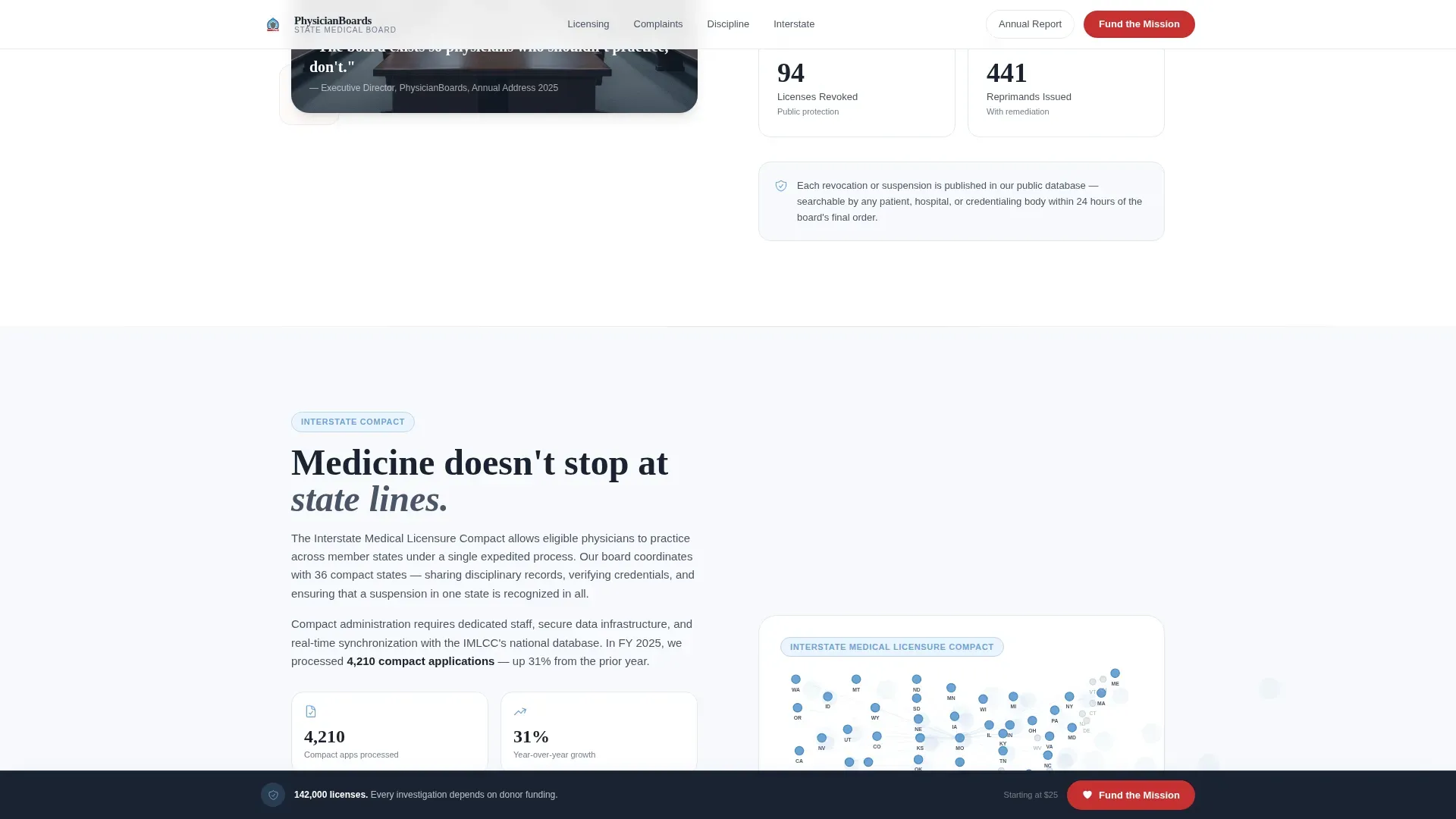
- Four alternating zigzag content blocks covering licensing volume, complaint resolution, disciplinary hearings, and interstate compact coordination, each pairing a visual asset with a narrative that names a specific funding gap
- A three-step inline donation form with four pre-set giving levels tied to named impacts, plus a secondary "Download the Annual Report" email capture path for visitors who are not yet ready to give
Feature list
This template is built around specific interactive and visual capabilities described in the source brief. Each feature below maps directly to a design or functional decision in the layout.
Animated Icon Grid Header
The header opens with eight rounded-square icon tiles fading in left to right as the page loads. Icons include a stethoscope, gavel, diploma scroll, shield, map pin, bar chart, handshake, and clock. The staggered animation feels like items on a checklist being completed, giving the board immediate visual authority before a word is read.
Zigzag Data Storytelling Layout
Each of the four main content blocks alternates image-left/text-right and text-left/image-right. The sequence escalates from routine licensing volume through complaint resolution timelines, disciplinary hearings, and interstate compact coordination. Each block functions as one chapter of a report, with a data callout in sky blue and a funding-gap conclusion that naturally leads to the donation form.
Three-Step Inline Donation Form
The giving form is embedded directly in the page rather than opening a separate window. Step one presents four pre-set amounts: $25 covers one license verification, $75 funds a credentials review, $150 sponsors a complaint intake, and $500 covers a full investigation month. Step two captures name and email. Step three handles payment. The stepped layout reduces friction and keeps donors in context.
Sticky Donation Bottom Bar
After the visitor scrolls past the second data section, a persistent bottom bar appears carrying the "Fund the Mission" call to action in mission red. The bar stays visible as the reader continues through the escalating data story, so the giving path is always one tap or click away without interrupting the content flow.
Secondary Email Capture Path
Visitors not yet ready to give can select "Download the Annual Report." This path captures name and email and positions the board to follow up with quarterly impact data. The capture modal keeps the primary donation path intact while nurturing a second audience toward a future giving decision.
Cloud Canvas Color and Typography System
The layout uses a four-color palette: soft cumulus white (#F7F9FC) for open backgrounds, steady slate (#4A5568) for body text and section dividers, clinical sky blue (#6BA3D6) on data callouts and interactive highlights, and mission red (#C53030) reserved exclusively for the donate button and urgent-need statistics. Fraunces serif headlines pair with DM Sans body text to achieve the institutional authority of an industry report with enough warmth to remind readers that human lives are behind every number.
Page sections overview
| Section | Purpose |
|---|---|
| Icon Grid Header | Establish authority and present the "Fund the Mission" primary call to action |
| Licensing Volume Block | Tell the data story of physician certification volume with a rising-line micro-chart |
| Complaint Resolution Block | Show investigation timelines and explain how donor funding shortened the process by nineteen days |
| Disciplinary Hearings Block | Escalate stakes with hearing data and explain the cost of a full disciplinary process |
| Interstate Compact Block | Show coordination reach and present the "Download the Annual Report" email capture |
| Linear Footer | Provide contact information, legal notice, and supporting links in a single-row layout |
Design & branding system
The visual identity follows an Educational Guide theme layered over an Industry Report creative direction. Every color choice and typographic decision reinforces the board's dual role: a trusted public institution and an organization asking for voluntary support. The palette communicates health authority without feeling cold.
- Four-color Cloud Canvas system: cumulus white backgrounds, slate text, sky blue data highlights, and mission red reserved only for donation calls to action and urgent statistics, so the red never loses its urgency through overuse
- Fraunces serif headlines give the page the weight of a published report. DM Sans body text keeps the body copy readable at any length, which matters when credentialing coordinators and legislators are reading detailed information about investigation timelines
- Rounded-square icon tiles, deliberate white space, and a clean section-divider system reduce visual noise so each data story lands with full impact, building the sense of reliability that health care organizations depend on
Mobile & speed optimization
The template is desktop-first because credentialing coordinators and legislators primarily access the board on larger screens. Full mobile support is included because health care professionals also visit on phones, particularly physicians checking license status or eligibility on the go. The layout adapts without sacrificing the data-story structure.
- Static content sections are built as server components so the page loads quickly even when the animated icon grid and scroll-reveal effects are active
- The three-step donation form and sticky bottom bar are built as client components, keeping interactivity isolated so it does not slow the read path for visitors who arrive only to access license data or contact board staff
- Scroll-reveal animations powered by GSAP ScrollTrigger trigger as each zigzag block enters the viewport, maintaining the annual-report pacing on both desktop and mobile without requiring heavy assets
How this template helps you convert
Every layout decision in this template is oriented toward a single outcome: converting informed readers into donors. The escalating data story does the persuasion work, and the donation form removes every possible barrier at the moment the visitor is ready to act.
- The icon grid animation establishes credibility in the first five seconds so that philanthropic donors, hospital administrators, and health care foundations arrive at the first zigzag block already trusting the data they are about to read
- Each alternating content block ends with a named funding gap, so the "Fund the Mission" button appears at the exact moment the visitor understands what their fee or gift will accomplish, linking giving levels to specific regulatory outcomes like license verification or a completed investigation month
- The sticky bottom bar and secondary email capture path ensure that no visitor leaves without taking some action, whether that is submitting a donation or downloading the annual report, creating a two-track nurture system from a single landing page visit
Other information about this template
This template is designed to reflect how state medical boards actually operate and communicate. Several regulatory facts and sector norms shaped the content structure and section choices described above.
- State medical boards are responsible for issuing licenses for the practice of medicine in their respective states. Each state medical board enforces a Medical Practice Act that defines the requirements for practicing medicine, and the template's data sections are structured to reflect those statutory obligations.
- Medical boards are typically composed of volunteer physicians and public members appointed by the governor. Board staff carry the day-to-day responsibility of processing every license application, handling fee payments, and managing the documents submitted by each applicant.
- The Federation of State Medical Boards assists state medical boards in their mandate to protect public health and safety through proper licensing and discipline. It also provides a directory with contact information for each board across all 50 states, the District of Columbia, and United States territories.
- State medical boards issue licenses for the general practice of medicine, which includes allopathic (MD) and osteopathic (DO) categories. The licenses are undifferentiated, meaning physicians are not licensed based on specialty or practice focus. Certification in a specific medical specialty, such as internal medicine or surgery, is not required to obtain a license to practice medicine.
- Board certification helps physicians demonstrate their expertise in a specific medical specialty and can enhance job prospects. The certification process typically involves completing an accredited residency program and passing a specialty board examination. The American Board of Medical Specialties (ABMS) represents 24 certifying boards and nearly one million active board certified physicians.
- States are authorized under the United States Constitution to establish laws and regulations protecting the health, safety, and general welfare of their citizens. Each of the 50 states and United States territories has enacted laws that govern the practice of medicine and outline the responsibility of state medical boards to regulate that practice.
- Applicants for medical licenses must meet specific educational and training requirements as outlined by state medical boards. Most state medical boards require applicants to submit their applications electronically. Many have transitioned to a fully paperless application process to improve efficiency.
- The Controlled Substance Utilization Review and Evaluation System (CURES) fee will increase for licenses with certain expiration dates, and boards and bureaus under the Department of Consumer Affairs must expedite licensure application processing for eligible service members in qualifying federal programs beginning July 1, 2024.
- Navigational paths in the template can be adapted for distinct user groups such as physicians, the public, and health care organizations. Contact information is positioned prominently in the footer so the board does not appear evasive to any visitor.
- This is the boards trusted medical licensing regulatory landing page template, built to serve regulatory bodies that protect public health through licensing, certification, and disciplinary oversight of physicians and other health care professionals.
- State medical boards adopt policies and guidelines to improve the overall quality of health care. The structure and authority of medical boards vary from state to state, with some being independent and others sitting within larger department-level agencies.
- The template can support content relating to pharmacists, pharmacy licensing, and controlled substances regulations where those areas fall within the board's authorized scope of practice. Note that coverage of such regulated categories should follow the board's verified eligibility requirements and published regulations before any related section is published.
- Organizations seeking further information about adapting the license reinstatement, unrestricted license, or clinical skills assessment sections of this layout can use the secondary email capture path to direct visitors to the appropriate board office or external resource. Detailed information about training program requirements and medical education standards can be linked from the interstate compact block or the report download path.
- Medical schools and medical education institutions are frequent partners of state medical boards. The template's development was informed by the need for health care organizations to achieve compliance with medical regulations while maintaining a public-facing presence that builds trust through data, not just claims.
Theme
Educational Guide
Creative direction
Industry Report
Color system
Cloud Canvas
Style
Zigzag/Alternating
Direction
Donation/Fundraising
Page Sections
Animated Icon Grid Header
Zigzag Data Story Blocks
Three-step Inline Donation Form
Sticky Donation Bottom Bar
Secondary Email Capture Path
Cloud Canvas Color System
Related questions
Who is the primary audience this landing page is built for?
Can the donation form giving levels be changed?
Does this template include a path for visitors who are not ready to donate?
What makes this layout suitable for a regulatory body rather than a generic nonprofit?
Can the template support content about physician certification and specialty boards?