Precision Connector Manufacturer Landing Page Template
Crimp is a zigzag landing page template built for connector and cable manufacturers. It pairs a cinematic production-line header with escalating case study sections, a Carbon Fiber color system in deep graphite, machined aluminum, and furnace orange, and two conversion paths: a direct engineering review request form and a gated connector selection guide download.
by Rocket studio
Quick summary
Crimp is a single-page template designed for precision connector and cable manufacturers. It opens with a behind-the-scenes production video header and flows through alternating case study sections that build credibility by industry. Two lead capture paths serve buyers at different stages, from active sourcing to early research.
Who this template is for
This template is built for manufacturers who need to earn buyer trust before asking for a meeting. It speaks directly to technically minded audiences who evaluate vendors on demonstrated capability, not marketing claims.
- Connector and cable manufacturers sourcing leads from procurement engineers and OEM design teams
- Contract manufacturers presenting capabilities across volume tiers, from prototype runs to 50,000-unit production
- Industrial suppliers targeting clients in aerospace, defense, medical, automotive, and telecom sectors
What problem this template solves
Most manufacturing landing pages either look too generic or bury the proof. Procurement engineers sourcing MIL-spec (military specification) harnesses under deadline need to see capability evidence fast. This template solves the credibility gap by leading with manufacturing reality rather than marketing language.
- Visitors leave before trust is established because the page shows no deployment proof
- High-intent buyers in regulated industries need spec-level detail before they will request a quote
- Two different buyer stages, active sourcing and early research, require separate conversion paths on the same page
What you get with this template
You get a fully structured zigzag landing page with alternating dark and light sections, each built around a case study narrative arc. The layout escalates from lower-stakes deployments to defense-grade applications, raising the credibility ceiling with each scroll.
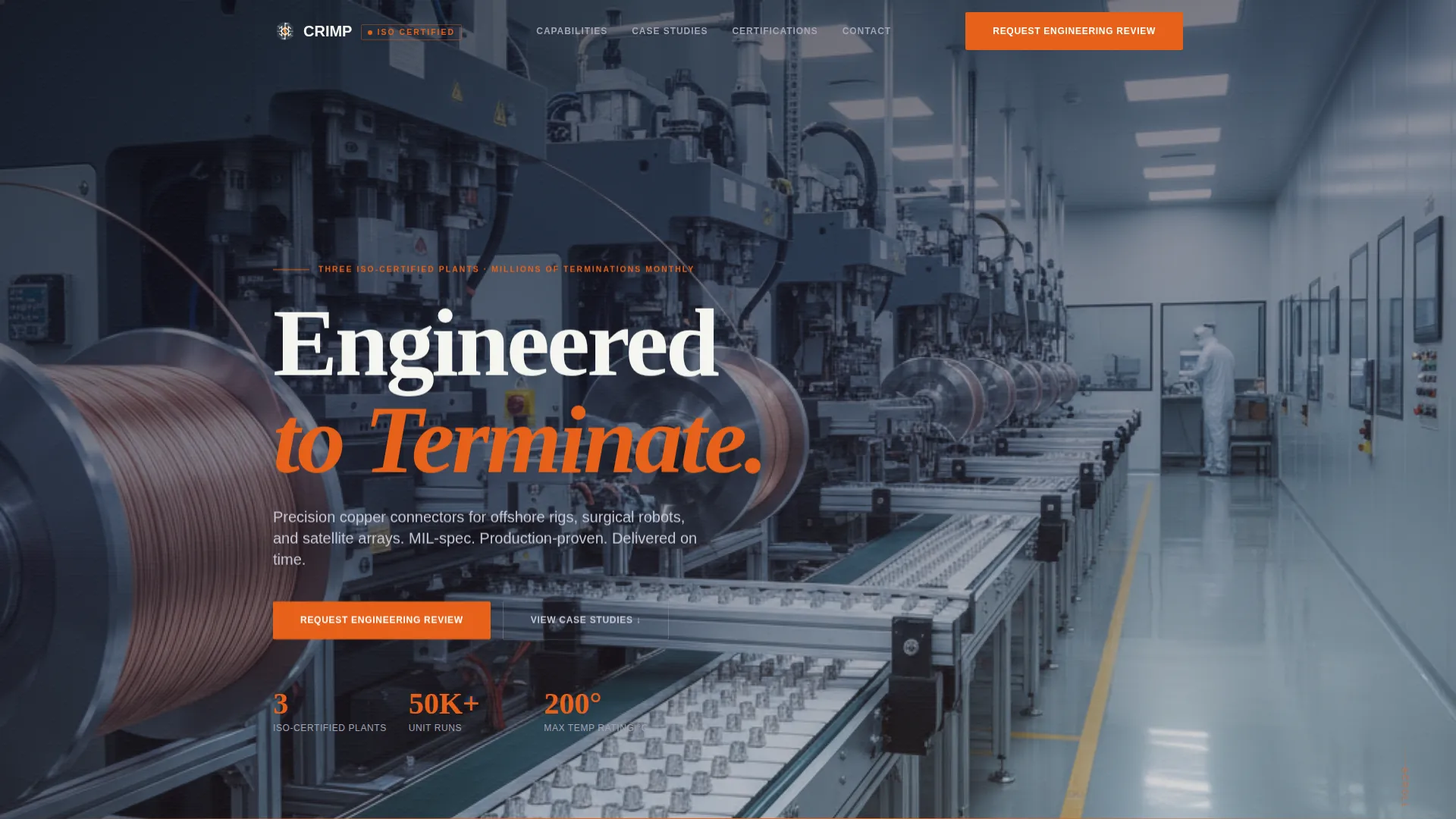
- A cinematic 4K production-line header section with overlay headline typography
- Four escalating case study sections covering consumer electronics, automotive, aerospace, and defense
- Two lead generation components: an engineering review intake form and an email-gated guide download
Feature list
This template includes purpose-built sections and conversion components drawn directly from the source brief. Every element is designed to match the expectations of technical buyers in high-stakes manufacturing categories.
Cinematic Behind-the-Scenes Header
The header features a slow dolly video shot along the production line, moving from raw copper wire through stamping, coiling, crimping, continuity testing, laser marking, and overmolding in one continuous take. The headline "Engineered to Terminate" appears in machined-steel typography as a finished connector assembly drops into a tray. This section sets the manufacturing credibility tone immediately.
Escalating Case Study Narrative Sections
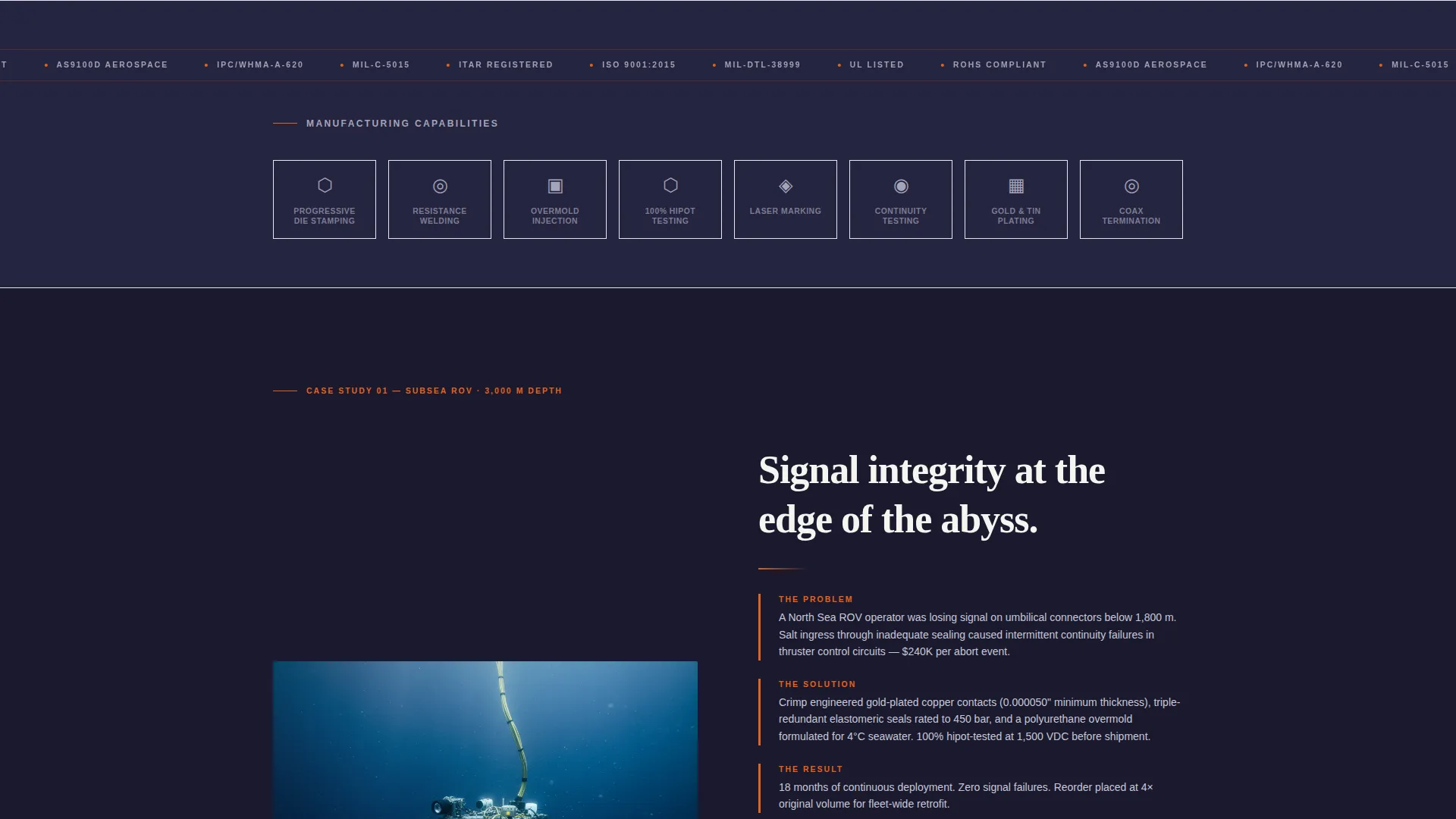
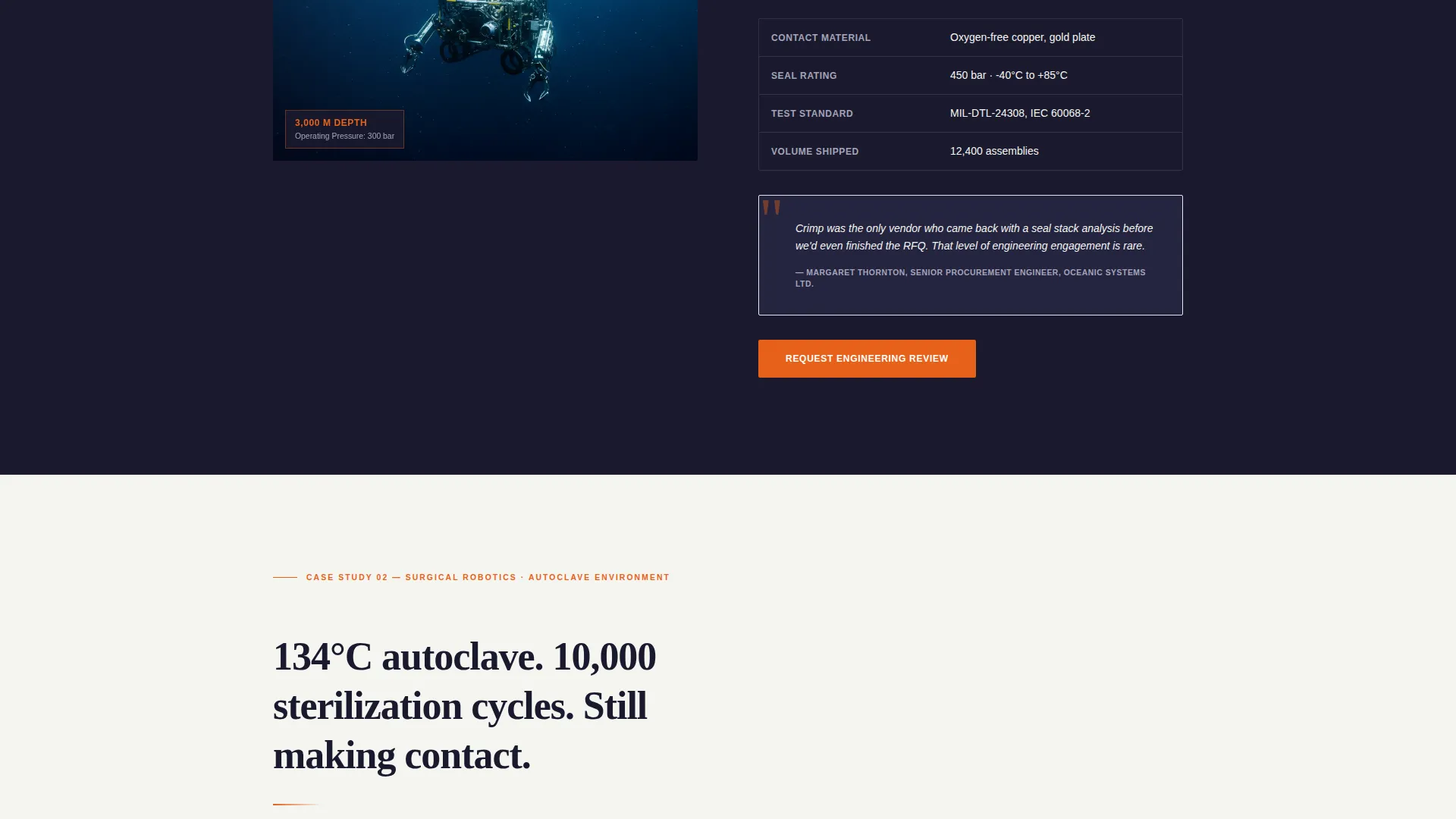
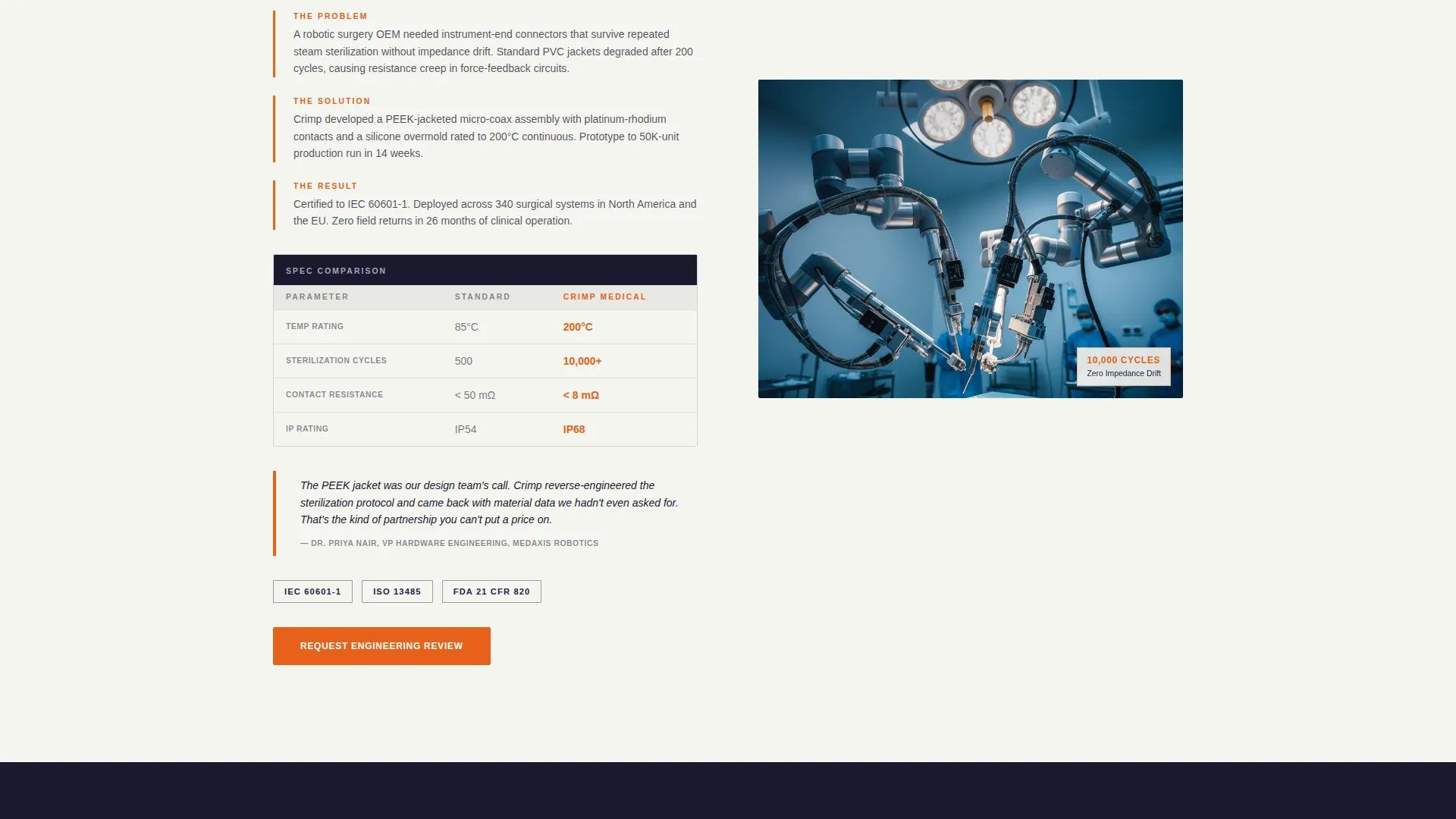
Each zigzag section tells one deployment story in three beats: the engineering problem, the manufacturing solution, and the measured field result. Stories escalate from consumer electronics to automotive to aerospace to defense. Dark graphite sections carry hero application photography while clean-room white sections hold exploded-view diagrams, spec comparisons, and pull-quote testimonials.
Engineering Review Intake Form
The primary call to action is "Request Engineering Review," a short-form intake that collects application environment via dropdown, estimated annual volume, and an optional file upload for drawings or spec sheets. The furnace orange button repeats at the close of every case study section, earning the click after each proof point.
Gated Connector Selection Guide Download
A secondary conversion path offers a downloadable connector selection guide behind an email gate. This captures top-of-funnel visitors who are still in the research phase without forcing a premature sales conversation.
Carbon Fiber Color System
The palette uses deep graphite (#1A1A2E), machined aluminum (#A4A4B8), furnace orange (#E8611A), and clean-room white (#F5F5F0). Dark sections alternate with white spec panels, creating a visual rhythm that mirrors the industrial environment described in the brief.
Spec Tables and Exploded-View Diagram Panels
White sections include structured spec comparison tables and exploded-view diagram layouts. These give procurement engineers and OEM design teams the technical detail they need to evaluate connector suitability before reaching out.
Page sections overview
| Section | Purpose |
|---|---|
| Production Line Header | Establish manufacturing credibility with cinematic video and headline |
| Case Study One | Consumer electronics deployment story with problem, solution, result |
| Case Study Two | Automotive application narrative with spec comparison panel |
| Case Study Three | Aerospace deployment story with exploded-view diagram |
| Case Study Four | Defense-grade case study with pull-quote testimonial |
| Engineering Review Form | Primary lead capture for active sourcing buyers |
| Selection Guide Gate | Secondary email capture for research-phase visitors |
Design & branding system
The Industrial Raw theme is expressed through a Carbon Fiber color system that feels like a stamping facility at shift change. Every color choice has a functional role: graphite grounds the layout, aluminum provides midtone structure, orange marks every action point, and white opens space for technical detail.
- Deep graphite (#1A1A2E) for dark alternating sections and hero photography backgrounds
- Furnace orange (#E8611A) for all call-to-action buttons, data callouts, and visual emphasis points
- Clean-room white (#F5F5F0) for spec table panels, exploded-view sections, and pull-quote testimonials
Mobile & speed optimization
The zigzag alternating layout is structured to reflow naturally on smaller screens, stacking case study content vertically without losing the three-beat narrative structure. Visual weight is managed through the color system rather than relying on decorative elements.
- Alternating sections stack cleanly on mobile, preserving the problem-solution-result story arc per case study
- Furnace orange call-to-action buttons remain prominent and tappable at all viewport sizes
- Spec tables and diagram panels are contained within white sections, keeping technical detail readable on narrow displays
How this template helps you convert
This template is built around a principle of proof before ask. Every conversion moment is preceded by a concrete deployment story. The layout is designed to move two distinct buyer types toward action without pushing either group before they are ready.
- The escalating case study structure builds trust incrementally, so by the time a procurement engineer reaches the engineering review form, the manufacturing capability has already been demonstrated across four industries.
- The dual conversion path serves both active buyers and research-phase visitors on the same page, capturing leads at two funnel stages without requiring separate pages or campaigns.
Other information about this template
This template is well-suited for manufacturers operating across multiple certified facilities and shipping high volumes monthly. The case study narrative format is particularly effective in regulated industries where procurement decisions require documented evidence of field performance.
- The three-beat case study structure (problem, solution, result) works equally well for subsea, surgical, and satellite connector applications
- ISO certification references and hipot (high-potential dielectric) testing callouts can be placed naturally within the white spec panels
- The file upload field in the engineering review form supports buyers submitting drawings or specification sheets, reducing the friction of initial contact
- The template suits manufacturers targeting MIL-spec harness sourcing, custom overmold projects, and high-volume contract manufacturing inquiries
Theme
Industrial Raw
Creative direction
Case Study Narrative
Color system
Carbon Fiber
Style
Zigzag/Alternating
Direction
Lead Generation
Page Sections
Cinematic Production-line Header
Escalating Case Study Sections
Engineering Review Intake Form
Gated Selection Guide Download
Spec Tables and Diagram Panels
Carbon Fiber Color System
Related questions
Who is this landing page template designed for?
Can the template handle both prototype and high-volume production inquiries?
What makes the case study layout effective for industrial buyers?
Does the template include a way to capture leads who are not ready to request a quote?
How does the color system reinforce the industrial tone?