Specialty Farming Professional Website Template
Croak is a commercial frog farm landing page template built for B2B aquaculture operators. It guides high-intent buyers through a scroll-driven lifecycle story, from spawn cluster to market-weight harvest, while front-loading scale proof and sustainability data. The zigzag layout, blueprint visual style, and dual call-to-action system are designed to convert procurement managers into quote requests.
by Rocket studio
Quick summary
Croak is a single-page commercial aquaculture template built around one goal: turning serious buyers into quote requests. It tells the biological story of American bullfrog production through a scroll-driven zigzag layout. Engineering Blueprint visuals, lifecycle photography, and bold sustainability data work together to build buyer confidence before any call to action appears.
Who this template is for
This template is built for operators running commercial-scale frog farming facilities that serve multiple buyer segments. It speaks directly to businesses that need to prove operational credibility before a procurement conversation begins.
- Southeast Asian restaurant suppliers and food service procurement managers sourcing consistent live-weight frog supply
- Pharmaceutical research and development labs buying skin peptides for antimicrobial research programs
- Organic farmers and land managers stocking ponds for natural mosquito and slug biocontrol
What problem this template solves
B2B aquaculture buyers are skeptical by default. They need proof of scale, biological consistency, and supply reliability before they will request a quote or pick up the phone. Most generic agriculture pages fail to deliver that evidence fast enough.
- Buyers leave before seeing yield data, certifications, or survival-rate figures that would build trust
- Fragmented page layouts bury the operational story, making it hard for procurement teams to evaluate capacity
- No clear call-to-action path means high-intent visitors who are ready to buy have nowhere obvious to go
What you get with this template
You get a complete, structured landing page that traces the full production lifecycle while building a layered commercial argument. Every section is designed to carry a specific job, from awareness to conversion.
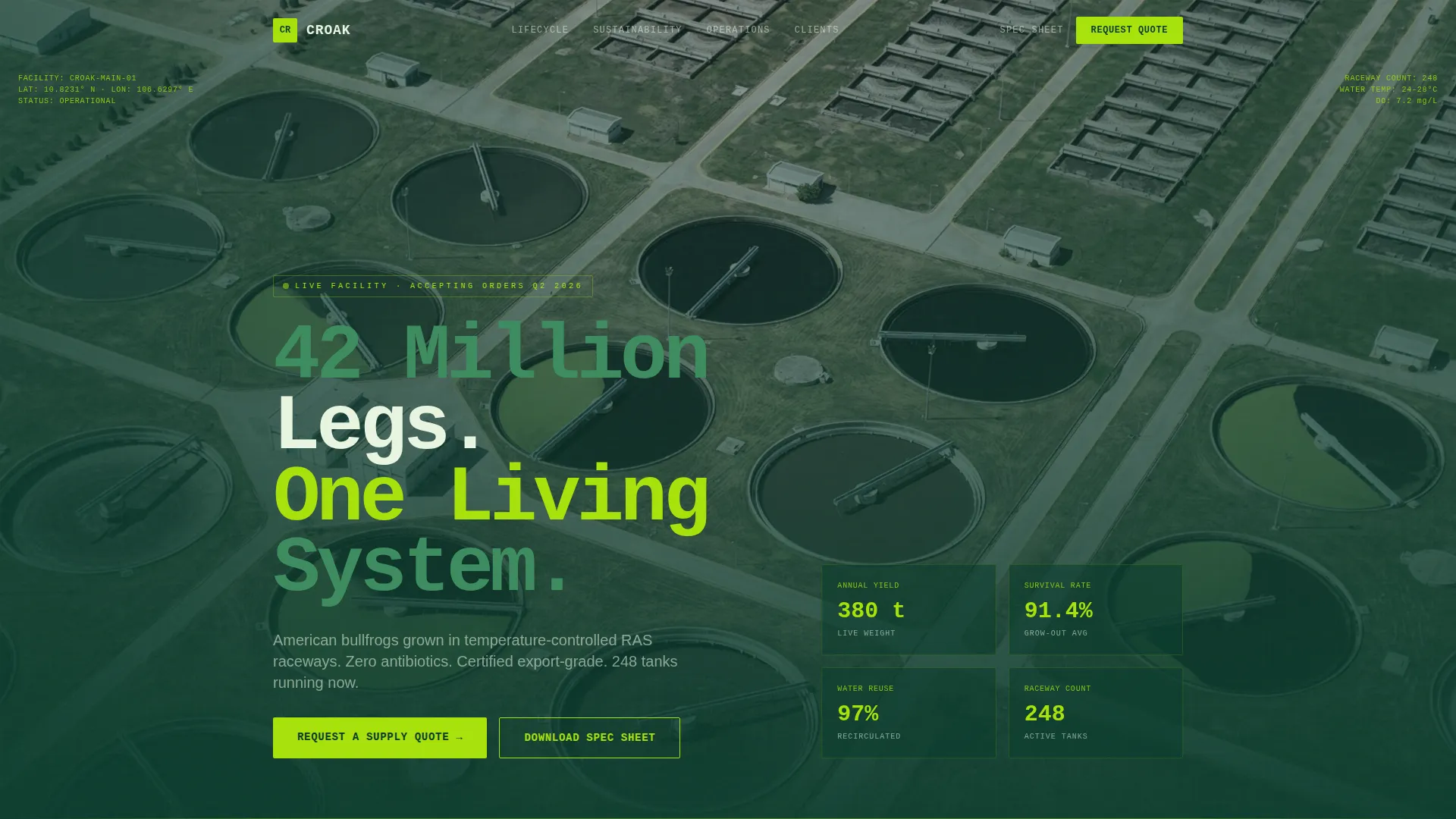
- A panoramic hero section with a monospaced headline, aerial raceway photography, and glassmorphic stat cards
- A four-stage lifecycle zigzag with close-up photography alternating with blueprint-style systems diagrams and engineering annotations
- Three sustainability interrupt sections woven between lifecycle stages, each featuring a standalone environmental impact statistic
- A bento-grid scale proof section displaying tank counts, annual yield tonnage, and export certifications
- A three-panel client segment section serving food service, pharmaceutical, and biocontrol audiences simultaneously
- A dual call-to-action block combining a full-width quote request and a spec sheet download form
Feature list
This template is built around a set of purposeful structural and visual capabilities, each chosen to serve the commercial aquaculture context.
Scroll-Triggered Zigzag Lifecycle Layout
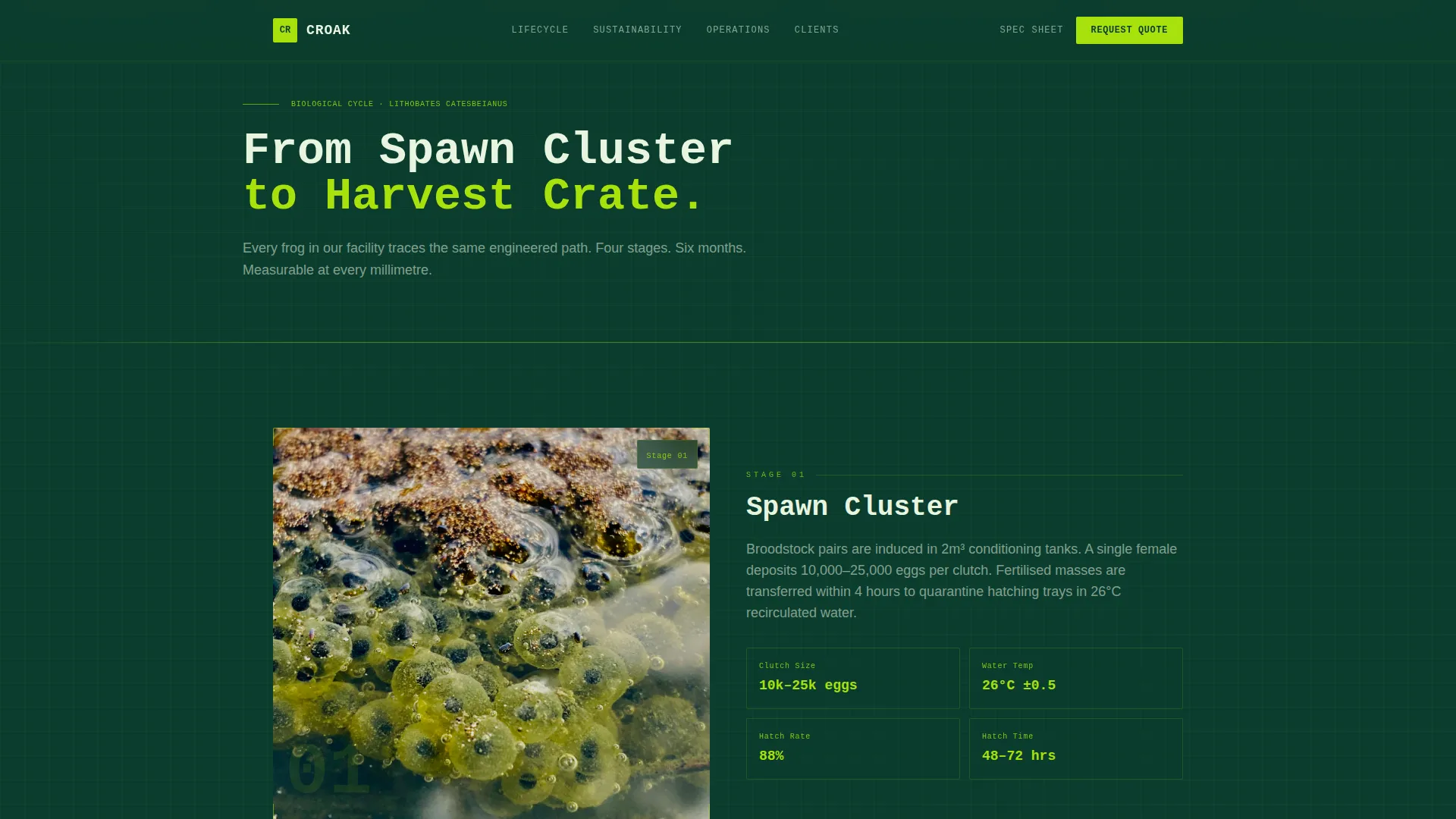
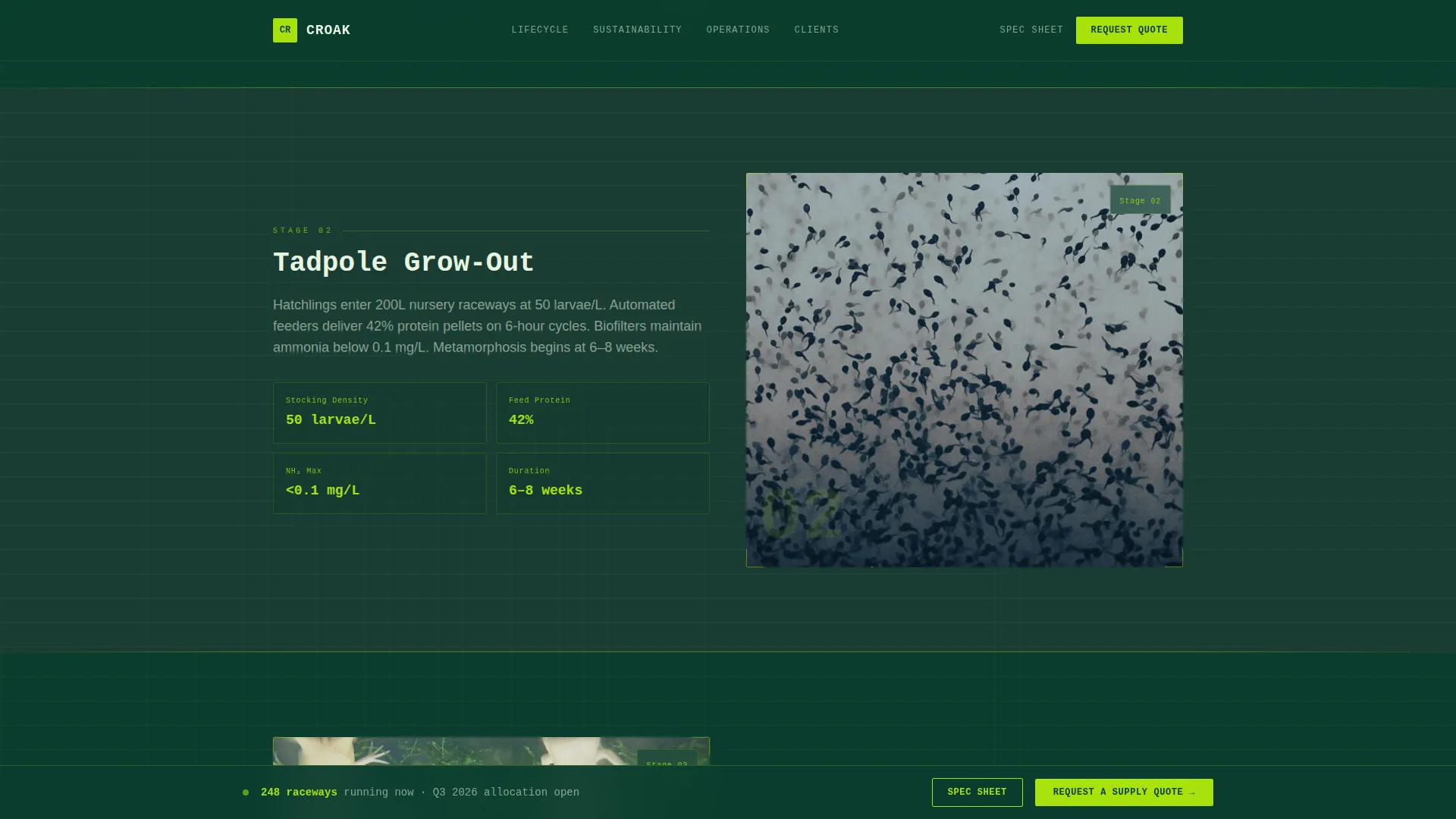
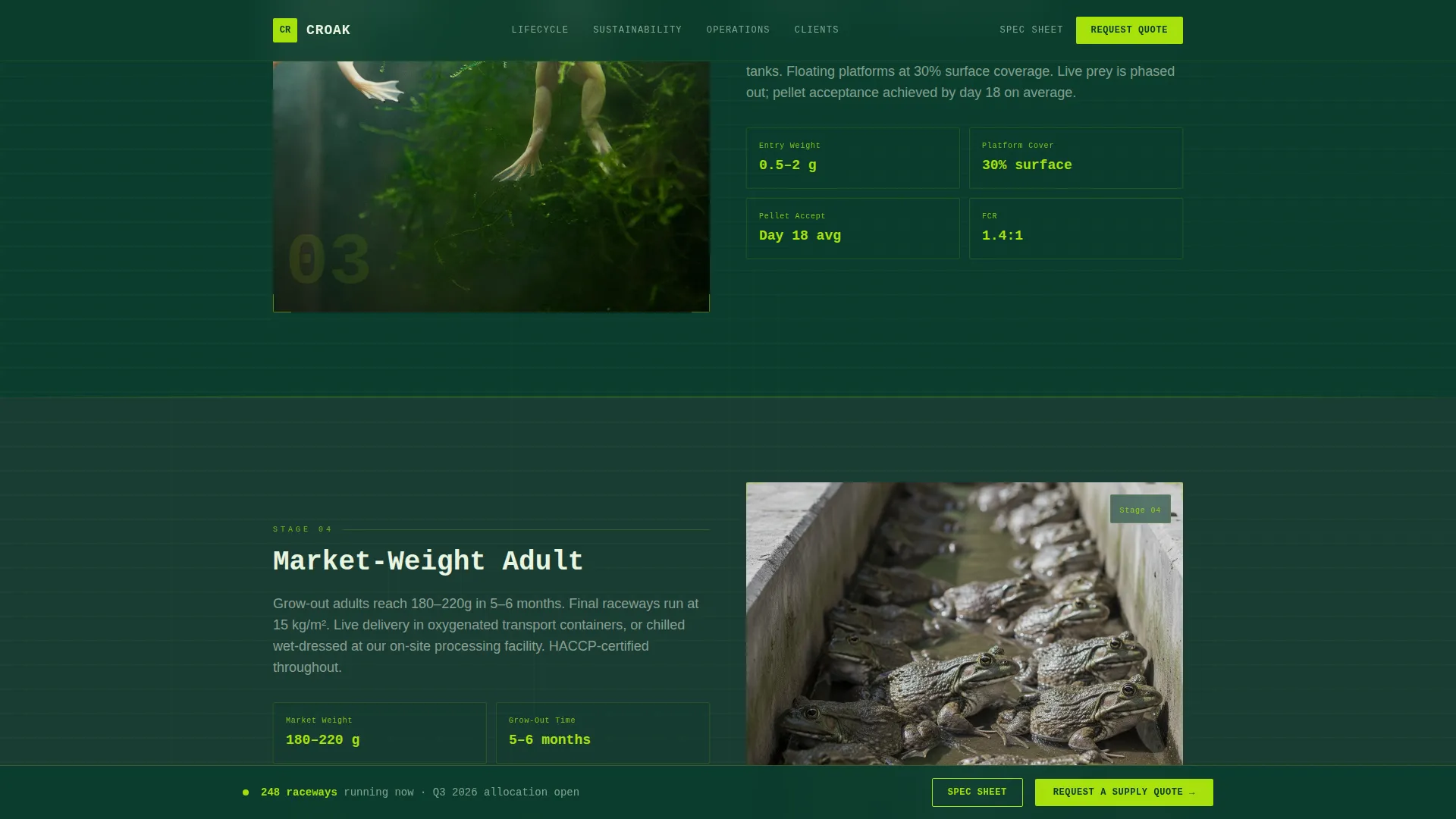
Four alternating sections trace the frog's journey from spawn cluster through tadpole, froglet, and harvest-ready adult. Each section pairs a close-up lifecycle photograph with a blueprint-style diagram, creating a rhythm that keeps buyers reading.
Blueprint Annotation System
Engineering-style data callouts layer over each lifecycle image. Water chemistry panels, feed-conversion ratios, and survival-rate percentages appear as schematic annotations, giving technical buyers the specifics they need without disrupting the visual flow.
Glassmorphic Hero Stat Cards
The hero section combines a full-bleed aerial photograph with semi-transparent stat cards. These front-load the scale proof, showing tank counts, annual yield, and certifications immediately so buyers form a credible first impression before scrolling.
Dual Call-to-Action Conversion System
A sticky bottom bar activates after the second section and stays visible throughout the scroll. A full-width call-to-action block appears again before the footer. Both routes lead to a dedicated quote form on a second page.
Spec Sheet Lead Capture
A secondary call to action offers a downloadable hatchery spec sheet in exchange for an email address. The document covers breeding cycle timelines, yield data, and facility certifications, capturing earlier-funnel visitors who are not yet ready to request a quote.
Sustainability Interrupt Sections
Three standalone stat breaks interrupt the lifecycle sequence at regular intervals. Each one presents a single environmental impact figure, covering water reuse rates, zero-antibiotic protocols, or carbon footprint comparisons against conventional animal protein.
Page sections overview
| Section | Purpose |
|---|---|
| Panoramic Hero | Establish scale and hook attention with aerial imagery and bold headline |
| Spawn Stage | Open the lifecycle story with blueprint-annotated spawn cluster content |
| Sustainability Interrupt One | Introduce water reuse rate as a standalone environmental stat |
| Tadpole Stage | Continue lifecycle zigzag with close-up tadpole photography and diagrams |
| Sustainability Interrupt Two | Present zero-antibiotic protocol as a key environmental credential |
| Froglet Stage | Show mid-growth phase with feed-conversion ratio annotations |
| Sustainability Interrupt Three | Deliver carbon footprint comparison versus conventional protein |
| Adult Harvest Stage | Close the lifecycle with harvest-ready adult imagery and yield data |
| Scale Proof Grid | Display tank counts, annual tonnage, and export certifications |
| Client Segments Panel | Address food service, pharma, and biocontrol buyers in parallel |
| Quote and Spec Sheet | Drive quote requests and email capture before the footer |
Design & branding system
The visual identity blends Engineering Blueprint precision with a lush Rainforest color system. The result feels organic and measured at the same time, like technical schematics drawn on leaves.
- Color palette: deep canopy black-green (#0B3D2E) and murky pond water (#1A3C34) alternate as section backgrounds, wet fern (#3E8C5F) carries headline type, and vivid tree-frog chartreuse (#A8E10C) marks every call-to-action element, data callout, and hover state
- Typography: JetBrains Mono handles headlines and all data annotations for a monospaced blueprint feel, while DM Sans carries body copy for clean readability
- Thin chartreuse rule lines run between sections like schematic wiring drawn on a blueprint overlay, reinforcing the engineering aesthetic throughout
Mobile & speed optimization
The template is designed desktop-first because B2B procurement decisions typically happen at workstations. Full mobile support is included so the page remains usable across all devices.
- Scroll-triggered animations and counter reveals are handled by client components, keeping static sections lightweight and fast to load
- Server components power all static content sections, separating rendering concerns for a smoother experience on slower connections
- Dual-unit display throughout the page shows both metric and imperial measurements, supporting international procurement teams without layout disruption
How this template helps you convert
The page is structured so that trust is earned before any ask is made. Buyers accumulate evidence as they scroll, which means the call to action feels like a logical next step rather than a cold pitch.
- The hero section front-loads scale proof through stat cards and aerial imagery, establishing operational credibility within the first viewport so buyers stay engaged rather than bouncing
- The sticky call-to-action bar appears after the second section and follows the buyer through the rest of the scroll, keeping the quote request path visible without interrupting the lifecycle story
- The spec sheet download offers a lower-commitment conversion point for buyers who need more detail before committing to a supplier conversation, widening the funnel without diluting the primary goal
Other information about this template
This template is purpose-built for the specialty farming and commercial aquaculture niche. It is not a generic agriculture layout adapted for frog farming. Every structural decision, from the section order to the annotation style, reflects the specific sales process of a multi-segment frog production facility.
- The template supports English-language content with USD pricing references and dual metric/imperial unit display throughout
- Animation intensity is high by design, with scroll-triggered zigzag reveals, counter animations, and chartreuse rule lines that draw in as the visitor scrolls
- Blueprint annotation hover states and a lifecycle progress indicator add interactive depth for desktop buyers spending time evaluating the facility
- The footer follows a horizontal flow layout that keeps navigation clean and on-brand without competing with the primary conversion elements above it
Theme
Engineering Blueprint
Creative direction
Movement & Cause
Color system
Rainforest
Style
Zigzag/Alternating
Direction
Click-Through
Page Sections
Zigzag Lifecycle Scroll Layout
Blueprint Annotation Overlays
Panoramic Hero with Stat Cards
Dual Call-to-action Conversion Path
Spec Sheet Email Capture
Sustainability Interrupt Sections
Related questions
Who is this landing page template designed for?
Does the template include the quote request form?
What is the spec sheet download feature?
Can this template support a desktop-first B2B audience?
Can I adapt this template if I only serve one buyer segment?