Organic & Sustainable Farm Blog Website Template
Cultivar is a zigzag landing page template built for aquaponics farms and organic growers. It follows a seasonal narrative arc across five richly photographed sections, guiding visitors from spring seedlings to a glowing winter greenhouse. A botanical color system and editorial typography create warmth and trust, while two clear calls to action drive CSA signups and wholesale inquiries.
by Rocket studio
Quick summary
Cultivar is a single-page landing page template designed for closed-loop aquaponics farms and organic produce operations. It moves visitors through a full growing year using a zigzag alternating layout, botanical visuals, and two distinct conversion paths: a community-supported agriculture subscription and a wholesale restaurant partnership inquiry.
Who this template is for
This template is built for growers and food producers who want a page that feels as alive as their farm. It works especially well for operations that sell directly to consumers and to professional buyers at the same time.
- Aquaponics farms selling community-supported agriculture shares and microgreens to local subscribers
- Farm-to-table restaurant suppliers who need a polished wholesale inquiry path for chefs and buyers
- Urban agricultural educators or school district programs building outreach around a living ecosystem
What problem this template solves
Most farm websites look like brochures. They show a logo, a list of products, and a contact form. Cultivar solves the deeper problem: helping a visitor feel the farm before they commit to buying from it.
- Visitors do not trust faceless produce sources; the template answers that with named varieties, harvest seasons, and chef testimonials
- A single generic contact form loses both retail and wholesale leads; the template provides two clearly separated conversion paths
- Static pages cannot communicate the rhythm of a living system; the seasonal scroll structure builds that rhythm section by section
What you get with this template
You get a fully structured single-page layout with five content sections, a half-page hero, and a footer. Every section is pre-designed and ready to receive your photography, copy, and harvest data.
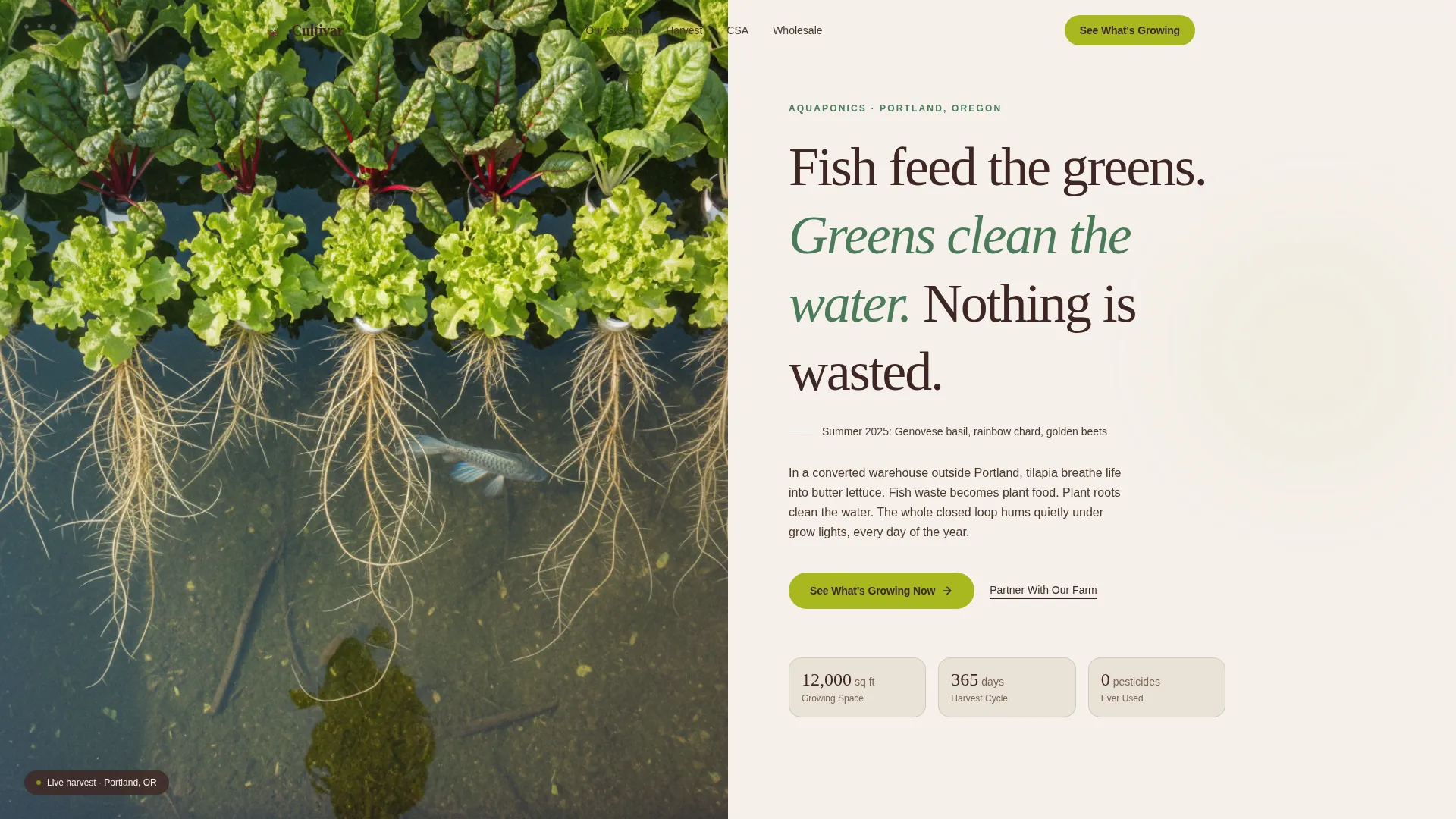
- A hero split with an overhead grow-bed photo panel and a warm serif headline area, plus a timestamped seasonal subhead field
- Four zigzag body sections covering spring seedlings, summer harvest, autumn preservation, and winter greenhouse atmosphere
- Two call-to-action flows: a primary button in botanical yellow-green and a quieter secondary text link for wholesale partners
Feature list
This template includes the following built-in design and layout capabilities.
Zigzag Alternating Section Layout
Each of the four seasonal sections alternates between photo-left/text-right and text-left/photo-right. This creates a gentle reading rhythm that guides visitors down the page without fatigue.
Half-Page Hero with Seasonal Subhead
The hero splits into a full-bleed photography panel and a text column. A single-line subhead field below the headline is designed to display the current harvest season and named varieties, making the page feel current rather than evergreen.
Dual Conversion Path Design
The primary call to action, "See What's Growing Now," appears in the hero and repeats at each seasonal section. A secondary path, "Partner With Our Farm," sits as a quieter loam-brown text link, keeping both retail and wholesale audiences moving toward their relevant destination.
Scroll Reveal and Parallax Animation
Sections use staggered text reveals and parallax photo layers on scroll. Image panels include a hover zoom interaction. Seasonal section transitions add a sense of turning pages through the calendar.
Social Proof Integration Points
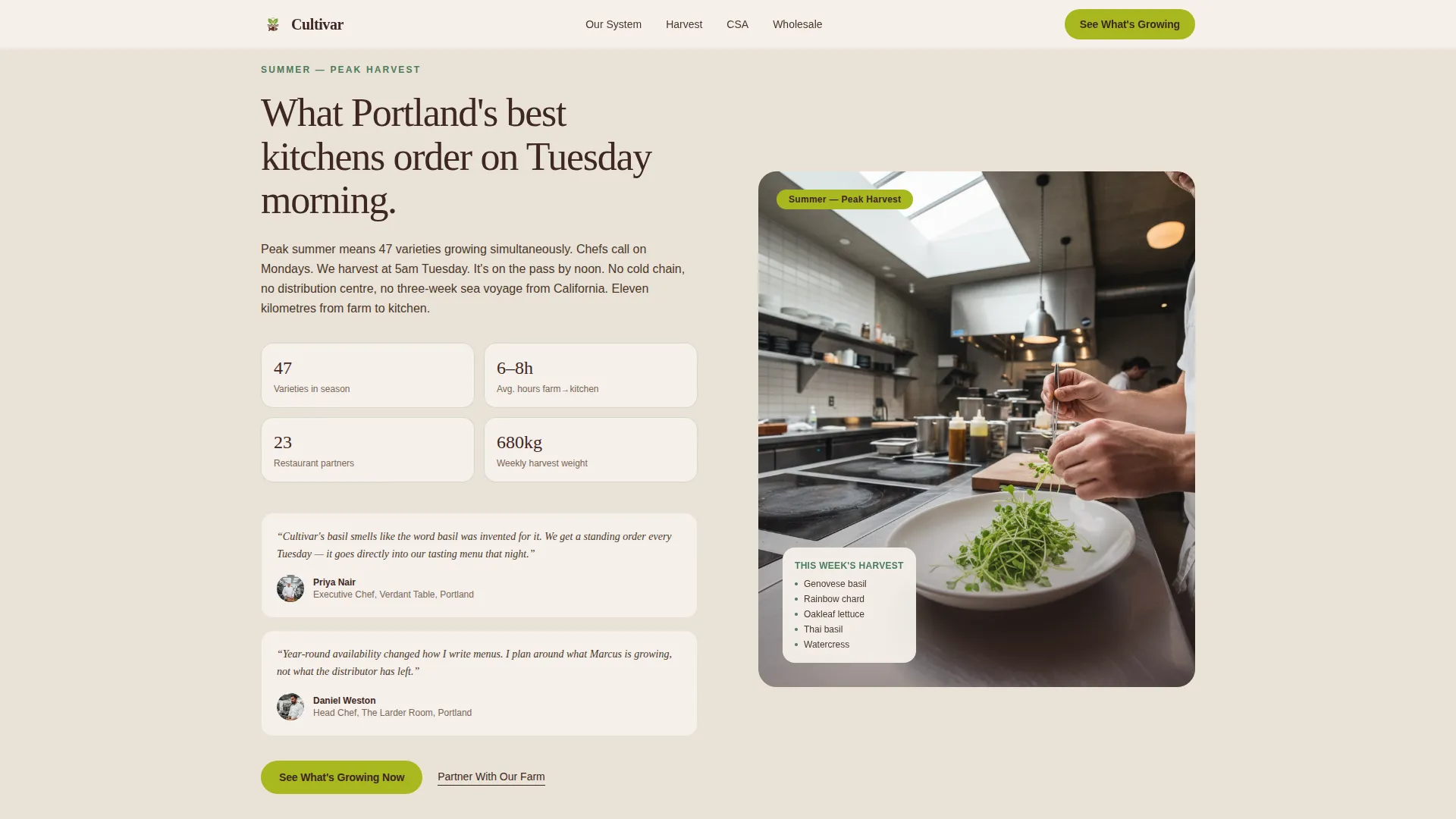
The summer section includes structured space for chef testimonials with restaurant name attribution, alongside harvest metrics and community-supported agriculture subscriber counts.
Botanical Typography System
Headlines use Fraunces, a warm expressive serif that reinforces the organic, editorial tone. Body text uses DM Sans for clean legibility. The contrast between the two creates a clear visual hierarchy across all sections.
Page sections overview
| Section | Purpose |
|---|---|
| Hero split header | Introduce the farm with an overhead grow-bed photo and a warm serif headline |
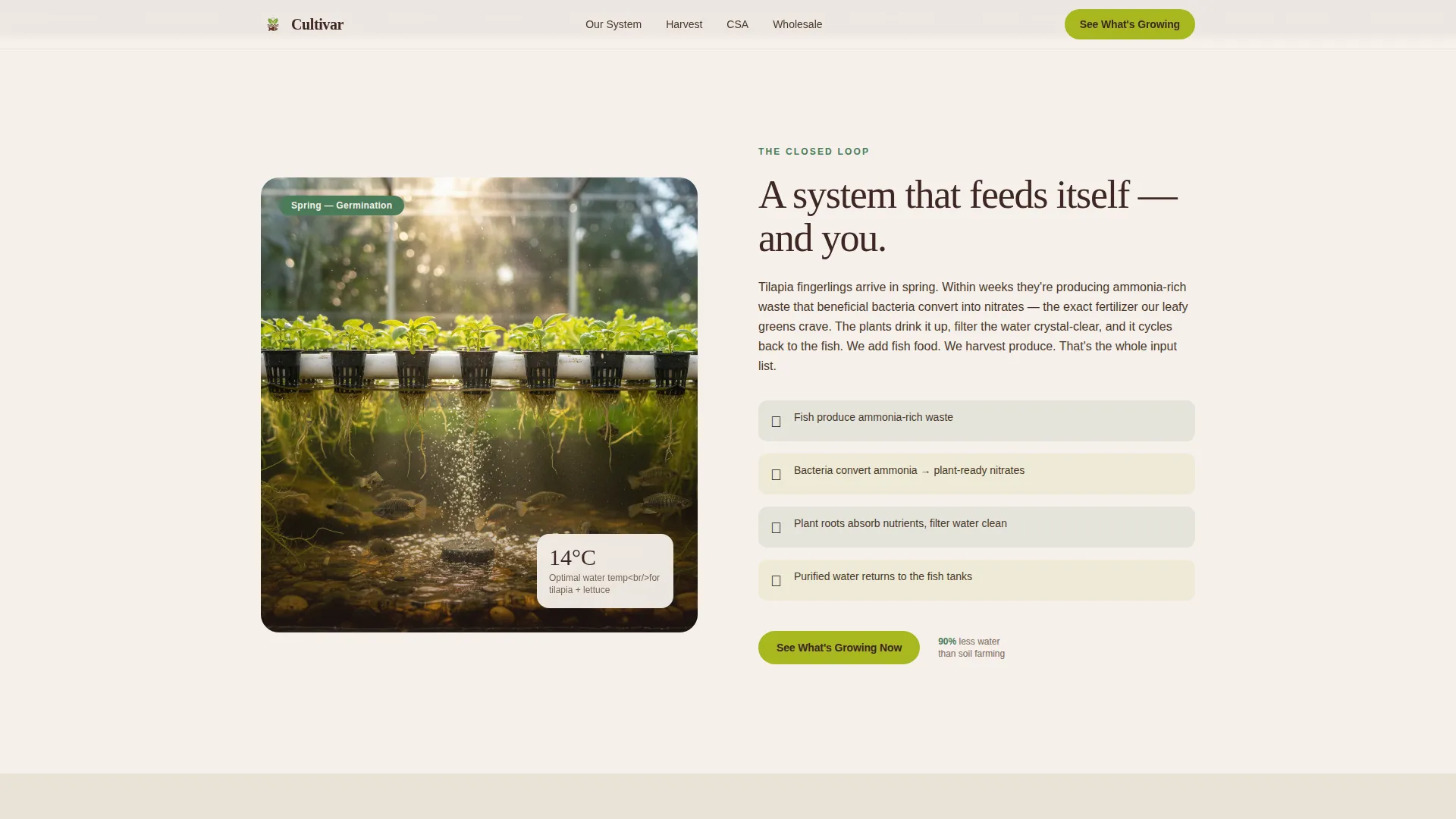
| Spring seedlings section | Explain the closed-loop aquaponics system through spring imagery and supporting text |
| Summer peak harvest | Display chef testimonials, named varieties, and harvest data at peak season |
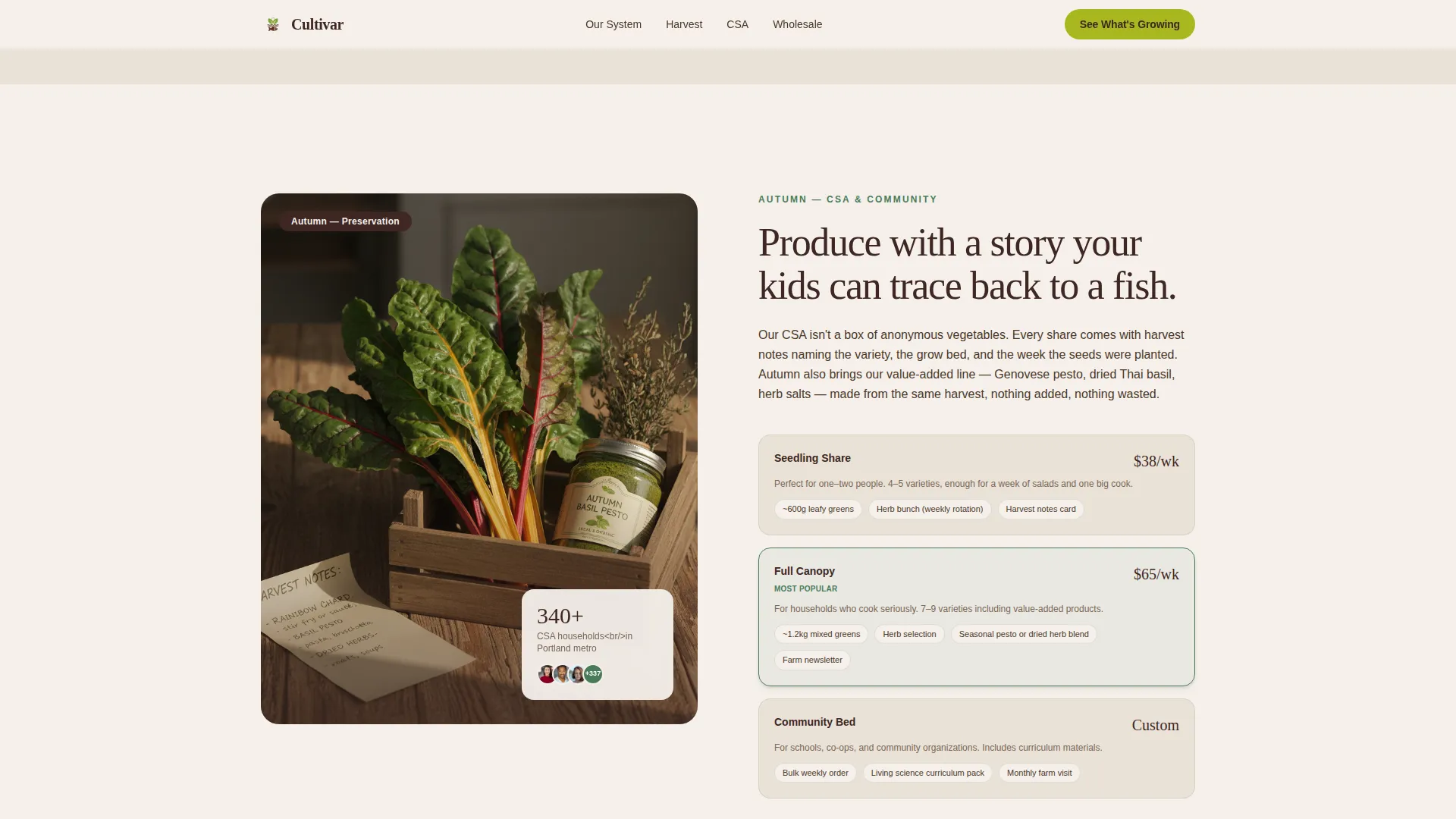
| Autumn preservation section | Present value-added products, preserved goods, and the community-supported agriculture story |
| Winter greenhouse section | Close with an atmospheric full-width scene and final call-to-action block |
| Footer layout | Provide navigation and contact links in a horizontal flow pattern |
Design & branding system
The template uses a Botanical color system built around four intentional values. Every color choice reinforces the feeling of a working organic farm in the Pacific Northwest.
- Deep loam brown (#3E2723) grounds structural sections and secondary text links, evoking dark soil
- Living chlorophyll green (#4A7C59) serves as the dominant accent across headings and key visual elements
- Soft propagation white (#F5F0EB) provides breathing space between content-dense sections
- Ripe yellow-green (#A8B820) activates all primary call-to-action buttons and hover states, drawing the eye without shouting
Mobile & speed optimization
The template is designed desktop-first with strong mobile adaptation built in. Scroll-based interactions are handled through CSS scroll-behavior and Intersection Observer reveals, which keep animation lean and layout-stable across screen sizes.
- Zigzag columns stack vertically on smaller screens, preserving the seasonal narrative in a single-column flow
- Optimized image handling and CSS-driven animations keep the layout responsive without heavy scripting
- Parallax layers are designed to degrade gracefully on touch devices so the reading experience stays clean
How this template helps you convert
Cultivar earns the click before it asks for one. The seasonal scroll builds desire progressively, so visitors arrive at the final call to action already hungry rather than uncertain.
- The hero immediately establishes freshness and specificity with named varieties and a harvest date, reducing the skepticism visitors bring to unfamiliar farm brands
- Repeating the primary call-to-action button at each seasonal section means visitors can convert at any point in the scroll without needing to reach the bottom
- The dual-path structure routes chefs and casual buyers to separate actions, reducing friction and preventing one audience from crowding out the other
Other information about this template
Cultivar fits naturally within the Agriculture and Environment category, specifically the organic and sustainable farm subcategory. It is built for the aquaponics farm niche and carries a Garden and Growth visual theme throughout.
- The template style is Zigzag/Alternating with a Seasonal/Moment creative direction, making it suitable for any farm that tells its story through the calendar
- The landing page direction is Click-Through, meaning the page is designed to carry visitors to a second page for form completion rather than hosting a form inline
- The header concept is Half-Page Photo and Text, one of the most conversion-friendly hero layouts for visually rich food and agriculture brands
- Localization context is English, United States dollars, and a Portland, Oregon regional frame, though the layout adapts to any regional farm context
Theme
Garden & Growth
Creative direction
Seasonal/Moment
Color system
Botanical
Style
Zigzag/Alternating
Direction
Click-Through
Page Sections
Zigzag Alternating Section Layout
Half-page Hero with Seasonal Subhead
Dual Conversion Path Design
Scroll Reveal and Parallax Animation
Social Proof Integration Points
Botanical Typography System
Related questions
Can I use this template for a farm that is not an aquaponics operation?
Does this template include the subscription or inquiry forms?
How many calls to action does the template include?
Is the seasonal content locked to specific crops or months?
What typography does this template use?