Seasonal Crop Farm Landing Page Template
Furrow is a hero-dominant soybean farm landing page built for grain elevator operators, food manufacturers, and commodity brokers. It follows a seasonal scroll journey through planting, canopy, harvest, and logistics, front-loading certified yield data, lab-tested composition specs, and a clear click-through path to a sourcing inquiry form. Four generations of river-bottom farming, one page to prove it.
by Rocket studio
Quick summary
Furrow is a single-page, click-through landing page template built for identity-preserved, non-GMO soybean farm operations. It uses a cinematic, season-by-season scroll structure to move qualified buyers from first impression straight to a sourcing inquiry. The Sunset Mesa color system, panoramic aerial photography, and scroll-reveal animations create a warm, grounded experience that feels as confident as a farmer who knows the numbers are good.
Who this template is for
This template is built for agricultural commodity sellers who need to earn the trust of professional buyers before a single phone call happens. It speaks directly to buyers in the grain and food manufacturing supply chain, presenting farm credentials with the same care that goes into growing the crop.
- Grain elevator operators scheduling harvest logistics and delivery windows for row crops
- Food manufacturers sourcing certified identity-preserved, non-GMO soybeans at larger scale
- Commodity brokers tracking available field crops volume and basis-point shifts at rural terminals
What problem this template solves
Most farmers selling soybeans at meaningful volume face the same problem: serious buyers want documentation, proof of scale, and logistical clarity before they pick up a phone. A generic farm website cannot carry that weight. Buyers who source field crops professionally tend to move fast, and they will not wait for a slow page or a cluttered layout to give them what they need.
- No form fields on the page slow the trust-building process, so the template front-loads proof instead
- Buyers can verify acreage via satellite imagery, review lab-tested composition specs, and check a live volume ticker before committing to a conversation
- The persistent bottom call-to-action bar locks in after the visitor passes the logistics panel, keeping the next step visible without interrupting the scroll
What you get with this template
Furrow delivers a fully structured, hero-dominant landing page organized around four growing-season moments. Every section is purpose-built to move a qualified buyer toward the sourcing inquiry click. The layout is desktop-first, matching the workflow of grain buyers at office terminals, with a mobile fallback so the page functions well on smartphones too.
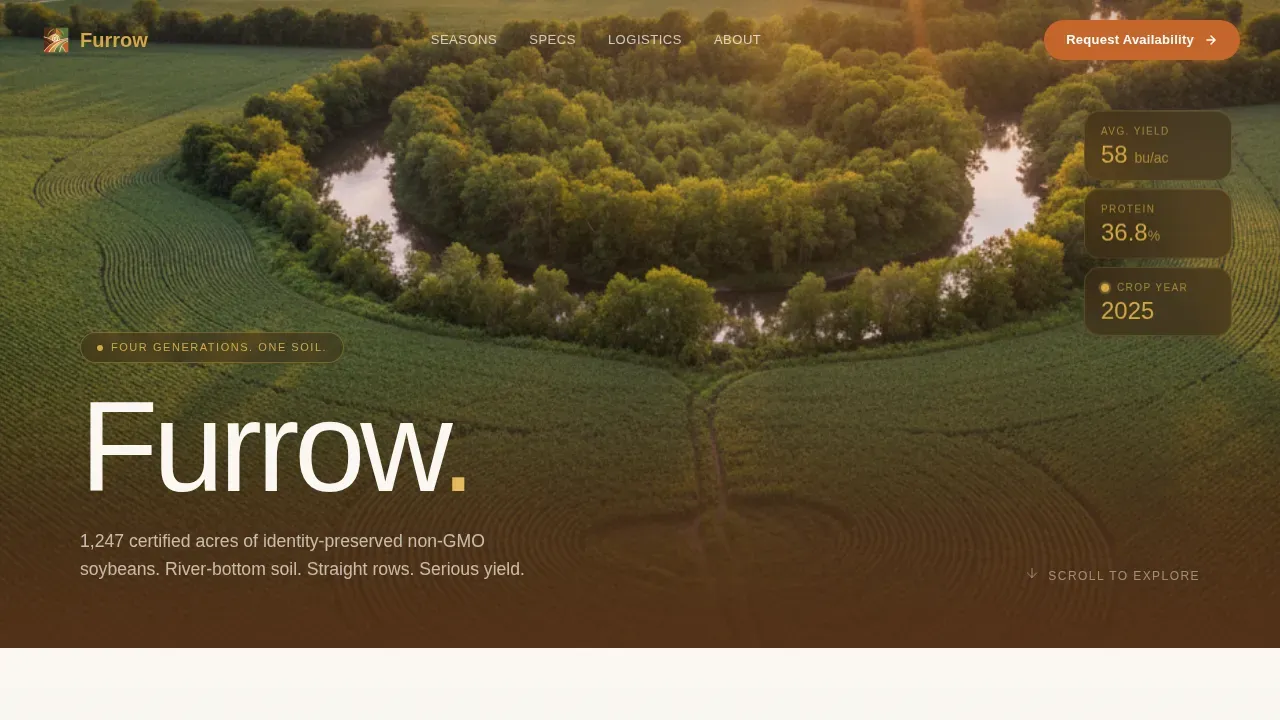
- A 90-viewport-height cinematic hero with a drone aerial photograph, scroll-reveal farm name and tagline, and floating harvest stat widgets
- Five distinct content sections moving through spring planting, summer canopy, fall harvest, and winter logistics, each carrying one headline stat
- A persistent bottom call-to-action bar, a rolling volume ticker, a delivery radius map, and a secondary "Download Our Spec Sheet" text link beneath each seasonal section
Feature list
This section describes the core built-in capabilities delivered by the Furrow template as defined in the source brief.
Panoramic Aerial Hero Section
The hero stretches edge to edge across ninety percent of the viewport, showing a drone photograph taken fifteen feet above a soybean field at canopy close in late July. Rows radiate outward toward a tree-lined creek on one side and a grain bin complex on the other. The farm name and the line "Four generations. One soil." rise from the bottom in harvest gold after the first pixel of scroll, creating a reveal that rewards attention without demanding it.
Seasonal Scroll Journey
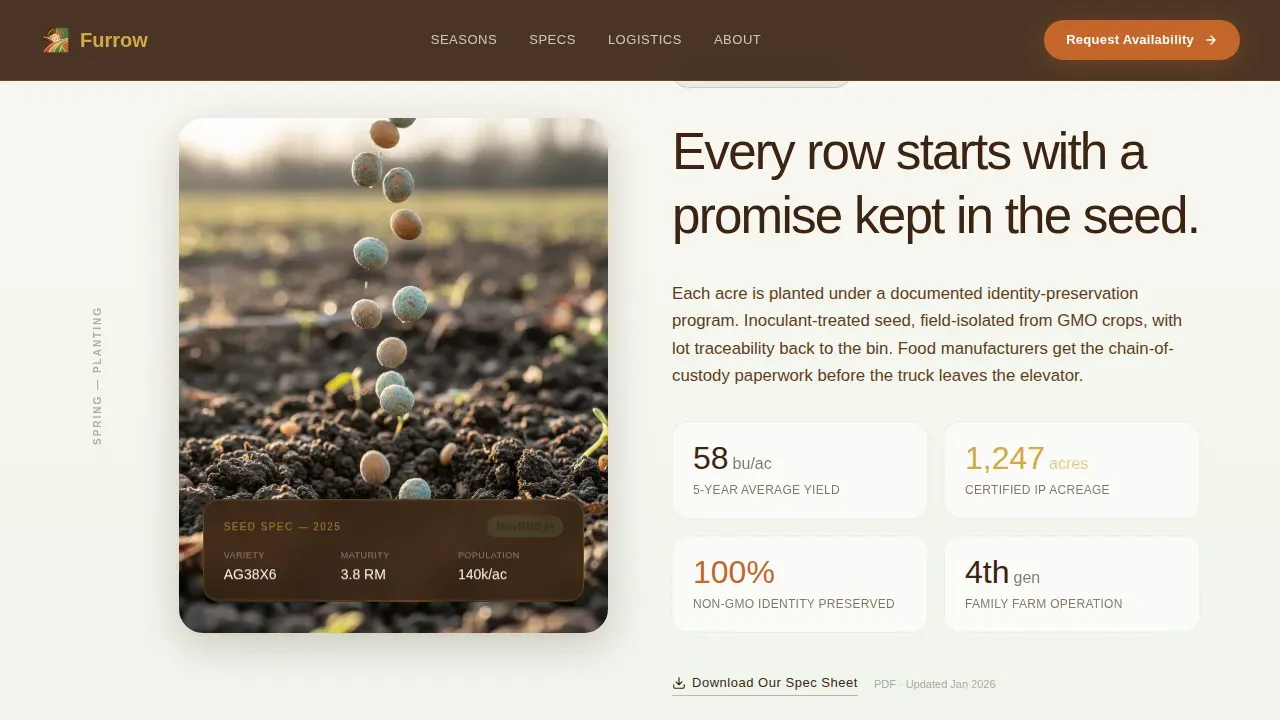
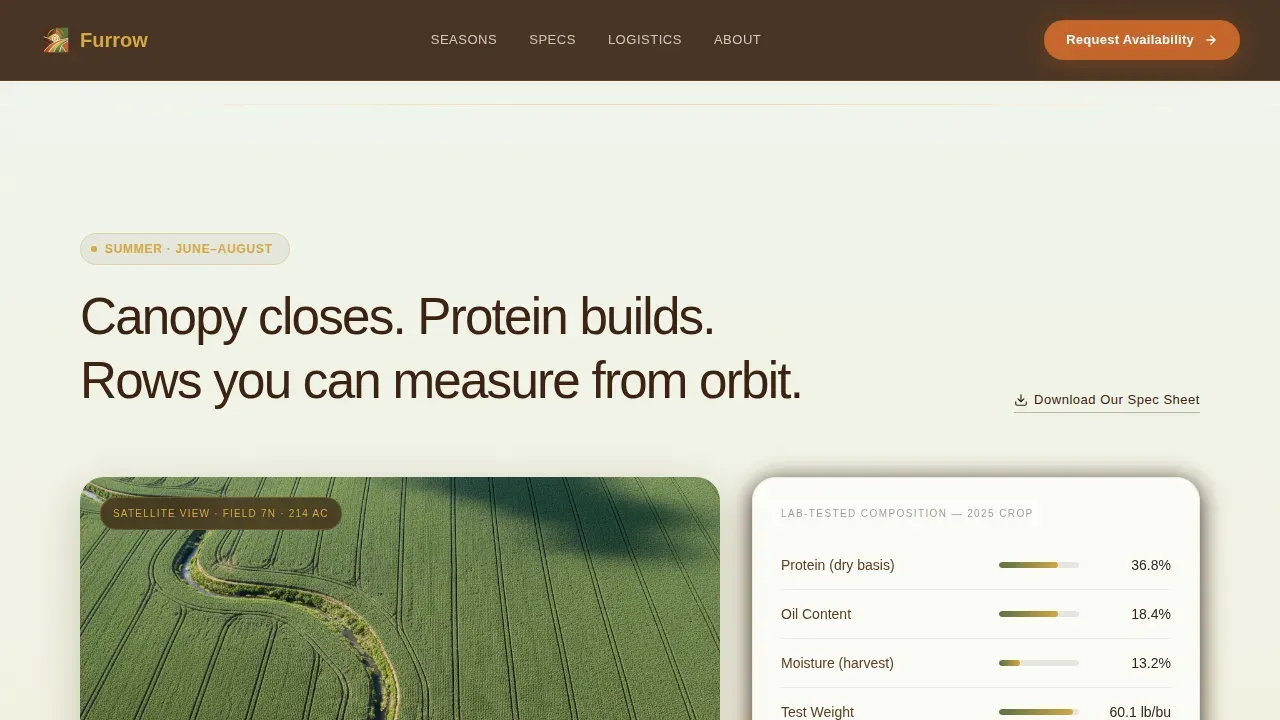
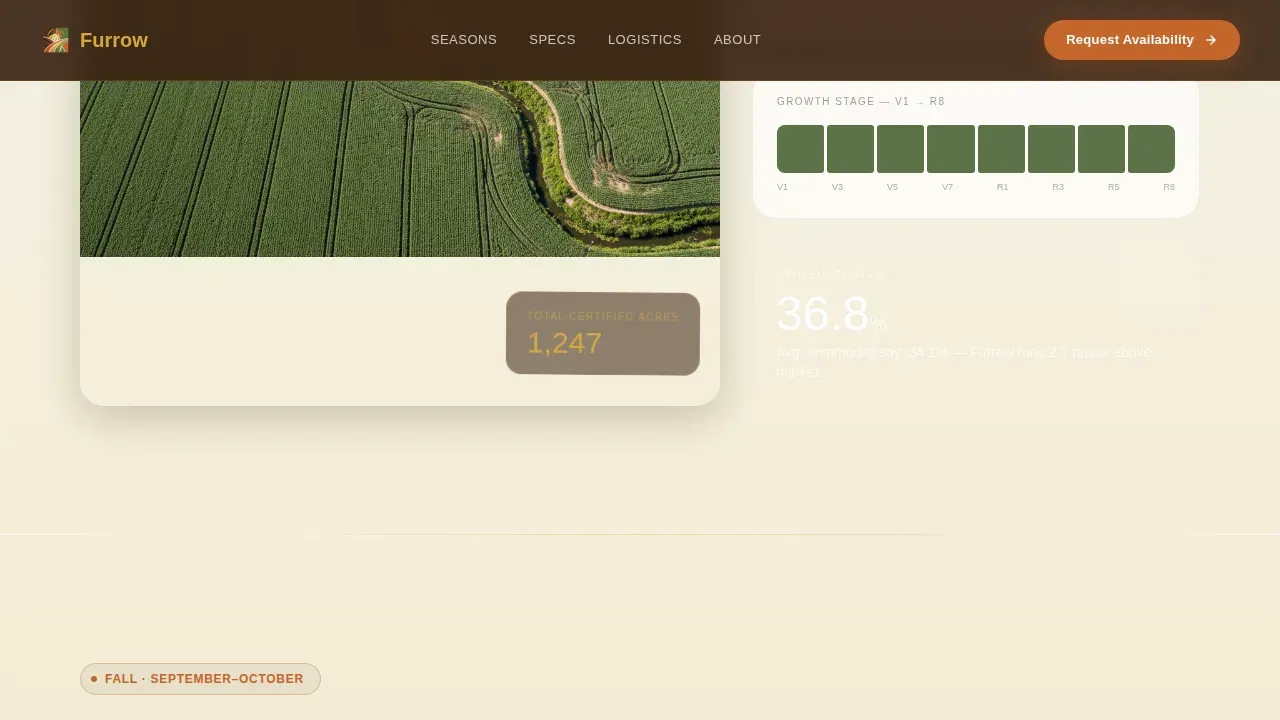
Each of the four main content sections represents a distinct moment in the soybean growing cycle. Spring planting shows inoculant-coated seeds dropping into black soil and establishes the farm's identity-preserved credentials. Summer canopy presents satellite-verified acreage of 1,247 acres and a protein content figure of 36.8 percent. Fall harvest carries combine header footage, moisture-test readouts, and the primary call-to-action pill. Winter logistics closes with the delivery radius map, storage capacity of 850,000 bushels, and the animated volume ticker. The palette shifts warmer as the visitor scrolls deeper, so the page itself ripens from canopy green through harvest gold to burnt mesa orange.
Scroll-Reveal Animations and Floating Stat Widgets
Scroll-reveal animations are built into each section transition, driven by Intersection Observer so elements enter the viewport cleanly. Floating glassmorphic stat cards surface key numbers without interrupting the reading flow. Parallax layers add depth to the aerial and field photography, and shimmer hover effects on imagery keep the experience visually alive without slowing the page down.
Persistent Bottom Call-to-Action Bar
After the visitor scrolls past the logistics panel, a burnt-orange persistent bar locks into the bottom of the viewport. It carries the primary call-to-action, "Request This Season's Availability," and stays visible through the remainder of the scroll. This means the click-through path is always within reach once the buyer has absorbed enough proof to act.
Animated Volume Ticker
A rolling ticker displays the current crop-year volume remaining in real time, giving buyers the urgency signal they need without manufactured scarcity language. Grain elevator operators and commodity brokers who track basis daily will recognize and trust this format immediately.
Proof-First Click-Through Structure
No form fields appear on this page. Instead, the template earns each click by placing satellite imagery of acreage, lab-tested composition specs, a delivery radius map, and the animated volume ticker before the call-to-action. A secondary "Download Our Spec Sheet" text link sits beneath each seasonal section for buyers who need documentation before committing to a conversation.
Page sections overview
| Section | Purpose |
|---|---|
| Cinematic Aerial Hero | Opens with a 90vh drone photograph and scroll-reveal farm identity |
| Spring Planting Panel | Establishes identity-preserved credentials and shows seed-to-soil process |
| Summer Canopy Panel | Presents satellite acreage proof, 1,247 acres, and 36.8% protein content |
| Fall Harvest Panel | Delivers combine imagery, moisture readouts, and primary call to action pill |
| Winter Logistics Panel | Shows delivery radius, 850k bushel storage, and animated volume ticker |
Design & branding system
The Sunset Mesa color system grounds the visual identity in the physical reality of harvest season. Every color is drawn from the farm landscape itself, from deep plowed-earth brown through mature canopy green to the burnt orange of a county road at dusk. The result is a palette that feels earned rather than chosen, heavy with the weight of a season's work paying off.
- Deep plowed-earth brown (#3B2413) serves as the dominant background tone, anchoring the page in the soil beneath every crop
- Mature soybean canopy green (#5A7247) carries the spring and summer panels, giving way to dusted harvest gold (#D4A843) as the scroll ripens
- Burnt orange (#C4652B) is reserved exclusively for calls-to-action and interactive highlights, so every clickable element reads clearly against the warm field palette
Typography is set in DM Sans at bold display sizes. Confident, grounded letterforms match the tone of a farmer who talks about yield when the numbers are good. The Garden and Growth theme runs through every visual decision, from the parallax field layers to the golden-hour warmth of the imagery treatment.
Mobile & speed optimization
Furrow is designed desktop-first because grain buyers and commodity brokers tend to operate at office terminals. The layout prioritizes wide aerial photography, multi-column stat panels, and the persistent bottom bar in that context. A mobile fallback ensures the page looks and functions well on smartphones for buyers who check availability on the go.
- CSS scroll-behavior and GPU-accelerated transforms handle the parallax and reveal animations without layout reflows on either device class
- Intersection Observer drives all scroll-reveal triggers, so elements only animate when they enter the visible viewport
- The animated volume ticker, floating stat widgets, and persistent call-to-action bar all reflow cleanly for smaller screens
How this template helps you convert
The Furrow template is built around one business goal: move a qualified buyer from first scroll to a sourcing inquiry click. Every structural decision serves that path. The page earns the click before it asks for it, placing proof ahead of persuasion and documentation ahead of any call-to-action.
- The seasonal scroll structure front-loads satellite imagery, lab-tested specs, and harvest data so buyers arrive at the call-to-action already informed, reducing friction at the decision point
- The persistent bottom bar locks in after the logistics panel, keeping "Request This Season's Availability" visible without interrupting the reading flow that built the buyer's confidence
- The secondary "Download Our Spec Sheet" link beneath each seasonal section catches buyers who need documentation before a conversation, creating a second conversion path that feeds the same sourcing inquiry funnel
Other information about this template
The Furrow template draws on farming practices and agronomic context that matter to professional soybean buyers. Understanding these details helps any farm operation present itself credibly to grain industry partners.
- Soybeans are typically harvested between September and November. Harvest timing is critical, with beans ideally at 13 to 15 percent moisture. Harvesting soybeans too wet leads to spoilage and costly artificial drying, so moisture-test readouts built into the harvest panel communicate operational discipline to buyers.
- Weed management is a serious quality signal for identity-preserved buyers. Grass weeds and broadleaf competition reduce yield and contaminate grain streams. The template's emphasis on crop rotation, cover crops, and documented growing practices signals the kind of farm management that food manufacturers and processors require.
- In-furrow fertilizer applications are a standard part of modern row crop production. Starter fertilizer applied in the furrow can provide a concentrated band of nutrients, particularly phosphorus, that roots access during early growth when soil temperatures are cold. Phosphorus is essential for germination and early root development. Starter fertilizer placed in-furrow gives young plants a measurable advantage in cold soil conditions. Research, including 2023 trials, has shown that in-furrow starter fertilizer programs do not always increase soybean yield at every site, so farmers are encouraged to conduct their own trials and evaluate fertilizer programs carefully for profitability. The Furrow template's spring planting section is designed to surface this kind of agronomic transparency as a trust signal.
- Furrow irrigation is a time-tested method used across many field crops and row crops. Furrows are small, parallel channels that carry water to irrigate the crop. Furrow irrigation suits most soil types, though very coarse sands are not recommended because of high percolation losses. Uniform flat or gentle slopes are preferred for furrow irrigation, with grade not exceeding 0.5 percent. Water is supplied to each furrow from the field canal using siphons or spiles. Furrow spacing is selected to ensure adequate wetting of the entire root zone. Lateral movement of water through the soil profile depends on soil type and stream size. Alternate furrow irrigation, where every other furrow is irrigated rather than all of them, is one method growers use to manage water supply effectively and reduce losses. Furrow irrigation benefits include stabilizing yield and seed quality across seasons when rainfall is variable. Proper furrow construction ensures water reaches the downstream end without excessive percolation losses. The template's logistics section can support presentation of irrigation infrastructure details that buyers sourcing at larger scale want to see.
- Sudden Death Syndrome (SDS), caused by the fungus Fusarium virguliforme, is one of the most damaging diseases affecting soybeans. The fungus infects soybean roots and can survive in the soil over winter. To manage SDS and similar diseases, farmers plant later in the spring, rotate crops, and regularly till the soil. Cover crops can also protect soil structure between growing seasons. Crop rotation with corn or wheat disrupts SDS pressure and helps control weeds and other pests simultaneously.
- Cover crops play a meaningful role in soybean production systems. Cover cropping enhances soil structure, improves nutrient availability, and reduces erosion between cash crop seasons. No-till planting into cover crops reduces soil disturbance and improves moisture retention. Diverse crop mixes disrupt weed life cycles and improve overall farm productivity. The use of cover crops is a sustainability metric that B2B partners in the food manufacturing sector increasingly require from their sourcing partners.
- Field crops including field corn, sweet corn, wheat, and vegetables are commonly grown in rotation with soybeans in Corn Belt production systems across Illinois and neighboring states. Rotating soybeans with field corn is the most common practice. Planting corn in rotation with soybeans reduces disease pressure and weed competition. One crop of corn followed by one crop of soybeans in two rows of alternating strips is a common field layout. Most farmers in the upper Midwest quickly realized that diverse rotations outperform continuous soybean production over time, a finding supported by ongoing research at institutions including Iowa State University.
- Fungicide applications protect soybean plants from foliar diseases during the growing season. Active ingredient selection matters for fungicide programs, particularly when diseases like sudden death syndrome, frogeye leaf spot, or white mold are present. Timing fungicide applications to coincide with early reproductive growth stages provides the most beneficial protection for yield potential. Integrated pest management strategies help control insects, pests, and diseases while reducing input costs.
- Soil health is a long-term investment. Regular soil testing helps growers optimize nutrient management and understand what the root zone needs at each growth stage. Soil conditions including drainage, organic matter, and compaction all affect how well soybeans feed on available nutrients. Phosphorus, nitrogen, and potassium tend to be the primary nutrients managed through fertilizer programs. Maintaining the right soil surface conditions at planting encourages uniform germination and strong early plant stands. Good soil drainage is also critical during wet spring seasons when heavy rains can delay planting and wash out fields. Adverse weather, including heavy rains, snow, and flooding, can delay soybean harvesting schedules and force difficult decisions about moisture management and artificial drying costs.
- Equipment transparency builds confidence with buyers who need to know that a farm can actually harvest at the volume being offered. Transparency in equipment listing shows capability for capturing low-hanging pods, which matters for minimizing field losses at harvest. A tractor and planter setup capable of covering 1,247 acres in a tight spring planting window is a logistical credential, and the Furrow template's seasonal section structure gives a farm the visual real estate to present that information clearly.
- The seed company a farm partners with signals variety selection quality, identity-preservation protocols, and agronomic support access. Buyers sourcing non-GMO identity-preserved beans at volume want to know that the seed supply chain is as documented as the harvest chain.
- Logistics and scheduling information displayed on this template includes delivery radius mapping, storage capacity figures, and the animated volume ticker. Drop-off locations, hours of operation, and current transport context can be presented within the logistics panel. Storage capacity of 850,000 bushels is a meaningful figure for elevator operators evaluating whether a single farm can feed their scheduling needs across a fall harvest window.
- The template supports inclusion of food safety certifications or organic standards documentation as trust signals. Displaying those credentials alongside lab-tested composition specs builds immediate trust with food manufacturers who require documented sourcing chains. A field day invitation or buyer visit section can be added to extend the relationship-building function of the page.
Theme
Garden & Growth
Creative direction
Seasonal/Moment
Color system
Sunset Mesa
Style
Hero-Dominant (90/10)
Direction
Click-Through
Page Sections
Cinematic 90-viewport Hero with Scroll Reveal
Four-panel Seasonal Scroll Journey
Persistent Bottom Call-to-action Bar
Animated Volume Ticker and Proof Elements
Secondary Spec Sheet Download Links
Sunset Mesa Color System and DM Sans Typography
Related questions
Who is the Furrow template built for?
Does this template include form fields for buyer inquiries?
Can the seasonal stats and volume figures be updated each crop year?
What makes Furrow different from a standard farm website template?
Can the template support a farm that grows other crops alongside soybeans?