PCOS Patient Education Landing Page Template
Cycle is a PCOS patient education landing page template built for women who want answers, not more confusion. It pairs a bold Stacked Type Tower hero with 50/50 split-screen sections, an inline phenotype quiz, and a Slate & Sky color system that feels clinical yet warm. The page guides every visitor from "What is PCOS?" to "What is MY type?" before asking for anything in return.
by Rocket studio
Quick summary
Cycle is a single-page template designed for PCOS patient education platforms. It uses a Problem→Solution Arc across three 50/50 split-screen sections, a monumental typographic hero, and a five-question inline quiz that reveals a visitor's PCOS phenotype before any email gate appears. The Healing Space design language keeps the experience warm, clinical, and deeply human.
Who this template is for
This template is built for educators, patient advocates, and health platform founders who want to create a meaningful digital space for women navigating polycystic ovary syndrome. It suits anyone whose audience has been dismissed, misdiagnosed, or is just beginning to understand their diagnosis.
- Women's health educators and PCOS coaches who want to turn complex hormonal science into accessible, empathetic content
- Patient advocacy organizations and digital clinic founders building a trusted resource for women of reproductive age
- Health content creators who need a structured plan to guide visitors from symptom recognition through to a personalized PCOS care pathway
What problem this template solves
Most people with polycystic ovarian syndrome spend years cycling through wrong diagnoses before anyone names what is actually happening. They arrive at health websites and find generic lists that do not reflect their personal experience. This template exists to close that gap.
- Symptoms like acne, hirsutism, irregular cycles, and unexplained weight changes are named clearly, not buried in medical jargon
- Visitors cannot identify which PCOS type applies to them from static content alone, so the inline quiz converts passive readers into engaged patients with a personalized result
- Women with PCOS often experience anxiety and depression alongside physical symptoms; the template's empathetic tone and mental health acknowledgment help visitors feel seen before they are asked to act
What you get with this template
Cycle delivers a fully structured single-page layout with every section you need to educate, engage, and convert visitors who are actively seeking answers about their ovaries, their hormones, and their future health.
- A Stacked Type Tower hero that sets the emotional and informational tone instantly, with PCOS symptoms woven directly into the typographic architecture
- Three 50/50 split-screen content sections that move visitors progressively from broad PCOS education through to personalized phenotype discovery
- A five-question inline quiz with a sky-blue progress bar, multi-select symptom cards, and a phenotype result screen that delivers value before collecting any data
Feature list
This template includes a carefully considered set of interactive and visual components, each mapped to a specific moment in the patient education journey.
Stacked Type Tower Hero
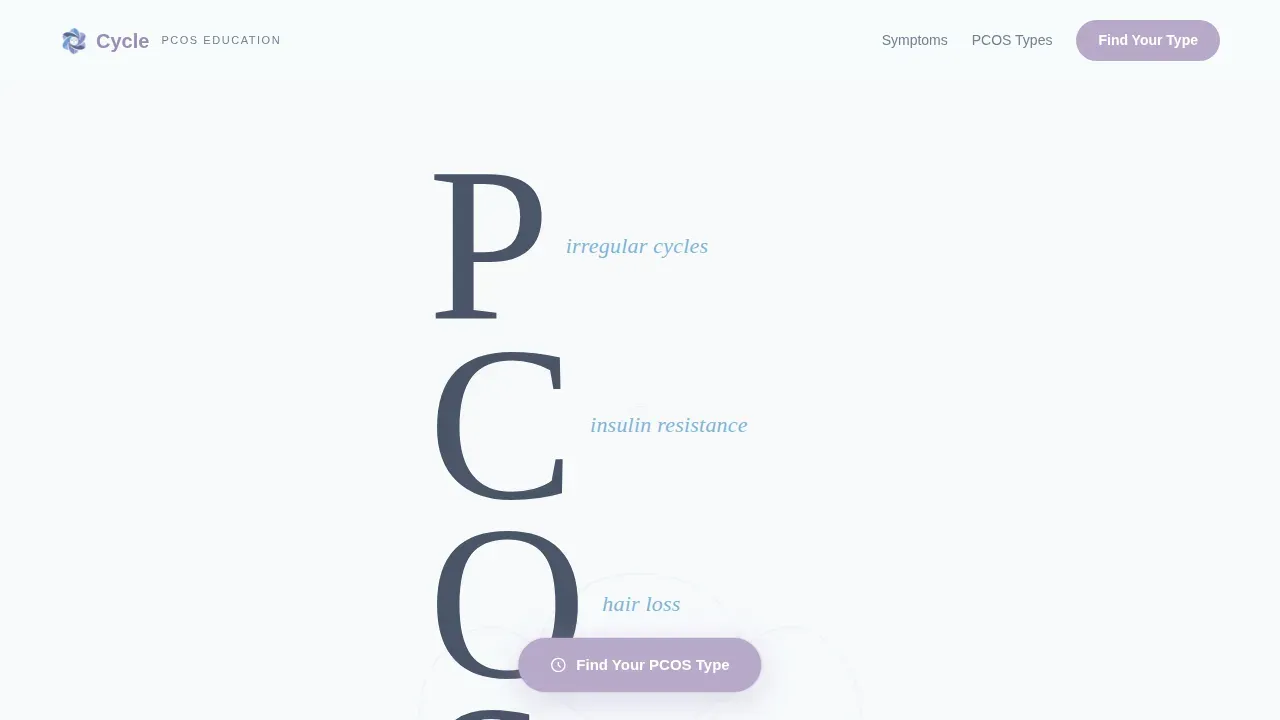
The hero sets PCOS at architectural scale. The letters stack vertically in thin slate letterforms, with symptoms, irregular cycles, hair loss, fatigue, insulin resistance, appearing in sky-blue italic between each character. A single line beneath the tower anchors the emotional promise of the page. No imagery is needed; the typography carries everything.
Problem→Solution Split Screen Sections
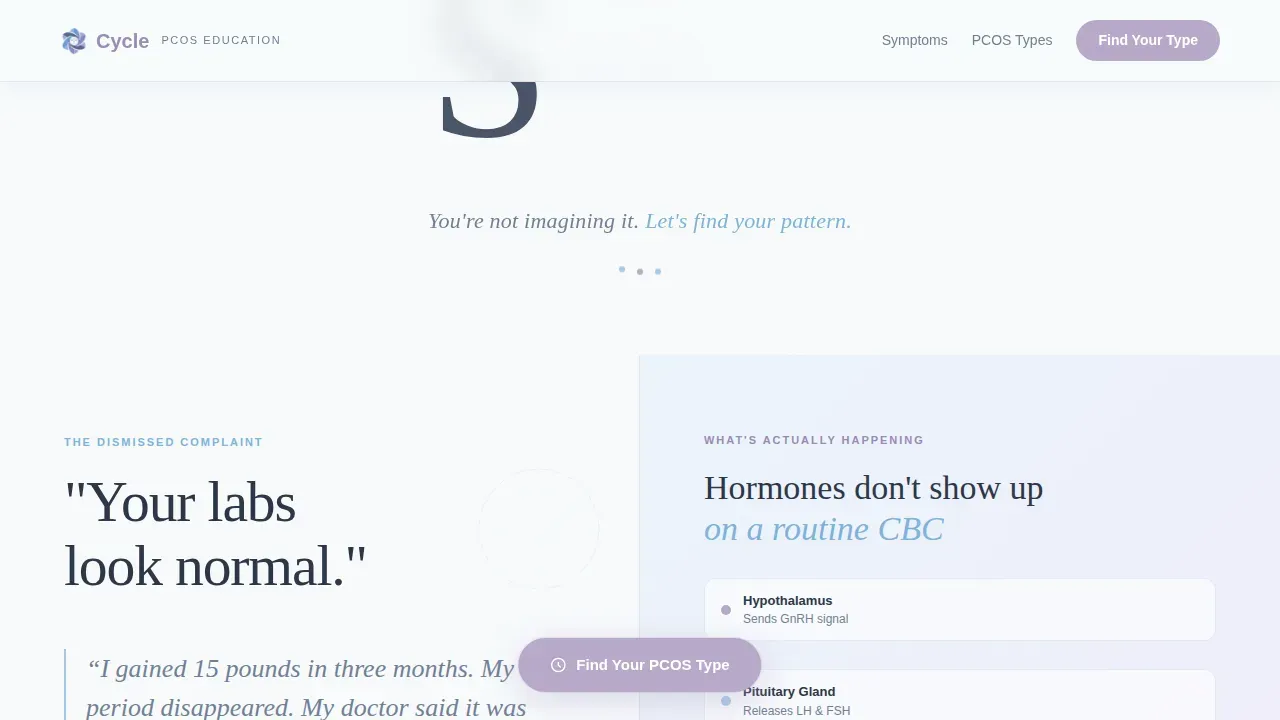
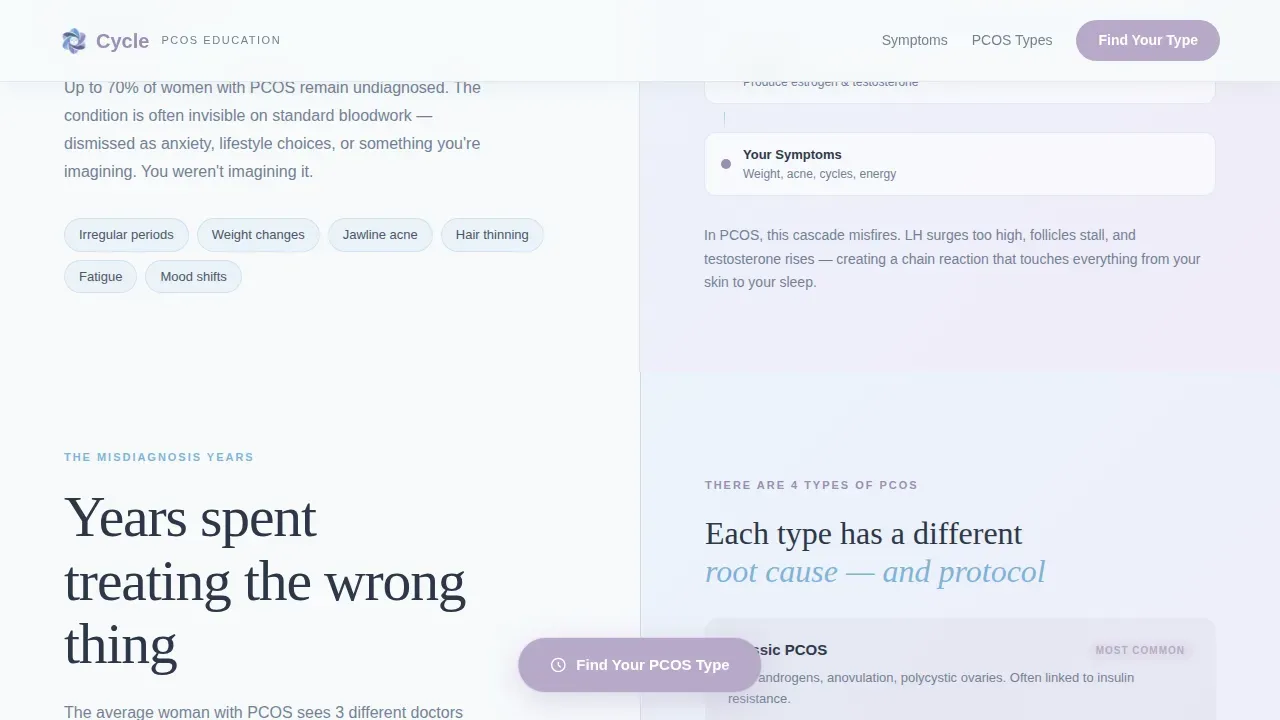
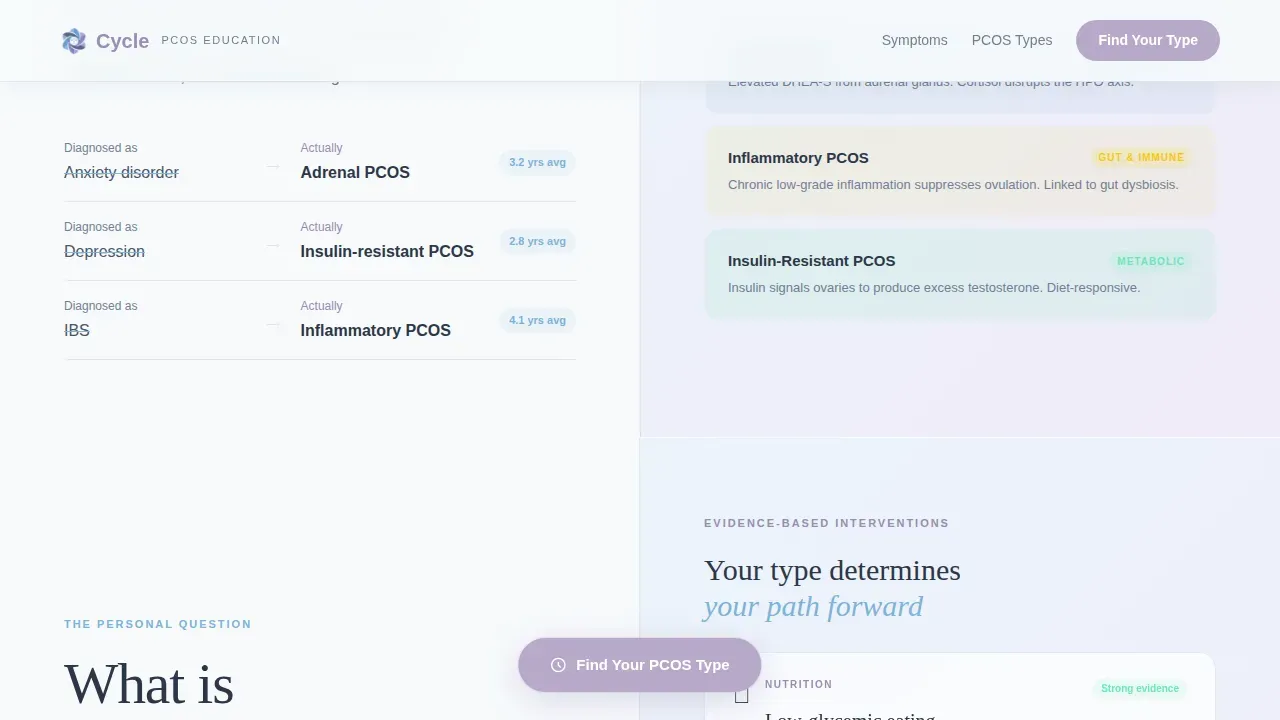
Three 50/50 split-screen sections carry visitors through a structured arc. Left panels present named problems in slate typography over faint anatomical line art. Right panels deliver hormonal pathway explanations, PCOS type overviews, and lifestyle intervention cards in sky blue. Each section narrows the conversation from general to personal.
Inline Phenotype Quiz Funnel
The quiz opens directly on the page without a redirect. Five sequential cards cover cycle regularity, primary symptoms with multi-select, current diagnoses, top health concern, and age. A soft progress bar tracks advancement. The visitor sees her PCOS phenotype, classic, adrenal, inflammatory, or insulin-resistant, before any email is requested.
Lavender Call-to-Action System
The primary call to action, "Find Your PCOS Type," appears in lavender after the third split-screen section and stays pinned gently to the bottom of the viewport as the visitor scrolls. The lavender accent also marks interactive elements and progress indicators throughout, creating a consistent visual language for moments that invite action.
Empathy-Led Testimonials Block
A dedicated social proof section features testimonials from women describing the moment they were finally diagnosed. These stories build trust in the platform's approach and reassure new visitors that their concerns are valid. The block is designed to support the page's emotional arc without slowing the scroll toward the quiz.
Mobile-First Responsive Layout
The template is built with a mobile-first approach, ensuring that women researching PCOS from parking lots, exam rooms, or phones at 2 a.m. have a seamless experience. The split-screen sections reflow naturally into single-column layouts on smaller screens, and the inline quiz cards are touch-optimized for easy multi-select interaction.
Page sections overview
| Section | Purpose |
|---|---|
| Stacked Type Tower Hero | Opens with monumental PCOS typography and sets the emotional tone |
| Dismissed Symptoms Split | Names common symptoms on the left; explains hormonal causes on the right |
| Hidden Architecture Split | Contrasts misdiagnosis patterns with PCOS type pathway cards |
| Your Type Split | Presents phenotype descriptions alongside lifestyle and supplement evidence cards |
| Inline Phenotype Quiz | Guides visitors through five questions to reveal their PCOS type |
| Testimonials Block | Shares empathy-led stories from women who were finally diagnosed |
| Footer Flow | Closes the page with clear next steps and supporting navigation |
Design & branding system
Cycle uses a Healing Space visual identity built around a Slate & Sky color system. Every color choice serves a functional purpose: slate grounds the problem side of the page, sky blue opens the solution side, and lavender marks every moment of interaction or progress. The serif and sans-serif type pairing keeps the page feeling simultaneously clinical and warm.
- Colors: clinical slate (#4A5568) for informational panels, soft sky blue (#A7C7E7) for solution spaces, cloud white (#F7FAFC) for breathing room, and lavender (#B8A9C9) for all interactive elements and calls to action
- Typography: Fraunces serif for the stacked hero and section headlines, DM Sans for body copy and quiz interface text, creating a clear visual hierarchy that guides the eye naturally
- Visual style: anatomical line art sits behind slate left panels at low opacity, infographic-style hormonal pathway diagrams appear on the right, and generous white space prevents the page from feeling clinical in the wrong way
Mobile & speed optimization
The template is designed with a mobile-first philosophy. Women searching for PCOS answers often do so from their phones, in moments of urgency, which means the page must load quickly and respond intuitively to touch.
- Scroll-linked split-screen transitions are medium-weight animations that feel smooth without taxing device performance, keeping the first paint fast
- The inline quiz runs its state in React with no external dependencies, so phenotype results load immediately without a network round-trip
- All split-screen sections reflow to a single-column layout on mobile, and quiz cards are sized and spaced for comfortable thumb interaction
How this template helps you convert
The page is engineered around a quiz funnel that delivers value before making any ask. Every design and copy decision moves the visitor one step closer to completing the assessment and entering the platform's education pathway.
- The Problem→Solution Arc builds progressive trust across three split sections, so by the time visitors reach the quiz, they already understand why identifying their PCOS type matters and feel confident the platform has the knowledge to help them
- The inline quiz removes friction by staying on the page, presenting one card at a time, and showing a phenotype result before requesting an email address, which means visitors receive something genuinely useful before the platform asks for anything
- The pinned lavender call-to-action button remains visible throughout the scroll journey, creating a low-pressure but persistent invitation that respects the visitor's pace while consistently pointing toward the next step
Other information about this template
This template is especially well suited for platforms that want to reflect current best practices in PCOS patient education. The content framework built into the layout supports evidence-based information, empathetic language, and actionable tools in the right proportions.
- The cycle empowering pcos patient education landing page template is designed to support the kind of personalized care strategies that researchers and practitioners increasingly recommend, since polycystic ovarian syndrome manifests differently in every person
- The Rotterdam criteria for diagnosing PCOS, irregular ovulation, elevated androgens, or polycystic ovaries on ultrasound, informs how the template frames the diagnosis section, making it easier for educators to present accurate clinical context
- The template's quiz structure aligns with the principle that there is no one-size-fits-all plan for treating PCOS; the four phenotype results (classic, adrenal, inflammatory, insulin-resistant) reflect the genuine variability in how polycystic ovary syndrome presents
- Period trackers and menstrual cycle data play an important supporting role in PCOS management; the template's design can accommodate guidance on how to track cycle patterns and use that data in conversations with healthcare providers
- Lifestyle modifications including exercise habits, sleep quality, and nutrition strategies are part of the evidence base for managing PCOS; the right-hand solution panels in the split sections are structured to present these strategies clearly
- The template supports the inclusion of trust indicators such as medical reviewer credentials and educational disclaimers, which are important for any PCOS health platform presenting clinical information to patients
- Academic citations from sources such as ACOG or the Mayo Clinic can be incorporated into the hormonal pathway explanation cards, reinforcing the platform's credibility
- Peer support links and community resources can be added to the footer section to build ongoing engagement beyond the initial quiz
Theme
Healing Space
Creative direction
Problem→Solution Arc
Color system
Slate & Sky
Style
Split Screen (50/50)
Direction
Quiz/Assessment
Page Sections
Stacked Type Tower Hero
Problem-solution Split Screen Layout
Inline Phenotype Assessment Quiz
Persistent Lavender Call to Action
Empathy-led Testimonials Section
Mobile-first Responsive Structure
Related questions
Who is the Cycle template built for?
Does the inline quiz collect email addresses before showing results?
Can I adapt the PCOS phenotype categories shown in the quiz?
Is this template suitable for visitors using mobile phones?
What design experience do I need to customize this template?