Neo-Retro Tajik Restaurant Landing Page Template
Dastarkhan is a full-width immersive landing page template built for a Tajik restaurant. It follows a cinematic Day-in-the-Life scroll structure, moving from morning craft to evening feast. The Neo-Retro Fire and Earth color system, scroll-linked color shifts, and inline ordering tools work together to make visitors hungry before a single price appears on screen.
by Rocket studio
Quick summary
Dastarkhan is a single-page restaurant template that tells a full day inside a Central Asian kitchen. The scroll moves through dawn bread-making, a midday dish showcase, quiet afternoon tea, and an evening plov ceremony. Every section is designed to earn trust and appetite before presenting ordering options. It is warm, cinematic, and built for direct sales.
Who this template is for
This template is built for independent Tajik and Central Asian restaurants that want a landing page with real character. It is a great fit for owners who care deeply about food storytelling and want their online presence to feel as lived-in and welcoming as the dining room itself. If you have found that generic food templates flatten your culture into stock photography, this one is built differently.
- Restaurant owners serving Central Asian diaspora communities who want a place online that feels like home
- Food-forward establishments bringing authentic plov, lagman, and tandoor cooking to adventurous diners
- Operators ready to book direct orders and table reservations without relying on third-party delivery platforms
What problem this template solves
Most restaurant landing pages are apparently built for speed of setup rather than depth of impression. They lead with pricing, skip the story, and apparently leave the visitor unmoved. The gap between what a great Central Asian kitchen actually feels like and what a standard food template communicates is enormous. This template closes that gap by treating the landing page as an experience first and a transaction second.
- Visitors apparently scroll through six full sections of food, craft, and atmosphere before a single price appears, so the meal sells itself
- The inline ordering flow and sticky call-to-action button remove friction at the exact moment hunger peaks
- The day-in-the-life scroll structure gives context and warmth to every dish, which matters for cuisine that carries decades of tradition and history
What you get with this template
You get a production-ready, full-width immersive landing page built around a cinematic day-in-the-life narrative. The template is structured across six main scroll sections plus a footer, each prepared with placeholder content, color-coded layout blocks, and interactive components. No-code platforms allow users to create or adapt templates like this one without traditional programming skills, and the architecture here is built to support that kind of fast customization.
- A hero section with a full-viewport macro food photograph and a film-title-card headline treatment
- Six storytelling sections that move from morning craft through evening feast, complete with inline ordering buttons and a sticky amber call-to-action
- A footer built on the Arc Browser Split pattern with a tagline area and social links
Feature list
This template is packed with prompt-backed capabilities designed to serve a restaurant that takes its food and its guests seriously. Every feature below is directly grounded in the template brief.
Cinematic Hero with Macro Food Photography
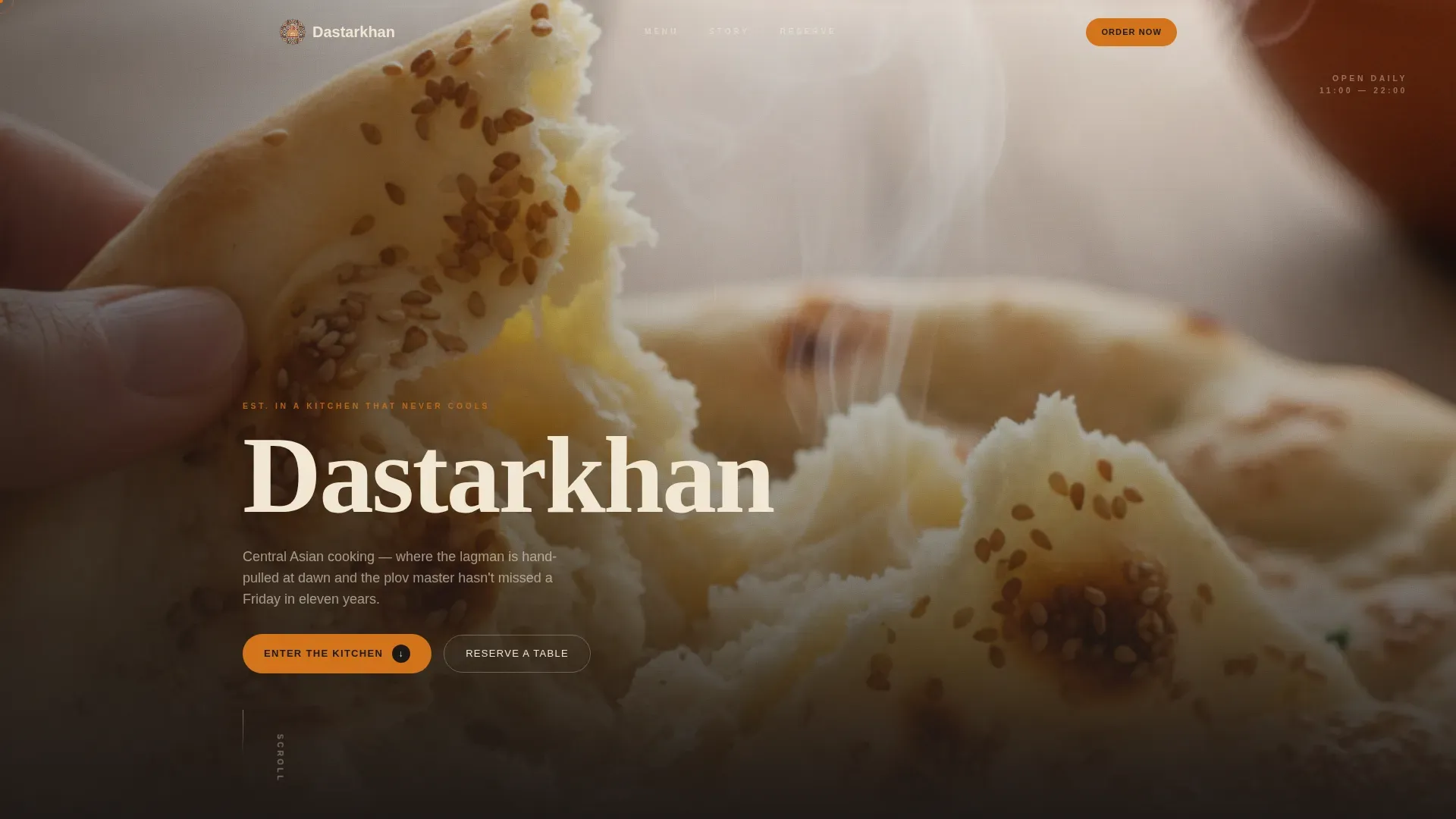
The hero opens on a full-viewport close-up of freshly torn non bread. Steam still rises. A hand enters the frame mid-tear. No price, no menu link, no clutter for the first two beats. Then the restaurant name appears in a chunky retro Cyrillic-inspired serif display typeface, cream on charcoal, positioned low-left like a film title card. It is a great opening that earns attention before asking for anything.
Day-in-the-Life Scroll Narrative
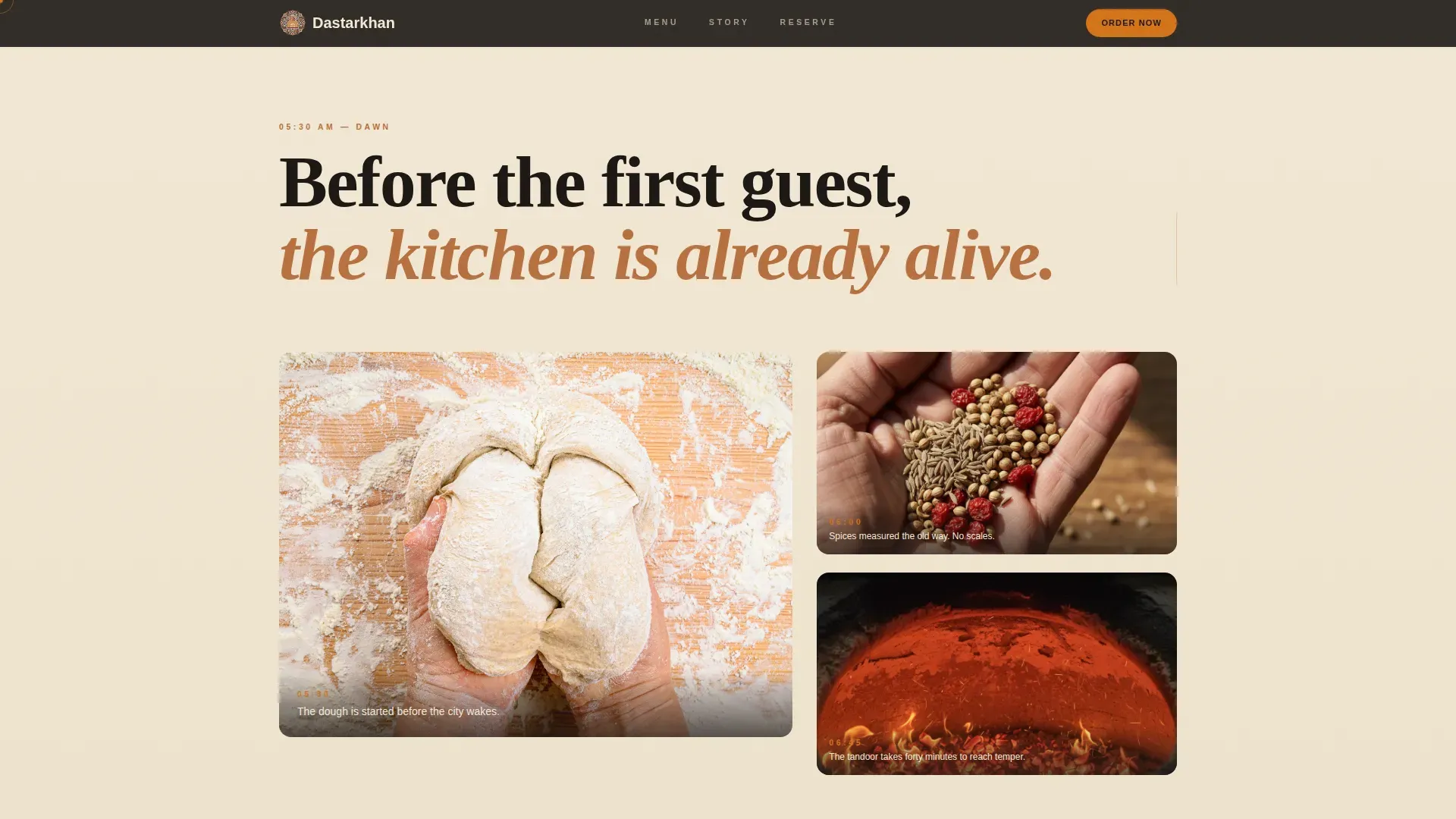
The scroll follows a single day inside the kitchen. Morning sections show hands kneading dough, spices measured in palms, and the tandoor being lit. Midday brings the lunch rush: steam clouds, a waiter carrying three bowls of shurbo, and dish photography that makes the meal feel immediate. Afternoon shifts to tea service and suzani textiles catching window light. Evening arrives with the plov master inverting the kazan and the communal table filling with guests. Each section transition carries a color shift from cream mornings to amber afternoons to charcoal evenings.
Scroll-Linked Time-of-Day Color Transitions
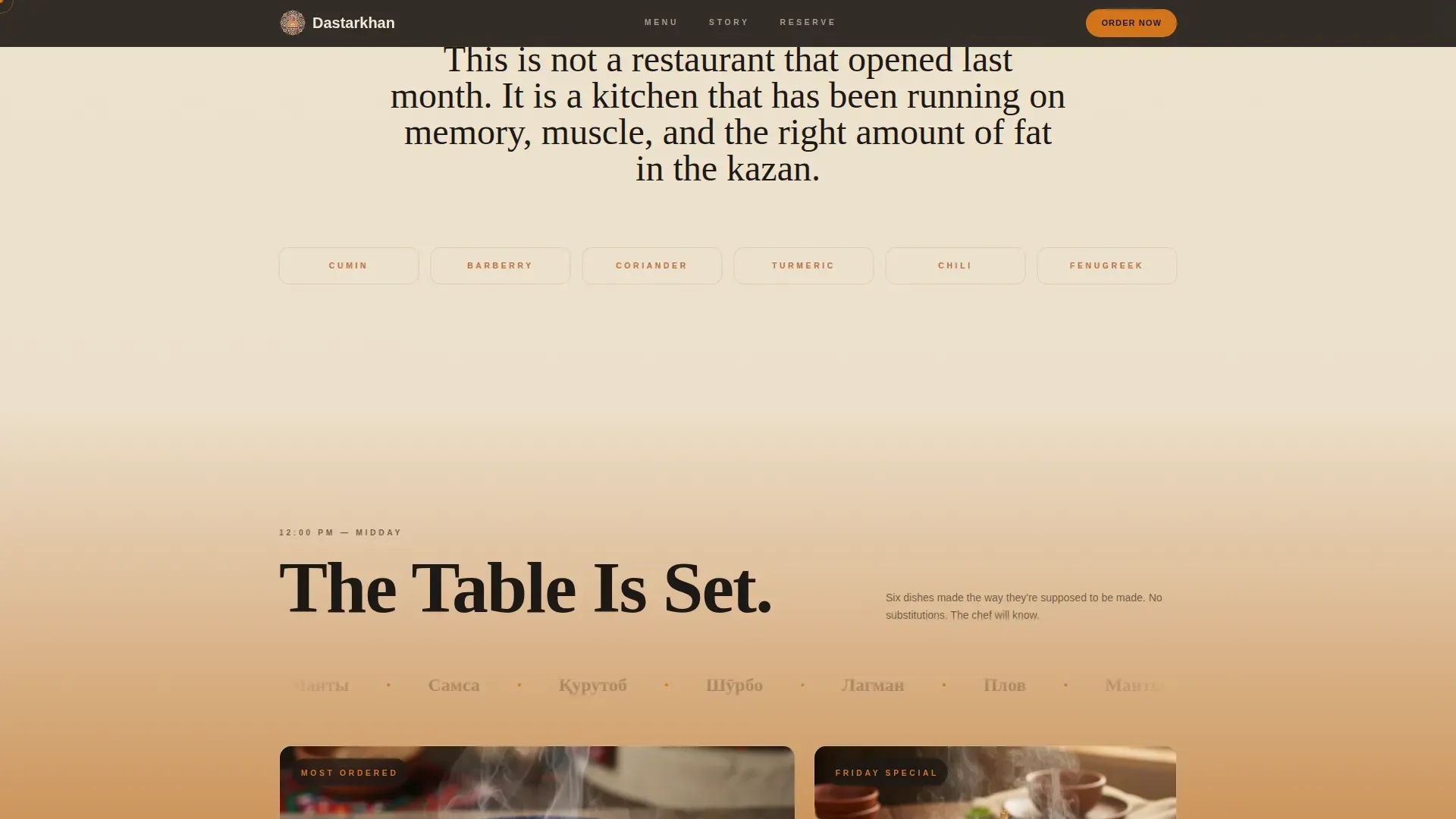
The page itself apparently changes as the visitor scrolls. Morning sections are washed in raw cotton cream. Midday sections warm into tandoor-flame amber. Evening sections deepen into blackened charcoal. This is not decoration; it is apparently a storytelling device that makes the scroll feel like time passing inside the room. The color relation between palette and time of day is one of the most distinctive details in this template.
Inline Dish Ordering with "Add to Order" Buttons
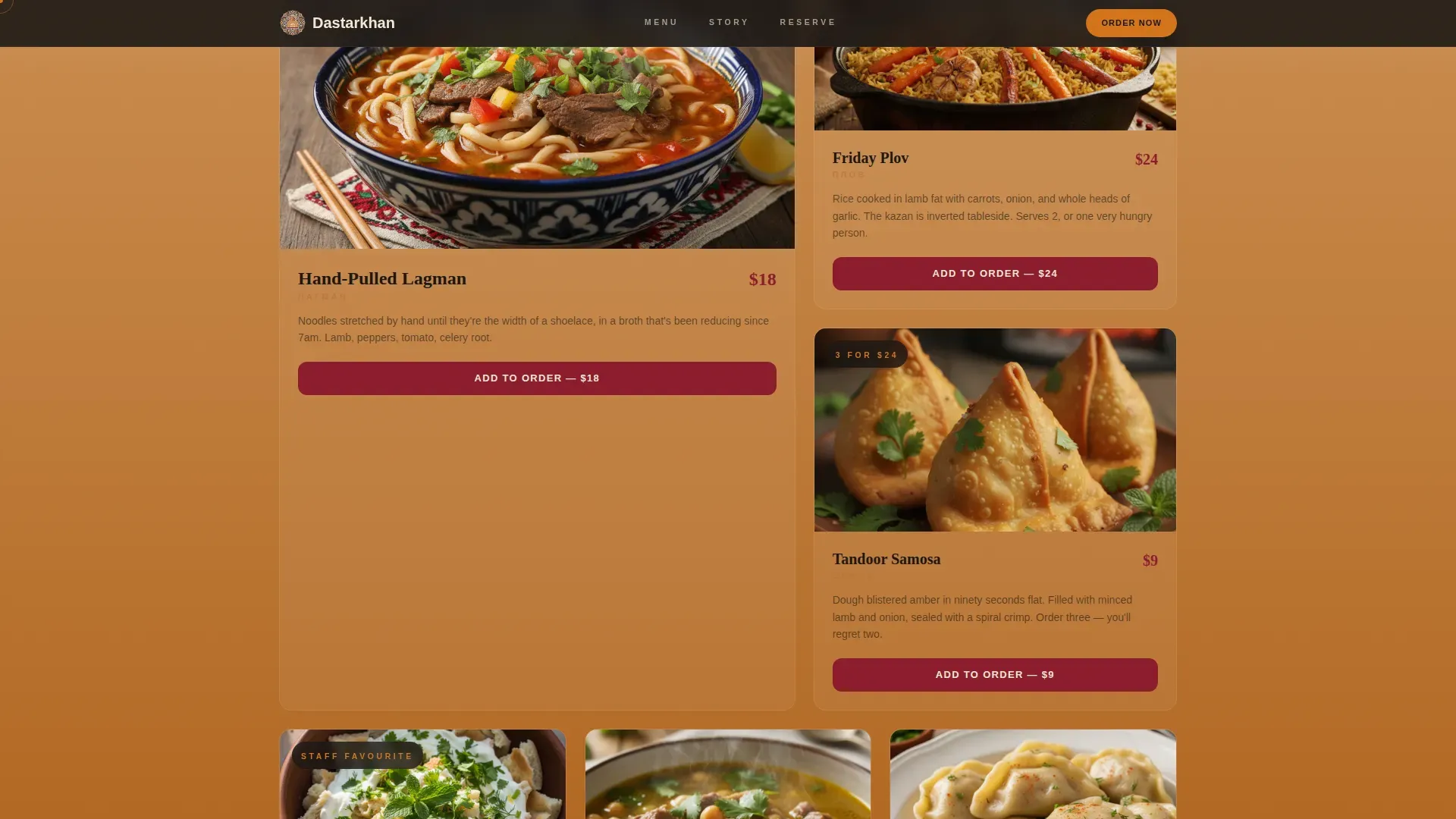
As visitors scroll past the midday dish showcase, each food photograph includes a one-tap "Add to Order" button in pomegranate red with the price visible. This removes the gap between appetite and action. Visitors do not need to navigate to a separate menu page. The order starts right where the hunger is. This is apparently one of the fastest paths from browsing to buying available in a food template of this kind.
Sticky "Order the Full Dastarkhan" Call-to-Action
After the midday section, a sticky amber button labeled "Order the Full Dastarkhan" appears and stays visible as the visitor continues scrolling. It links to a curated family-style feast menu with per-person pricing. The button does not appear too early. It is apparently withheld until the food has done its work. A secondary cream-outlined "Reserve a Table Tonight" button floats in the evening section as a quieter alternative path.
Neo-Retro Fire and Earth Visual System
The palette is built from five colors: blackened cast-iron charcoal, tandoor-flame amber, sun-dried clay, pomegranate seed red, and raw cotton cream. Together they feel like a hand-painted Soviet-era tea house sign weathered by fifty summers. Vintage typography using Fraunces serif display and DM Sans body text reinforces the Neo-Retro identity. This design system bridges tradition and contemporary taste in a way that is immediately recognizable and hard to copy with a generic tool.
Page sections overview
| Section | Purpose |
|---|---|
| Cinematic Hero | Opens with macro bread photography and a film-title-card restaurant name reveal |
| Dawn Craft Story | Shows morning kitchen prep: dough, spices, tandoor lighting |
| Midday Dish Showcase | Presents food photography with inline "Add to Order" buttons and pricing |
| Afternoon Tea Service | Covers atmosphere, suzani textiles, tea culture, and a cinematic testimonial |
| Evening Plov Ceremony | Features the kazan inversion, communal table, and the Dastarkhan feast call-to-action |
| Arc Split Footer | Closes with tagline, contact details, and social media links |
Design & branding system
The visual identity follows a Neo-Retro approach that combines nostalgia with modern clarity. The result is a design that reminds visitors of something real and lived-in rather than something produced by a template factory. Vintage typography and a weathered color palette enhance the neo-retro theme while keeping the page fast to read and easy to navigate. The palette draws from deep charcoal and warm off-white accented with traditional Tajik tones, and subtle deconstructed Ikat and Suzani patterns serve as background overlays and section dividers.
- Fire and Earth palette: charcoal #1C1714 for headers, amber #D4731A for buttons and hover states, clay #B8703F for mid-tone surfaces, pomegranate #8C1C2C for price tags and spice accents, cream #F2E8D5 for text and breathing space
- Typography: Fraunces bold retro serif for display headings, DM Sans clean modern sans-serif for body copy, improving readability across all screen sizes
- Ikat and Suzani pattern overlays used as section dividers, reinforcing the cultural identity of the restaurant without overpowering the food photography
Mobile & speed optimization
The template is designed with a mobile-first perspective, which matters enormously for this audience. Diaspora families searching for a place to eat on a Saturday night are almost always on their phones. Most restaurant searches apparently occur on mobile devices, which is why every button, scroll section, and food image in this template is built to be thumb-friendly and fast to load. The design ensures a responsive layout that works as well on a small screen as it does on a widescreen desktop.
- Mobile-first layout with thumb-friendly buttons including the sticky amber call-to-action and pomegranate inline ordering buttons
- Lazy loading for image-heavy sections, so the page does not bear the full weight of high-resolution food photography all at once
- Next.js Image optimization applied to the macro photography and dish showcase imagery to keep the scroll smooth
How this template helps you convert
The conversion strategy is built into the scroll sequence itself. The page earns the purchase by making the visitor hungry first. Six full sections of food, craft, and atmosphere appear before a single price is shown. This is not an accident; it is a deliberate structure that mirrors how a great meal actually works. You do not pay before you sit down. You sit, you smell the food, and then you order. The template follows that same logic online.
- The scroll sequence builds appetite and trust through cinematic food storytelling, so by the time the sticky amber button appears and the inline ordering options arrive, the visitor is already emotionally committed to the meal
- The dual call-to-action structure, "Order the Full Dastarkhan" for feast orders and "Reserve a Table Tonight" for dine-in reservations, serves both buyer intents without forcing a choice too early
Other information about this template
This template is one example of what is possible when a no-code platform generates a production-ready website from a detailed natural language prompt. No-code tools allow restaurant owners to create and customize a page like this without traditional programming skills, significantly reducing the time and cost of building a restaurant landing page. Templates in these platforms can be tailored to specific cultural themes, and this one is among the most culturally specific available for Central Asian cuisine.
Food plays a central role in the history of the Silk Road world, and Tajik cuisine carries that history in every dish. Plov is apparently the most discussed subject in Central Asian food culture, and apparently it bears enormous symbolic weight at communal meals. Lagman, samosas, shurpo, qurutob: these are dishes with long histories, prepared with care and fresh ingredients including lamb, rice, meat, vegetables, and fresh herbs and spices that apparently bring the region's agricultural richness to the table. Dry fruits, nuts, and garden produce are also part of this tradition, and the template makes room for that world to be visible.
The Silk Road linked Central Asia to Persia, Russia, India, and Europe across centuries of trade and exchange. Tajikistan's culinary traditions reflect that history. Tea is a vital part of the tradition, apparently served at every gathering and in every relation between host and guest. The afternoon tea section of this template brings that subject to life with a view of suzani textiles and quiet ceremony. The template apparently reminds visitors of traditions they may have lived with for years or are discovering for the first time.
The design history of this template draws on the visual tradition of Soviet-era Central Asian graphic art. That history is visible in the chunky retro typeface, the weathered color palette, and the way cream and charcoal apparently carry the weight of decades of painted signs and newspaper mastheads. The painting-like quality of the color system is intentional. It bridges the past and the present in a way that apparently reminds anyone with roots in that world of something they know.
From a practical standpoint, the template supports the following at a glance:
- Built for the "Dastarkhan Neo Retro Tajik Restaurant Landing Page Template" brief with full design and section fidelity
- English content throughout, with Central Asian dish names preserved in their original form for authenticity
- USD pricing displayed on inline order buttons and the feast menu
- Contact details, social media links, and location information placed prominently in the footer
- The footer follows the Arc Browser Split pattern with a tagline, bringing a contemporary graphic perspective to a culturally rooted design
- Suitable for restaurants coming to the market today with no existing web presence, as well as those ready to replace a generic template that was apparently not bringing the right guests through the door
- The page is worth considering for any food-forward operator who wants to book more direct orders and build a stronger relation with the community they serve
- Celebrations, festivals, and communal meals are core subjects in Tajik culture, and the evening section of this template is prepared to support that kind of occasion-based marketing
- Children, families, and multigenerational groups are all part of the target audience, and the design speaks to all of them without apparently losing its edge for the adventurous food-curious couple who found the place on a blog
- The template can link to external ordering systems, social profiles, and reservation tools through standard hyperlinks in the call-to-action buttons
- Availability of feast packages and per-person pricing can be displayed and updated directly within the inline menu section
- The page read time is fast, and the visual hierarchy ensures visitors do not need to search for what they need
- Cash and card payment context can be added to the footer information block without structural changes
- For operators who want to shop for other templates in the same category, this template sits within a broader collection of Food and Beverage designs, including plenty of options for other parts of the world
Theme
Neo-Retro
Creative direction
Day-in-the-Life
Color system
Fire & Earth
Style
Full-Width Immersive
Direction
Direct Sales
Page Sections
Cinematic Macro Hero Section
Day-in-the-life Scroll Narrative
Scroll-linked Color Transitions
Inline Dish Ordering Buttons
Sticky Feast Call-to-action Button
Neo-retro Fire and Earth Design System
Related questions
Can I use this template without coding experience?
Does the template support both dine-in reservations and direct ordering?
Can I keep the Central Asian dish names in their original form?
How many sections does this landing page include?
Is this template suitable for mobile users?