Turkmen Restaurant Dining Reservation Landing Page
Dastarkhan is a single-column landing page template built for an authentic Turkmen restaurant. It guides visitors through a sensory scroll journey, from a nine-tile photo mosaic header to narrative dish stories and a focused booking form. The Neo-Retro Citrus Burst palette and cinematic scroll animations create appetite before the reservation call to action ever appears.
by Rocket studio
Quick summary
Dastarkhan is an immersive single-column landing page template designed for an upscale Turkmen restaurant. It opens with a nine-tile asymmetric photo mosaic, moves visitors through smoke, bread, broth, and roasted meat in sequence, and closes with a focused booking form. Every visual and copy choice earns the reservation click by making the visitor hungry first.
Who this template is for
This template serves restaurant owners and operators who want their online presence to match the warmth and depth of their food. It is built for people who understand that hospitality is not just a service but a statement about care, generosity, and cultural pride.
- Owners of Turkmen, Central Asian, or broadly regional restaurant concepts who want a page that reflects genuine culinary identity
- Food and beverage entrepreneurs targeting curious local diners, adventurous couples, and expat families searching for the taste of home
- Designers and no-code builders who need a fully styled, content-ready starting place for a high-emotion dining reservation page
What problem this template solves
Most restaurant landing pages treat food as a product listing. They show a price, a photo, and a button. That approach leaves the visitor cold. A Turkmen restaurant carries generations of hospitality tradition, and a flat product page cannot hold that weight.
- Visitors arrive without context, scroll past dish names they do not recognize, and leave without booking because nothing made them feel the place
- Restaurant owners spend time wrestling with layout and color decisions instead of focusing on the story their food already tells
- Generic booking pages miss the emotional connection that drives a first visit and earns a second one
What you get with this template
You get a fully designed, single-column landing page ready to adapt and launch. Every section is built around sensory storytelling: the page does not ask for a reservation until the visitor has already tasted the meal in their mind.
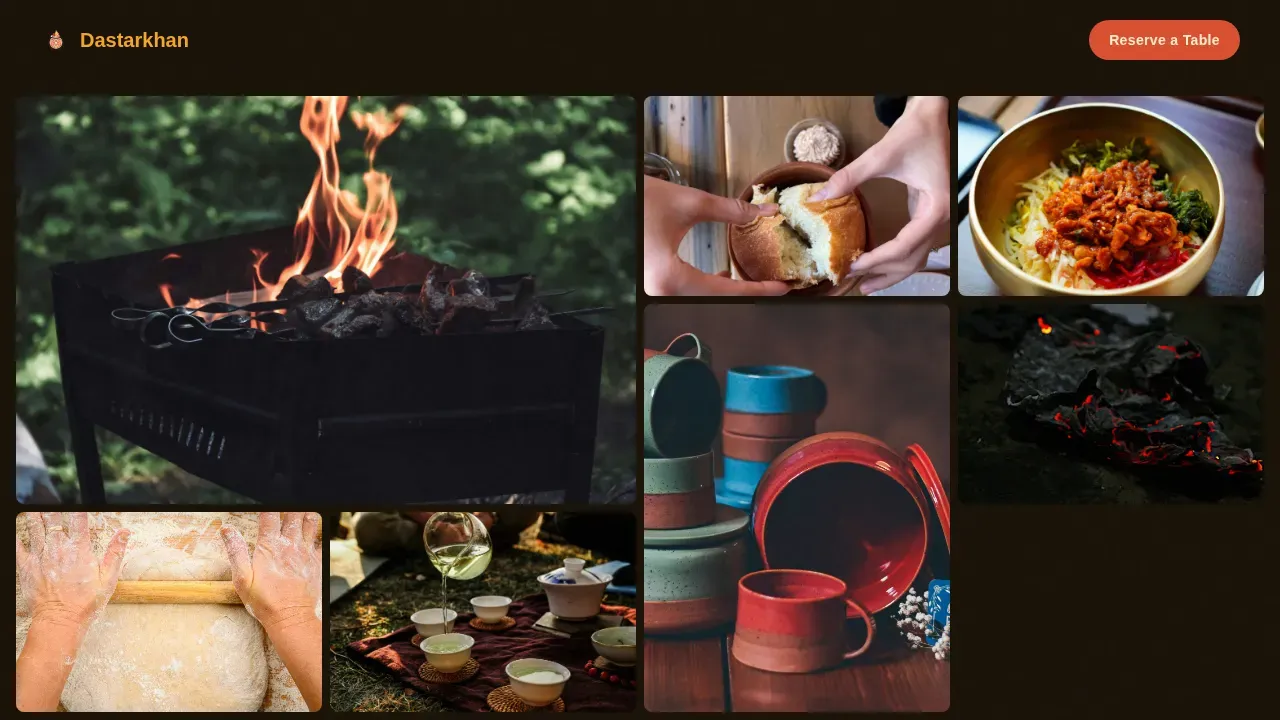
- A nine-tile asymmetric Photo Grid Mosaic header featuring saturated, tightly cropped food photography placeholders, including lamb skewers, plov, tandyr glow, and grandmother's hands on dough
- Narrative dish sections for signature Turkmen food, including plov, lagman, and lamb, written as stories with floating spice illustration placeholders in the margins
- A focused booking form asking for date, party size, and one optional field for celebrations or dietary needs, plus a secondary "Order for Pickup" path with a phone number link
Feature list
This template's features are drawn directly from the brief and reflect the specific creative, structural, and functional decisions built into the design.
Nine-Tile Asymmetric Photo Mosaic Header
The header is not a single hero image. It is a grid of nine tightly cropped, saturated food photographs arranged asymmetrically so the eye bounces between tiles of different sizes. Close-ups of glistening lamb fat, steam escaping torn çörek, a tower of plov crowned with quail eggs, stacked turquoise ceramic piala bowls, a glowing charcoal tandyr, a grandmother's hands rolling dough, kök çay being poured from height, pomegranate seeds on a brass tray, and an overhead table shot form the complete grid. The grid vibrates with color and texture and functions as the primary visual statement of the restaurant.
Sensory Scroll Journey Structure
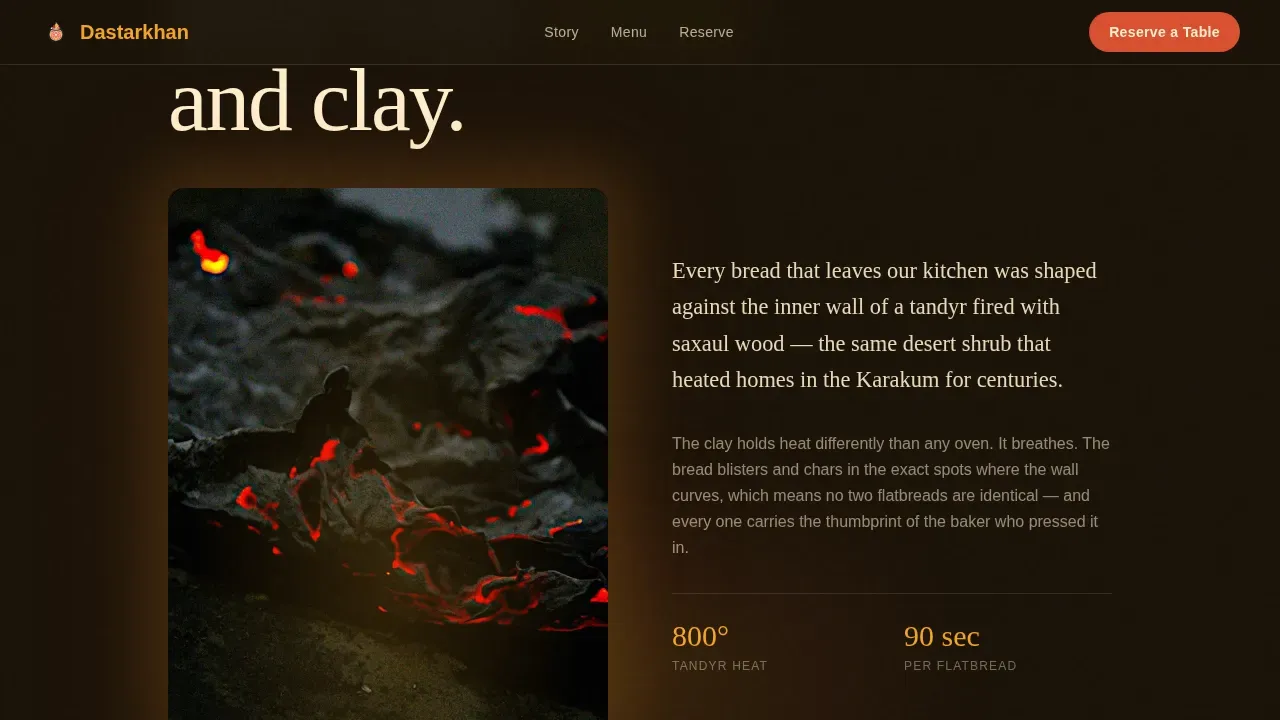
The page is organized as a meal, not a menu. Each scroll section deepens the flavor: the tandyr intro comes first with a close-up photo and a single sentence about smoke and clay. Signature dishes follow as narrative stories, describing the rice toasting before describing the plate. Floating spice illustrations drift in the margins. Images grow larger and descriptions grow shorter as the visitor scrolls, building appetite through rhythm until the final section shows a single photograph of an empty chair at a set table, waiting.
Sticky Booking Call to Action Bar
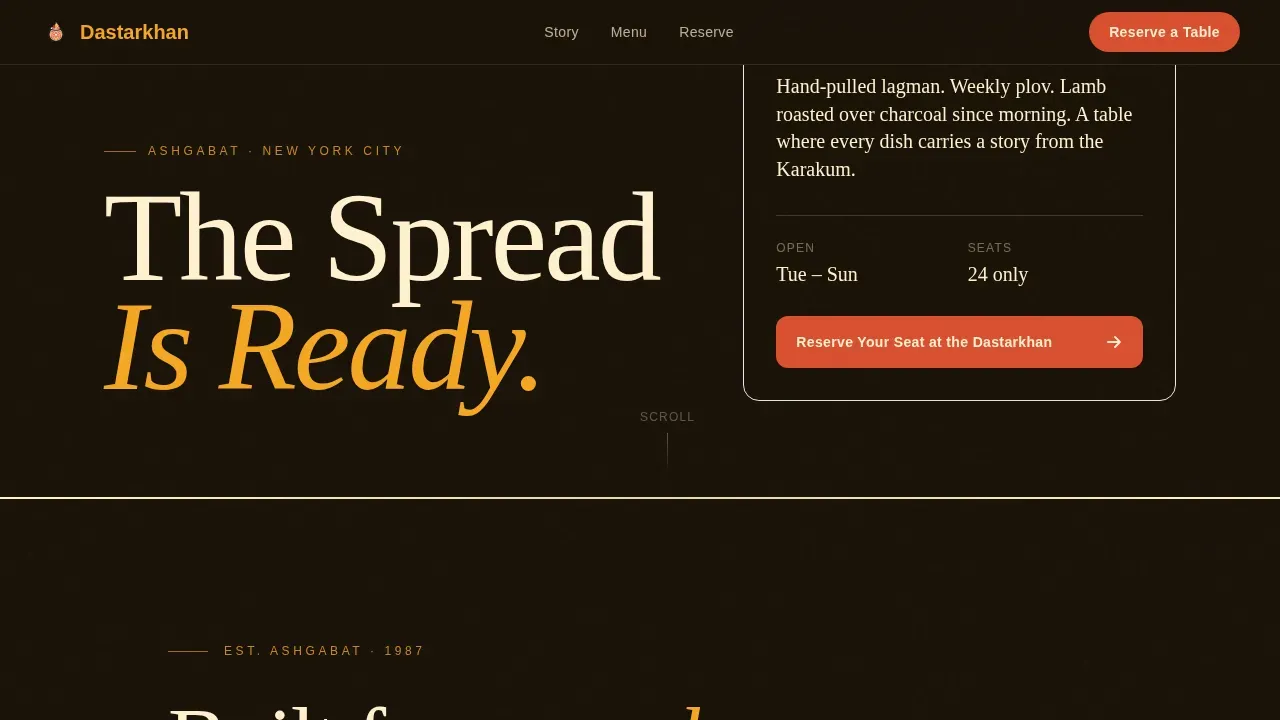
The primary call to action, "Reserve Your Seat at the Dastarkhan," appears first beneath the header mosaic in tomato red. After the midpoint of the page, a sticky bottom bar carries the same call to action so it remains accessible without interrupting the storytelling scroll. This placement strategy follows a proven principle: placing a prominent reservation button above the fold increases booking conversions, and keeping it visible through the lower half of the page removes friction at the moment of decision.
Focused Booking Form with Secondary Pickup Path
The booking form keeps its fields minimal: date, party size, and one optional text field asking about celebrations or dietary needs. A secondary path labeled "Order for Pickup" serves visitors who are not ready to dine in. It links to a simplified menu view and displays a phone number prominently. This dual-path approach captures both the table reservation audience and the takeaway audience without cluttering the primary conversion flow.
Neo-Retro Citrus Burst Visual System
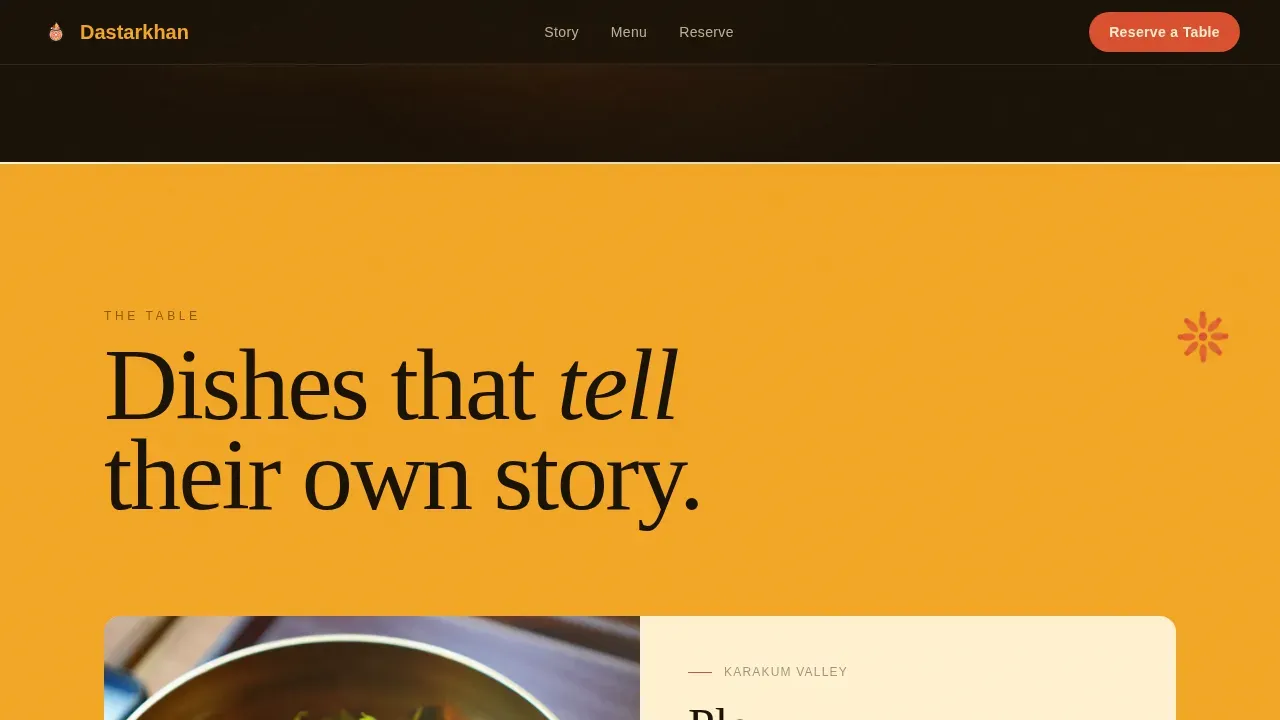
The color system uses four values: sun-dried saffron yellow (#F4A623), roasted tomato red (#D94F30), toasted sesame cream (#FFF1D0), and deep kazan black (#1A1208). Saffron yellow floods alternating section backgrounds. Tomato red marks every interactive element and hover state. Sesame cream holds the text-heavy spaces. Kazan black provides the typographic weight. The palette recalls a Soviet-era enamel sign repainted by a contemporary graphic designer: warm, punchy, and nostalgic without feeling dusty.
Cinematic Scroll Animations and Scroll-Triggered Reveals
The template includes a cinematic entrance animation, scroll-triggered section reveals, floating spice element animations in the margins, and GPU-accelerated CSS animations for smooth performance. Images are lazy-loaded. Hover states are active on dish cards. These animation choices support the Taste and Aroma creative direction: every interaction deepens the sensory experience rather than distracting from it.
Page sections overview
| Section | Purpose |
|---|---|
| Photo Grid Mosaic | Establishes visual identity with nine saturated food image tiles |
| Tandyr Origin Intro | Opens sensory storytelling with smoke and clay close-up |
| Signature Dishes | Presents plov, lagman, and lamb as narrative food stories |
| The Table Atmosphere | Shows overhead ambiance shot of a fully set table |
| Booking Form | Captures reservations and directs pickup orders |
| Linear Footer | Closes page with contact and navigation in single row |
Design & branding system
The design language is Neo-Retro, a style that takes the visual weight of Soviet-era graphic design and runs it through a contemporary food-culture lens. The result feels like a chaikhana enamel sign reimagined by someone who grew up eating plov on a Friday and studied typography on a Tuesday.
- Typography uses Fraunces, an expressive serif, for headlines, and DM Sans for body text, creating a pairing that feels editorial and warm at the same time
- The Citrus Burst color system alternates saffron yellow section backgrounds with sesame cream text areas, using tomato red exclusively for interactive elements and kazan black for all structural type
- Spice illustrations float in section margins as decorative elements, reinforcing the Taste and Aroma creative direction without competing with the food photography
Mobile & speed optimization
The template is built mobile-first. Restaurant bookings skew heavily toward mobile devices, and most diners search for food on the go and book from their phones. A mobile-responsive design ensures ease of booking from any device, and the sticky bottom bar becomes especially effective on small screens where it stays within thumb reach.
- Images are lazy-loaded so the page feels fast even on a cellular connection, keeping the visitor in the sensory scroll rather than waiting for assets to appear
- CSS animations are GPU-accelerated so scroll-triggered reveals and floating spice elements run smoothly on both mobile and desktop without layout shift
- The booking form is structured with minimal fields so it is fast to complete on a mobile keyboard, reducing drop-off at the critical conversion moment
How this template helps you convert
The entire page is designed as a persuasion sequence. The visitor does not see a booking form until the template has done its full job. By the time the sticky call to action bar appears, the visitor has walked through smoke, bread, broth, and meat. They are already at the table in their mind.
- The photo mosaic header creates immediate sensory impact, signaling that this restaurant is worth the visit before a single word of copy is read. A high-quality dining reservation page should feature professional photos of traditional dishes and cozy ambiance to create cultural immersion, and the mosaic delivers exactly that above the fold.
- The sticky bottom bar, which appears after the midpoint scroll, keeps "Reserve Your Seat at the Dastarkhan" visible without interrupting the storytelling. The minimal booking form, with just date, party size, and one optional field, removes every possible reason to abandon the reservation before completing it.
Other information about this template
This template draws on a deep understanding of what makes a Turkmen dining experience worth a special trip. The word "Dastarkhan" itself describes the traditional cloth or surface where food is shared in Persian and Central Asian cultures. An authentic Turkmen restaurant is referred to as a Dastarkhan, meaning tablecloth or feast. The name carries the full weight of the hospitality tradition it represents.
- In Central Asian cultures, the table is never just a surface for eating. It is a place where families gather, where elders hold court, where children learn the rituals of care and generosity by watching their parents. Women hold a respected position in Kazakh and broader Central Asian families as nurturers, educators, and keepers of traditions. Men are traditionally seen as protectors and providers. Both roles converge at the Dastarkhan, where the responsibility of feeding guests with abundance is held as a point of family honor.
- Kazakh and Turkmen family traditions reflect the importance of preserving cultural identity across generations. Family gatherings are an essential aspect of this culture, fostering unity and joy. Kazakh family traditions emphasize unity, kindness, and generosity, ensuring that no family member is left behind. Elders hold a revered place, embodying wisdom and authority that passing generations carry forward.
- Signature dishes of Turkmen cuisine include Plov, Ishlekli, and Shurpa. The template's narrative dish sections are built around these kinds of stories: the rice toasting, the lamb rendering, the flatbread dimpled by the same hands that learned the pattern in Ashgabat. Including a brief narrative about the restaurant's origin enriches the dining experience and promotes cultural storytelling in a way that a plain menu list never could.
- The reservation page incorporates elements of Turkmen hospitality: the option to note celebrations or dietary needs in the booking form mirrors the attentive care a host offers guests at a traditional Dastarkhan. Private dining options and special cultural night announcements can be added to the template as the restaurant's offering grows.
- No-code platforms enable users to create landing pages without extensive programming knowledge. AI-powered tools can simplify the process of creating landing pages for dining reservations further, allowing restaurant owners to focus on their food and their guests rather than on technical details. User-friendly landing pages enhance the customer experience for dining reservations by removing friction from the booking path.
- A menu is the most requested piece of information for 80 percent of diners. The template's secondary "Order for Pickup" path with a simplified menu view and phone number addresses this need directly. Diners are more likely to trust a restaurant that provides allergen and pricing details in the menu, so the template's structure leaves clear space for that information.
- Customer reviews that highlight the authenticity of the food and the warmth of the service build credibility. The template's social proof approach leans on implied authenticity: grandmother's hands rolling dough, the origin city of Ashgabat, a weekly-changing plov that signals a kitchen in constant care.
- Whether visitors arrive from cities across the country or from the neighborhood around the corner, the page speaks to the same central desire: a meal that feels like home. Expat families visiting from other cities carry the memory of çörek and dograma. Adventurous couples in search of their next food obsession make their first visit and come back. Children who grow up visiting this restaurant carry that sense of place forward, the way all meaningful food traditions are held and passed on across time.
- This template is built for the Dastarkhan authentic Turkmen dining reservation landing page template use case: a single-column, booking-first, story-led page for a restaurant that takes both its food and its guests seriously.
Theme
Neo-Retro
Creative direction
Taste & Aroma
Color system
Citrus Burst
Style
Single Column Flow
Direction
Booking/Scheduling
Page Sections
Nine-tile Asymmetric Photo Mosaic Header
Sensory Scroll Journey Layout
Sticky Reservation Call to Action Bar
Minimal Focused Booking Form
Neo-retro Citrus Burst Color System
Cinematic Scroll Animations
Related questions
Can I adapt the booking form for my restaurant's specific needs?
Is this template suitable for a restaurant outside Turkmen cuisine?
How does the sticky call to action bar work?
Does the template include the food photography?
Can this template support private dining or special event promotions?