Historic Home Mortgage Broker Landing Page Template
Deed is a split-screen landing page template built for historic home mortgage brokers. It pairs immersive period architecture photography with tension-release copy blocks that name specific loan products for specific preservation challenges. A vintage-styled address input drives the primary click-through flow, routing visitors to a pre-filled application, so every scroll builds trust before a word is spoken.
by Rocket studio
Quick summary
Deed is a single-page, split-screen landing page template for mortgage brokers who specialize in historic home financing. The left panel delivers sharp, loan-specific copy while the right panel fills with full-bleed period architecture photography. The result is a page that feels as considered as the homes it finances, drawing in preservationists, first-time buyers, and investors, then routing them confidently toward an application.
Who this template is for
This template is built for a very specific kind of broker: one who knows the difference between a knob-and-tube inspection and a full rewire, and whose clients are just as particular. If your business lives at the intersection of preservation and lending, this page was designed for you.
- Historic home mortgage brokers offering renovation-to-permanent loans, non-warrantable condition overlays, or Section 106 compliance support
- Brokers whose clients include preservation-minded buyers, first-time purchasers of older farmhouses or Federal-era townhouses, and investors converting historic structures into residential units
- Lending professionals who need a landing page that demonstrates fluency before a prospect ever picks up the phone
What problem this template solves
Most mortgage landing pages are built for conventional buyers and conventional homes. A broker who finances century-old Victorians, mid-century Craftsmans, or fieldstone-foundation farmhouses needs a page that speaks to why those properties are complicated, and proves, immediately, that the broker knows how to solve it. Generic templates leave that story untold.
- Conventional landing page designs fail to address the specific lender objections that come with historic properties, leaving preservation-minded buyers feeling unseen
- Brokers lose qualified leads when prospects cannot quickly identify whether the broker handles their property type and loan situation
- A mismatch between visual identity and audience erodes trust before the copy even loads
What you get with this template
You get a fully designed, single-page click-through layout that builds credibility through specificity. Every section follows a deliberate tension-release rhythm, naming a real problem that traditional lenders have with historic homes, then resolving it with a precise loan product. The page earns the application click rather than simply asking for it.
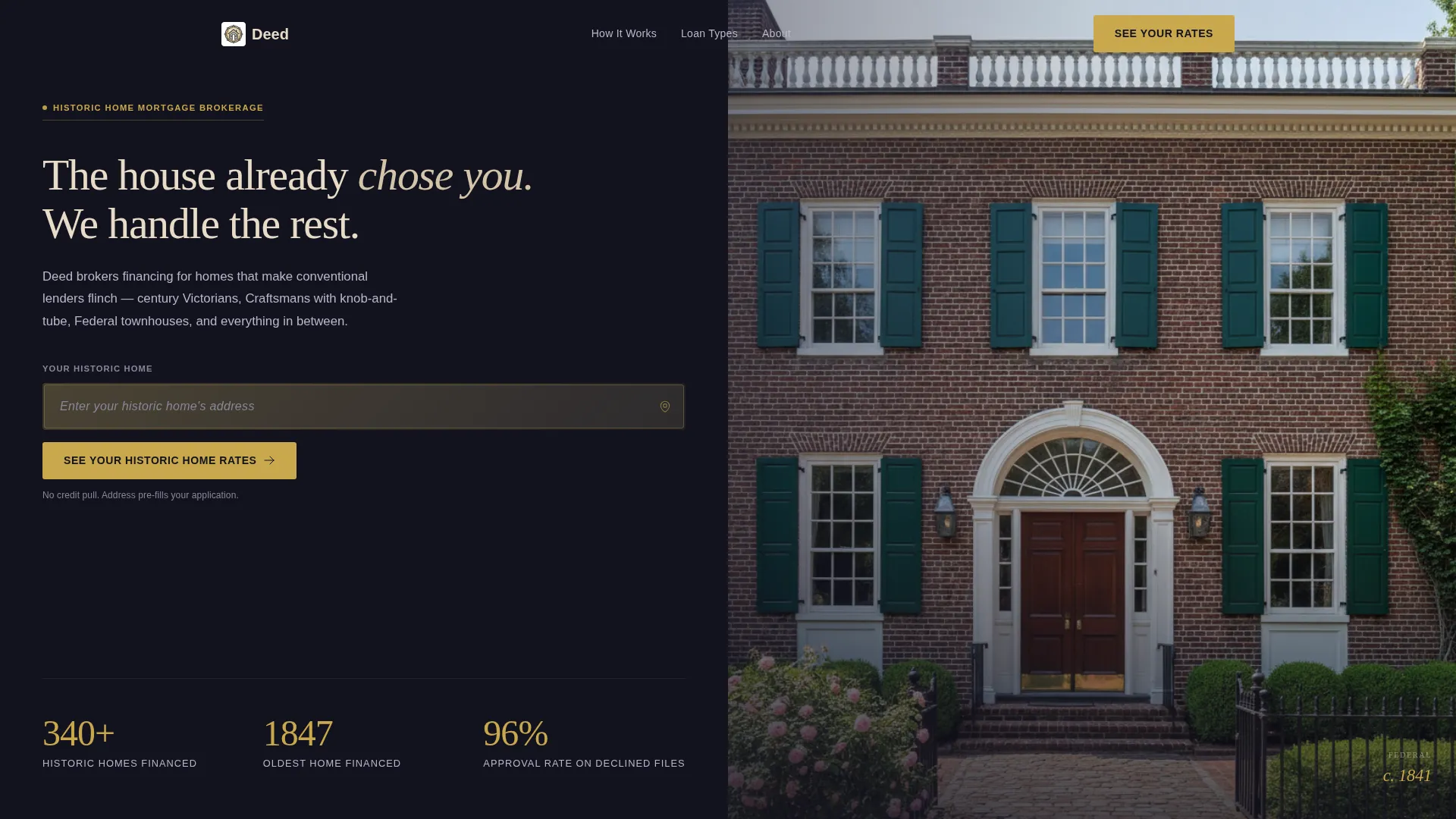
- A split-screen (50/50) header with a vintage address-plate input field on the left and a slowly panning period-home photograph on the right, with the image shifting subtly as the visitor types
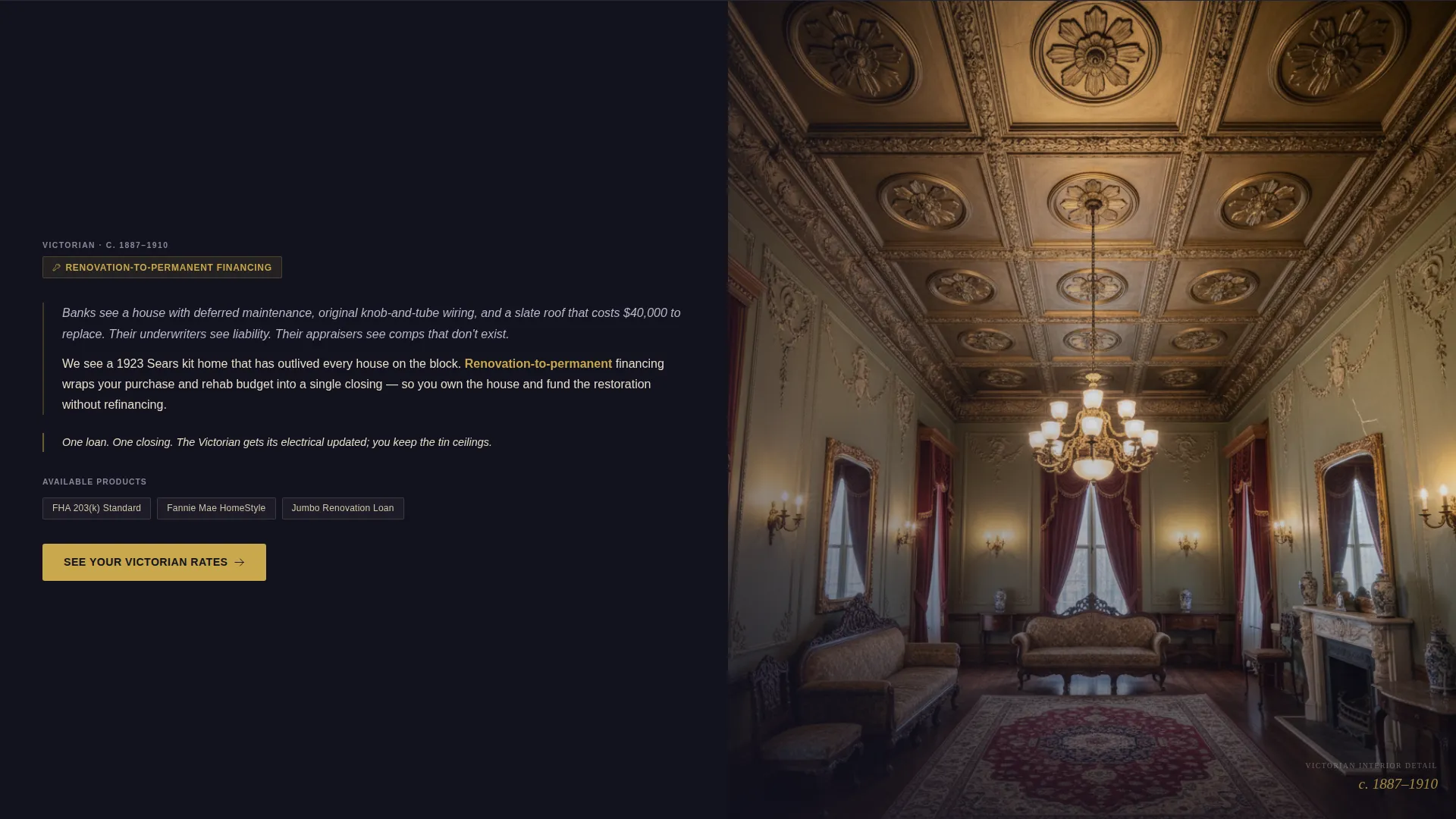
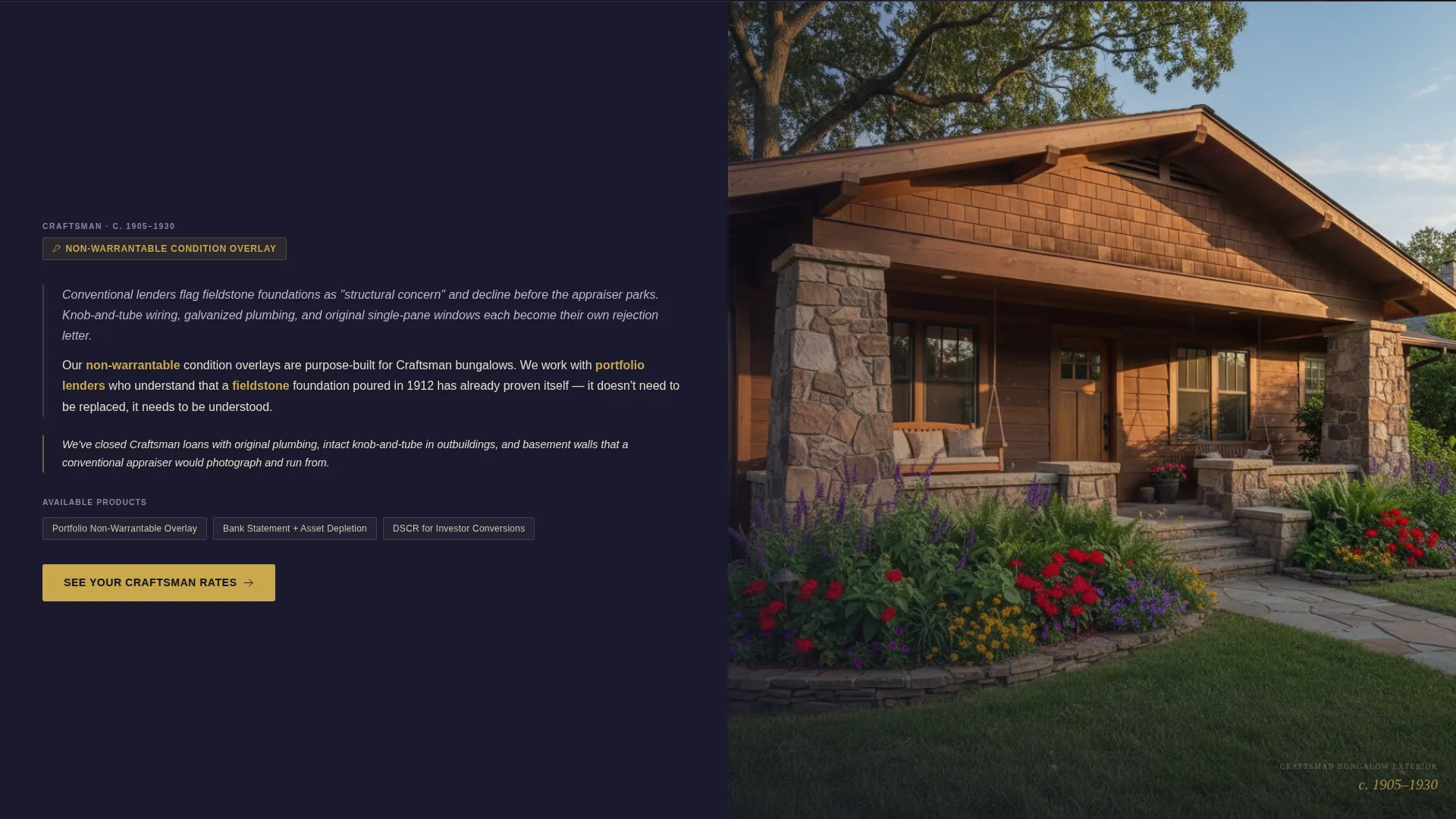
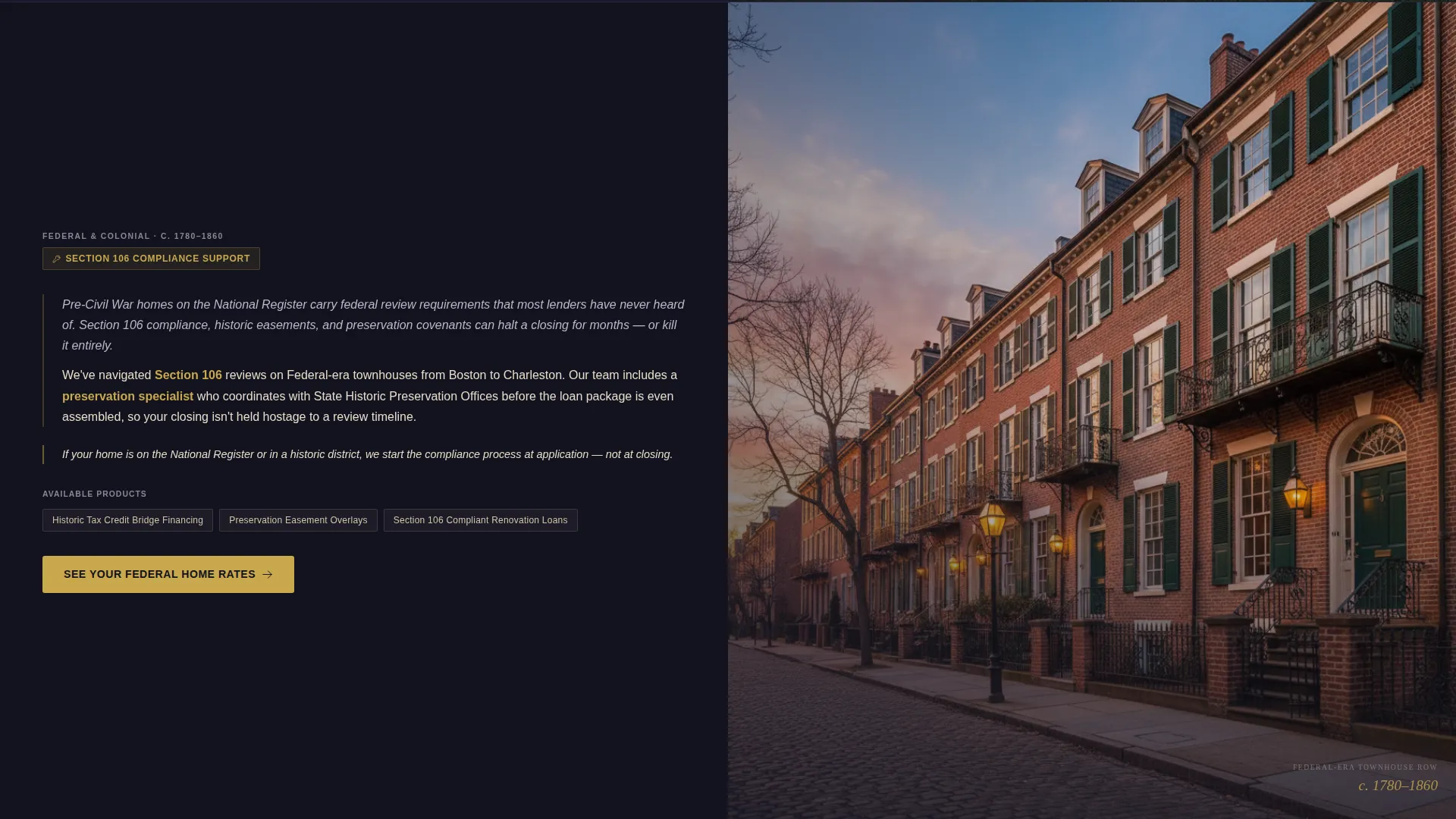
- A scroll-driven immersive section sequence where full-bleed photography moves from exterior to interior to architectural detail as the visitor reads through tension-release copy blocks
- Two conversion paths: a primary "See Your Historic Home Rates" click-through routing to a pre-filled application, and a secondary email-capture offer for the Historic Home Buyer's Guide
Feature list
This section covers the core built-in components and design capabilities that ship with the Deed template.
Split-Screen Address Input Header
The header divides the viewport equally. The left side holds a location input styled as a vintage address plate, with placeholder text reading "Enter your historic home's address." The right side displays a high-contrast dusk photograph of a period home, with interior amber light visible through original wavy glass. As the visitor types, the image shifts between Victorian, Craftsman, and Colonial reference photography.
Tension-Release Scroll Sections
Each scrollable section pairs a single, pointed fact about why a specific historic home type troubles traditional lenders with an immediate resolution naming the broker's relevant loan product. The rhythm is deliberate: problem stated, solution named, trust earned. Full-bleed photography tightens from exterior wide shots to intimate interior and architectural detail as the visitor scrolls deeper.
Dual Conversion Path Design
The primary call to action, "See Your Historic Home Rates," appears first in the header as the address input's submit action, then resurfaces after each tension-release section. Clicking routes to the broker's full application with the address pre-filled. A secondary path, "Download the Historic Home Buyer's Guide," captures an email from visitors who are researching but not yet under contract.
Loan-Specific Copy Framework
The template copy framework explicitly names loan types tied to real preservation challenges: renovation-to-permanent financing, non-warrantable condition overlays, and Section 106 compliance support. This specificity signals expertise to knowledgeable buyers and eliminates the uncertainty that generic mortgage pages leave behind.
Dark Immersive Visual System
The Cloud Canvas color palette uses deep charcoal for backgrounds and typographic weight, aged parchment for content panels and form fields, soft overcast gray for dividers and secondary text, and muted gold reserved for buttons, rate figures, and hover states. The visual language feels like finding a hand-drawn floor plan inside a leather-bound deed book.
Page sections overview
| Section | Purpose |
|---|---|
| Split-Screen Header | Address input paired with shifting period-home photography to open the conversion flow |
| Tension-Release Block 1 | Victorian-era lender objection named and resolved with a specific loan product |
| Tension-Release Block 2 | Craftsman-era knob-and-tube framing resolved with renovation financing copy |
| Tension-Release Block 3 | Federal or colonial property challenge addressed with condition overlay context |
| Buyer's Guide Capture | Secondary email-capture offer for pre-contract visitors downloading the Historic Home Buyer's Guide |
| Repeat Primary call to action | "See Your Historic Home Rates" resurfacing after each content section to sustain the conversion path |
Design & branding system
The Deed template uses a Dark Immersive theme built on the Cloud Canvas color system. Every color choice references the physical materials of old homes: cool plaster shadow against warm paper, brass catching light in a dim corridor. The palette is not decorative, it is functional, directing attention to the exact elements that drive action.
- Deep charcoal (#1A1A2E) dominates backgrounds and sets the atmospheric weight; aged parchment (#E8DCC8) washes over content panels and form fields to create warmth and readability
- Soft overcast gray (#B8B8C8) softens dividers and secondary text without competing with primary content; muted gold (#C9A84C) is reserved strictly for interactive elements, rate figures, buttons, and hover states
- Full-bleed period architecture photography shifts in framing as the visitor scrolls, moving from wide exterior dusk shots inward to tight architectural details, reinforcing the sensation of walking deeper into the property
Mobile & speed optimization
The split-screen layout is designed to reflow cleanly for smaller viewports, maintaining the visual separation between copy and photography without requiring horizontal scrolling. The address input and call-to-action buttons remain prominent and tappable at all screen sizes.
- The 50/50 split stacks vertically on mobile, keeping the address input above the fold and the period-home photograph immediately below it for visual context
- Call-to-action buttons retain their muted gold styling and full-width tap targets on mobile, preserving the conversion path across devices
How this template helps you convert
Every design and copy decision in Deed is oriented toward one outcome: a visitor who feels understood enough to click. The page does not ask for trust, it demonstrates expertise and then makes the next step easy.
- The address input creates immediate personalization. Visitors type their property's location before reading a single word of pitch copy, which shifts the dynamic from broadcast to conversation and increases the chance they complete the primary call to action.
- The tension-release section rhythm resolves real lender objections in real time. By naming specific loan types, renovation-to-permanent financing, non-warrantable condition overlays, Section 106 compliance support, the page proves competence before any human interaction occurs, reducing friction at the application step.
- The secondary Buyer's Guide path captures leads who are not yet ready to apply. Visitors who are still in the research phase can exchange their email for a practical resource, keeping them inside the broker's pipeline without forcing a premature commitment.
Other information about this template
The Deed template is a strong fit for brokers operating in a specialized niche where the quality of a lender's knowledge matters as much as the rate. The design language and copy framework work together to communicate that specialization at a glance.
- The template style is Split Screen (50/50), a format well suited to pairings of data-entry forms with immersive photography, common in high-intent property and lending contexts
- The page direction is Click-Through, meaning the primary goal is routing a warm, address-qualified visitor to the broker's full application rather than closing the transaction on the page itself
- The Cloud Canvas color system and Dark Immersive theme were selected specifically to evoke the material qualities of historic architecture, differentiating this page visually from the clean-white aesthetic of conventional mortgage marketing
- This template is designed for single-page deployment and does not require a multi-page site structure to deliver its full conversion sequence
Theme
Luxe Minimal
Creative direction
Case Study Narrative
Color system
Warm Stone
Style
Split Screen (50/50)
Direction
Booking/Scheduling
Page Sections
Split-screen Address Input Header
Tension-release Scroll Sections
Dual Conversion Path Layout
Loan-specific Copy Framework
Dark Immersive Cloud Canvas Palette
Related questions
Can I update the photography to match my local market's home styles?
Does the address input pre-fill the broker's application form?
Who is the secondary Buyer's Guide capture section designed for?
Can the loan-type copy be edited to reflect my specific products?
Is this template suitable for a broker who works with investors as well as homebuyers?