Judiciary & Legal Professional Website Template
The Justice template is a commanding military court defense landing page built for legal funds that fight inside the Uniform Code of Military Justice (UCMJ) system. It uses a Monochrome Steel palette, a modular card grid layout, and a transparent fund-allocation structure to earn donor trust fast. Every section is built to convert visitors into donors or email subscribers.
by Rocket studio
Quick summary
Justice is a single-page, card-grid landing page template built for military court defense legal funds. It pairs cold institutional authority with radical financial transparency to move donors from understanding to action. The design speaks directly to active-duty service members, military families, and veterans' advocates who need clarity under pressure.
Who this template is for
This template serves organizations that fund or provide defense services inside the military justice system. It is built for teams that understand the weight of a UCMJ charge and need a page that reflects that seriousness.
- Military defense legal funds seeking donor acquisition
- JAG-experienced attorneys or advocacy groups representing service members at court-martial
- Veterans' organizations that assist active-duty enlisted facing Article 32 hearings or nonjudicial punishment proceedings
What problem this template solves
Finding legal counsel at 0200 when a court-martial notice arrives is not a search for inspiration. Visitors arrive with urgency. They need to understand what the fund does, how it spends money, and whether it wins. A generic page loses them. This template holds their attention with documented outcomes and clear numbers.
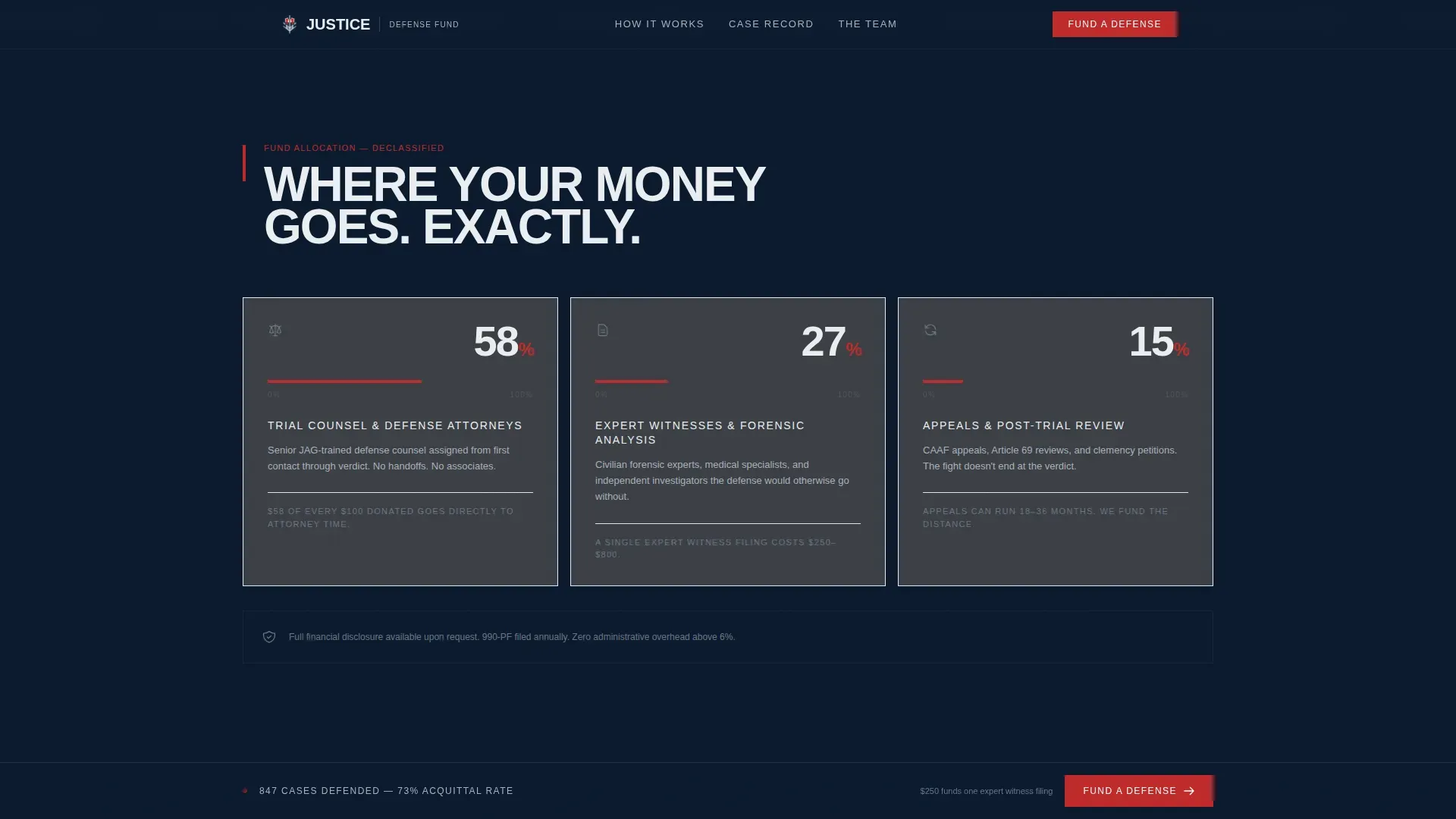
- Donors need to see fund allocation before they give; the template shows it first
- Families need to understand the nature of UCMJ proceedings quickly, without legal jargon
- Organizations need a page that builds authority through case records, not decorative claims
What you get with this template
The template delivers a fully structured, desktop-first landing page with complete mobile support. Every section is pre-built and editable. No filler content. No vague layouts.
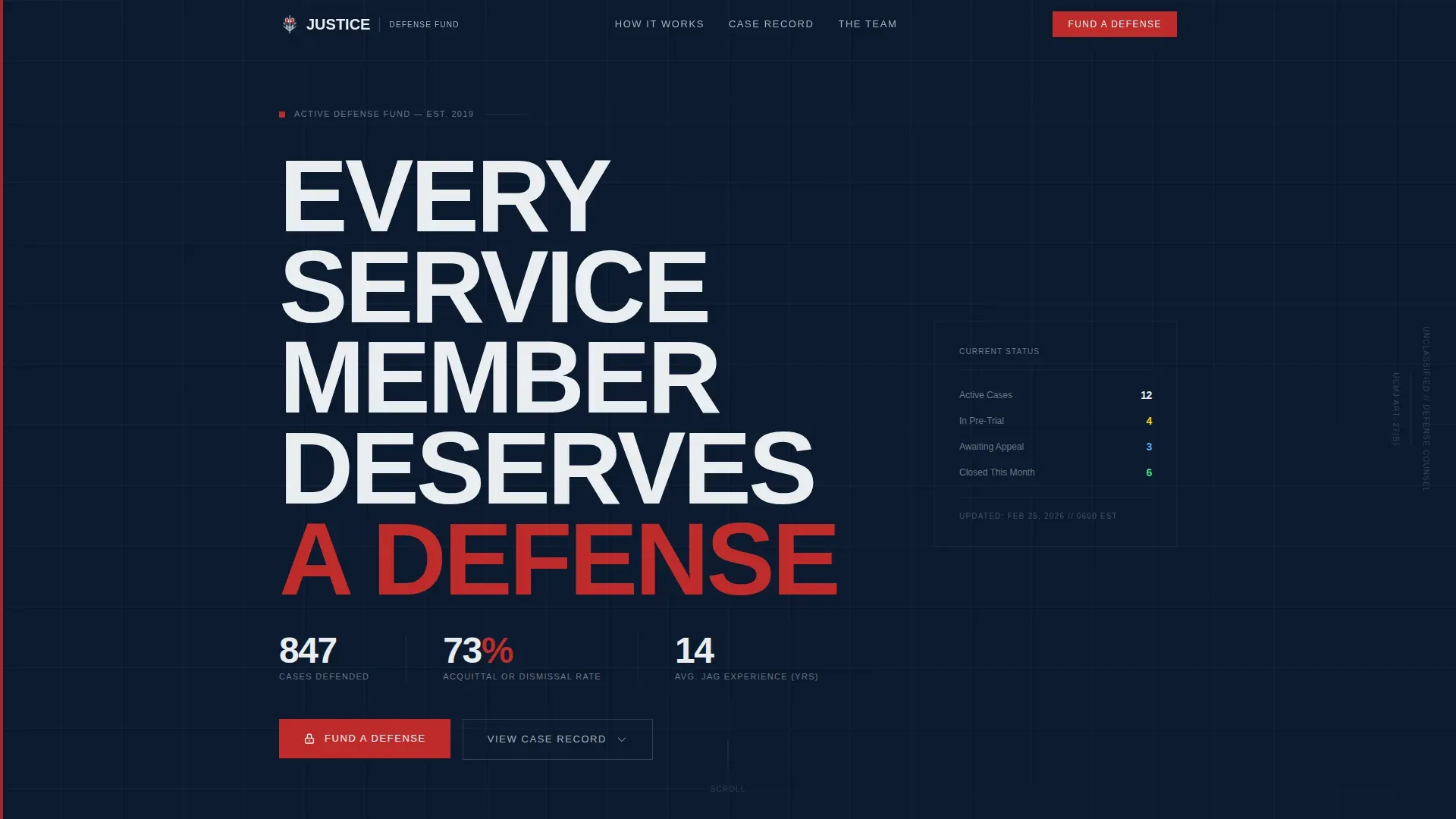
- Hero block with a giant left-aligned headline and service-record stat line
- Three-row modular card grid covering fund allocation, after-action case reports, and legal team credentials
- Donation form with preset cost-anchored amounts, a custom field, and a sticky call-to-action bar
Feature list
The Justice template includes the following built-in sections and interaction patterns.
Giant Headline Hero Block
A full-width, left-anchored hero with condensed sans-serif type set against a deep navy void. Below the headline, a single stat line presents case count and acquittal rate like a service record. No imagery. The typography carries all the authority.
Transparent Fund Allocation Cards
Three gunmetal-gray cards each display a percentage breakdown with an animated red progress bar. Donors see exactly how trial counsel, expert witnesses, and appeal costs are funded before they reach the donation form.
After-Action Case Report Cards
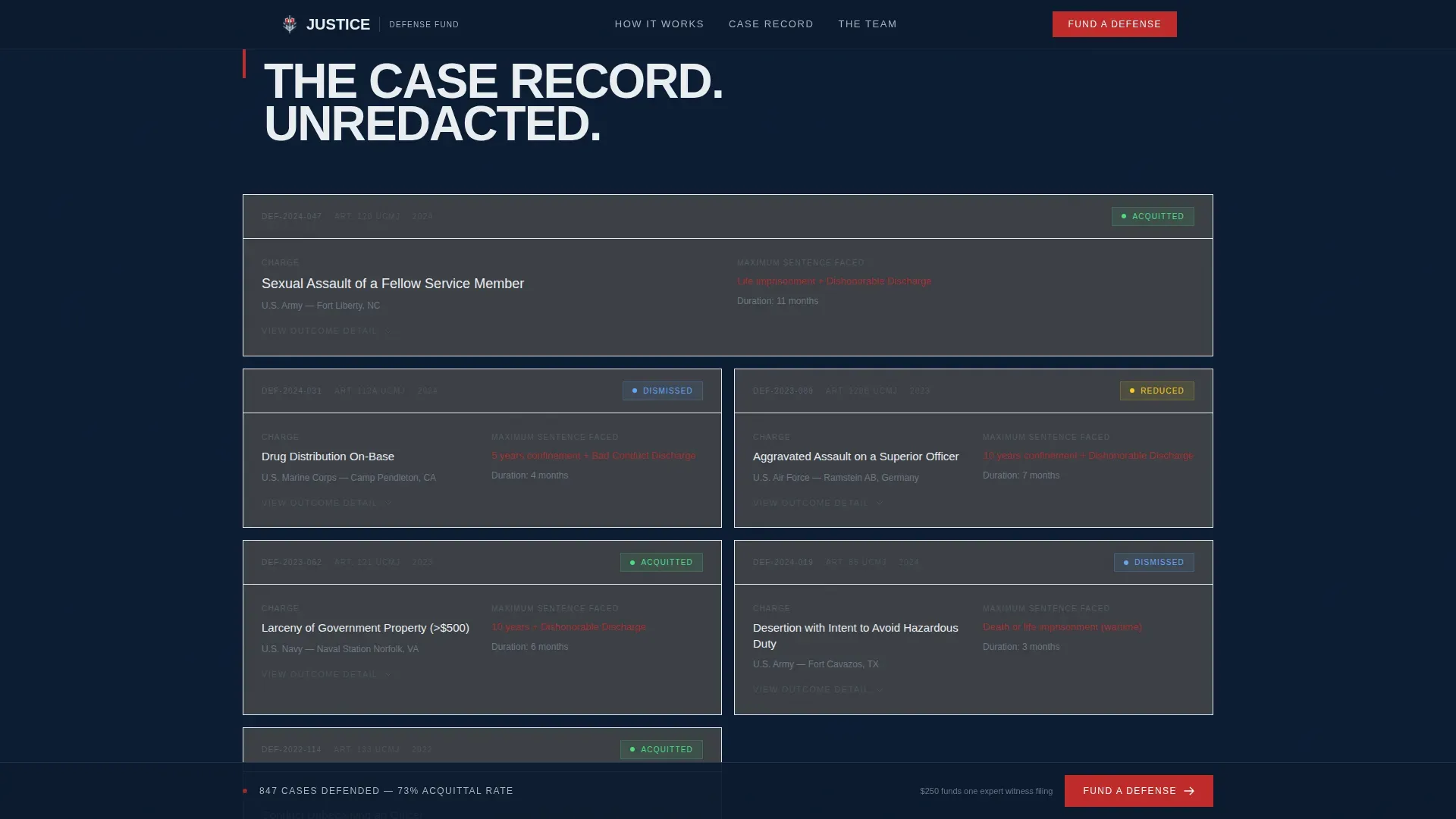
Anonymized case cards read like military after-action reports: charge filed, maximum sentence possible, outcome achieved. Each card raises the emotional stakes and demonstrates real impact without compromising client privacy.
Legal Team Credential Cards
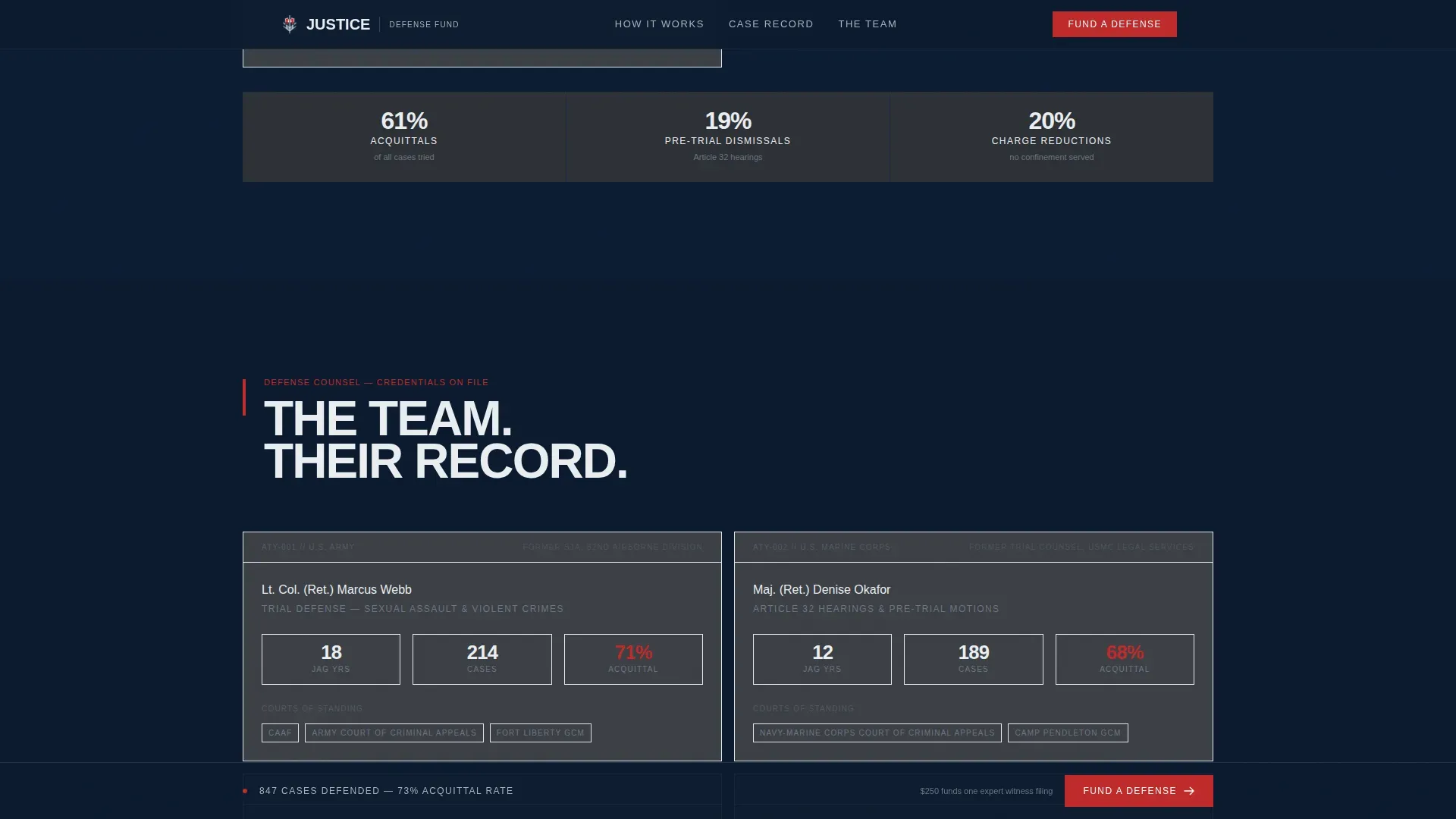
Attorney cards show case counts, years of JAG experience, and courts where they hold standing. No glamour headshots. The format mirrors how a commanding officer reviews a service record.
Cost-Anchored Donation Form
Preset donation amounts are tied to real legal costs. For example, one amount covers an expert witness filing; another funds a full Article 32 hearing defense. A custom amount field and sticky call-to-action bar complete the conversion flow.
Email Subscription Capture
A secondary conversion block collects only an email address. It is framed as a transparency mechanism: subscribers receive case update documents so they can track exactly where funds went.
Page sections overview
| Section | Purpose |
|---|---|
| Hero Headline Block | Establish authority with stat-backed headline |
| Fund Allocation Cards | Show percentage breakdown per cost category |
| After-Action Reports | Demonstrate outcomes with anonymized case records |
| Legal Team Cards | Present JAG credentials and court standing |
| Donation Form | Convert visitors with cost-anchored preset amounts |
| Email Subscription Bar | Capture secondary leads with accountability framing |
| Sticky call to action Bar | Keep "Fund a Defense" visible after first scroll |
| Footer Row | Single-row linear footer with essential links |
Design & branding system
The visual identity follows an Institutional Authority theme. Every color and type choice earns its place or does not appear. The palette feels like a freshly pressed Class A uniform: starched, cold, and precise.
- Colors: dress-blue navy (#0B1A2E) body, gunmetal gray (#3B3F45) cards, steel-bright white (#EAEDF0) typography, service-ribbon red (#BF2A2A) for calls to action only
- Typography: condensed DM Sans weight for headlines, Manrope for body text
- No decorative imagery; layout density tightens as the user scrolls toward the donation form
Mobile & speed optimization
The template is built desktop-first to match donor research behavior, with full mobile support across all sections. Interactions are kept minimal and purposeful.
- Scroll-triggered card reveals and progress bar animations load without blocking the main thread
- Sticky call-to-action bar and donation selector use minimal client-side interaction
- The donation form and email capture are friction-light with no unnecessary fields
How this template helps you convert
Every layout decision is based on earning the donation before asking for it. The template shows the math first and the emotion second.
- Fund allocation cards answer the first donor question before it is asked, building trust at the top of the page
- Case outcome records demonstrate a real trial record, so visitors understand the level of defense the fund delivers
- Cost-anchored preset amounts explain exactly what each donation does, reducing hesitation at the point of giving
Other information about this template
This template is well-suited for any organization working within the military justice system, where understanding the rules governing proceedings is critical. The Uniform Code of Military Justice (UCMJ) covers 146 articles, and defense services span everything from nonjudicial punishment under Article 15 to General Court-Martial proceedings. A service member facing a charge has the right to counsel and the right to call witnesses. They may also appeal a commander's Article 15 decision within five calendar days from the date punishment is announced. The template's transparent structure reflects the nature of these proceedings clearly.
- The UCMJ governs all branches, including army units and other services, and its articles explain procedures from apprehension through appeal
- Defense attorneys investigate allegations, file motions, and assist clients in understanding their Article 31 rights against self-incrimination
- Accepting nonjudicial punishment is not an admission of guilt; service members may refuse and demand a court-martial, which is a serious decision requiring counsel
- The justice commanding military court defense landing page template is designed to meet the real-time urgency that military legal crises demand, any time of day
Theme
Institutional Authority
Creative direction
Transparent Process
Color system
Monochrome Steel
Style
Card Grid (Modular)
Direction
Donation/Fundraising
Page Sections
Giant Headline Hero Block
Transparent Fund Allocation Cards
After-action Case Report Cards
Legal Team Credential Cards
Cost-anchored Donation Form
Secondary Email Subscription Block
Related questions
What type of organizations should use this template?
Can the donation amounts and case records be customized?
Does the template explain the court-martial process to visitors?
Is the template suitable for Article 15 and nonjudicial punishment cases?
How does the sticky call-to-action bar work?