Expert Hematology Clinic Landing Page Template
The Hemoglobin landing page template is built for hematology clinics that need to convert referred patients into booked consultations. It pairs a cinematic testimonial hero with a structured zigzag process guide and a five-question symptom assessment. The result is a clinical, trust-first website that turns diagnostic uncertainty into a clear, navigable path forward.
by Rocket studio
Quick summary
The Hemoglobin template is a precision-built landing page for hematology clinics and diagnostic centers. It uses a Corporate Precision design, an Arctic White color system, and a step-by-step zigzag layout to walk referred patients from first visit to confident booking. Every section is designed to reduce anxiety and build trust before a single appointment is made.
Who this template is for
This template is ideal for specialty hematology practices that serve referred patients and need to communicate complex clinical services with clarity and authority. It is equally well-suited for teams building a new website who want a structured, professional starting point without building from scratch.
- Hematology clinics diagnosing and treating blood disorders such as anemia, leukemia, and hemophilia
- Healthcare providers who receive referrals from general practitioners and need a professional intake presence online
- Medical professionals including physicians, clinicians, and researchers who want to present their hematology department credibly to patients and colleagues
What problem this template solves
Patients referred to a hematology department arrive carrying months of unexplained symptoms, incomplete information, and quiet dread. A generic clinic website does little to calm those fears or explain what happens next. This template solves the gap between clinical expertise and patient comprehension.
- It replaces vague service pages with a step-by-step process that patients can follow from referral to treatment
- It reduces miscommunication between doctor and patient by setting clear expectations at every stage
- It gives visitors a structured way to understand their own clinical symptoms before their first appointment
What you get with this template
You get a fully structured, single-page layout designed around the patient journey in a specialist hematology setting. Every block, section, and interactive element has a defined purpose backed by the source brief.
- A testimonial hero section, a zigzag process guide, a conditions block, a five-question symptom assessment, and a credentials section
- Fraunces serif headlines paired with DM Sans body type, set against a clinical white and deep venous blue color system
- A five-step interactive quiz that delivers personalized next-step recommendations to each visitor, along with a secondary call-to-action for patients who already hold referral paperwork
Feature list
The features below reflect the exact capabilities described in the source brief for this template.
Cinematic Testimonial Hero
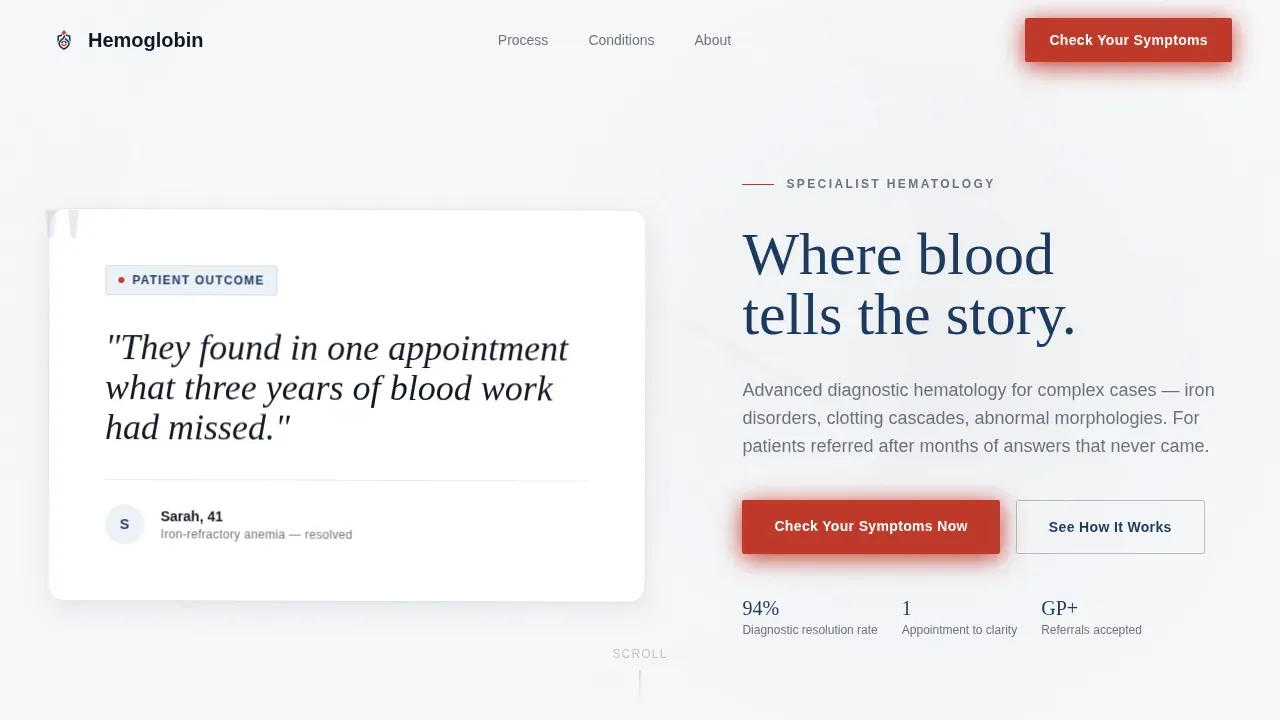
The hero opens with an oversized patient quote set in clean serif type against a desaturated blood cell background. The glassmorphism treatment keeps the visual clinical rather than decorative. No stock photography of smiling doctors. Words carry the authority.
Zigzag Step-by-Step Process Guide
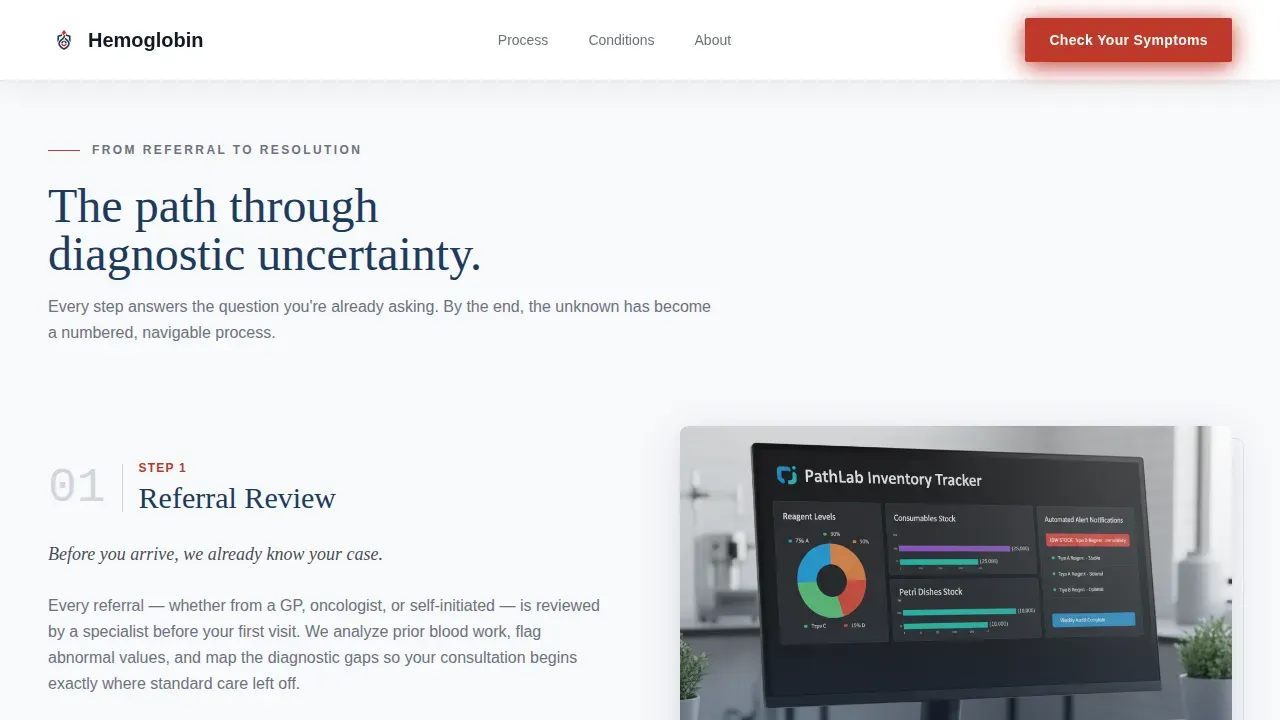
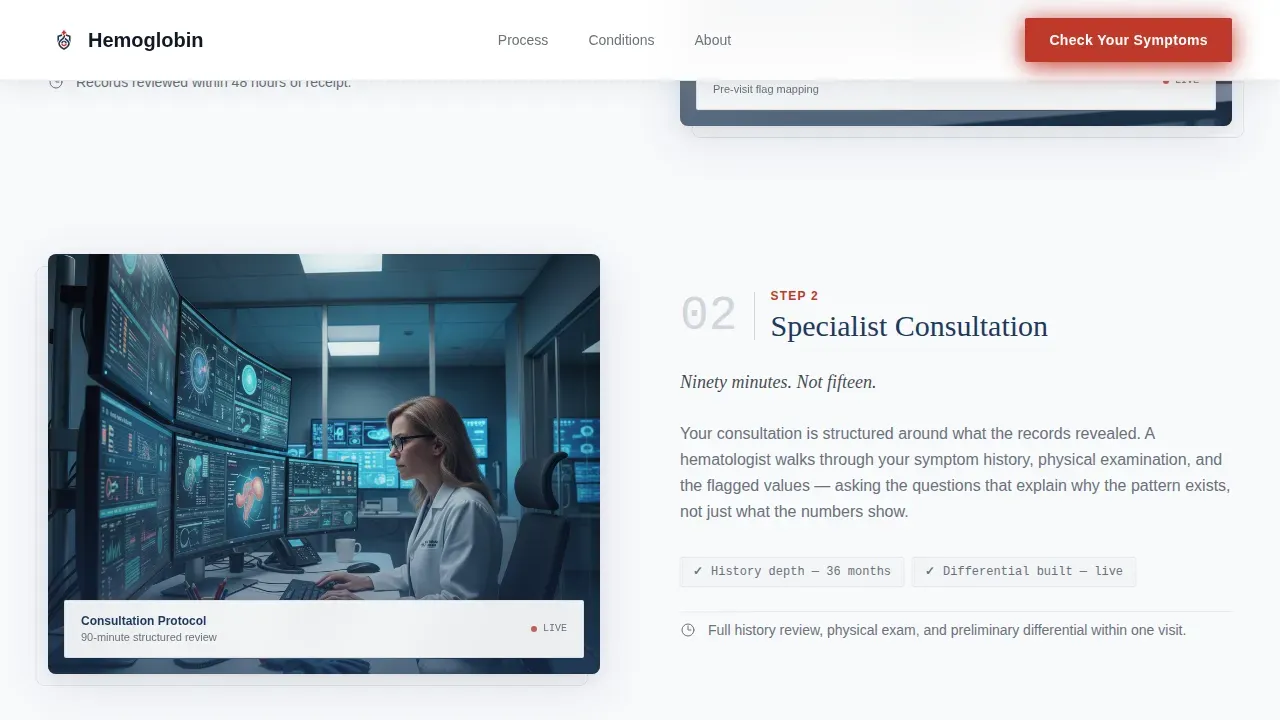
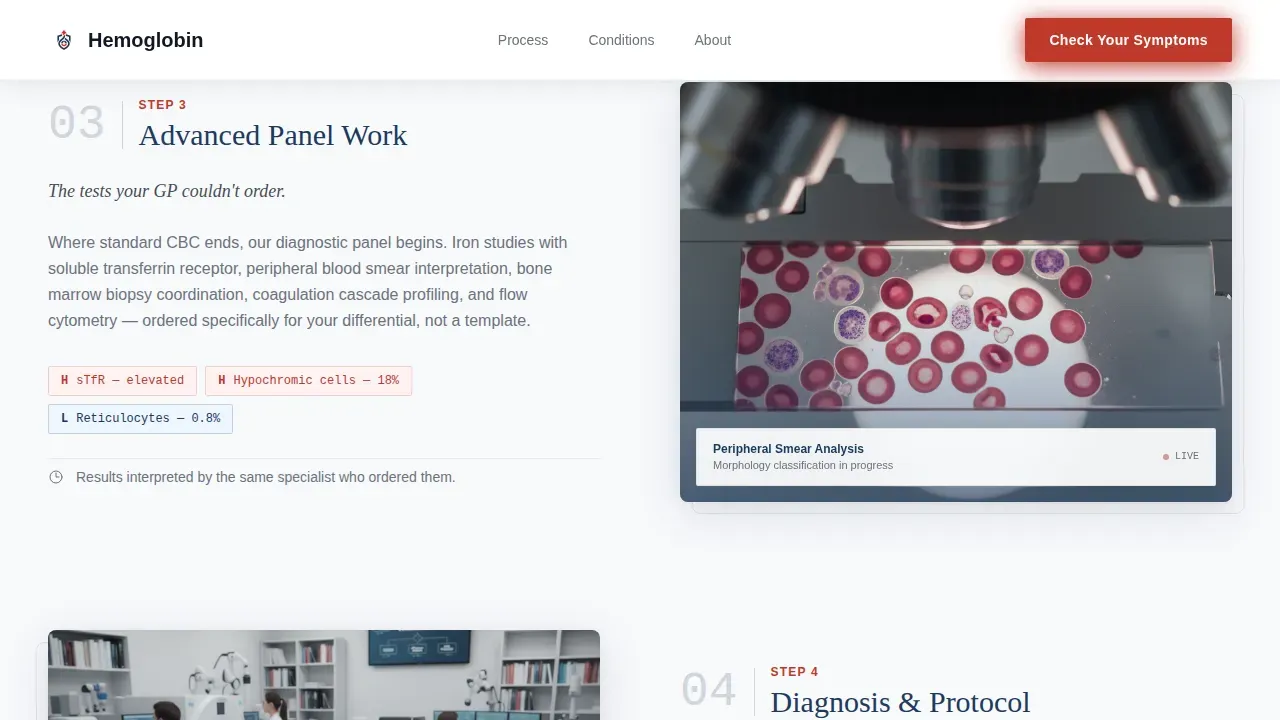
The core of the template alternates left-right content blocks to walk patients through each stage: referral review, consultation, advanced panel work, diagnosis, treatment protocol, and follow-up cadence. Each step answers the unspoken question patients carry: what happens next?
Five-Question Symptom Assessment
The primary call-to-action leads to a guided quiz covering symptom type, duration, prior blood work, referral status, and preferred appointment window. Results deliver a personalized next-step recommendation, not a diagnosis, giving patients a clear path without false certainty.
Conditions Bento Grid
An asymmetric bento layout presents the blood disorders the clinic addresses, including anemia, leukemia, and hemophilia. Staggered offset cards make the information scannable and visually structured, so users can quickly determine whether the clinic serves their situation.
Credentials and Trust Section
An asymmetric layout combines diagnostic statistics with secondary patient testimonials. This section gives physicians, researchers, and clinicians the evidence they need to feel confident referring patients to the practice.
Scroll-Triggered Animation System
Scroll-triggered reveals, stagger delays, and subtle parallax on the hero bring the page to life at a medium animation intensity. The quiz runs as a client component with state management, while static sections are set as server components for reliable performance.
Page sections overview
| Section | Purpose |
|---|---|
| Testimonial Hero | Opens with an oversized patient quote on a desaturated blood cell background to build immediate trust |
| Zigzag Process Guide | Walks patients step by step from referral review through treatment protocol and follow-up |
| Conditions We Diagnose | Asymmetric bento grid showing blood disorders the hematology department addresses |
| Symptom Assessment call to action | Five-question interactive quiz returning personalized next-step recommendations |
| Credentials and Trust | Stats and secondary testimonials proving clinical accuracy and referral volume |
| Footer | Arc Browser Split pattern with logo and tagline left, navigation links right |
Design & branding system
The design follows a Corporate Precision theme. Every visual choice is functional. Nothing decorates without purpose. The palette feels like a freshly calibrated analyzer: sterile, trustworthy, and quietly authoritative.
- Colors: clinical white (#F8F9FB) for backgrounds, instrument-panel gray (#D1D5DB) for borders, deep venous blue (#1E3A5F) for primary type and structure, and capillary red (#C0392B) reserved exclusively for calls-to-action and diagnostic accents
- Typography: Fraunces serif for headlines to convey specialist authority, DM Sans for body text and interface elements to ensure readability across all users
- Visual style: abstracted blood cell imagery desaturated almost to monochrome in the hero, glassmorphism on the testimonial card, and no stock photography anywhere on the page
Mobile & speed optimization
The template is built desktop-first, reflecting the reality that many referred patients and GP offices access hematology services on larger screens. Full mobile support is included so no visitor is left without a functional experience.
- Static sections are structured as server components, ensuring fast, reliable rendering for information-heavy blocks
- The interactive five-question quiz runs as a client component with state management, keeping the assessment responsive and accurate across devices
- Scroll-triggered animations use stagger delays and subtle parallax, calibrated to perform smoothly without overloading the browser
How this template helps you convert
The template is designed to move hesitant, frustrated patients from passive reading to active booking. Every section earns the next click.
- The testimonial hero immediately validates the clinic's diagnostic effectiveness by leading with a real resolved case, building trust before any services are listed
- The zigzag process guide replaces uncertainty with structure, so patients understand exactly what happens between referral and treatment before they commit to an appointment
- The five-question symptom assessment earns the conversion by proving the clinic already understands the patient's situation, delivering personalized recommendations that make booking feel like the obvious next step
Other information about this template
This template is well-suited beyond patient-facing use. It also serves as a presentation and education asset for teams that need to share hematology department capabilities with referring doctors, students, or research partners. Hematology presentations can simplify complex topics for various audiences, and effective presentations require advanced design and precision to convey accurate information.
- The template can be used to set up email capture through the quiz flow, allowing clinics to follow up with patients who complete the assessment but do not yet book
- Image assets are compatible with standard jpg and png formats, so teams can swap in their own photography or lab visuals without changing the layout structure
- The layout supports tailored content for different blood disorder topics, such as anemia management, leukemia staging referrals, and hemophilia treatment pathways, making it easy to meet the needs of diverse patient groups
- Clinicians, researchers, and students can use the template's structured sections to browse the clinic's diagnostic scope and understand the full range of services before making a referral or scheduling a consultation
- The template is reviewed against current hematology clinic design principles: lab areas, consultation rooms, and specialized equipment for analyzing blood samples are all reflected in the service descriptions
- For practices checking whether the template meets their requirements, the layout is fully editable, allowing teams to tailor each block to their specific hematology department and patient population without starting from scratch
- The Hemoglobin precision diagnostic hematology clinic landing page template is classified under Health and Medical, Hematology Medicine, making it straightforward to browse and find within the marketplace
Theme
Corporate Precision
Creative direction
Step-by-Step Guide
Color system
Arctic White
Style
Zigzag/Alternating
Direction
Quiz/Assessment
Page Sections
Cinematic Testimonial Hero Section
Zigzag Step-by-step Process Layout
Five-question Symptom Assessment Quiz
Asymmetric Conditions Bento Grid
Credentials and Trust Block
Scroll-triggered Animation System
Related questions
Can this template be used by a hematology department within a larger hospital?
Does the symptom assessment deliver an actual medical diagnosis?
Is the template suitable for physicians who want to refer patients digitally?
What blood disorders does the conditions section cover?
Can researchers or medical students use this template for educational purposes?