Immigrant-Owned Professional Website Template
Diaspora is a Neo-Retro gallery and detail landing page built for an immigrant-owned media house. It drives free subscribers to upgrade during a 72-hour flash sale by letting them taste six full stories before revealing a locked archive of forty-plus zines, documentaries, and audio essays rooted in culture, migration, and collective memory.
by Rocket studio
Quick summary
Diaspora is a single-page gallery and detail landing page for an immigrant-owned media house that publishes print zines, short documentaries, and audio essays. The design follows a Neo-Retro Ink and Paper system. A timed flash-deal mechanic pushes free subscribers toward a paid archive upgrade, making the gap between free and locked content feel physical and undeniable.
Who this template is for
This template was built for storytellers, publishers, and cultural archive organizations whose work lives outside the mainstream. It suits operators whose collection of publications speaks directly to diaspora communities, second-generation readers, and institutions that take the long view on history.
- Immigrant-owned media houses publishing zines, film, poetry, and audio essays
- University libraries and ethnic studies departments building a digital archive of community materials
- Cultural organizations whose research and publications document the lives of immigrants across country of origin boundaries
What problem this template solves
Most media templates are built for product launches or course sales. They do not know how to hold the weight of stories rooted in war, migration, family separation, and collective memory. They cannot communicate why forty locked pieces are worth more than six free ones, and they give no path for a free subscriber to feel the urgency of a 72-hour archive sale.
- Archives and publications struggle to convert browsers into paying members without a clear, emotionally resonant value gap
- Diaspora media projects need a landing page that can reflect cultural identity and community trust, not generic commerce
- Media houses focusing on immigrant history need a flash-sale mechanic that feels editorial, not transactional
What you get with this template
This template delivers a fully structured gallery and detail landing page with every section mapped to the upgrade journey. The layout is realized as a single-page scroll that moves a visitor from a warm hero image through a free gallery, past a locked archive, and into a conversion modal, all while a countdown timer keeps the flash deal present.
- A cinematic overhead hero with a torn-paper sale banner, a persistent editor's-red countdown timer, and six expandable free-content panels that provide information before the paywall begins
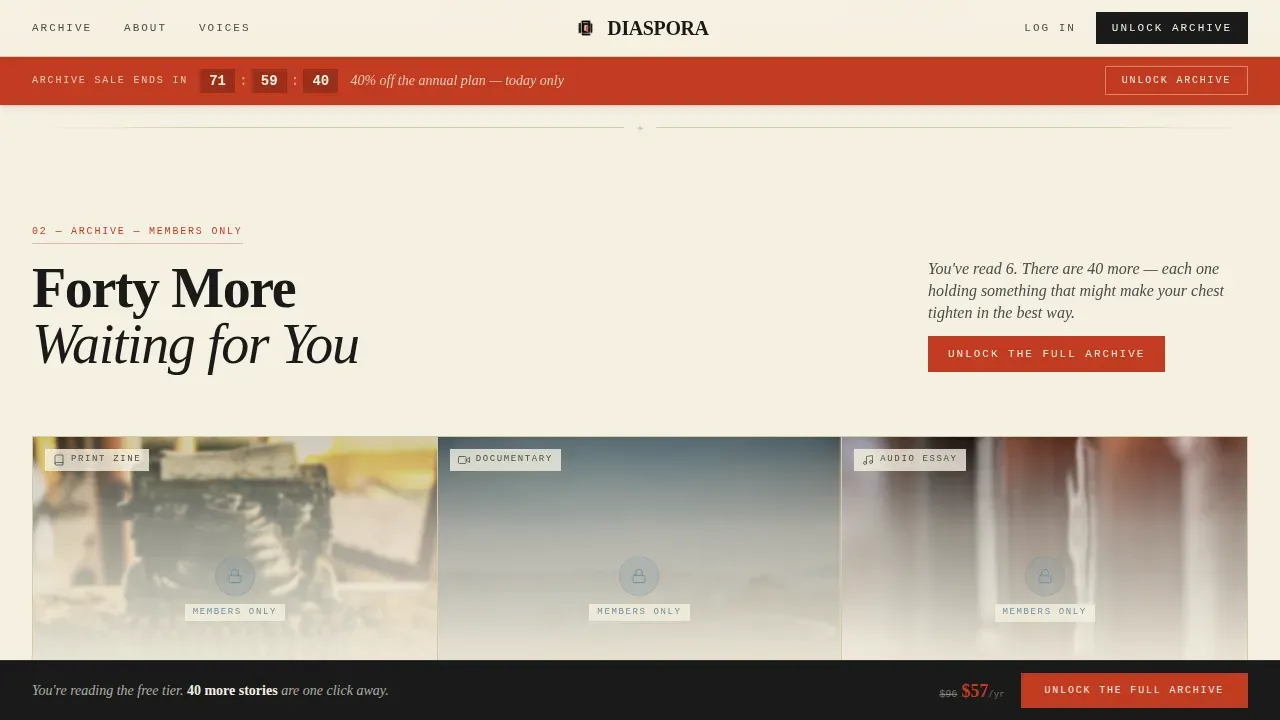
- A locked gallery of forty-plus titles marked with a translucent paper overlay and a padlock icon, making the value gap between free and paid tiers visible and felt
- A single-step upgrade modal with current plan display, flash-deal pricing slashed in editor's red, a monthly and annual billing toggle, and a secondary gift-a-subscription path
Feature list
This template is built around one clear concept: let the archive speak for itself, then ask for the upgrade. Every feature below serves that process.
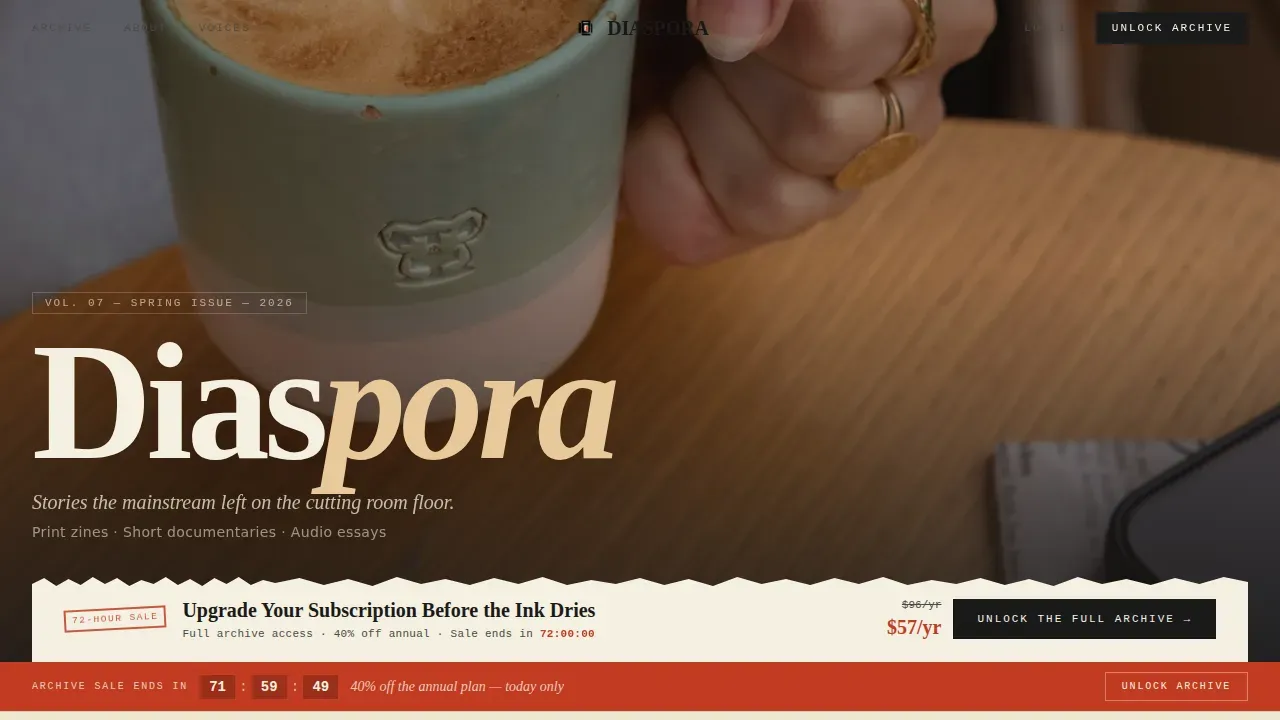
Cinematic Hero with Torn-Paper Sale Banner
The hero opens on a grain-heavy, overhead kitchen-table photograph. Open zines, a laptop mid-documentary, a coffee cup, a gold ring catching the light. A torn-paper banner overlays the bottom third with the 72-hour sale message. The composition feels like a film still, not a stock photo, and it sets the editorial tone before a single word of body copy is read.
Persistent Countdown Timer Bar
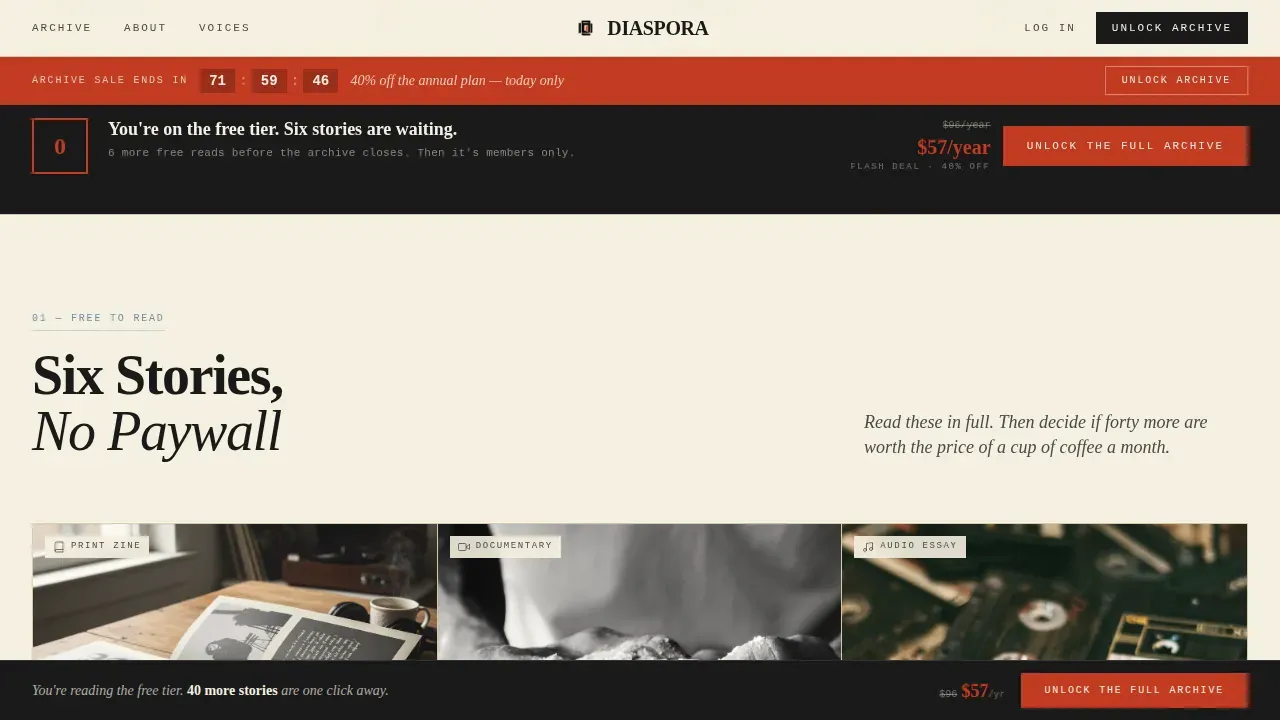
A sticky red countdown timer pins to the top of the page after the hero section and follows the visitor through every scroll. The timer is set in editor's red against newsprint cream. It keeps the flash deal active in peripheral vision without interrupting reading. Visitors who explore the free gallery, browse locked titles, or read pull-quotes never lose sight of the deadline.
Expandable Free Gallery Panels
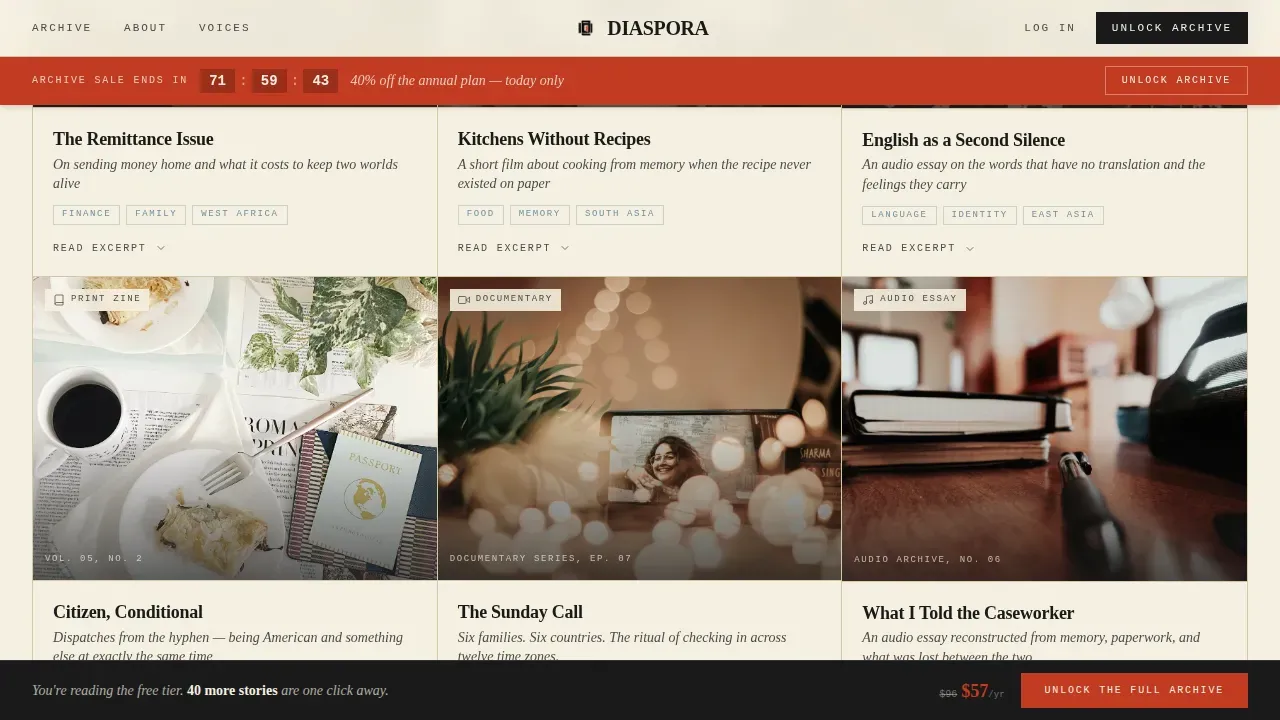
Six zine and documentary cover thumbnails open into detail panels showing a two-paragraph excerpt, a thirty-second trailer embed, and a pull-quote set in a typewriter serif. This is where visitors explore the full culture and craft of the archive before encountering the paywall. Each panel gives enough to make the reader want more, which is exactly the point.
Locked Archive Gallery with Paper Overlay
Forty-plus locked titles sit below the free gallery. Each locked piece carries a translucent paper overlay and a small padlock icon in carbon blue. The overlay mimics tissue paper placed over a page you can almost read but not quite. The locked gallery grows visibly longer than the free one, making the collection's depth impossible to ignore and the value gap impossible to dismiss.
Single-Step Upgrade Modal
Clicking any locked panel or the sticky footer call to action opens a focused upgrade modal. It displays the visitor's current plan, highlights the upgraded plan with the flash-deal price slashed in editor's red beside the original price, and offers a toggle between monthly and annual billing. A secondary path inside the modal lets existing upgraded subscribers gift a subscription, capturing a recipient email and an optional handwritten-style digital note.
Personalized Subscriber Banner
Returning free subscribers see a banner that counts how many locked stories they have browsed in the current month. This banner functions as a soft nudge, grounding the upgrade in each visitor's own reading behavior rather than abstract marketing language. It makes the ask feel personal, not pushy.
Page sections overview
| Section | Purpose |
|---|---|
| Hero Lifestyle Shot | Opens with editorial grain-heavy photograph and sale banner |
| Countdown Timer Bar | Sticky red urgency bar following visitor through full scroll |
| Free Gallery Panels | Six expandable content panels showcasing archive depth |
| Locked Archive Gallery | Forty-plus overlaid titles visualizing the paid collection |
| Subscriber Upgrade Banner | Personalized locked-story count nudging free members to upgrade |
| Upgrade Modal | Single-step plan comparison with flash pricing and billing toggle |
| Gift Subscription Path | Secondary modal capturing recipient email and personal note |
| Social Proof Carousel | Pull-quotes and community testimonials from diaspora readers |
| Footer Arc Split | Logo and tagline left, navigation links right |
Design & branding system
The visual identity runs on a Neo-Retro Ink and Paper system. Every color decision references a physical object: the aerogramme, the broadsheet, the editor's red pencil, the carbon copy. The palette does not feel like a mood board. It feels like a shoebox of letters discovered decades later, the paper yellowed but the handwriting still sharp.
- Newsprint cream (#F5F0E1) covers every background, anchoring the page in uncoated paper warmth; typewriter ribbon black (#1A1A1A) carries all body text with the density of a broadsheet headline
- Editor's red (#C23B22) appears only on countdown timers and pricing slashes, reserving its urgency for moments that deserve it; carbon-copy blue (#6B8FA3) marks secondary navigation, hover states, and padlock icons like marginalia in the page margins
- Typography uses Fraunces for display headings, DM Sans for body text and interface labels, and IBM Plex Mono for captions, pull-quote attributions, and archive labels, creating a layered editorial voice across every section
Mobile & speed optimization
The template is built desktop-first to serve library archivists and diaspora professionals working at a desk, but it carries full mobile support for readers who access publications and archive pages on the go. Diaspora audiences frequently reach cultural media through mobile devices, and the layout accounts for that.
- Interactivity is handled through native CSS smooth scroll and Intersection Observer reveals, keeping the page responsive without loading heavy external libraries
- Expandable detail panels, the upgrade modal, the gift modal, the billing toggle, and the countdown timer all function cleanly on smaller screens, preserving the editorial hierarchy across every device
How this template helps you convert
The conversion logic in this template is sequential and deliberate. It does not ask for money at the top of the page. It earns the ask by building desire across several scroll depths, then presenting the upgrade at the exact moment the visitor has realized what they are missing.
- Six free gallery panels let visitors explore full stories, excerpts, trailers, and pull-quotes, building genuine connection to the archive's culture and craft before the paywall begins
- The locked gallery makes the value gap physical and visible, with forty-plus overlaid titles sitting just below the free collection, and the personalized subscriber banner counts how many locked stories each visitor has already tried to access
- The sticky countdown timer and the single-step upgrade modal close the loop, presenting flash-deal pricing with a clear plan comparison and a one-click path to unlock the full archive before the deadline
Other information about this template
This template is a strong reference point for any organization building a digital archive that needs to do more than store content. The concept of a digital archive has shifted from passive storage to active circulation and transfer, and the Diaspora template is designed around that shift. Stories need to move between readers, communities, and institutions. This layout makes that movement feel natural and urgent.
The Iranian diaspora has produced some of the most well-documented examples of community archive work in North America. The Iranian-American Digital Archive Project, focusing on Iranian communities in the San Francisco Bay Area, documents immigration history through materials including documents, photographs, and letters, particularly those affected by events in Iran following 1979. That project demonstrates how a digital archive can reconstruct stories that war, exile, and forced migration would otherwise bury. The Diaspora template reflects those same priorities in its structure: start with the human story, make the collection visible, and give the reader a path deeper in.
Similar in spirit to Vietnamese diaspora archives and postmigrant blogs that compile shared histories beyond ethnic and national boundaries, this template treats the archive as a living site of memory rather than a static collection. Scholars in ethnic studies and university library curators will recognize the underlying logic: community archives serve as sites where collective histories are preserved, analyzed, and passed forward to future generations.
- The page structure is appropriate for media houses covering any diaspora community, including South Asian, West African, Caribbean, East Asian, and Latinx communities, and can hold stories spanning immigration, race, family, war, labor, and cultural identity
- Pull-quotes and testimonials from diaspora readers function as social proof and as part of the archive's living voice, reflecting real reader connections to the collection
- The gift-a-subscription path extends the archive's reach into family networks and community circles, matching the way diaspora publications naturally travel, sent from one person to another across country lines
- Poetry, interviews, audio essays, and film titles all fit the gallery format, making the template adaptable for media houses whose publications span multiple forms
- The template is built with awareness that some contributors and subjects in diaspora archives may need privacy protections; the design does not expose identifying data in any locked or preview content without editorial intent
- University departments, student researchers, and independent scholars will find the archive layout intuitive for browsing a large collection by title and media type
Theme
Neo-Retro
Creative direction
Flash Deal
Color system
Ink & Paper
Style
Gallery + Detail
Direction
Upsell/Upgrade
Page Sections
Cinematic Grain-heavy Hero Section
Persistent Editor's-red Countdown Timer
Expandable Free Gallery with Detail Panels
Locked Archive with Paper Overlay Effect
Single-step Upgrade Modal with Gift Path
Personalized Subscriber Engagement Banner
Related questions
Can this template hold a large archive collection?
Does the template support both monthly and annual subscription pricing?
Can I use this template for a media house that publishes across multiple formats?
Who typically uses a diaspora immigrant archive media landing page template like this?
Is the countdown timer connected to a real deadline?