Employment & Labor Law Professional Website Template
Disclose is a whistleblower attorney landing page template built for law practices that file qui tam suits, SEC and CFTC claims, and retaliation cases. It uses a stark Civic Service aesthetic to guide frightened employees through a five-phase process, systematically replacing fear with legal clarity. A confidential intake form and PDF lead-capture path convert cautious visitors into consultation requests.
by Rocket studio
Quick summary
Disclose is a single-page whistleblower attorney template designed to convert paralyzed witnesses into confidential consultation requests. It uses a transparent five-phase process layout, a stark Ink and Paper visual system, and two deliberate conversion paths to move visitors from dread to action without pressure or performance.
Who this template is for
This template is built for whistleblower and qui tam attorneys who need a client intake page that earns trust before it asks for a name. It suits solo practitioners and small law firms handling employment retaliation, healthcare fraud, government contract fraud, and securities violations under federal statute.
- Whistleblower and qui tam attorneys seeking confidential client intake
- Employment and labor law practices adding a fraud-reporting practice area
- Law firms handling SEC, CFTC, or False Claims Act matters for individual employees
What problem this template solves
Most legal landing pages ask for contact details before they explain why the visitor is safe. For a potential whistleblower, that sequence is a dealbreaker. This template reverses it. It walks the visitor through every phase of the legal process before asking for anything, systematically addressing the specific fears that cause people to close the tab and stay silent.
- Visitors arrive terrified of retaliation and do not know what happens after a call
- Standard intake forms feel unsafe to someone whose employer must not know they called
- Fear of the unknown process stops qualified leads from converting into consultations
What you get with this template
You get a fully structured whistleblower attorney landing page with a zigzag alternating layout, two conversion paths, and a visual identity built around quiet authority rather than legal-industry clichés. Every section is designed to answer one specific fear before moving to the next, so the scroll does the persuasion without a single hard sell.
- A hero section with a carved serif headline, recovery-to-date stat, and a single call to action
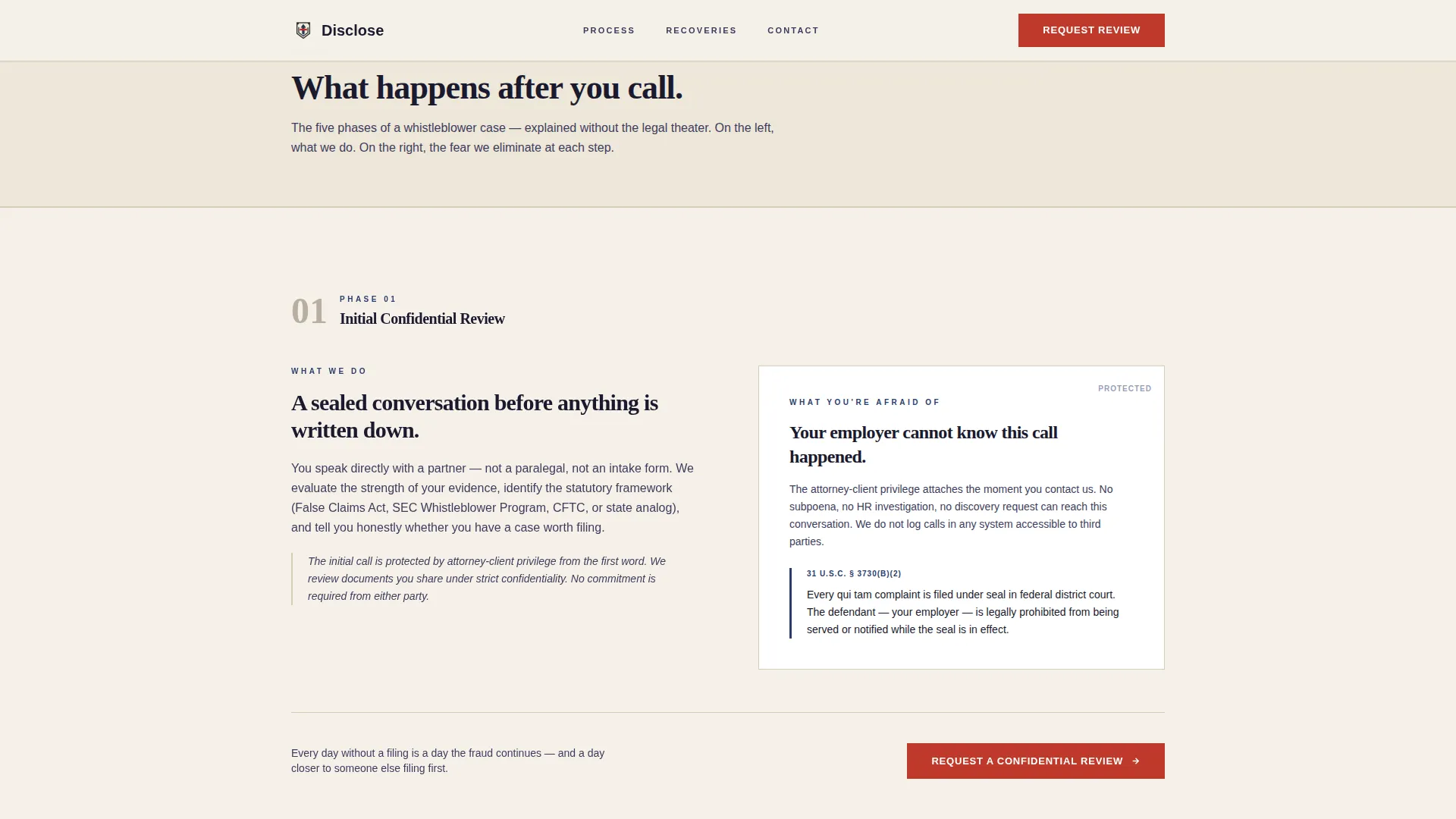
- A five-phase zigzag process section pairing plain-language explanations with cited legal protections
- A short confidential intake form requiring no name on the first screen
- A secondary PDF gate that captures email from visitors not yet ready to speak
- Understated case reference panels showing past recovery figures as social proof
- A minimal single-row footer with bar membership and federal statute trust indicators
Feature list
Five-Phase Zigzag Process Layout
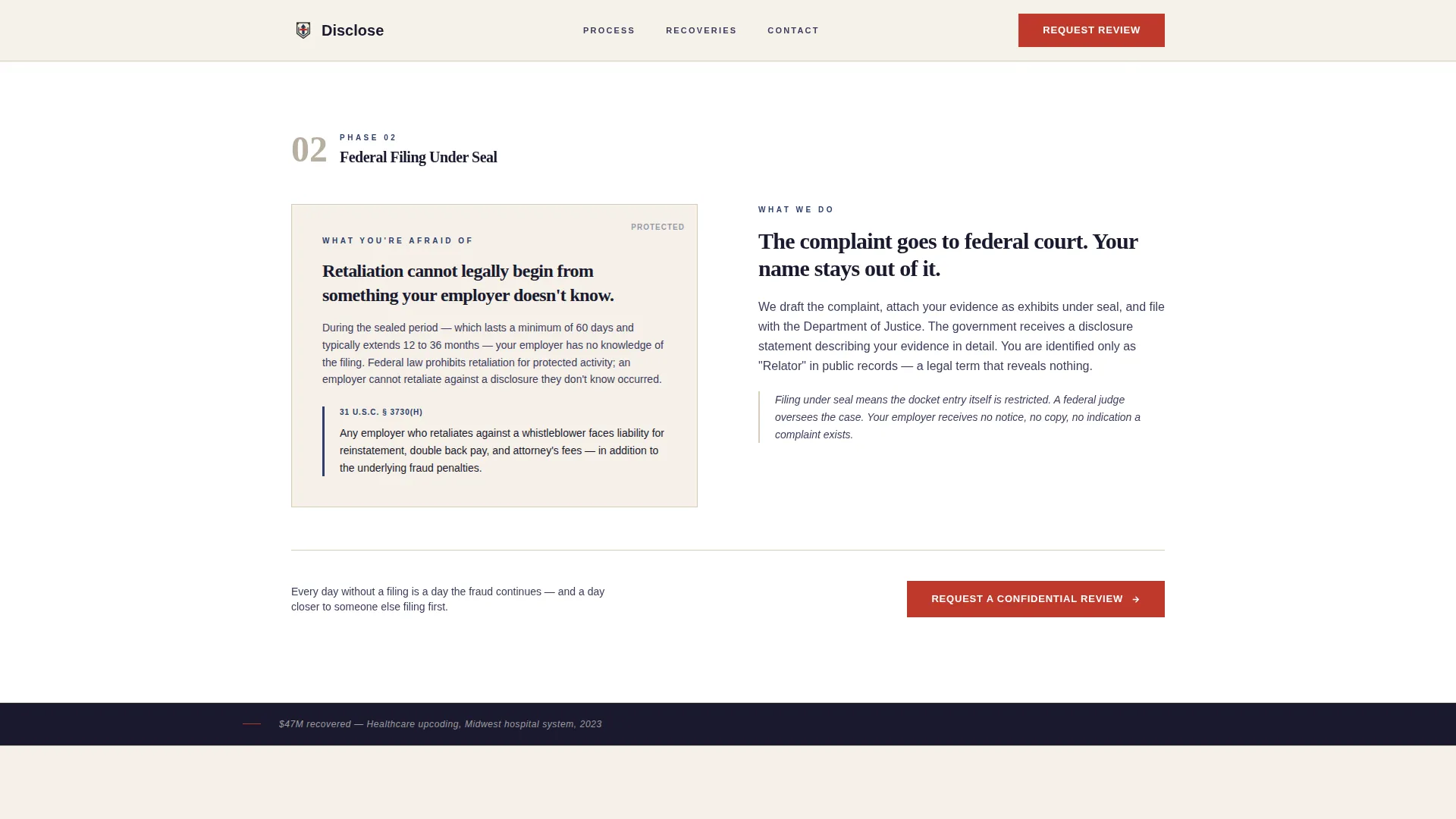
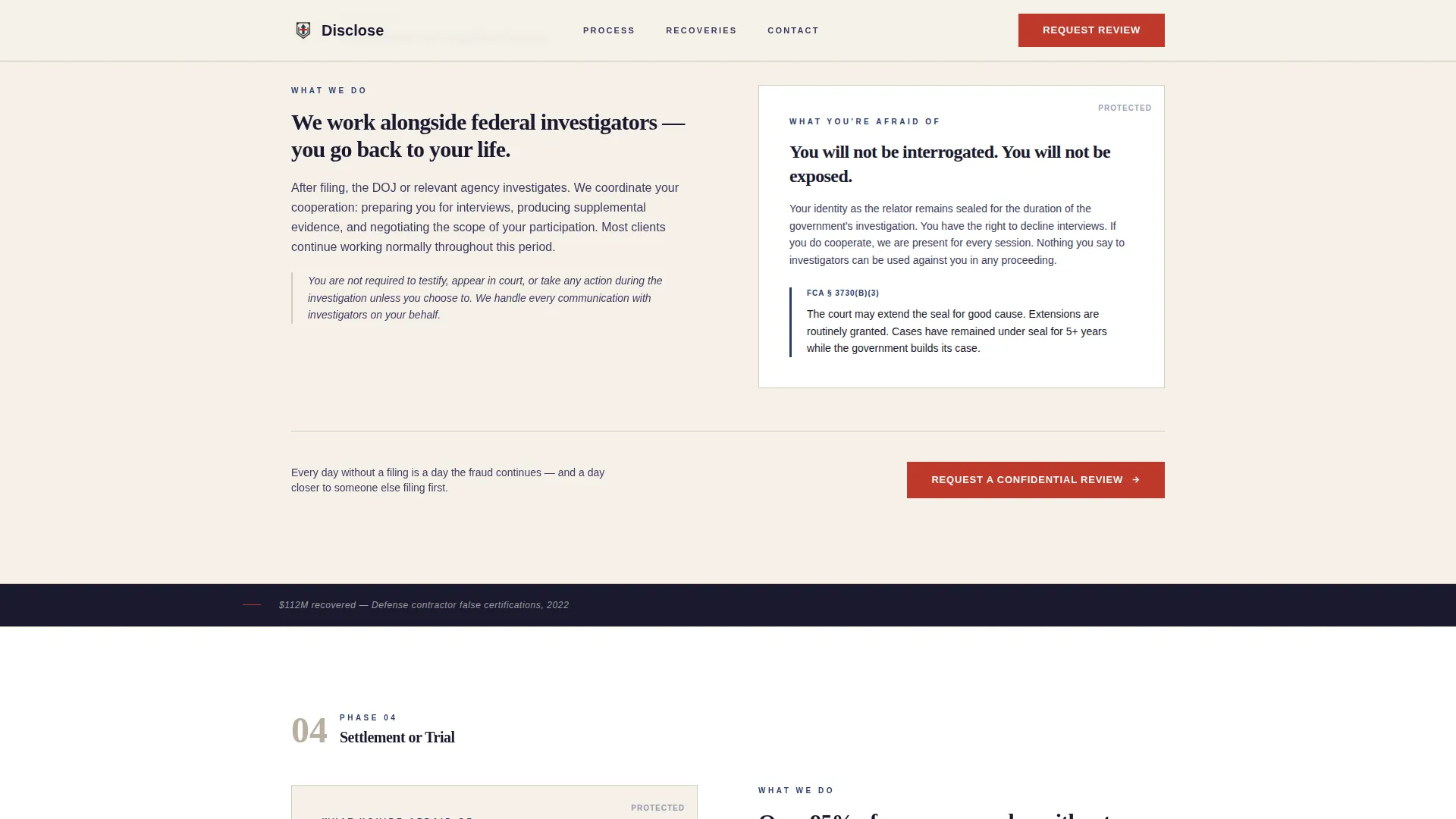
Each of the five process phases, from Initial Confidential Review through Reward Distribution, occupies its own alternating row. One panel explains what the attorney does at that stage. The opposite panel directly addresses the visitor's specific fear with plain-language legal protection language. The scroll dismantles dread step by step.
Dual Conversion Path Design
The template offers two ways forward. The primary path is a confidential intake form with a fraud-type dropdown, employer size field, and retaliation status indicator, with no name required on the first screen. The secondary path is a PDF gate for the Whistleblower Rights Guide, capturing an email address without forcing premature disclosure.
Redaction Red Call-to-Action System
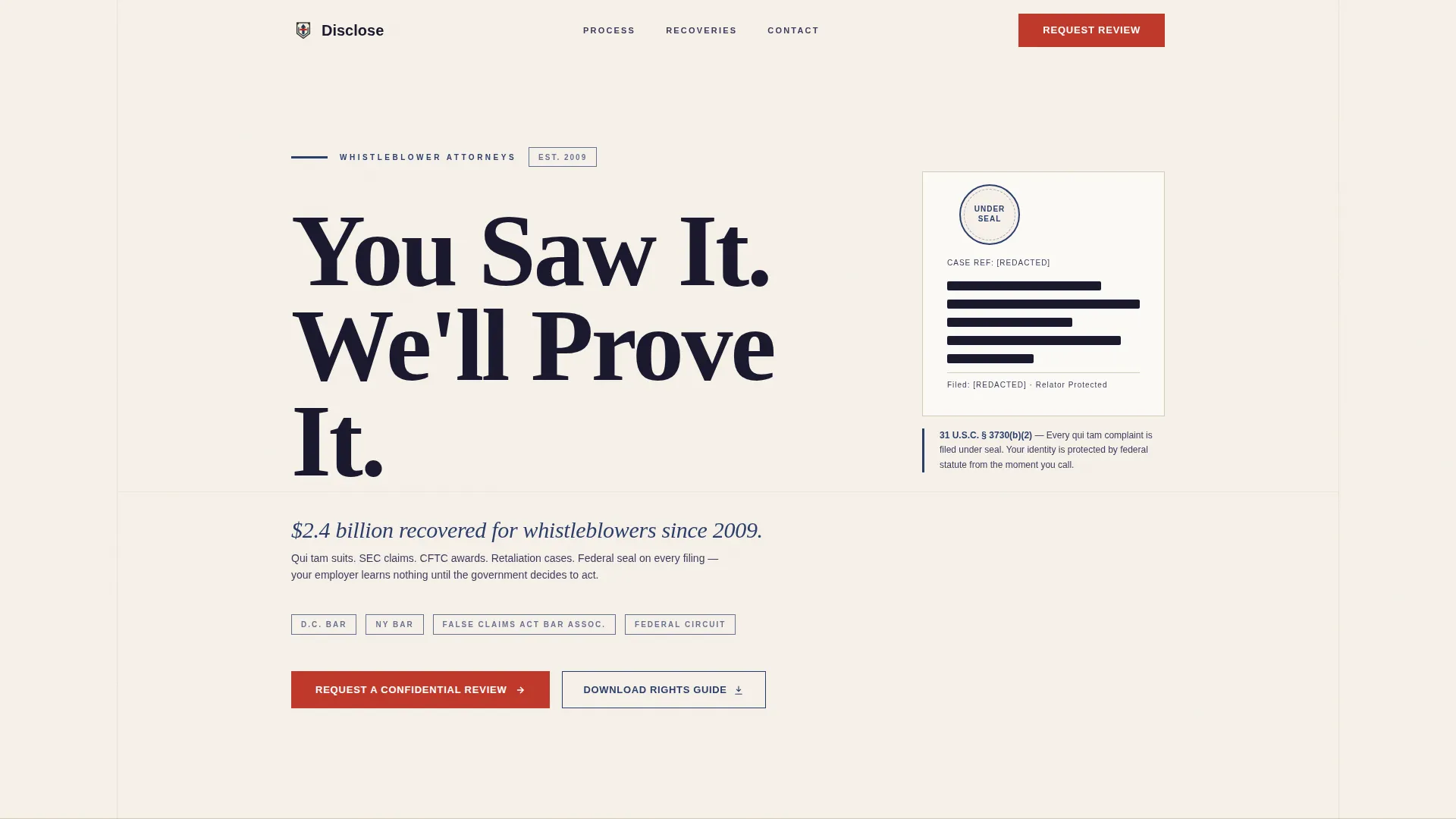
Every call to action reads "Request a Confidential Review" and appears in redaction red exclusively. It sits once beneath the hero headline and again after each process phase, ensuring the prompt is never more than one scroll away. The color appears nowhere else on the page, so the eye always knows where the action is.
Understated Case Reference Panels
Between process phases, the template includes low-key panels showing past recovery figures as case references. These are not testimonials or boastful claims. They present dollar amounts and fraud type in the same documentary tone as the rest of the page, letting the numbers build credibility without showmanship.
Stark Civic Service Hero Section
The hero uses a large carved serif headline on an aged parchment background with a single federal blue line of subtext showing total recoveries to date. There is no photography, no illustration, and no decorative element. The deliberate emptiness signals seriousness and creates a confidential atmosphere from the first scroll position.
Scroll-Triggered Reveal Animation
Section reveals are tied to scroll position using low-to-medium intensity staggered fade-up animations. Nothing flashes or bounces. Each phase appears as the visitor reaches it, reinforcing the feeling of a deliberate, one-step-at-a-time process rather than an overwhelming wall of legal information.
Page sections overview
| Section | Purpose |
|---|---|
| Hero Headline | Establish authority and present total recovery stat with a single call to action |
| Phase One Row | Explain Initial Confidential Review and address fear of employer discovery |
| Phase Two Row | Cover Federal Filing Under Seal and confirm filing confidentiality protections |
| Phase Three Row | Describe Government Investigation Period and address fear of timeline uncertainty |
| Phase Four Row | Outline Settlement or Trial phase and address fear of public exposure |
| Phase Five Row | Detail Reward Distribution and present real recovery figures in context |
| Case References | Show understated past recovery figures as credibility proof between phases |
| Confidential Intake | Collect fraud type, employer size, and retaliation status without requiring a name |
| PDF Lead Gate | Capture email via Whistleblower Rights Guide for visitors not ready to consult |
| Minimal Footer | Display bar memberships, federal statute citations, and single-row legal links |
Design & branding system
The visual identity follows a Civic Service theme built entirely on an Ink and Paper color system. The aesthetic references declassified government documents, where restraint signals authority and every element on the page earns its place. Nothing decorates. Nothing shines. The typography pairs a carved high-contrast serif for headlines with a clean sans-serif for body text, reinforcing the contrast between gravity and clarity.
- Four-color palette: documentary black (#1A1A2E), aged parchment (#F5F0E8), federal blue (#2C3E6B), and redaction red (#C0392B) used only for calls to action and urgent callouts
- Backgrounds alternate between parchment and white across zigzag rows; federal blue carries section headers and trust indicators
- Fraunces serif headlines give the page a carved, weighted authority; DM Sans body text keeps instructions readable and plain
Mobile & speed optimization
The template is built desktop-first, reflecting the reality that reviewing legal documents and completing intake forms are tasks people do on larger screens. Full mobile support is included so visitors who arrive on a phone can still read every phase clearly, tap the call to action, and reach the intake form without friction.
- Desktop-first layout preserves the document-like proportions of the zigzag rows and hero section
- Mobile breakpoints restack alternating rows into a readable single-column flow
- Scroll-triggered animations use lightweight fade-up reveals to keep the page feeling responsive without heavy effects
How this template helps you convert
The template converts by replacing the visitor's fear of the unknown with a concrete, sequential understanding of the legal process. It never asks for trust before it has been earned. Each phase answered, each protection cited, and each recovery figure shown adds one more reason to click.
- The five-phase process layout answers the visitor's most paralyzing questions before any form appears, so the intake request feels like a logical next step rather than a leap of faith.
- The no-name-required intake form and the PDF gate offer two different levels of commitment, capturing both ready leads and cautious researchers without forcing either group to act before they are ready.
Other information about this template
This template is designed exclusively for the United States legal market, using USD figures and referencing federal statutes including the False Claims Act, Dodd-Frank Act, and related employment retaliation protections. It is built for a B2C legal intake context where the visitor is an individual employee, not a corporate client. The page tone is deliberately formal and calm, avoiding urgency tactics that would feel threatening to someone already frightened.
- Localization: United States jurisdiction, USD currency, federal law framing throughout
- Target fraud categories covered by the intake dropdown: healthcare, government contracts, securities, environmental, and other
- The PDF gate secondary path is designed to warm up visitors over time through email follow-up, without requiring any identifying disclosure on the first interaction
Theme
Civic Service
Creative direction
Transparent Process
Color system
Ink & Paper
Style
Zigzag/Alternating
Direction
Click-Through
Page Sections
Five-phase Zigzag Process Layout
Dual Conversion Path Design
Redaction Red Call-to-action System
Understated Case Reference Panels
Stark Civic Service Hero Section
Scroll-triggered Reveal Animation
Related questions
What type of law firm is this template built for?
Does the intake form require visitors to give their name?
What are the two conversion paths in this template?
Can this template support a practice that handles multiple fraud types?
What visual style does this template use?