Celiac Disease Care Professional Website Template
A single-column landing page built for the celiac disease clinical trial finder niche. It guides newly diagnosed adults, parents of celiac children, and long-diagnosed patients through a warm, story-first experience, from emotional recognition to clinical literacy to a lightweight trial-matching screener. The Organic Flow layout and Teal Catalyst color system make a complex medical topic feel human and approachable.
by Rocket studio
Quick summary
This is a single-column flow landing page for a celiac disease clinical trial matching platform. It opens with a real participant testimonial, unfolds into a scrolling mosaic of patient stories and clinical education blocks, and closes with a profile screener and a free downloadable guide. The design balances botanical warmth with clinical precision throughout.
Who this template is for
This template is built for health-tech teams and patient advocacy organizations that need to connect the celiac disease community with active research opportunities. It works especially well for platforms that lead with trust and patient voice rather than clinical jargon.
- Newly diagnosed adults (roughly ages 18 to 45) still processing endoscopy results and looking beyond a strict gluten-free diet
- Parents searching for emerging therapies for celiac children
- Long-diagnosed patients whose villous atrophy has not resolved despite years of strict adherence
What problem this template solves
Finding relevant clinical trials through general medical databases is genuinely hard for celiac patients. Filters are broad, language is technical, and nothing speaks to their specific situation. This template closes that gap by leading with emotional recognition before asking anything of the visitor.
- Patients feel unseen when trial platforms treat celiac disease as a single, simple condition
- Educational gaps leave visitors unable to evaluate whether a trial is right for them
- Generic call-to-action forms collect distrust, not conversions
What you get with this template
You get a fully structured single-column landing page that progresses from empathy to action. Every section is intentional, moving the visitor from feeling understood to feeling informed to feeling ready to act.
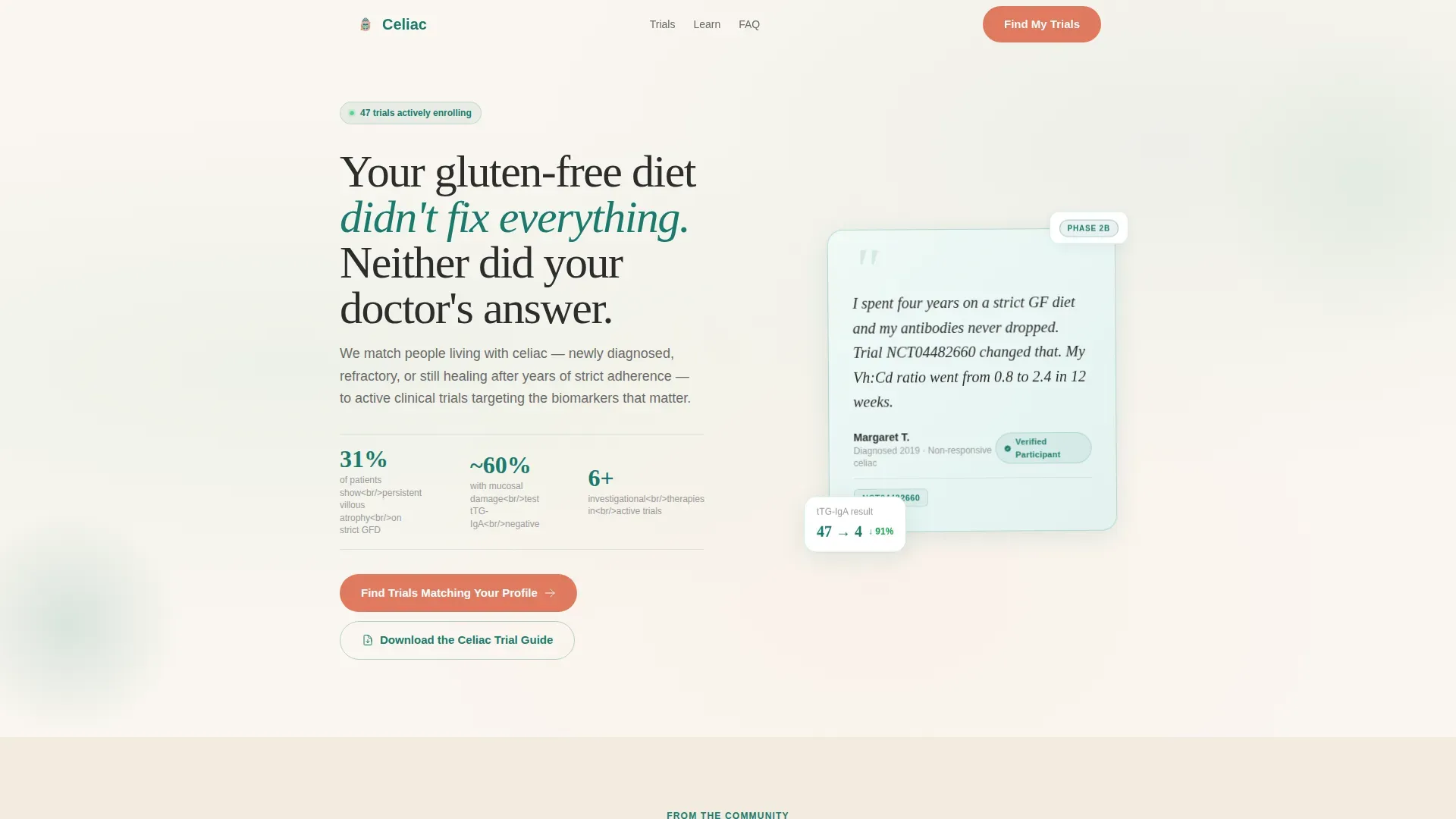
- A hero section with a floating testimonial card, headline, and dual call-to-action buttons
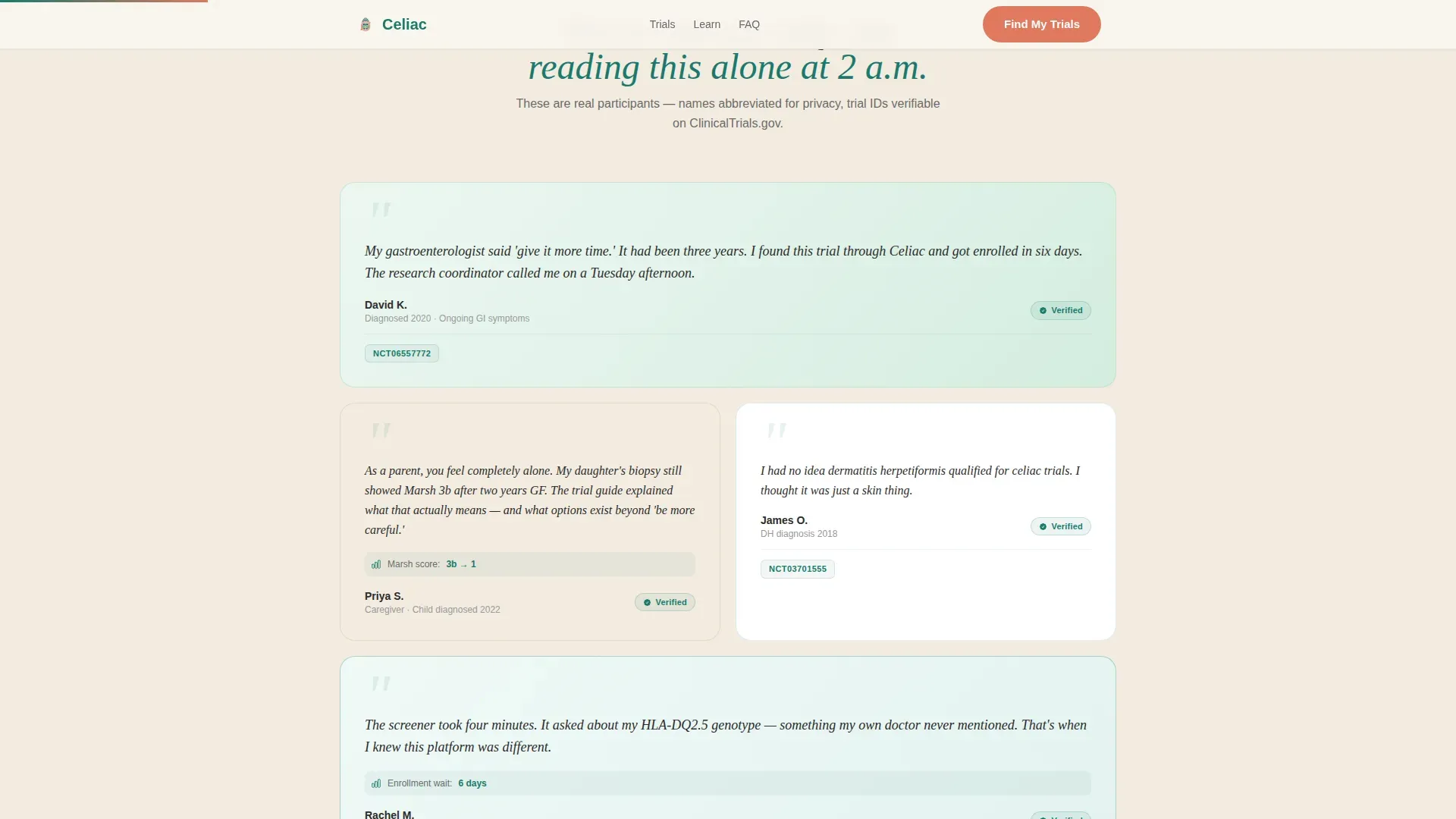
- A scrolling testimonial mosaic with varied card shapes, biomarker references, and verified-participant badges
- Clinical literacy education blocks, an active trials showcase, a profile screener, and a gated PDF download section
Feature list
This template includes the following built-in content features and structural components.
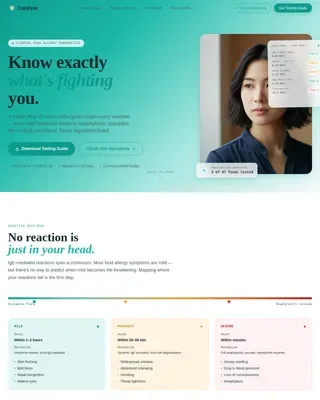
Hero Testimonial Card
The page opens with a single real participant story set in a warm serif typeface against a parchment background. The card has soft rounded corners, a faint teal border, and a verified-participant badge. No stock photography is used, just a first name, a diagnosis year, and a trial identifier.
Testimonial Mosaic Section
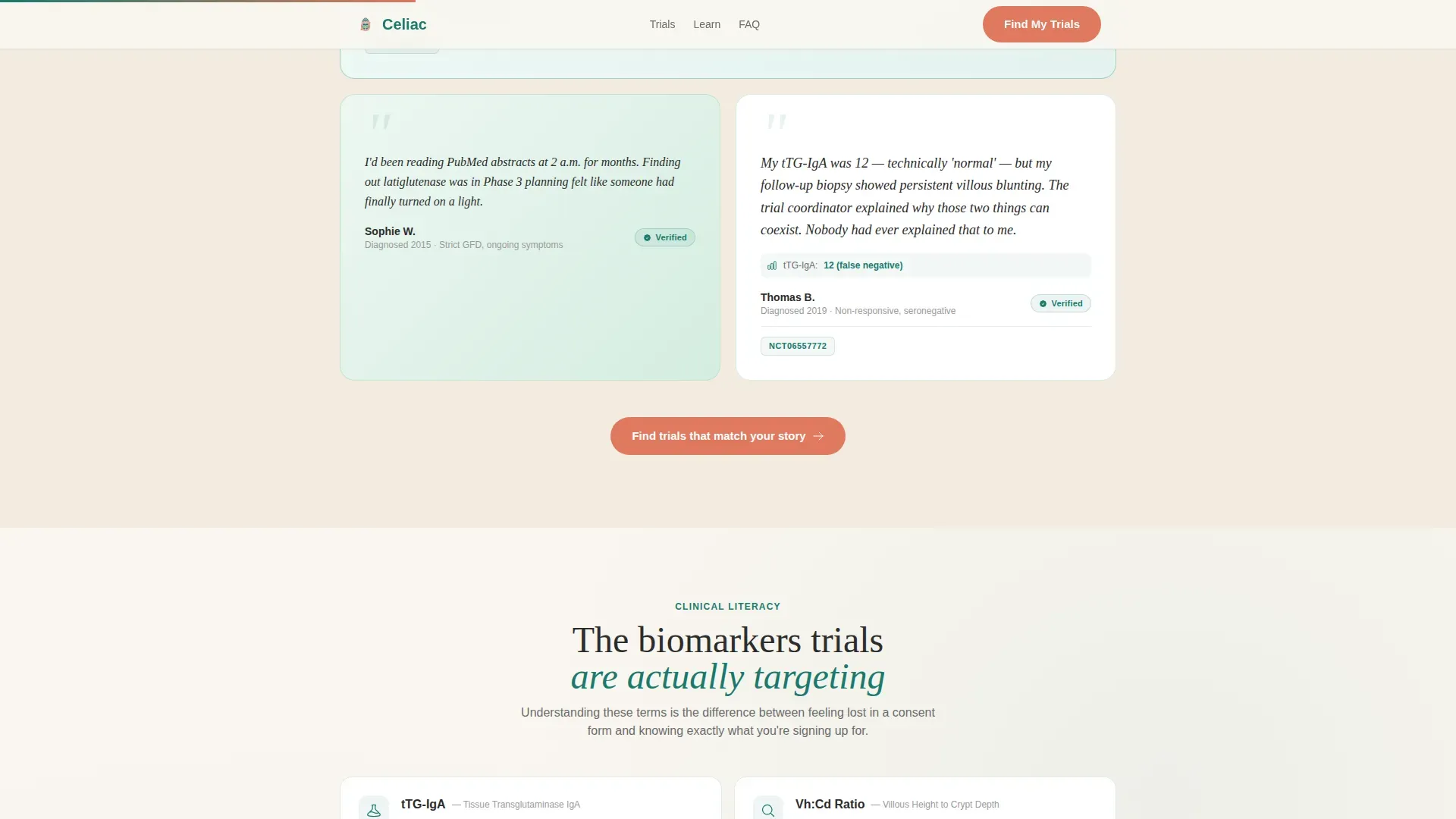
A scrolling sequence of patient story cards unfolds below the hero. Cards vary in shape and emphasis. Some quote tissue transglutaminase immunoglobulin A (tTG-IgA) numbers, some describe the moment a research coordinator called, and some carry caregiver voices. Staggered card reveals and scroll-linked opacity animate the sequence.
Clinical Literacy Education Blocks
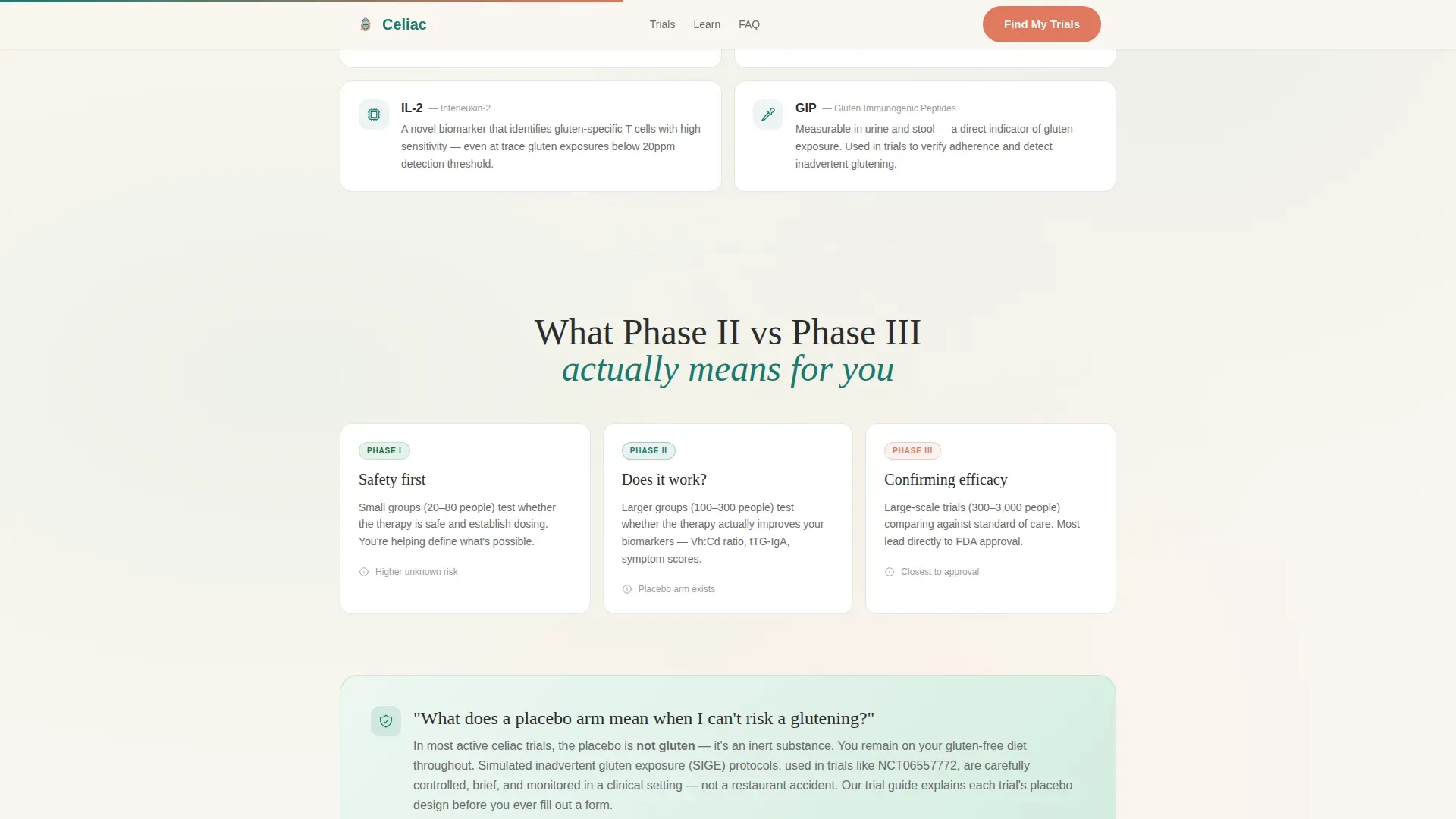
Between testimonial clusters, the page places focused educational content. Blocks explain the difference between Phase II and Phase III trials, what a placebo arm means for someone who cannot risk a glutening, and which biomarkers current trials are targeting, including tTG-IgA, villous height to crypt depth ratio (Vh:Cd), interleukin-2 (IL-2), and gluten immunogenic peptides (GIP).
Active Trials Showcase
An asymmetric bento-style grid displays current trials with phase badges. Each tile is clearly labeled and visually distinct. The layout is built for quick scanning on a mobile screen.
Profile Screener Form
A lightweight step-progression form collects diagnosis type (celiac disease, refractory celiac, or dermatitis herpetiformis), years since diagnosis, current symptom status, and ZIP code. The primary call-to-action button reads "Find Trials Matching Your Profile."
Gated PDF Download
A secondary conversion path offers "Download the Celiac Trial Guide" gated by email address only. No phone number or last name is required. The gate is intentionally minimal to reduce friction and build trust.
Page sections overview
| Section | Purpose |
|---|---|
| Hero Testimonial Card | Opens with emotional recognition and dual call-to-action |
| Testimonial Mosaic | Builds trust through scrolling patient and caregiver stories |
| Clinical Literacy Blocks | Educates visitors on trial phases, placebo arms, and biomarkers |
| Active Trials Showcase | Displays current trials with phase badges in bento layout |
| Screener and PDF Download | Converts visitors through profile form and low-friction email gate |
| Footer | Logo, tagline, navigation links, and social icons |
Design & branding system
The visual identity follows an Organic Flow theme with a Teal Catalyst color palette. The aesthetic feels like a botanical apothecary, glass jars, pale wooden shelves, and warm afternoon light. Clinical precision and organic warmth share equal weight throughout.
- Colors: deep teal (#1A7A6D) for headers and iconography, warm parchment (#FAF6F0) for backgrounds, soft celiac-awareness green (#A8D5BA) behind testimonial cards, and quiet coral (#E07A5F) reserved exclusively for call-to-action buttons and notification badges
- Typography: Fraunces serif for headlines and testimonial pull quotes; DM Sans for body text and interface labels
Mobile & speed optimization
The template is built mobile-first, reflecting how celiac patients actually search, on their phones, late at night, after reading medical forums. Every layout decision prioritizes readability and usability on small screens.
- Single-column flow eliminates horizontal complexity on mobile viewports
- Server components handle static content sections to support leaner page delivery
How this template helps you convert
The page is structured to earn trust before it asks for anything. Each section prepares the visitor for the next, so the call-to-action never feels abrupt or transactional.
- The testimonial mosaic leads with emotional validation, showing visitors that the platform already understands their specific clinical frustration before a single form field appears
- Clinical literacy blocks build enough confidence for visitors to self-evaluate trial eligibility, which makes the screener feel useful rather than intrusive
- The dual conversion paths, a profile screener and a low-friction PDF gate, give both action-ready and research-mode visitors a meaningful next step
Other information about this template
This template was designed specifically for the celiac disease clinical trial finder niche within Health and Medical. It reflects the real behavioral patterns of this audience: late-night searching, distrust of generic medical platforms, and hunger for information written at a human level.
- The footer follows an Arc Browser Split layout (Pattern 7): logo and tagline on the left, navigation links on the right, and social icons along the bottom
- Animation is set to medium intensity, staggered card reveals, scroll-linked opacity, and a subtle float effect on the hero testimonial card
- The FAQ accordion component is included as an interactive element within the page
- The template supports diagnosis subtypes including celiac disease, refractory celiac disease, and dermatitis herpetiformis in the screener flow
Theme
Organic Flow
Creative direction
Testimonial Mosaic
Color system
Teal Catalyst
Style
Single Column Flow
Direction
Content/Resource
Page Sections
Hero Testimonial Card with Dual Call to Action
Scrolling Testimonial Mosaic
Clinical Literacy Education Blocks
Active Trials Bento Showcase
Step-progression Profile Screener
Low-friction PDF Email Gate
Related questions
Who is this landing page template designed for?
What sections are included in this template?
Does the screener form collect sensitive personal information?
Can I adapt this template for a different celiac disease subcategory?
What makes this template different from a general medical landing page?