Real Estate & Property Law Portfolio Website Template
Docket is a single-column landing page template built for landlord-tenant attorneys practicing in New York City housing courts. It opens with a press mentions bar, moves through three narrative case studies, and leads visitors into a five-question triage quiz. The result is a credibility-first page that speaks the housing court vocabulary visitors already carry through the door.
by Rocket studio
Quick summary
Docket is a single-column landing page for a New York City landlord-tenant attorney. It opens with media proof, moves through three anonymized case narratives, and closes with a five-question housing triage quiz. Every design choice reflects a case-file aesthetic. The template converts frightened tenants and financially pressured landlords into booked case reviews.
Who this template is for
This template is built for attorneys who work both sides of the housing court docket. It speaks directly to the people those attorneys serve every day.
- Rent-stabilized tenants who found a marshal's notice on their door
- Small landlords managing a non-paying occupant with mortgage pressure building
- Co-op boards working through a proprietary lease or shareholder holdover dispute
What problem this template solves
Most legal landing pages look the same: a headshot, a list of practice areas, and a contact form. They do not speak to the urgency of a housing court deadline. This template solves that gap by meeting visitors exactly where they are.
- Visitors arrive frightened or under financial pressure, not casually browsing
- Generic legal pages fail to signal court-side knowledge or dual-representation experience
- A missing triage step means the attorney wastes intake time on misfits
What you get with this template
You get a fully structured single-column landing page that earns trust before it asks for anything. Every section is purposefully sequenced to move a housing court visitor toward a booked case review.
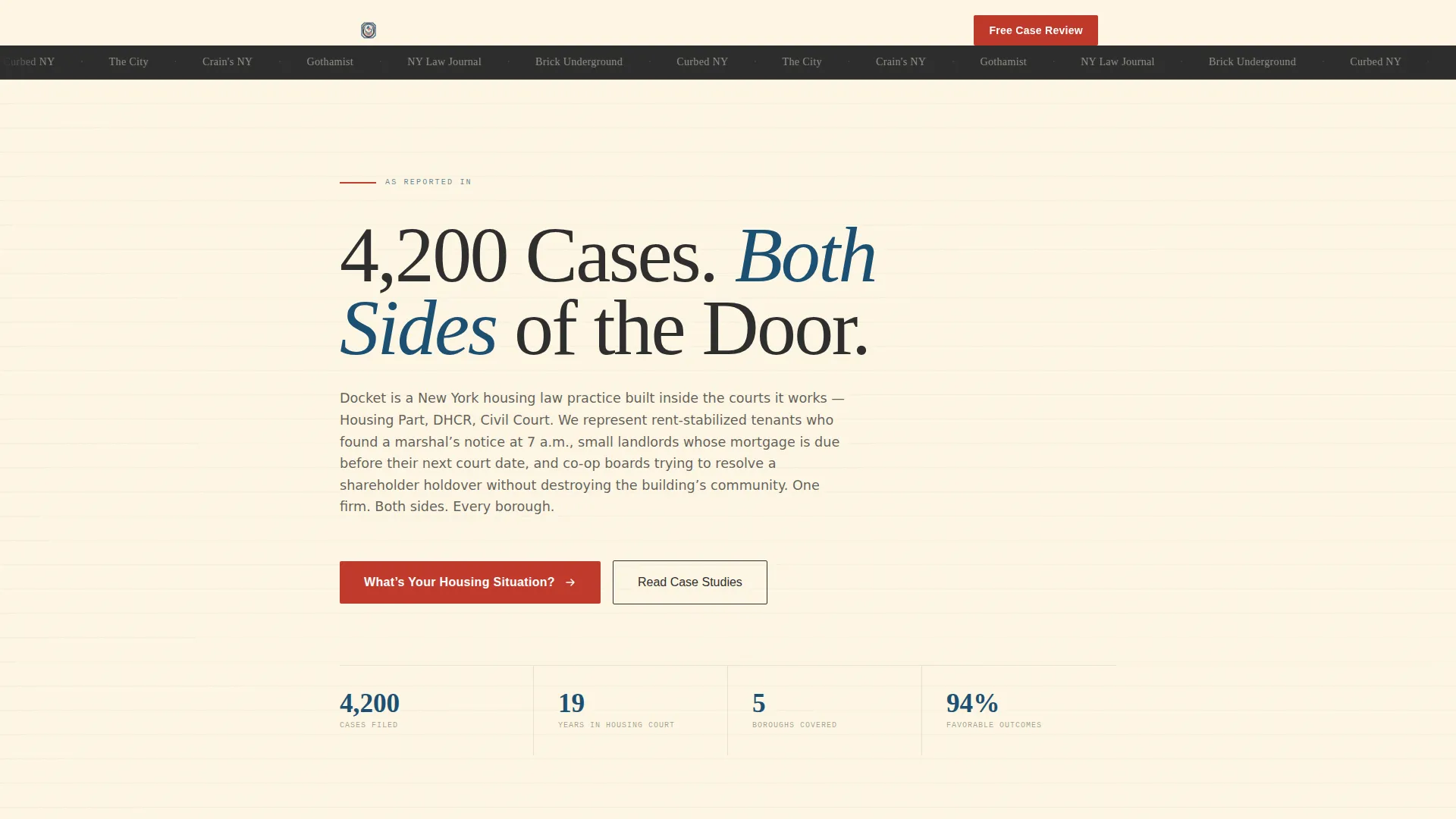
- A press mentions bar with linked media logos for immediate third-party credibility
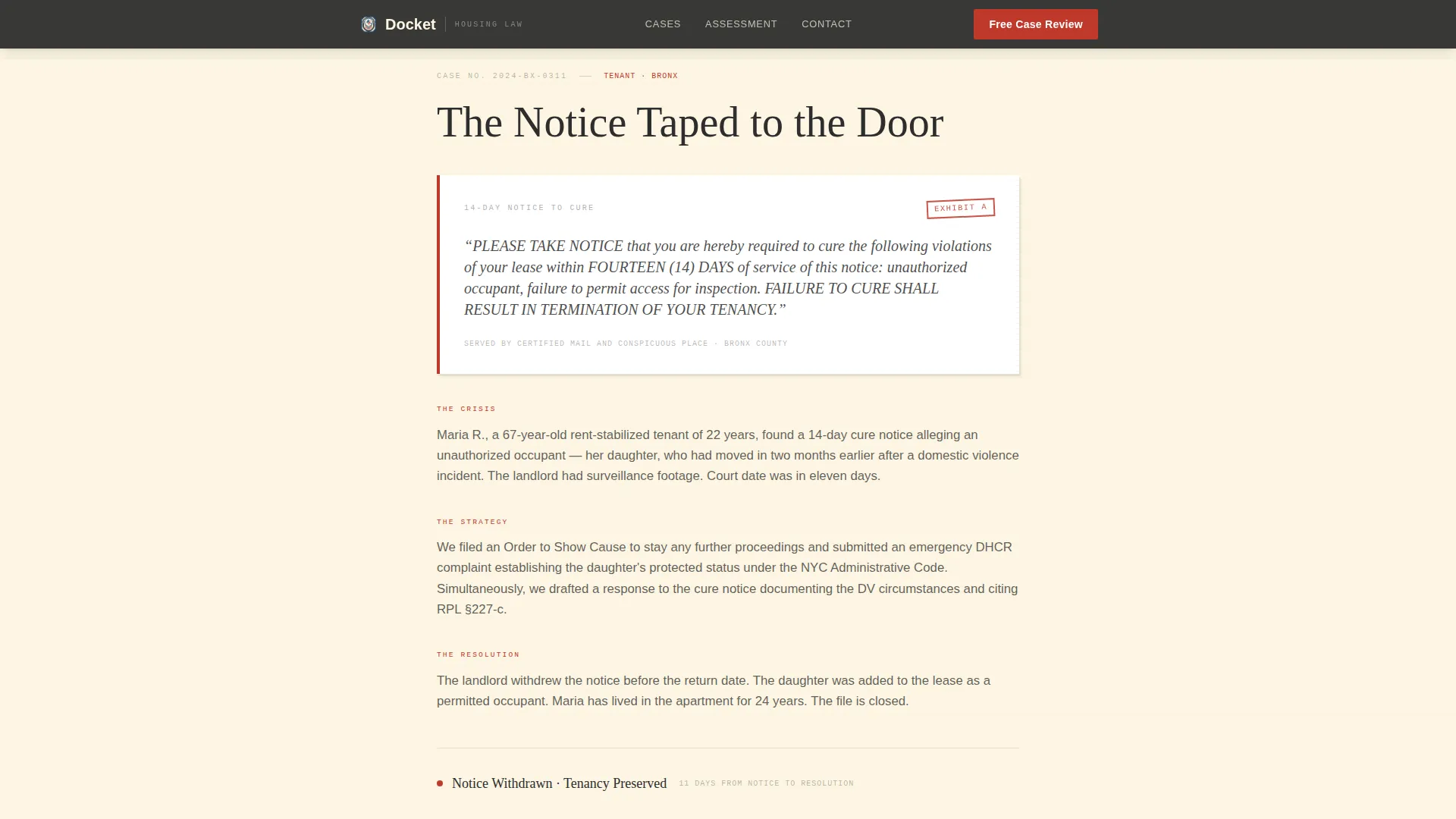
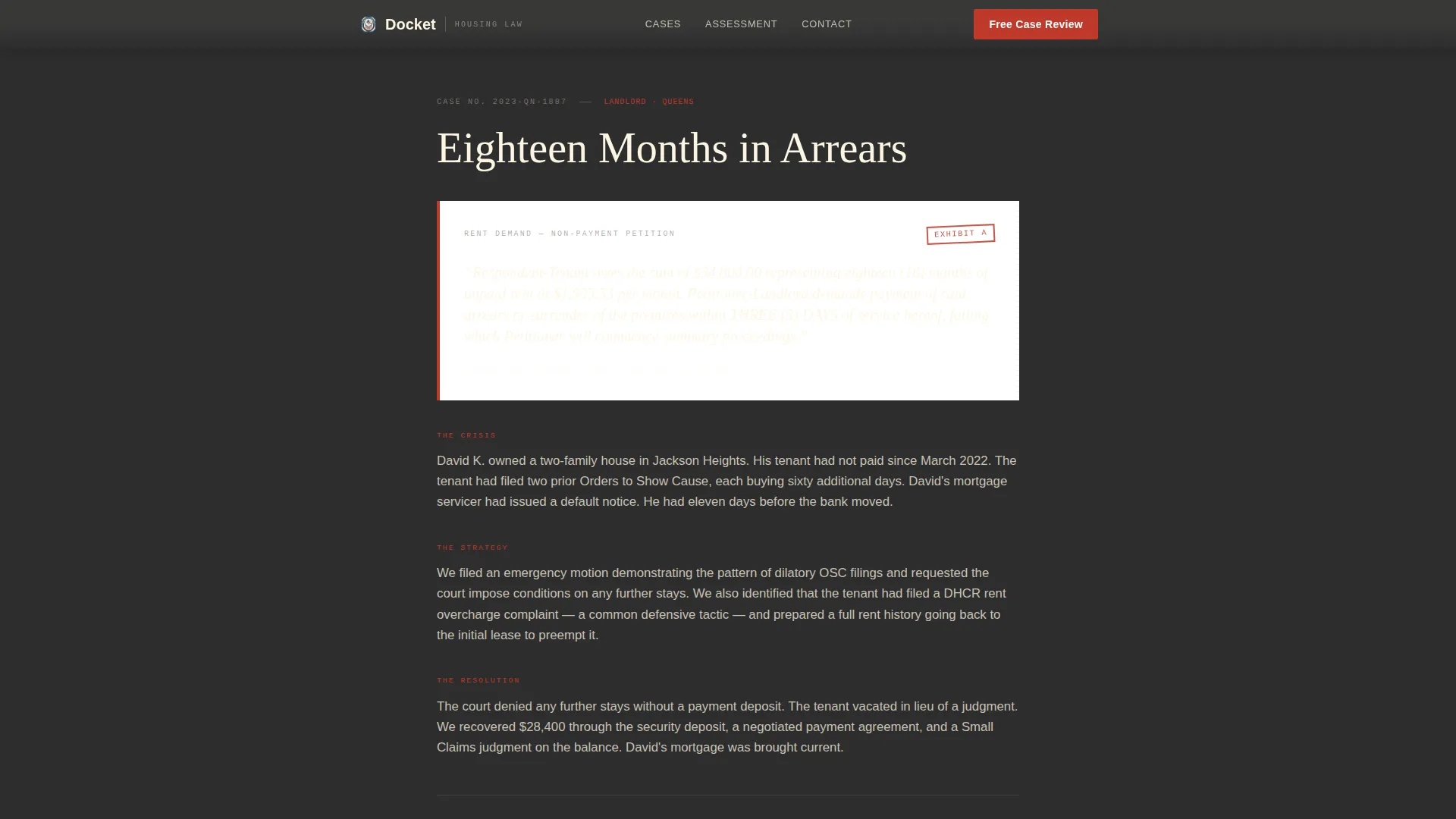
- Three narrative case study blocks, each opening with a styled document blockquote
- A five-step housing triage quiz that classifies results as urgent, time-sensitive, or strategic
Feature list
This template is built around a small set of high-impact components. Each one serves the conversion sequence directly.
Linked Press Mentions Bar
A horizontal scroll bar above the hero headline displays real media outlet logos. Each logo links to the actual published article, giving visitors verifiable third-party proof before they read a single line of attorney copy.
Editorial Hero Headline Block
The headline sits in a serif typeface on cream, with no hero image and no stock photography. A single paragraph below it establishes dual representation in plain, authoritative language. The weight comes from typography and copy, not decoration.
Case Study Narrative Blocks
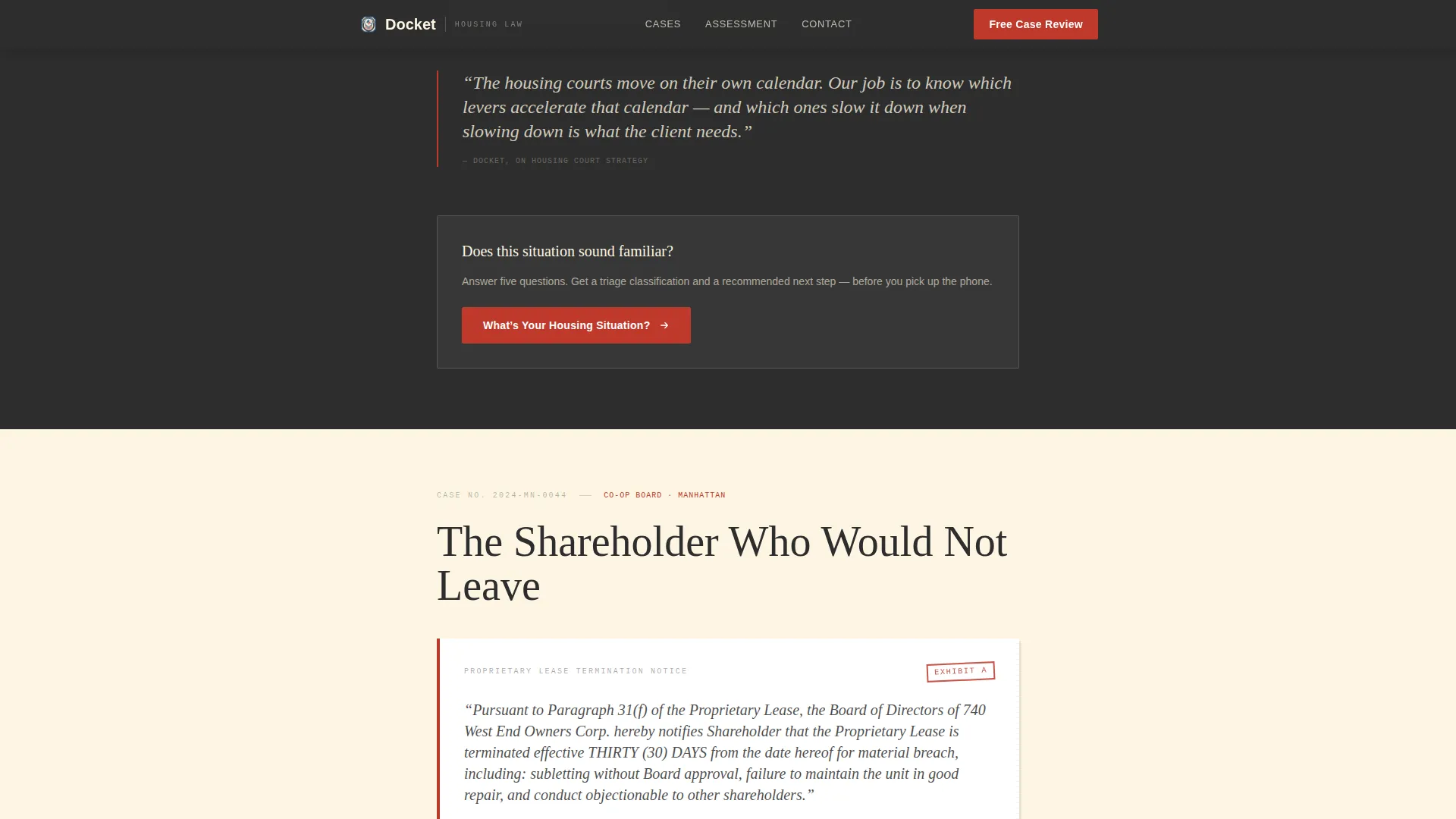
Three anonymized cases scroll in sequence: a tenant who kept their apartment after a 14-day notice, a landlord who recovered eighteen months of arrears, and a co-op board that resolved a shareholder holdover in forty days. Each case opens with a styled document blockquote and unfolds in three beats: crisis, legal strategy, resolution.
Attorney Philosophy Pull-Quotes
Between case study blocks, pull-quote sections surface the attorney's voice. These short statements anchor the narrative in principle rather than salesmanship, keeping the tone credible across the full scroll.
Five-Step Housing Triage Quiz
The primary call to action is an interactive quiz titled "What's Your Housing Situation?" It asks five questions covering role, borough, triggering document, days until the next court date, and opposing counsel contact. Results deliver a triage classification with a recommended next step and a "Schedule a Case Review" button.
Single-Row Footer
A linear single-row footer closes the page cleanly without visual noise, keeping the final conversion path clear and uncluttered.
Page sections overview
| Section | Purpose |
|---|---|
| Press Mentions Bar | Establishes media credibility above the headline |
| Hero Headline Block | States dual representation with editorial authority |
| Case Study One | Tenant retains apartment after 14-day notice |
| Pull-Quote One | Attorney voice grounds the narrative in philosophy |
| Case Study Two | Landlord recovers eighteen months of arrears |
| Primary Quiz call to action | First "What's Your Housing Situation?" prompt appears |
| Pull-Quote Two | Second attorney statement deepens trust |
| Case Study Three | Co-op board resolves holdover in forty days |
| Triage Quiz Module | Five-question interactive assessment with classified result |
| Final call to action Block | "Schedule a Case Review" button anchors the bottom |
| Single-Row Footer | Linear footer closes with minimal distraction |
Design & branding system
The visual identity follows a Civic Service theme built on an Ink and Paper color system. Every color choice references the physical materials of a well-organized case file.
- Filing-cabinet charcoal (#2D2D2D) for body text and dark section backgrounds, legal pad cream (#FDF6E3) for long-read sections, court-stamp blue (#1B4F72) for headings and navigation anchors, and redline accent (#C0392B) reserved for calls to action and urgent callouts
- Fraunces serif for display headlines and Docket Metro Sans (DM Sans) for body text, pairing editorial authority with clean readability
- Alternating charcoal and cream section backgrounds create the rhythm of tabbed dividers inside a brief, with no hero imagery anywhere on the page
Mobile & speed optimization
The template is designed desktop-first to match the legal research context of its audience, with full mobile support built in from the start.
- Single-column flow collapses naturally on smaller screens without restructuring the narrative sequence
- Scroll-reveal animations, stagger effects, counter animation on the 4,200 cases metric, and quiz state machine transitions are built with minimal client-side JavaScript to keep the page fast on any device
How this template helps you convert
Every structural decision in this template is oriented toward one outcome: turning a housing court visitor into a scheduled case review.
- The press mentions bar at the top creates immediate credibility before the visitor has read the attorney's own words, reducing the instinct to bounce.
- The case study sequence mirrors the visitor's own situation in escalating stakes, making the attorney's experience feel directly relevant rather than general.
- The triage quiz earns the click by demonstrating that the attorney already understands housing court vocabulary and timeline pressure, lowering the barrier to booking.
Other information about this template
This template sits in the Legal and Compliance category under the Real Estate and Property Law subcategory, targeting the landlord-tenant attorney niche with a high intersection match. A few additional details worth noting:
- The page is localized to New York City with borough-specific language and NYC housing court vocabulary built into the quiz questions
- The 4,200 cases metric is displayed with a counter animation as a scroll-triggered social proof signal
- The triage quiz result screen includes a "Schedule a Case Review" button, making the conversion step feel earned rather than pushed
- The creative direction is Case Study Narrative, and the header concept is Press Mentions, both of which are rare choices in legal landing pages and help this template stand apart from generic attorney sites
- The template uses a Pattern 1 linear single-row footer, keeping the closing section clean and focused
Theme
Civic Service
Creative direction
Case Study Narrative
Color system
Ink & Paper
Style
Single Column Flow
Direction
Quiz/Assessment
Page Sections
Linked Press Mentions Bar
Editorial Hero Headline Block
Case Study Narrative Blocks
Five-step Housing Triage Quiz
Attorney Philosophy Pull-quotes
Single-row Linear Footer
Related questions
Who is this landing page template designed for?
Does the quiz actually classify visitor urgency?
Can this template be used if I only represent tenants or only represent landlords?
What design style does this template use?
How many sections does this landing page include?