Judiciary & Legal Advanced Professional Website Template
Docket is a hub-and-spoke Supreme Court resource landing page built for law students, journalists, educators, and citizens. It opens with a live-data stats tableau showing current term numbers, then guides visitors through anchor-nav spoke sections covering how cases reach the Court, current justices, landmark decisions, term calendar, and filing access, all in a hushed, library-grade visual identity.
by Rocket studio
Quick summary
Docket is a single-page Supreme Court resource directory that answers real questions before asking for anything in return. A typographic stats dashboard anchors the header, a sticky anchor nav organizes six spoke sections, and expandable accordions let visitors go as deep as they need. The design feels like a law library reading room: authoritative, calm, and genuinely useful.
Who this template is for
This landing page is built for civic publishers, legal information platforms, and educational organizations that need to serve a wide range of readers reliably. It works equally well for institutional resource hubs and independent legal journalism projects.
- Law students and legal researchers who need fast access to case citations, cert grants, and oral argument transcripts
- Journalists, civics educators, and engaged citizens who want plain-language answers about how the Court works and how its decisions affect everyday life
What problem this template solves
Supreme Court information is scattered across court websites, law review archives, and news databases. Visitors either find too little context or become lost in technical language with no clear path forward. This template consolidates the most important content into one structured, navigable page.
- There is no single destination that combines current term data, justice profiles, landmark rulings, and filing guidance in one readable flow
- First-time visitors abandon pages that feel intimidating or unclear; the FAQ-driven structure meets readers where they are and earns their attention before presenting any call to action
What you get with this template
You get a complete, fully structured landing page layout ready for a Supreme Court resource directory. Every section is purpose-built and connected through the sticky anchor navigation.
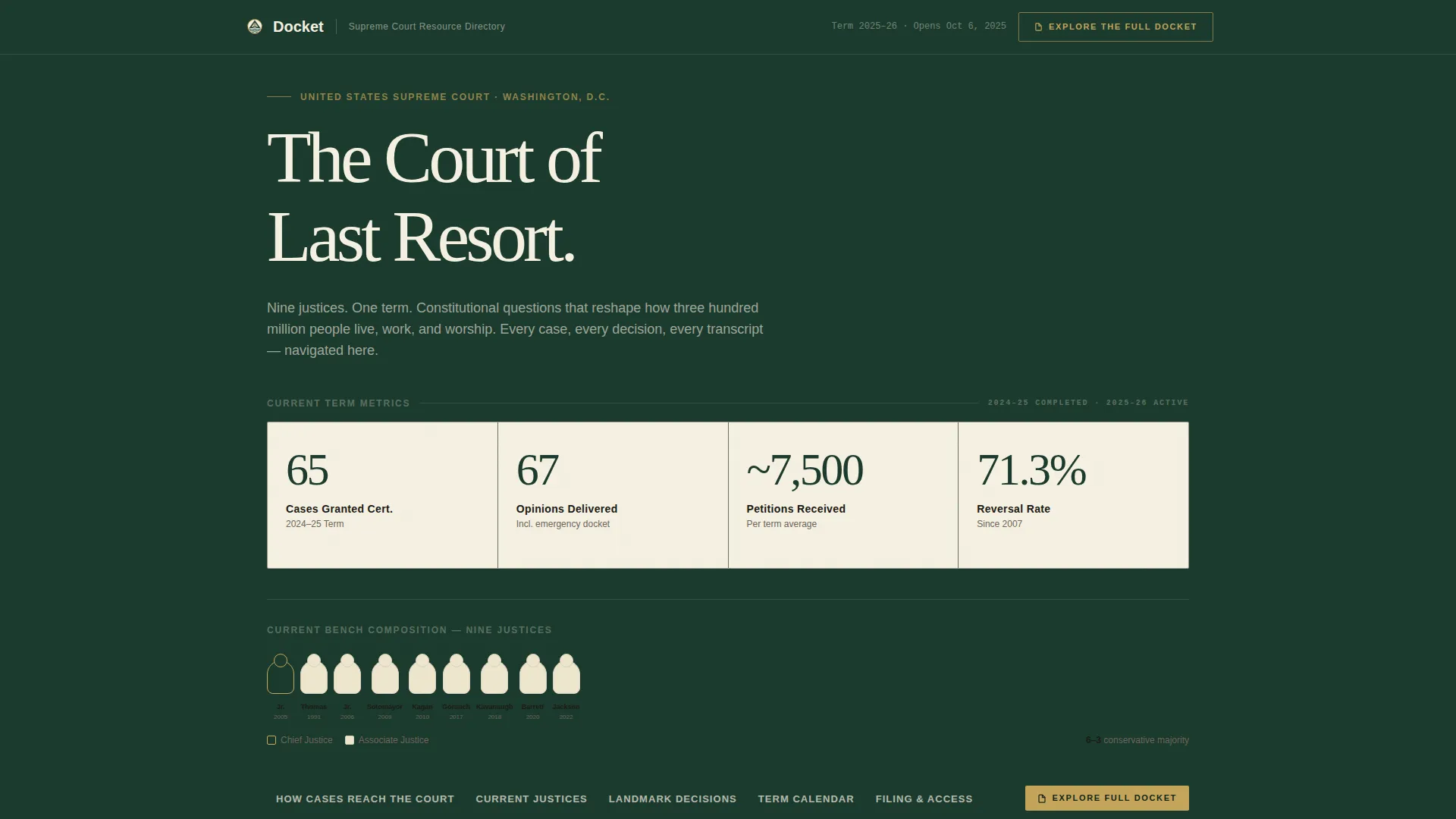
- A typographic hero tableau showing cert grants, opinions delivered, pending oral arguments, and bench composition as nine minimal portrait silhouettes
- Five spoke sections covering the cert petition flow, current justices, landmark decisions, the term calendar, and filing and access resources
- A primary call-to-action linking to the case database and a secondary email subscription form with a term-interest checkbox for opinions, oral arguments, and cert grants
Feature list
This landing page includes a focused set of built-in components, each serving a distinct purpose in the visitor journey.
Stats and Metrics Hero Tableau
The header opens with a clean, typographic dashboard. It displays the current term's cert grants, opinions delivered, pending oral arguments, and bench composition. Large serif numerals set against parchment cream communicate gravity and transparency without photography or illustration.
Sticky Anchor Navigation
A persistent navigation bar pins below the header as the visitor scrolls. Spoke labels include "How Cases Reach the Court," "Current Justices," "Landmark Decisions," "Term Calendar," and "Filing & Access." The gold accent color marks the active state clearly.
FAQ-Driven Accordion Sections
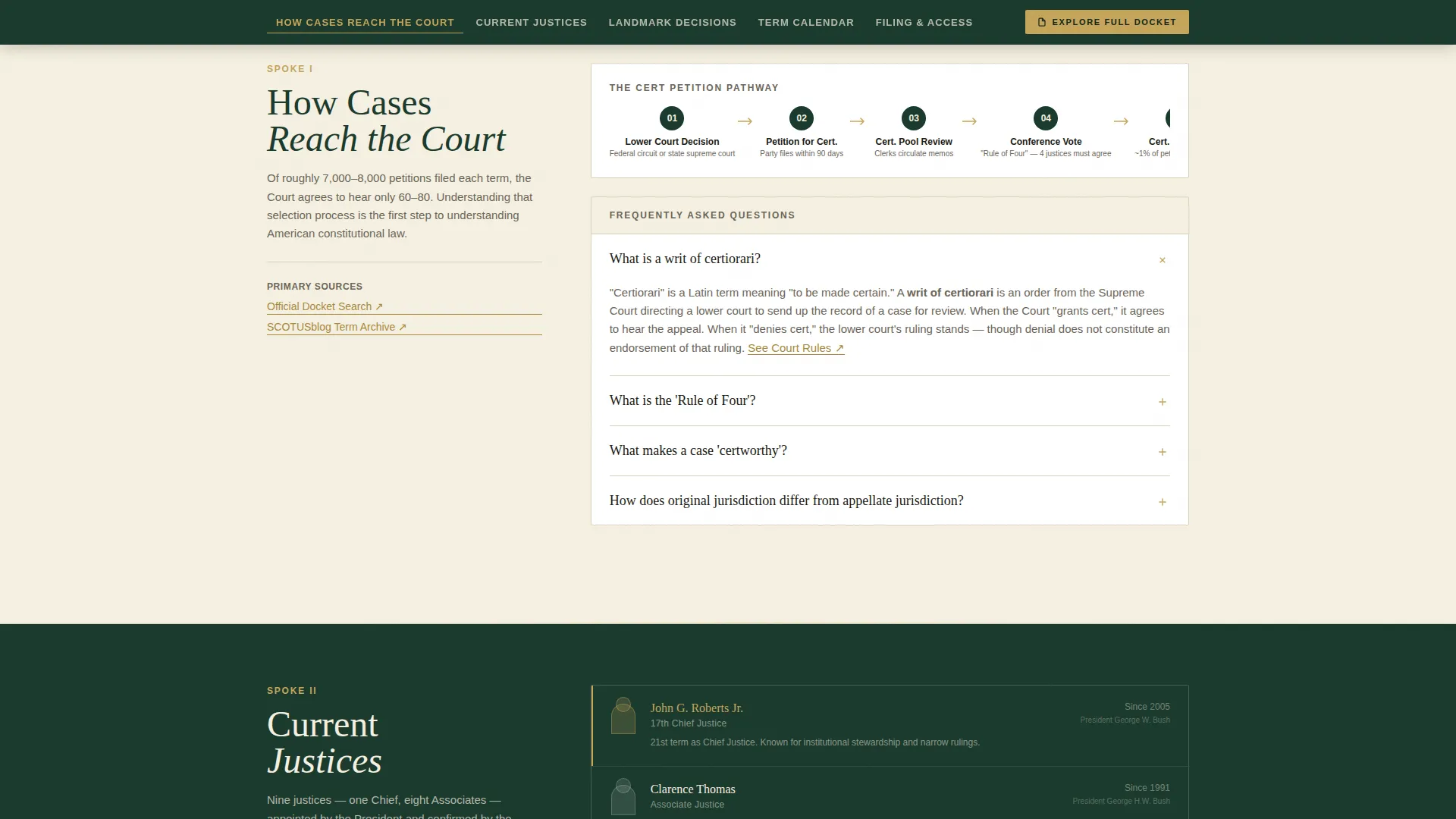
Each spoke section opens with a plainly worded question a real person would type into a search bar. Expandable accordions reveal deeper detail on demand. Embedded primary-source links are styled in the muted gold accent for instant recognition.
Justice Profile Section
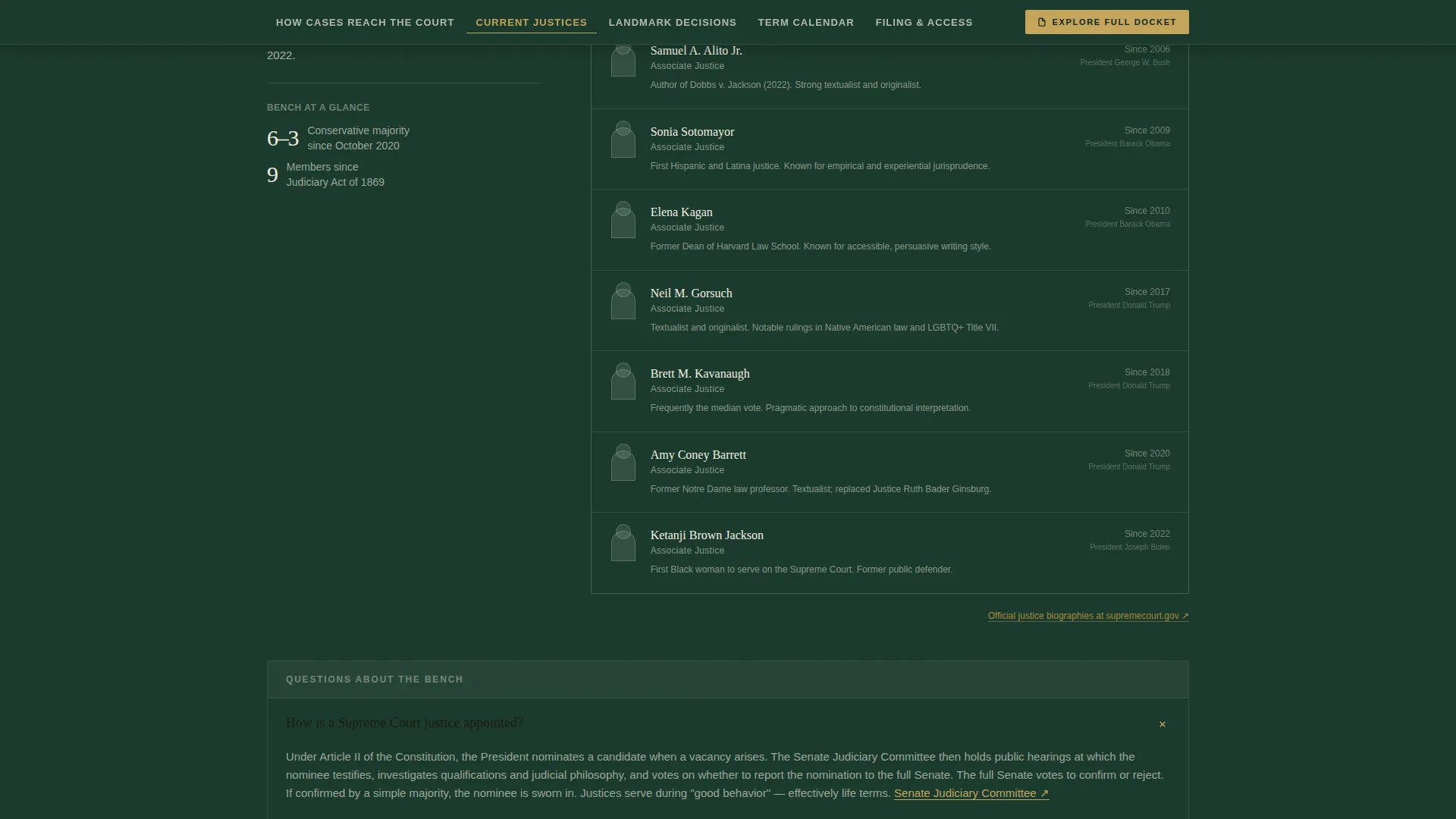
Nine minimal portrait silhouettes display each justice with appointment data. The layout is typographic and restrained, matching the overall library aesthetic without relying on photography.
Email Subscription Form
A lightweight subscription module offers "Subscribe to Term Updates" with a single email field. A term-interest checkbox lets subscribers choose between opinions, oral arguments, and cert grants, keeping sign-ups relevant and intentional.
Linear Single-Row Footer
The footer follows a clean, single-row pattern. It keeps the page grounded without adding visual noise, consistent with the overall directive to let content carry authority.
Page sections overview
| Section | Purpose |
|---|---|
| Hero Stats Tableau | Displays current term metrics and bench composition |
| Sticky Anchor Nav | Provides persistent spoke navigation across all sections |
| How Cases Reach the Court | Explains cert petition flow with accordion detail |
| Current Justices | Shows nine justice profiles with appointment data |
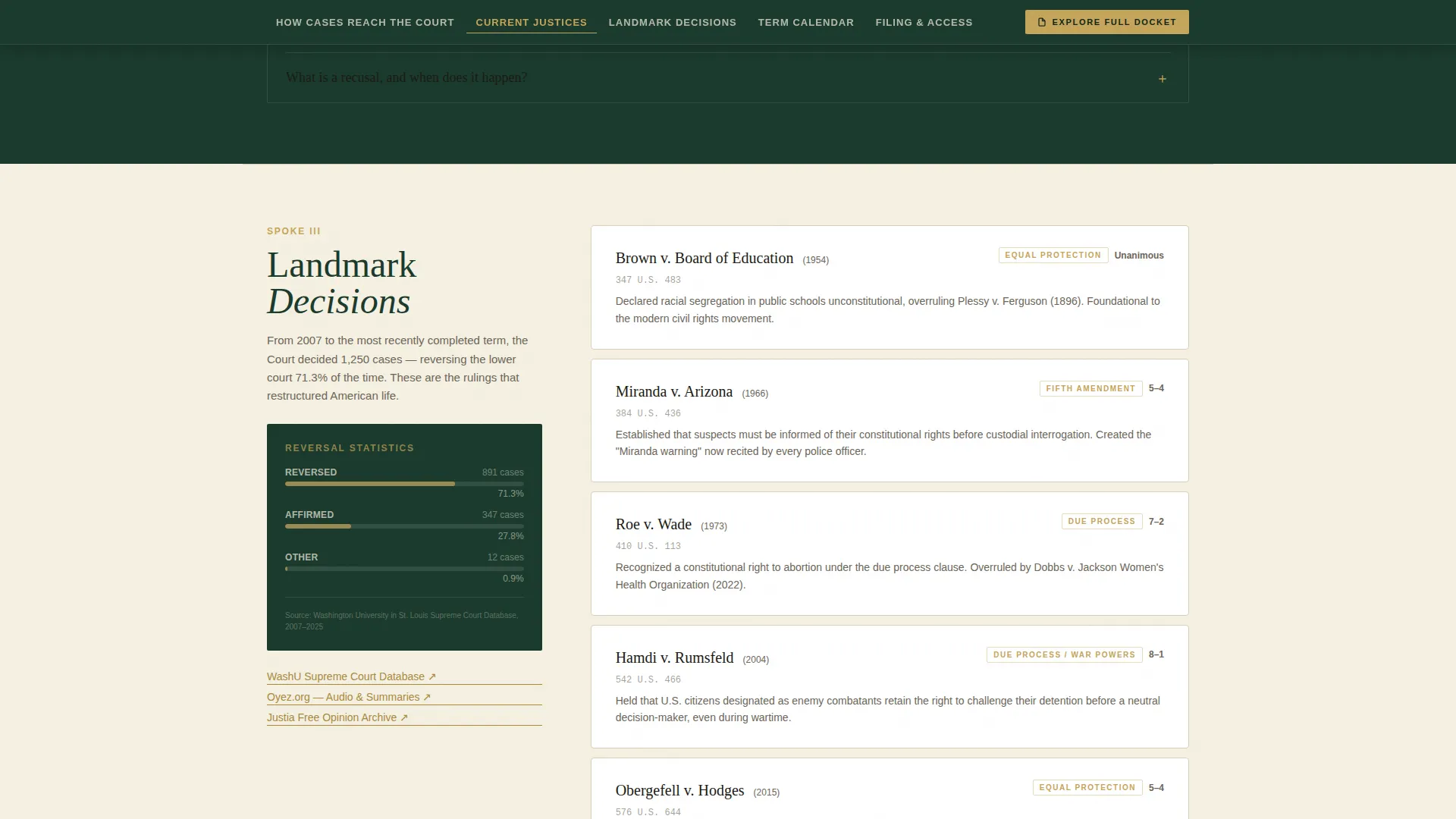
| Landmark Decisions | Surfaces historically significant rulings for reference |
| Term Calendar | Lists upcoming oral arguments and key term dates |
| Filing and Access | Guides users to filing resources and primary-source links |
| Email Subscription Module | Captures term-update sign-ups with interest selection |
| Linear Footer | Closes the page with a minimal single-row layout |
Design & branding system
The visual identity follows a Directory and Discovery theme anchored in a Forest Trust color palette. Typography pairs Fraunces, a display serif, for headings with DM Sans for body text, creating a reading experience that feels authoritative without being cold.
- Four-color palette: deep judicial evergreen (#1B3A2D) for the top bar and structure, parchment cream (#F5F0E1) for backgrounds, burnished oak (#6B4226) as a secondary tone, and muted gold (#C5A55A) reserved for active nav states, hover highlights, and citation links
- Serif-forward, typographic design with no photography or illustration; data and prose carry all visual weight, evoking a wood-paneled reading room
Mobile & speed optimization
The template is built desktop-first to serve law researchers working at their desks. The layout responds cleanly to smaller screens without sacrificing the structured reading experience.
- Scroll reveals and accordion expand-and-collapse interactions are implemented with minimal JavaScript, keeping the page light and focused
- Server Components handle static content sections, so the heaviest parts of the page load without unnecessary client-side overhead
How this template helps you convert
The conversion strategy is built on usefulness first. The page earns trust by answering questions brilliantly before presenting any request.
- The primary call to action, "Explore the Full Docket," appears in both the header metrics bar and as a persistent button in the anchor nav, so it is always one click away without interrupting the reading flow.
- The secondary conversion path, "Subscribe to Term Updates," is placed after enough value has been delivered. A single email field and a term-interest checkbox keep the ask small and the commitment clear.
Other information about this template
This template is designed for the United States civic and legal publishing context. It uses American case citation format throughout and assumes English-language legal terminology. The design philosophy prioritizes transparency and usefulness over persuasion.
- The social proof layer draws on real data signals: the template is structured to surface 2025 term statistics, primary-source citations, and historical data points such as the Court's 71.3% reversal rate for cases it agrees to hear
- The hub-and-spoke architecture means each spoke section can be updated independently, making the page practical to maintain across multiple Court terms
Theme
Directory & Discovery
Creative direction
FAQ-Driven
Color system
Forest Trust
Style
Hub & Spoke (Anchor Nav)
Direction
Content/Resource
Page Sections
Typographic Stats Hero Tableau
Sticky Anchor Navigation Bar
Faq-driven Accordion Sections
Justice Profile Display
Email Subscription with Interest Filtering
Dual Call-to-action Placement
Related questions
What types of visitors is this landing page designed to serve?
Can I customize the spoke sections for a different legal focus?
What is included in the email subscription form?
Does the template include real Supreme Court data?
Is this template suitable for a government agency or a civic nonprofit?