Expert Clinical Practice Landing Page Template
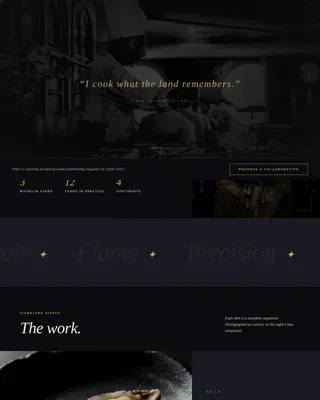
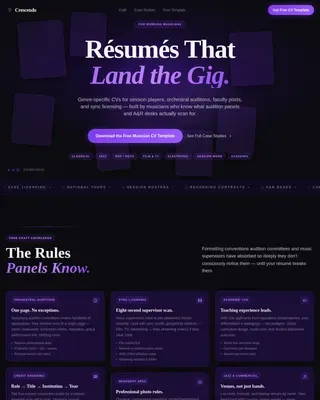
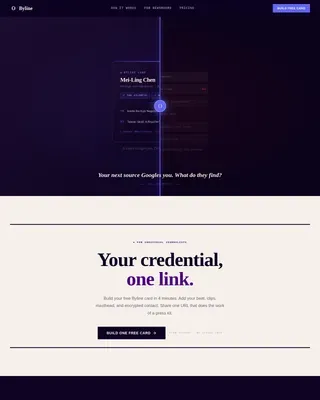
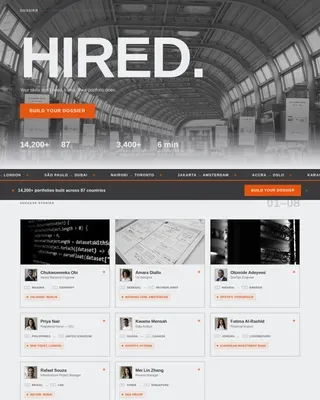
The Researcher Immersive Clinical Career Portfolio Landing Page Template is a dark, monograph-style portfolio built for clinical researchers targeting pharmaceutical sponsors, contract research organizations, and academic collaborators. It presents trial history, publication records, and regulatory milestones through chapter-by-chapter scroll storytelling, animated metrics, collaborator pull quotes, and a persistent "Propose a Collaboration" call-to-action bar.
by Rocket studio
Quick summary
This template gives clinical researchers a striking, evidence-first portfolio presentation designed to convert pharma sponsors and contract research organizations into collaboration partners. It reads like a sealed study binder coming to life: floating photo headers, full-page chapter scrolls, animated trial metrics, and a persistent lead-generation bar that glows brighter as visitors scroll deeper into the story.
Who this template is for
Clinical researchers need a portfolio that speaks the language of their audience: protocol rigor, enrollment track records, and peer-reviewed credibility. This template is built for that exact context. It serves researchers who want their portfolio presentation to do the heavy lifting before any conversation begins.
- Principal investigators seeking pharmaceutical sponsors or contract research organization partnerships
- Academic researchers looking to attract co-authors, collaborators, or invited lecture opportunities
- Clinical research professionals ready to showcase case studies, publication records, and regulatory milestones in one authoritative place
What problem this template solves
Most research portfolios bury the most important evidence. A curriculum vitae lists credentials but does not tell a story. A basic website presents information without building the weight of proof that serious clients expect. Hiring managers and sponsor teams evaluating a principal investigator need to see not just what was achieved, but how: the research methods chosen, the decisions made under protocol pressure, and the measurable impact left on trial outcomes.
- A plain document format cannot convey the depth of a researcher's thought processes, ethical navigation, or cross-functional team leadership
- Static layouts fail to present findings in a way that builds trust progressively as the visitor scrolls
- Without structured case studies and animated metrics, a portfolio cannot explain the full arc of a research project from hypothesis to regulatory submission
What you get with this template
This template delivers a complete, immersive single-page portfolio presentation. Every section is developed to showcase a clinical researcher's career as a cumulative argument. The layout guides visitors from first impression to collaboration request without friction.
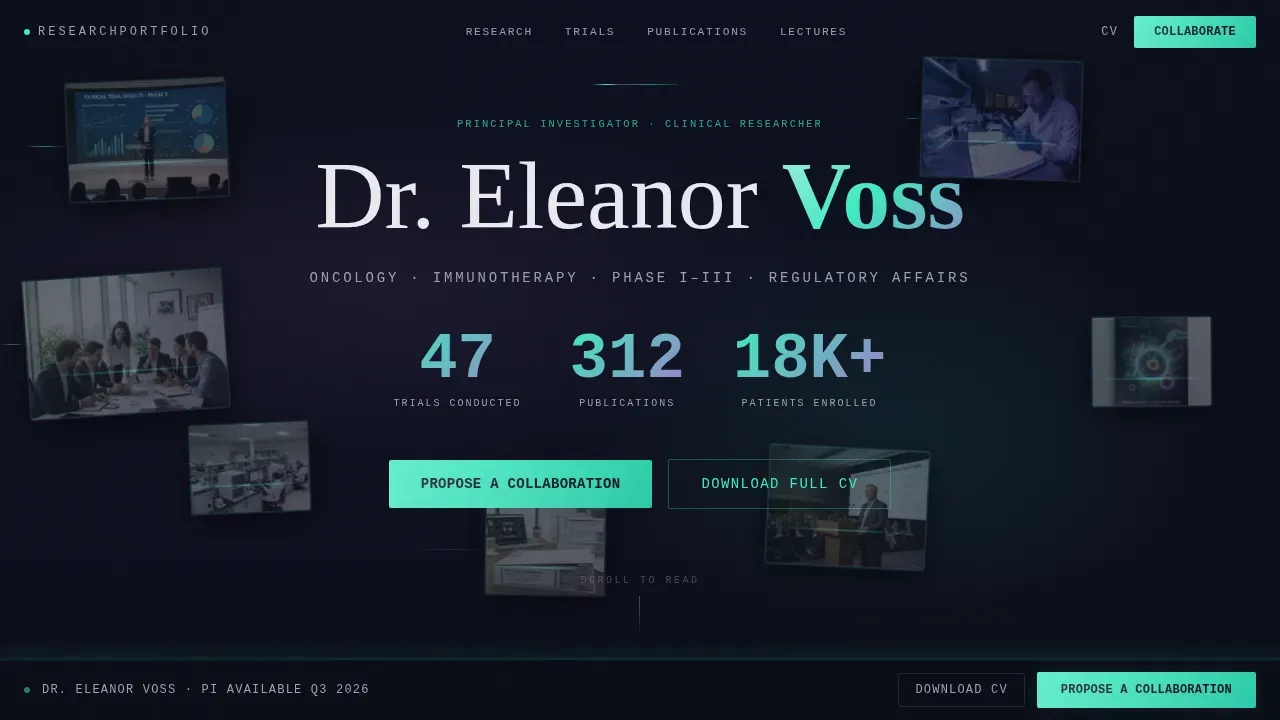
- A floating photo hero header that settles into a researcher name and credentials display, establishing identity and focus immediately
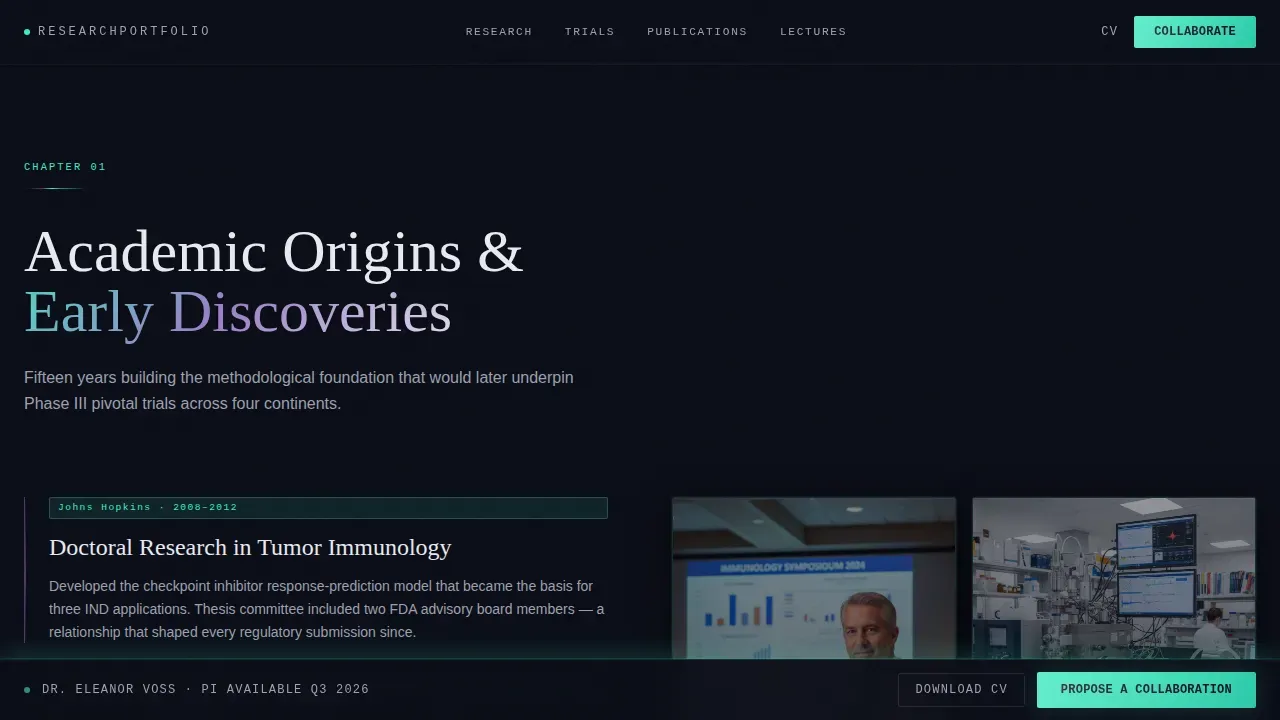
- Full-page career chapter sections with parallax scroll depth, covering academic origins, Phase II trial pivots, regulatory milestones, publication records, and invited lectures
- A persistent "Propose a Collaboration" call-to-action bar and a gated "Download Full CV" secondary path, both designed to convert visitors into qualified leads
Feature list
This template ships with a purposeful set of features tied directly to the demands of clinical research portfolio presentation. Each feature is built to highlight process, findings, and impact in a format that sponsors and colleagues can evaluate quickly.
Floating Photo Constellation Header
Headshots, lab candids, conference podium moments, and journal cover crops drift slowly across a deep obsidian field with iridescent glows trailing each frame. After a beat, the images settle into a loose grid and the researcher's name emerges in signal white alongside therapeutic area and phase experience. The effect demonstrates a career materializing from the dark, making an immediate and memorable first impression.
Full-Page Career Chapter Scroll
Each section of the portfolio functions as a standalone chapter, revealed one screen at a time with parallax depth. The scroll covers early academic research work, pivotal Phase II trials, regulatory milestones, publication records, and keynote history. This design process mirrors the structure of a research monograph, helping visitors absorb context before the final call to action.
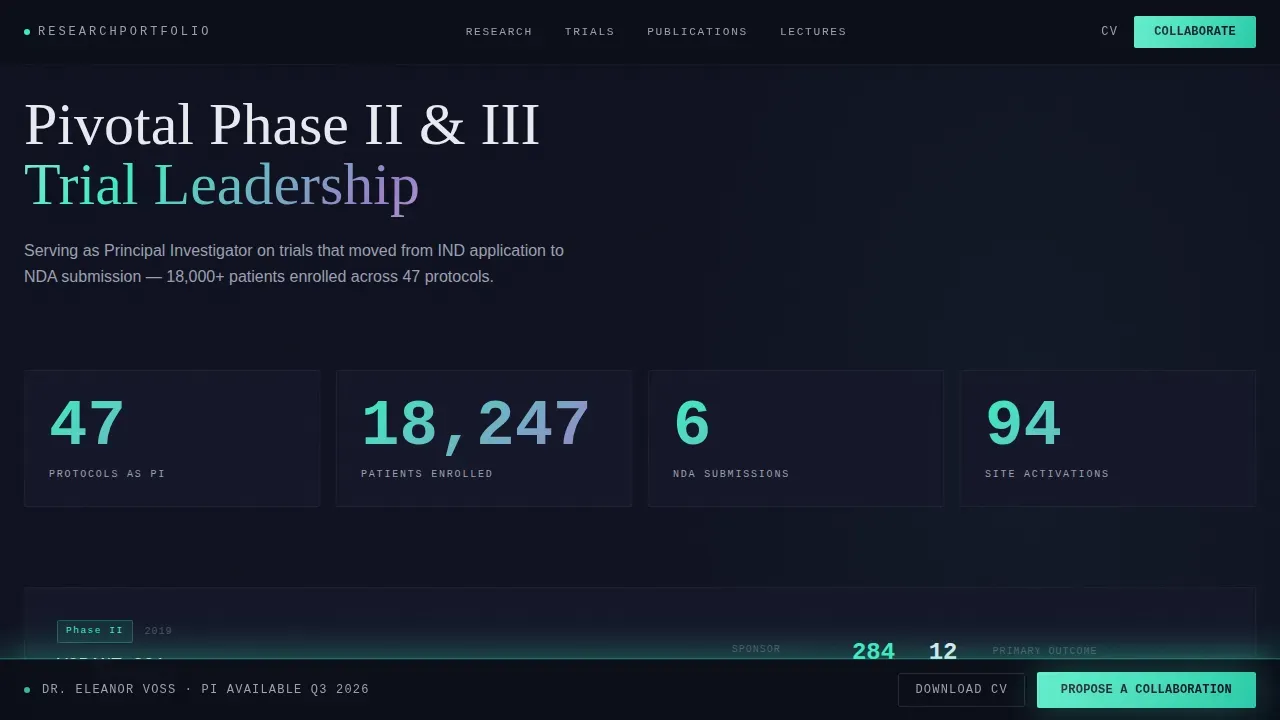
Animated Metrics and Data Display
Enrollment numbers, protocols authored, and publication citation counts animate into view as each chapter arrives on screen. The metrics use JetBrains Mono typography to reinforce the data-driven style. This feature helps hiring managers and sponsor teams evaluate impact quickly without reading dense prose.
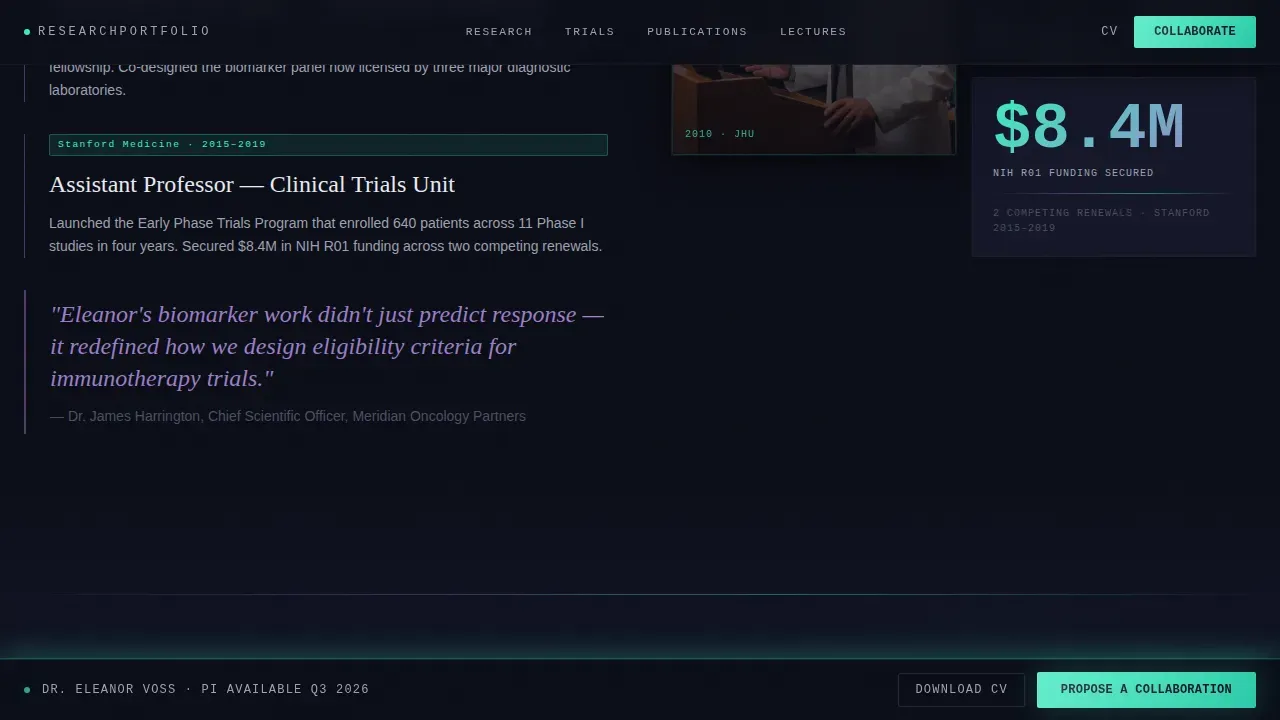
Collaborator Pull Quotes and Sponsor Logos
Phosphor violet italic pull quotes from colleagues and collaborators appear between data-heavy sections. Named sponsor logos anchor the social proof layer. Together, these elements substantiate research findings with human testimony and institutional credibility, moving the portfolio from a resume to a body of evidence.
Lead Generation Modal and CV Gate
A persistent bottom bar anchors the "Propose a Collaboration" call to action. Its teal glow intensifies as the visitor scrolls deeper, creating a scroll-linked signal that rewards engagement. Clicking opens a three-field modal: organization name, study phase and therapeutic area, and a free-text opportunity description. A secondary path offers CV download gated behind email capture.
Responsive Layout for Desktop and Tablet
The template is built desktop-first to match the workstation context of pharmaceutical sponsor review. The layout adapts cleanly for tablet viewing, ensuring the portfolio presentation remains sharp and readable across screen sizes. Responsive design keeps every section legible without sacrificing the immersive visual style.
Page sections overview
| Section | Purpose |
|---|---|
| Floating Photo Hero | Establish researcher identity and credentials |
| Career Chapter Scroll | Present career arc chapter by chapter |
| Publication Metrics Block | Animate cited works and trial numbers |
| Collaborator Testimonials | Add human testimony between data points |
| Lectures and Recognition | Showcase conference and keynote history |
| Collaboration call to action Bar | Convert visitors into collaboration leads |
| CV Download Gate | Capture emails via secondary conversion path |
Design & branding system
The visual identity follows a Dark Immersive theme built around an AI Iridescent color system. The palette feels like staring into a mass spectrometer readout: deep obsidian absorbs the background, while iridescent accents shift like reagent under ultraviolet light. Every design detail reinforces the authority and precision a clinical research audience expects.
- Color palette: obsidian (#0B0D17) background, phosphor violet (#7B5EA7) for section transitions and pull quotes, bioluminescent teal (#3EEBC2) for interactive states and key metrics, signal white (#E8EAF0) for body text
- Typography: DM Sans for readable body copy, Fraunces serif for chapter headings, JetBrains Mono for metrics and data displays
- Animation style: high-intensity, including floating photo drift, parallax chapter reveals, animated counters, and scroll-linked teal glow on the call-to-action bar
Mobile & speed optimization
The template is designed desktop-first to serve the workstation habits of pharmaceutical sponsors and contract research organization teams who evaluate principal investigators on large screens. It also scales cleanly to tablet viewports, keeping the portfolio easy to navigate for colleagues reviewing on the go.
- Responsive design adapts the full-page chapter layout and animated sections for tablet screen sizes without breaking the immersive style
- Server Components handle static sections for load efficiency; Client Components manage animations and modal interactivity
- The layout preserves easy navigation across all supported screen sizes, ensuring visitors can find details and link to key sections without confusion
How this template helps you convert
This portfolio is built as a lead generation machine, not a static showcase. Every design and content decision escalates the visitor's confidence until reaching out feels like the only rational next step.
- Front-loading proof: publication counts, trial enrollment numbers, and named sponsor logos appear early, so potential clients evaluate impact before they read a single paragraph of background
- Scroll-linked glow intensity on the call-to-action bar creates a subtle escalating signal that becomes impossible to ignore by the final chapter, turning passive readers into active inquiries
Other information about this template
This template is a strong match for clinical researchers exploring how to present their portfolio on the open web for the first time, as well as for experienced researchers who want to upgrade from a static curriculum vitae or a generic academic website. It supports a wide range of presentation contexts, including those working with non-profits, academic medical centers, and independent research sites.
- The template can be customized to reflect a personal brand, specific therapeutic focus areas, and individual style preferences without rebuilding the core layout
- It serves as a great example of how a ux research portfolio structure translates to clinical science: clear case studies, justified research methods, and transparent process details work equally well for bench researchers as for user experience professionals
- Researchers landing their first job in a principal investigator role or building a profile to attract a new team of collaborators will find the structure especially practical
- The portfolio presentation format supports the STAR method (Situation, Task, Action, Result) for structuring three to five detailed research projects with problem-action-result metrics
- Because research portfolios in clinical science are expected to demonstrate thought processes and ethical navigation alongside results, this template dedicates full-page chapters to process storytelling, not just outputs
- Templates like this one help researchers explain complex methodologies in plain language, making the portfolio accessible to both scientific colleagues and business stakeholders such as procurement teams and hiring managers
- For researchers who want to showcase usability tests, protocol iterations, or research methods alongside trial data, the chapter format provides the flexibility to include that material in sequence
- The design portfolio principles embedded in this template (clear information hierarchy, easy navigation, progressive disclosure) apply directly to how a ux researcher or clinical research professional would want to present findings to a cross-functional team
- Free templates for clinical researchers tend to offer minimal layout and no animation; this template is a premium alternative that delivers a polished, immersive experience developed specifically for the pharma and academic research context
- It is worth noting that a ux research case study and a clinical trial case study share the same structural logic: define the problem, describe the research process, present the findings, and link those findings to measurable impact on the final product or outcome
Theme
Dark Immersive
Creative direction
Creator Spotlight
Color system
AI Iridescent
Style
Storybook/Full-Page
Direction
Lead Generation
Page Sections
Floating Photo Constellation Hero
Full-page Monograph Chapter Scroll
Animated Trial Metrics Display
Collaborator Pull Quotes and Social Proof Layer
Scroll-linked Lead Generation Bar
Desktop-first Responsive Layout
Related questions
Who is this portfolio template designed for?
Can I customize the sections and color style?
Does the template support lead generation out of the box?
How does this template differ from a standard academic website?
Is this template suitable for researchers at early career stages?