Complete Environmental & Conservation NGO Professional Website Template
Drift is a masonry-layout landing page template built for coastal cleanup initiatives. It uses hyperlocal storytelling, educational debris cards, and a scroll-driven visual flow to move visitors from casual interest to genuine action. The Desert Rose color system and cinematic full-bleed header give the page a warm, salt-cured atmosphere that feels earned, not polished.
by Rocket studio
Quick summary
Drift is a single-page, masonry-layout template designed for ocean cleanup campaigns. It guides visitors through hyperlocal debris stories, a before-and-after jetty section, volunteer portraits, and a field identification guide. By the time the call to action appears, the problem feels local. The click to sign up feels like the only reasonable next step.
Who this template is for
This template is built for grassroots coastal organizations that need to turn passive awareness into active volunteer sign-ups. It works best when the story is local and the audience already lives near the water.
- Coastal nonprofit coordinators running recurring weekend cleanup events
- Community organizers mobilizing volunteers across beach, estuary, and harbor sites
- Dive shop owners, teachers, or local leads who want a credible recruitment page without a development budget
What problem this template solves
Most environmental landing pages talk about global scale. They show satellite images of ocean gyres and cite tonnage from the North Pacific. That distance lets visitors feel concerned without feeling responsible. Drift flips that logic.
- It makes pollution feel proximate by mapping local drainage paths and showing zip-code-specific debris data
- It replaces abstract statistics with neighborhood-level evidence, like a specific jetty or a familiar storm drain
- It earns the call to action through proximity rather than urgency, so visitors arrive at the sign-up link already convinced
What you get with this template
Drift delivers a fully structured, single-page layout that takes visitors on a deliberate scroll from cinematic shoreline imagery through micro-lesson story cards to a community portrait section and a practical field guide. Every section is designed to narrow the distance between the visitor and the problem.
- A full-bleed hero section with scroll-linked blur and a headline fade-in animation
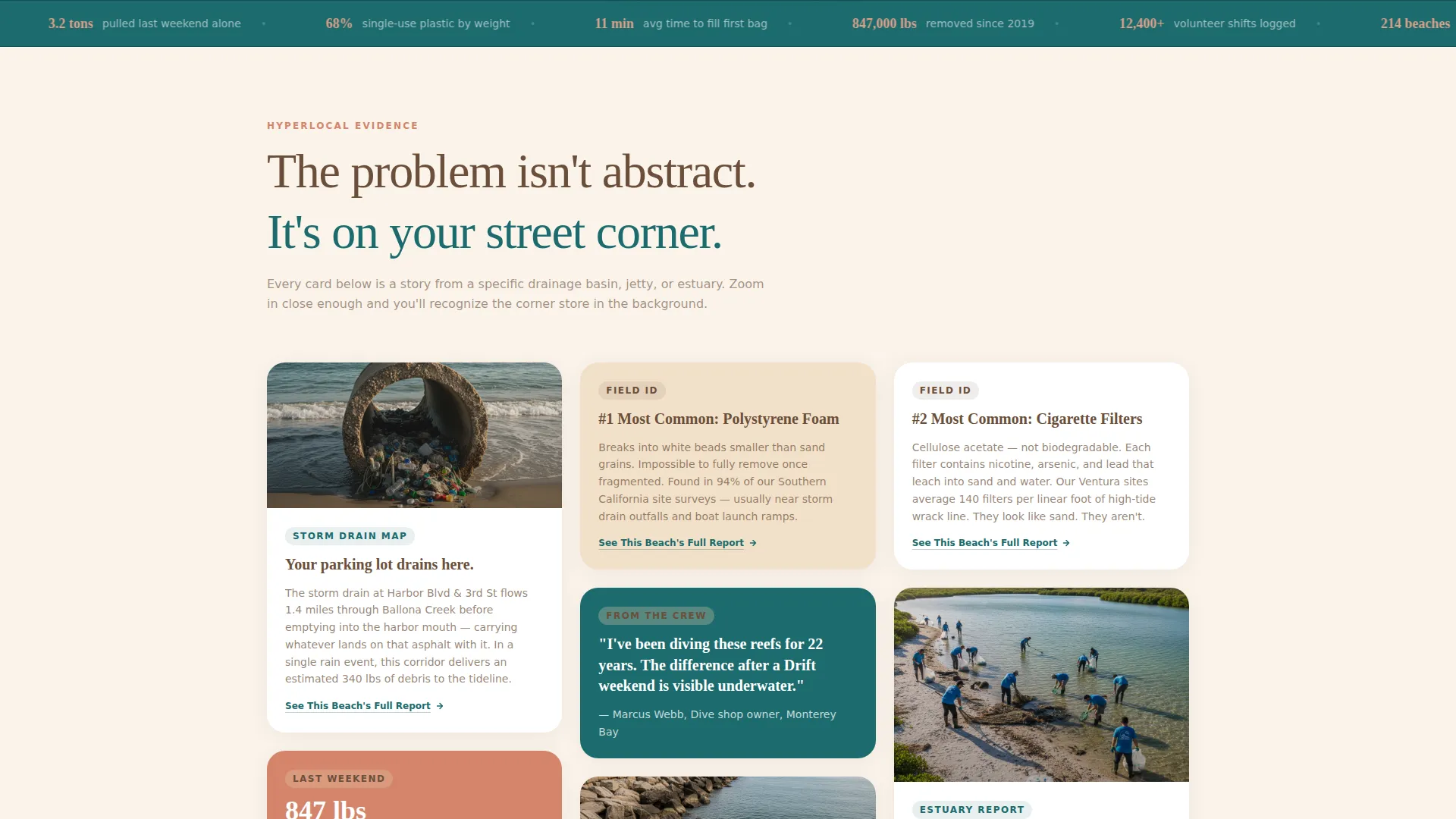
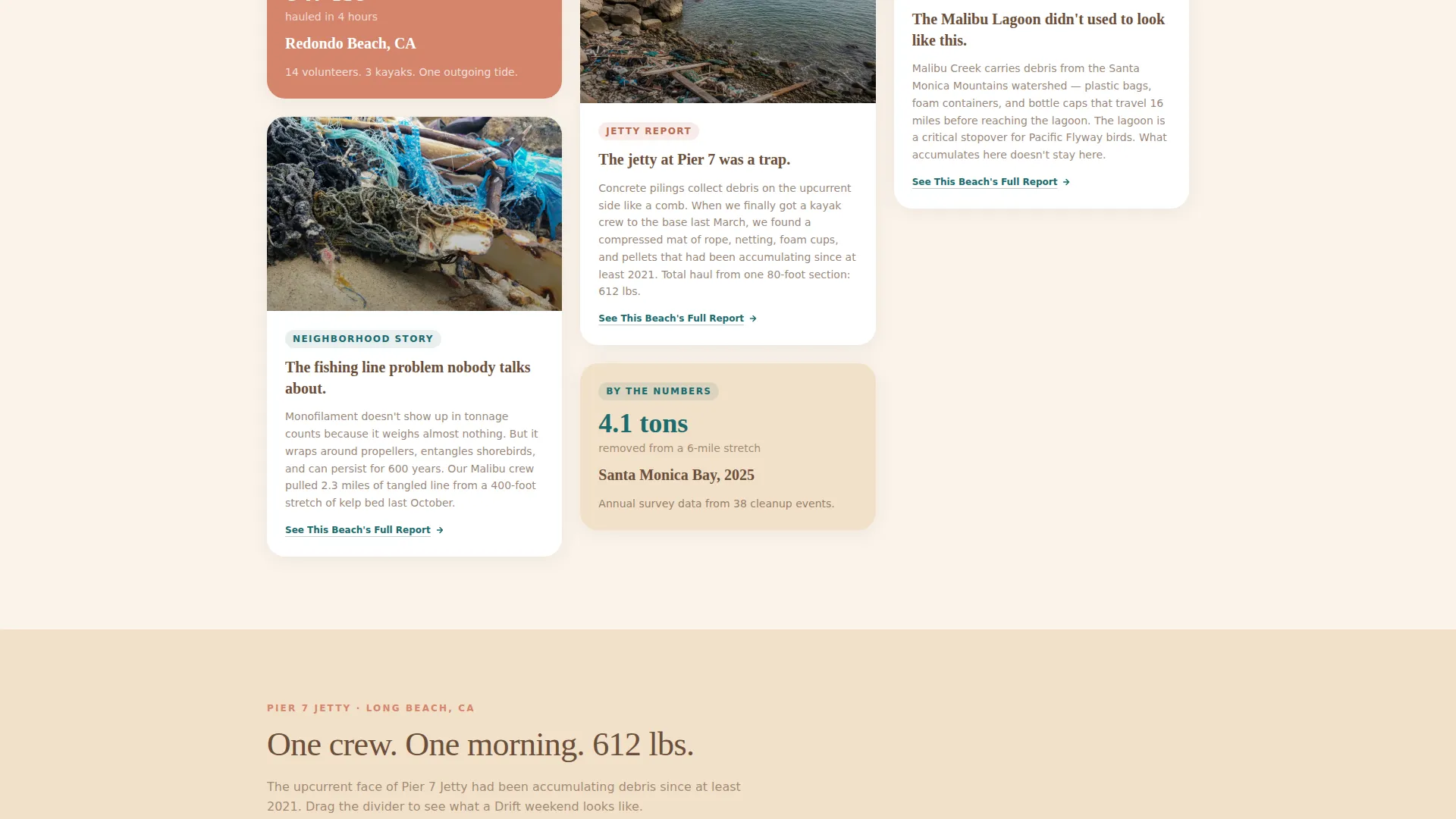
- A staggered masonry grid of hyperlocal debris story cards with hover states and secondary text links
- A before-and-after jetty section, a volunteer community section, a field identification guide, and a minimal footer
Feature list
A paragraph introduces the feature set before each item below.
Each feature in Drift is grounded in one design principle: the closer the story gets to the visitor's own coast, the more likely they are to act. Here are the core capabilities built into the template.
Full-Bleed Cinematic Hero
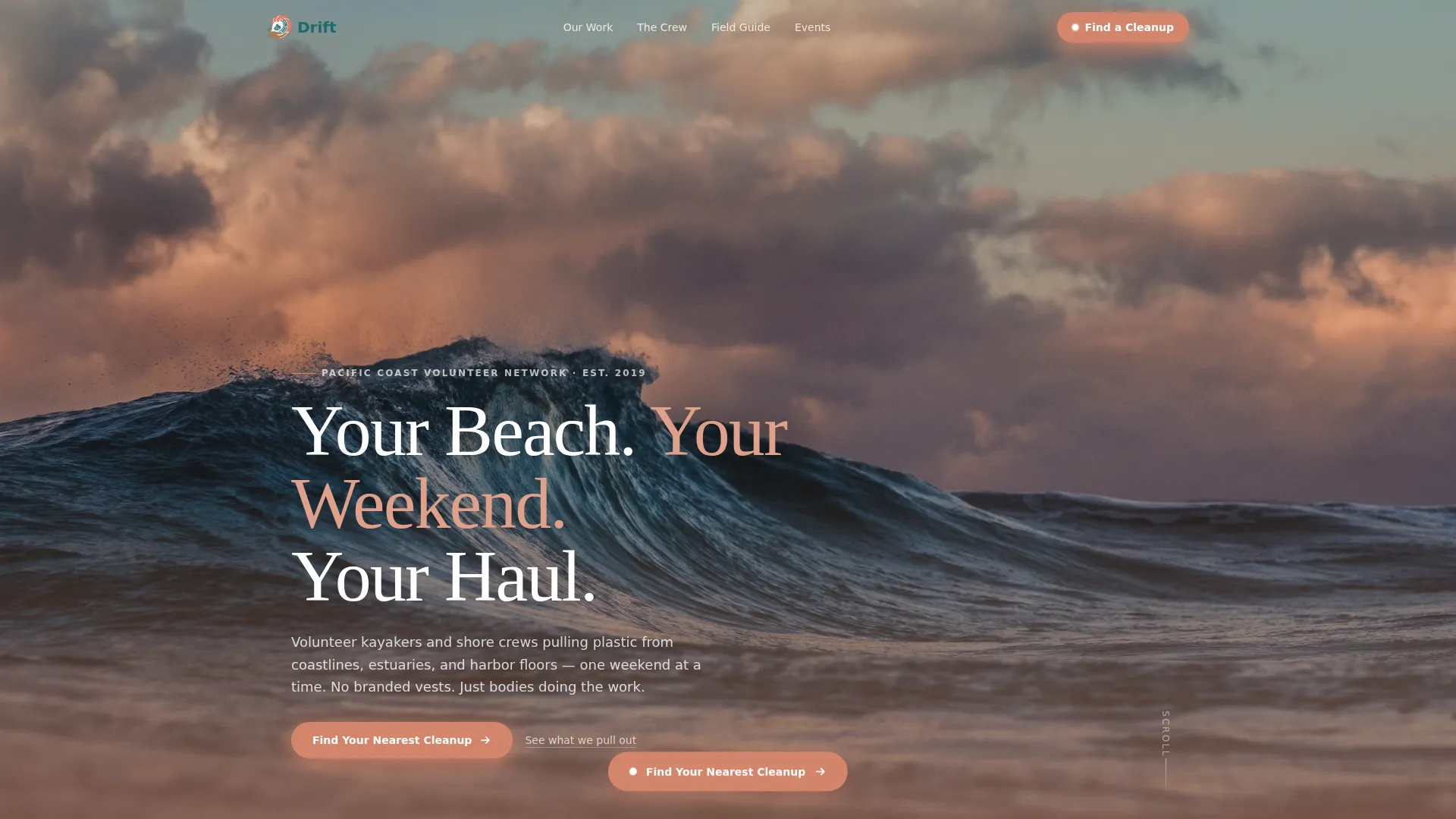
The header is a knee-height shoreline photograph at sunrise. It shows scattered fishing line, a half-buried water bottle, and three volunteers bent toward the wrack line. A single headline fades in over the image: "Your Beach. Your Weekend. Your Haul." Scroll-linked blur activates as the visitor moves down the page.
Staggered Masonry Card Grid
Cards are arranged in a masonry layout with staggered reveal animations triggered by scroll depth. Each card is a micro-lesson. One maps a drainage path from an inland storm drain to the harbor mouth. Another shows a before-and-after jetty with a tonnage counter. A third is a field identification guide for the five most common debris items pulled from that zip code's shoreline.
Before-and-After Jetty Section
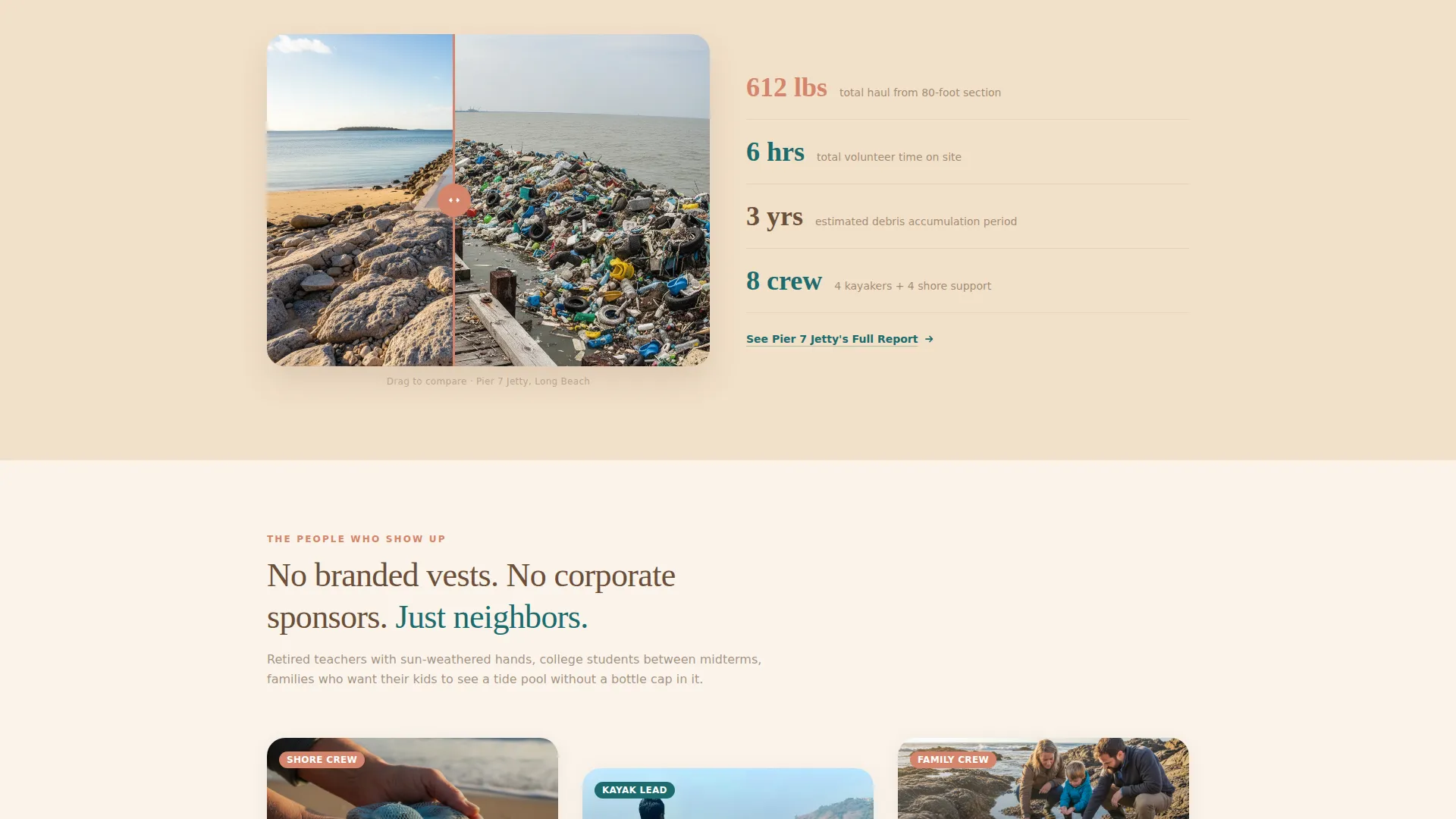
A dedicated section shows a local jetty transformation with a tonnage data callout. Visitors can toggle between the before and after states. The data callout is styled in deep saltwater teal to draw the eye and anchor the impact claim in something measurable.
Floating Call-to-Action Button
The primary call to action, "Find Your Nearest Cleanup," is a desert coral floating button. It appears only after the visitor scrolls past the third card row. This scroll-depth trigger ensures the button appears after the visitor has absorbed enough local evidence to feel personally implicated.
Volunteer Community Section
This section presents volunteer archetypes through authentic portrait-style layouts. No posed smiles or branded gear. The faces belong to retired teachers, college students, families, and dive shop regulars. The section reinforces trust through recognition rather than aspiration.
Field Identification Guide Cards
Five educational cards identify the most common debris types found at the target shoreline. Each card is styled as a micro field guide, consistent with the faded marine biology poster aesthetic. They teach while they recruit, giving first-time volunteers practical knowledge before they arrive.
Page sections overview
| Section | Purpose |
|---|---|
| Full-Bleed Hero | Sets cinematic scene, fades in headline |
| Masonry Story Grid | Delivers hyperlocal debris micro-lessons |
| Before-and-After Jetty | Shows measurable transformation with tonnage data |
| Volunteer Community | Humanizes the effort with authentic portraits |
| Field ID Guide | Teaches common debris types as educational cards |
| Minimal Footer | Closes page with horizontal pattern layout |
Design & branding system
The visual identity follows an Educational Guide theme built on a Desert Rose color system. Every color has a structural role. Nothing is decorative without also being purposeful.
- Sun-bleached coral (#D4856B) dominates card fills and hover states; dry dune sand (#F2E0C9) washes the background; deep saltwater teal (#1B6B6D) anchors headlines and data callouts
- Weathered driftwood brown (#6B4F3A) grounds body text so the layout reads as stable and legible
- Fraunces display serif drives headlines for warmth and weight; DM Sans handles body copy for clean readability at small sizes
Mobile & speed optimization
The template is built mobile-first. Volunteers check their phones on the beach, not at a desk. Every layout decision prioritizes the small-screen experience.
- The masonry grid reflows to a single column on mobile without losing card hierarchy or stagger timing
- Animations use native CSS scroll-behavior and IntersectionObserver reveals, with no third-party scroll library required
- The floating call-to-action button is thumb-accessible and remains pinned at a comfortable reach zone on smaller screens
How this template helps you convert
Drift earns the click. It does not demand it. The conversion path is built on proximity, not pressure.
- The masonry scroll narrows the story from regional coastline to a specific local drain, jetty, or zip code, so by the time the floating button appears, the visitor already feels like the beach belongs to them
- Secondary text links beneath each card ("See This Beach's Full Report") provide a lower-commitment next step for visitors who are not yet ready to sign up but are curious enough to keep reading
- The call-to-action button is withheld until scroll depth confirms engagement, which means it appears to a warm audience, not a cold one
Other information about this template
This template is built specifically for the ocean cleanup niche within the broader community and nonprofit category. It sits at the intersection of environmental conservation storytelling and volunteer mobilization design.
- Template style: Masonry layout with Pinterest-style card flow, staggered reveal animations, and variable card heights
- Creative direction: Local and neighborhood-focused, making global pollution problems feel street-level and personally relevant
- Header concept: Full-bleed photography with scroll-linked blur and a single fade-in headline, no illustrated or abstract header treatments
- Landing page direction: Click-through flow leading to an external event sign-up page, not an embedded form
- Color system: Desert Rose, a warm coastal palette that reads like a faded marine biology poster from a coastal nature center
- Suitable for organizations running events across US coastal geography, including both Pacific and Atlantic shoreline communities
Theme
Educational Guide
Creative direction
Local & Neighborhood
Color system
Desert Rose
Style
Masonry/Pinterest
Direction
Click-Through
Page Sections
Full-bleed Cinematic Hero Section
Hyperlocal Masonry Story Cards
Before-and-after Jetty Toggle
Scroll-depth Floating Call to Action Button
Volunteer Community Portrait Section
Field Identification Guide Cards
Related questions
What kind of organization is this template built for?
Does the template include a sign-up form?
Can I update the debris story cards with my own local data?
How does the floating call-to-action button work?
Is this template suitable for a one-time event or an ongoing program?