Dyeing & Finishing Mill Landing Page Template
Dyelot is a modular card-grid landing page built for precision dyeing and finishing mills. It uses an Engineering Blueprint visual theme to present each finishing capability as a technical data sheet. The layout drives lead generation through a "Send Your Spec" sticky footer form and a gated mill profile download, helping fabric buyers trust the mill before they ever make contact.
by Rocket studio
Quick summary
Dyelot is a single-page, card-grid layout designed for a precision textile finishing mill. It presents pad dyeing, stenter finishing, pigment printing, and other processes as individual spec-sheet cards. The page builds technical credibility card by card, then funnels visitors toward two clear actions: submitting a fabric specification or downloading a capability profile.
Who this template is for
This template is built for dyeing and finishing operations that need to communicate process capability to professional fabric buyers. It is most useful when your customers arrive already knowing what they need and simply need proof that your plant can deliver it.
- Garment manufacturers sourcing consistent Pantone matches across long fabric runs
- Home textile exporters requiring certified colorfastness for international buyer audits
- Technical fabric converters specifying functional finishes against fixed contract deadlines
What problem this template solves
Most finishing mills rely on PDF brochures or trade-fair conversations to explain what they do. A generic website rarely communicates the precision, certifications, and lead-time reality that industrial buyers need before they consolidate an order. This template solves that gap directly.
- Buyers leave without submitting a spec because the page gives no structured path to do so
- Process capabilities are listed as text rather than shown as comparable, scannable data
- Certification credibility is buried in footnotes instead of front-loaded at the top of the page
What you get with this template
You get a complete, ready-to-customize single-page layout that communicates finishing mill capability with the visual authority of a printed spec sheet. Every section is structured around the way industrial fabric buyers actually evaluate a supplier.
- A scrolling logo bar header that places certifications and buyer crests at the very top of the page
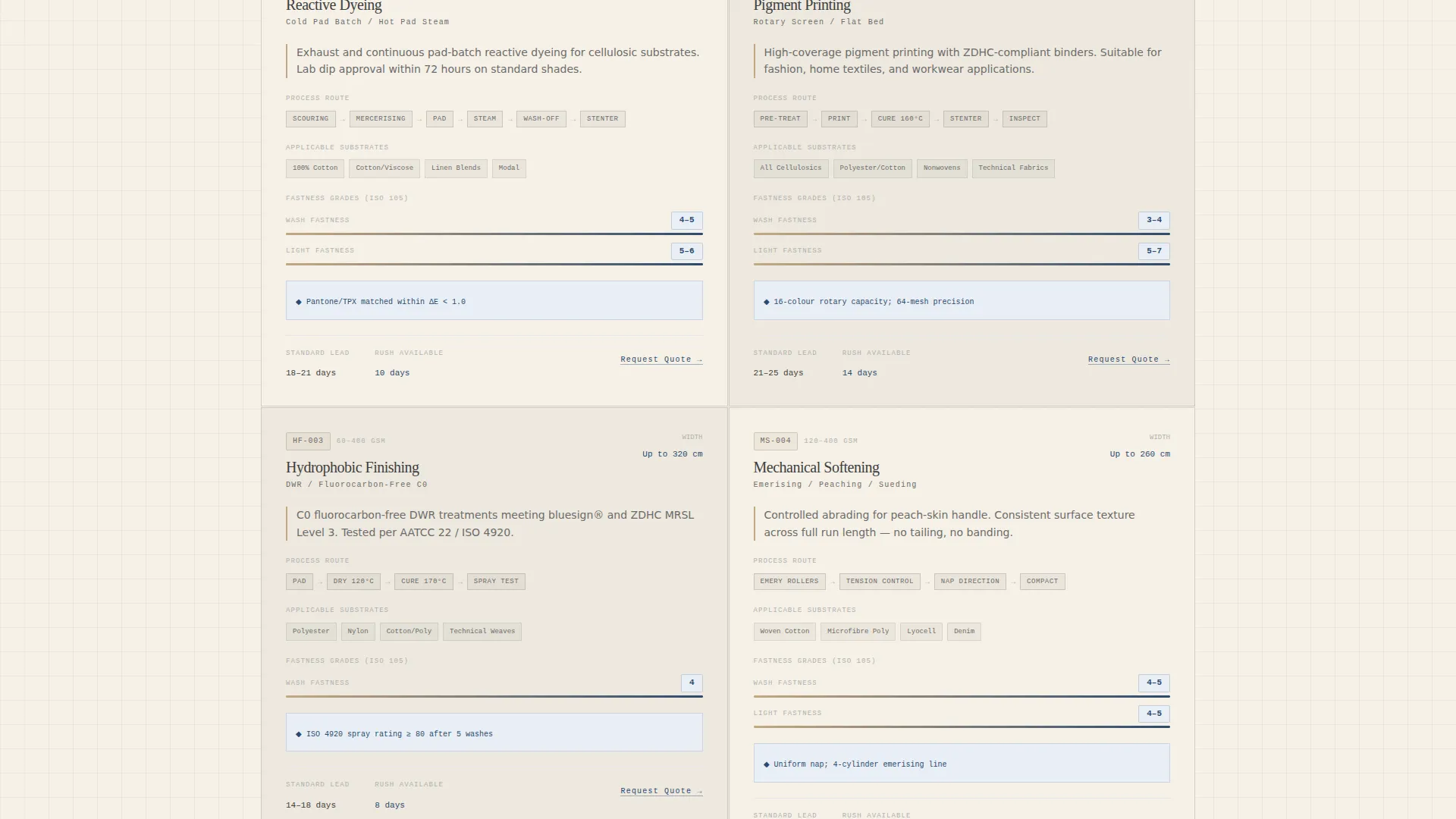
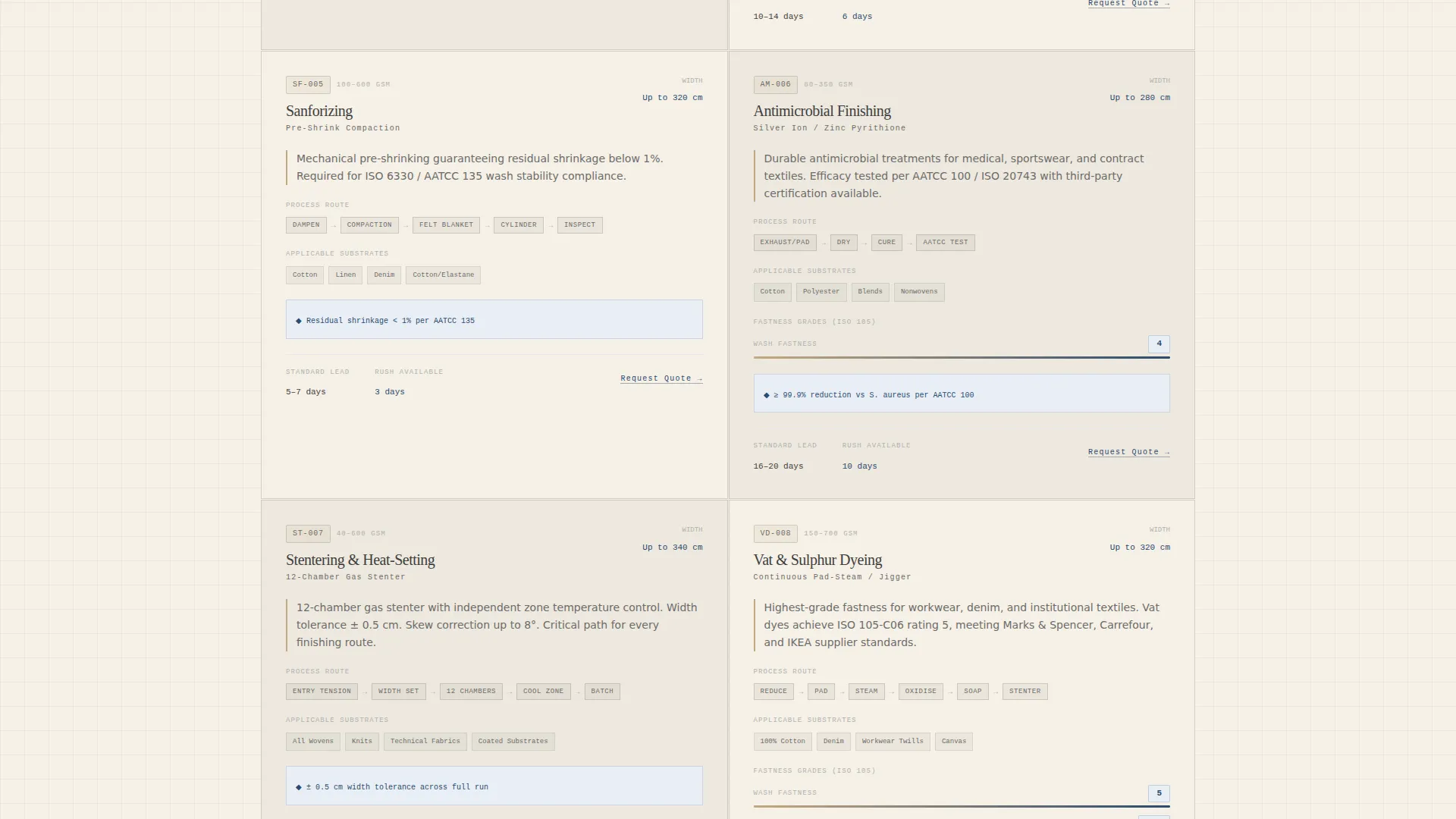
- A modular process card grid where each card presents one finishing capability in full technical detail
- A sticky footer lead form and a gated PDF download path for two distinct buyer conversion flows
Feature list
This template includes the following built-in design and layout capabilities.
Scrolling Certification Logo Bar
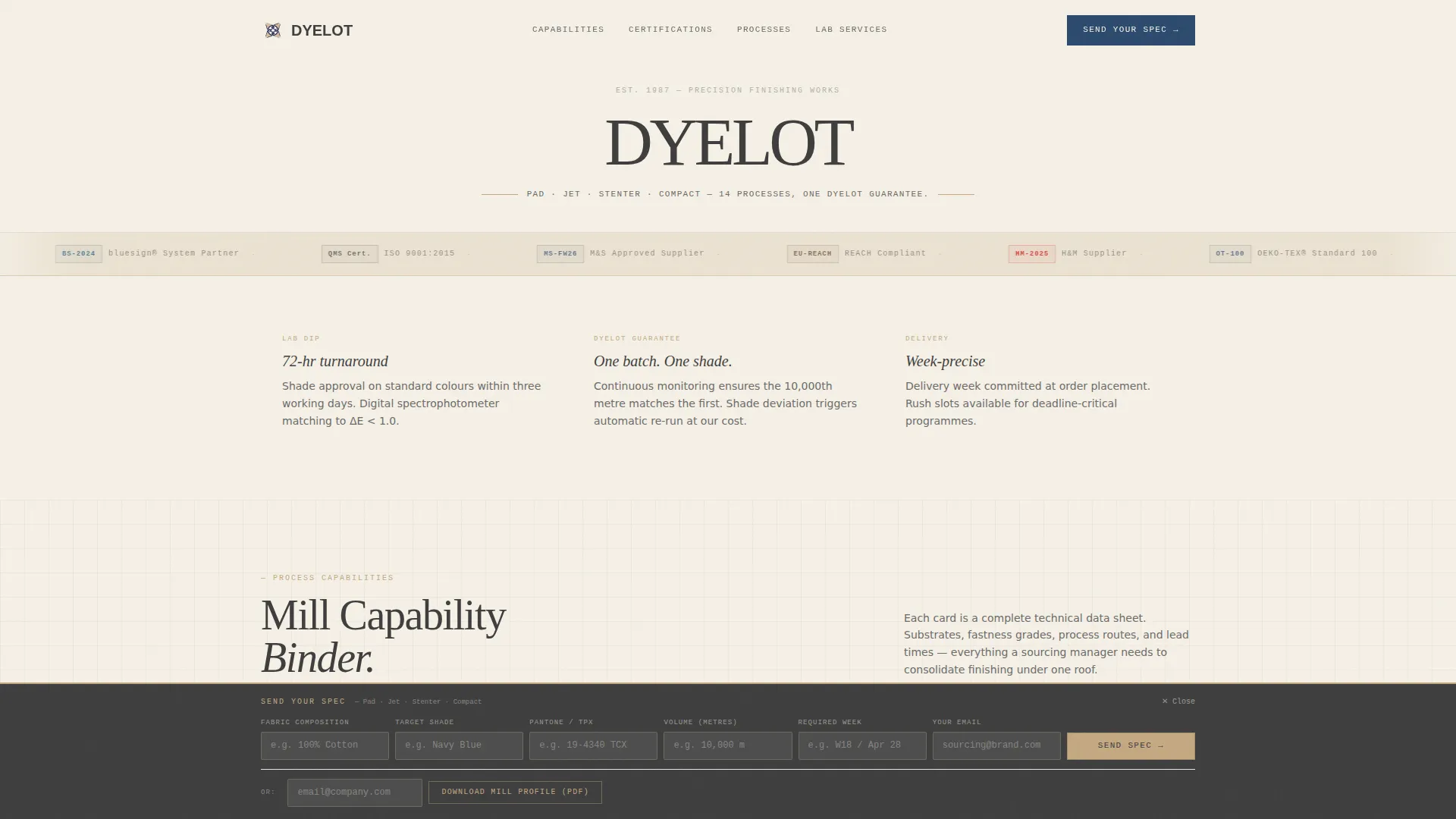
The header is a horizontal ribbon that scrolls slowly across a sandstone band. Client logos and certification marks share the space with the mill's own centered, static mark. No hero image competes for attention. The logos establish credibility before the visitor reads a single word of body copy.
Modular Finishing Process Card Grid
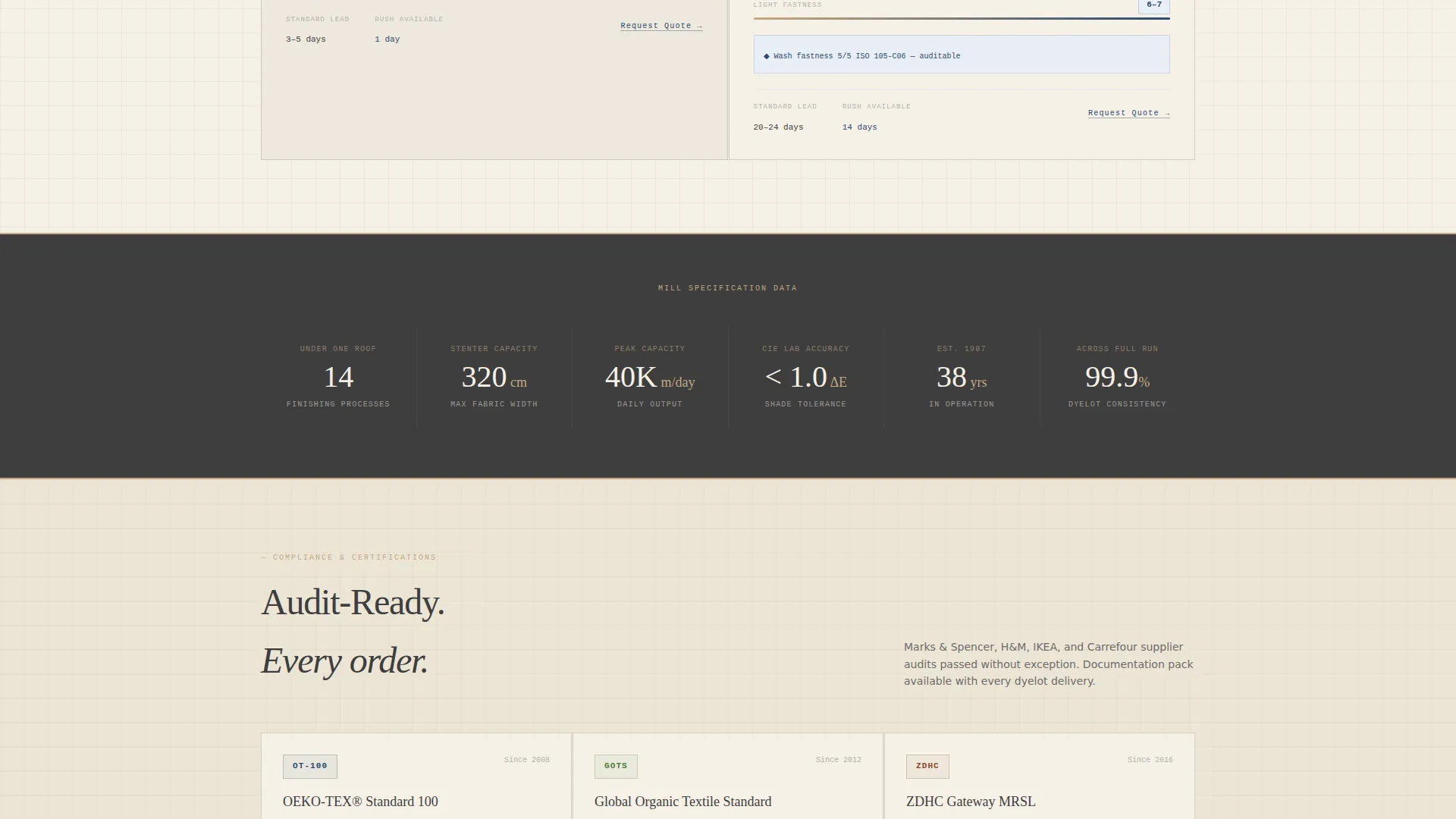
Each card in the grid represents one finishing capability: reactive dyeing, pigment printing, mechanical softening, hydrophobic coating, sanforizing, and others. Cards open like technical data sheets, showing a process diagram, applicable substrates, achievable fastness grades, and both standard and rush lead times. Card backgrounds alternate between ecru and sandstone in a checkerboard pattern that keeps the grid readable without feeling clinical.
Sticky Footer Lead Generation Form
A compact form is anchored in a sticky footer bar visible throughout the page. It collects fabric composition, target shade with an optional Pantone or TPX field, order volume in metres, and required delivery week. The form is positioned so that by the time a visitor has reviewed the process cards, submitting a spec feels like the natural next step.
Gated Mill Profile Download
A secondary conversion path labeled "Download Mill Profile" gates a PDF capability deck behind an email field. This path serves buyers who are early in their evaluation and prefer to review full specifications offline before committing to a direct inquiry.
Spec Sheet Typography System
Monospaced type is used wherever data appears: GSM values, fastness ratings, lead times, and process parameters. This typographic choice gives every technical figure the visual authority of a printed test certificate, reinforcing that the numbers on screen are real production specifications, not marketing estimates.
Engineering Blueprint Color System
The Warm Stone palette uses four defined values: kiln-fired sandstone, undyed cotton ecru, machine-cast iron, and a single reactive-dye indigo reserved for links, active states, and specification highlights. Card borders use fine iron-gray rules. Section backgrounds alternate between ecru and sandstone so the layout breathes without losing its technical character.
Page sections overview
| Section | Purpose |
|---|---|
| Certification Logo Bar | Establishes mill credibility instantly via scrolling certification and buyer logos |
| Tagline Rule Line | Sets process scope with a single mono-type line listing all fourteen finishing steps |
| Process Card Grid | Presents each finishing capability as an individual, scannable technical data sheet |
| Sticky Footer Form | Captures lead data with a structured spec-submission form anchored to the page bottom |
| Mill Profile Download | Offers a secondary conversion path gating a PDF capability deck behind an email field |
Design & branding system
The template uses an Engineering Blueprint theme built on the Warm Stone color system. The palette is intentionally neutral so that fabric color samples, process diagrams, and fastness data remain the visual focus. Every color has a defined role and is not used interchangeably.
- Kiln-fired sandstone (#C4A882) and undyed cotton ecru (#F5F0E6) alternate as section and card backgrounds
- Machine-cast iron (#3E3E3E) handles body text and card border rules; reactive-dye indigo (#2C4A6E) is reserved strictly for links, active states, and specification highlights
- Monospaced typography appears wherever numeric data is displayed, lending test-certificate authority to every measurement shown on the page
Mobile & speed optimization
The card grid is built on a modular structure that reflows cleanly across screen widths. The sticky footer form remains accessible on smaller screens so visitors can submit a specification without scrolling back to a dedicated section.
- Cards stack vertically on narrow viewports while maintaining their checkerboard background alternation
- The scrolling logo bar adjusts its scroll speed and tile count to remain legible on mobile screen widths
- Form fields in the sticky footer are sized for comfortable touch input on phones and tablets
How this template helps you convert
The page is structured as a deliberate progression from credibility to detail to action, mirroring the way a professional buyer evaluates a new supplier.
- The logo bar at the top front-loads certification and buyer credibility so visitors immediately know the mill meets industry standards, reducing early drop-off before the content loads.
- The process card grid builds trust card by card, giving buyers the exact technical detail they need to decide whether this mill can match their specification, so the lead form at the bottom feels like a logical next step rather than a cold ask.
Other information about this template
This template is part of the Manufacturing and Industrial category, sitting within the Textile and Garment Factory subcategory with a specific focus on the dyeing and finishing niche. It was designed to reflect the real workflow and vocabulary of a finishing plant, from greige cloth intake through hand-approved final output.
- The template style is Card Grid (Modular), making it straightforward to add or remove process cards as a mill's capability set changes
- The creative direction is Spec Sheet, meaning visual design choices consistently reinforce technical authority rather than lifestyle imagery
- The lead generation direction supports two distinct buyer journeys: a direct spec submission for buyers ready to place an order, and a profile download for buyers still in the evaluation phase
Theme
Engineering Blueprint
Creative direction
Spec Sheet
Color system
Warm Stone
Style
Card Grid (Modular)
Direction
Lead Generation
Page Sections
Scrolling Certification Logo Bar
Modular Finishing Process Card Grid
Sticky Footer Lead Form
Gated Mill Profile Download
Spec Sheet Monospaced Typography
Engineering Blueprint Color System
Related questions
Can I add or remove process cards from the grid?
What information does the 'Send Your Spec' form collect?
Is the mill profile download separate from the main lead form?
How does the certification logo bar work?
Who is this template designed for?