Supportive Parenting Network Landing Page Template
Cradle is a single-column flow landing page template built for infant social communities serving new parents with babies aged 0 to 12 months. It pairs a nine-square Photo Grid Mosaic header with a Day-in-the-Life scroll structure, a botanical color palette, and a streamlined booking form so families can reserve a free virtual Welcome Circle meetup in seconds.
by Rocket studio
Quick summary
Cradle is a warm, editorial landing page template designed for new-parent communities centered on infants from birth through twelve months. It leads with a candid photo mosaic, carries visitors through a 24-hour parenting arc, and ends at a minimal reservation form. Every design choice serves one goal: helping exhausted parents feel seen before they are ever asked to sign up.
Who this template is for
Cradle is built for anyone launching or growing an infant social community, parenting support program, or early childhood resource hub. If your site serves the people who are awake at 2 a.m. wondering whether the feeding schedule is normal, this template speaks their language.
- First-time mothers in the postpartum window (0 to 12 months) who are craving non-judgmental support and practical community resources.
- Stay-at-home dads and non-traditional caregivers who need weekday playdate partners and a judgment-free place to talk through early childhood parenting moments.
- Grandparents raising grandchildren who want modern guidance, education, and access to support services without feeling out of place.
What problem this template solves
New parents face a specific kind of loneliness. They are surrounded by a baby who needs everything and by a world that assumes parenting advice is easy to find. It is not. Most website designs for parenting communities treat parents like general web users: menus everywhere, long sign-up forms, and a homepage that could belong to any industry. Cradle solves that by building emotional recognition before the call to action ever appears.
A landing page for a new parent nurturing community must prioritize trust, empathy, and simplicity. This template is designed around that principle from the first pixel. The photo mosaic does not use polished stock photography. The scroll does not feel like a feature tour. The reservation form does not ask for more than three fields. Every element removes a common obstacle that causes parents to close the tab.
- Emotional mismatch between clinical, generic web design and the raw reality families experience in the first year is addressed by the Nurture & Care visual theme and the Day-in-the-Life scroll arc.
- Form friction that discourages sign-ups is reduced by keeping the interest form to first name, baby's age (a slider from 0 to 12 months), and preferred session time only.
- Commitment anxiety among first-time visitors is handled by a secondary path that lets users browse this week's topics before choosing to reserve a spot.
What you get with this template
Cradle delivers a complete, ready-to-customize single-column landing page. Every section, visual system, and interactive component described below is included in the template. You do not need to source separate design assets or build the layout logic from scratch. Families creating a community website can be up and running in a fraction of the time it would take to begin from a blank canvas.
- A structured five-section page flow covering the hero mosaic, the 24-hour Day-in-the-Life arc, a community features bento grid, a testimonial slider, and the Welcome Circle reservation form with footer.
- A complete botanical design system built on sage, linen, eucalyptus, and dried rose, paired with Fraunces serif headlines and DM Sans body text for every layout context.
- Interactive components including a testimonial slider, a baby age slider (0 to 12 months), a session time picker, and sticky navigation, all built with native CSS smooth scroll and no heavy external libraries.
Feature list
Cradle includes a focused set of features grounded in the brief. Each one serves the emotional and functional needs of the parents who will visit the page.
Nine-Square Photo Grid Mosaic Hero
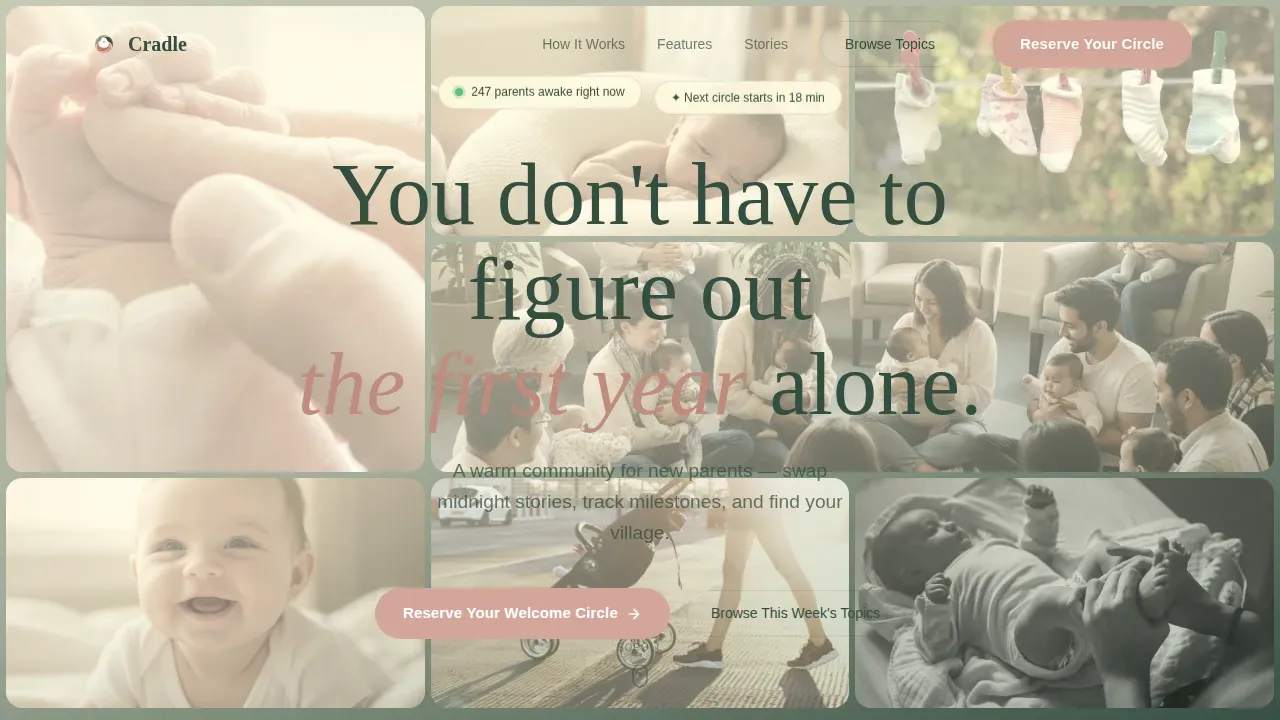
The hero section fills the entire viewport with nine soft-edged photo squares. Each square holds a candid, warm-toned image: a tiny fist around an adult finger, a onesie drying on a line, a parent asleep on a nursing pillow with a baby on their chest. The images are styled to look like real phone camera roll photos, not polished stock. A translucent linen overlay carries a single centered headline: "You don't have to figure out the first year alone." This is the emotional handshake that makes parents stop scrolling and start reading.
Day-in-the-Life 24-Hour Scroll Arc
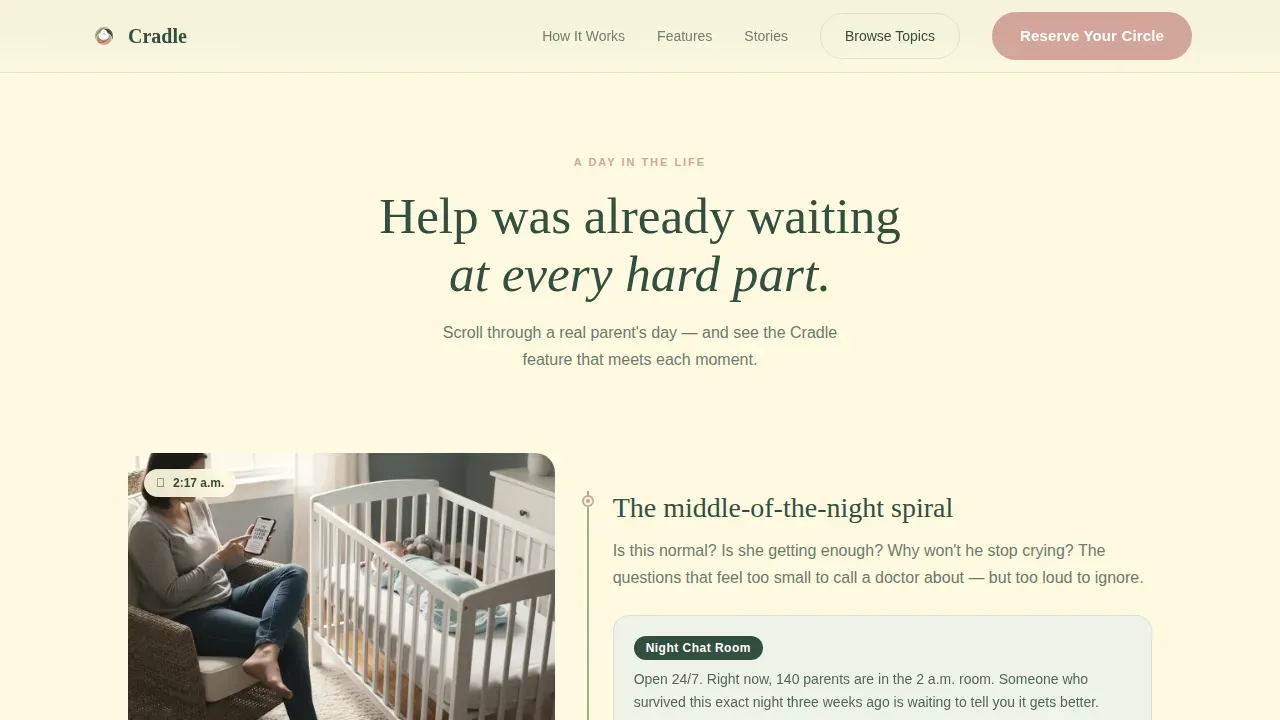
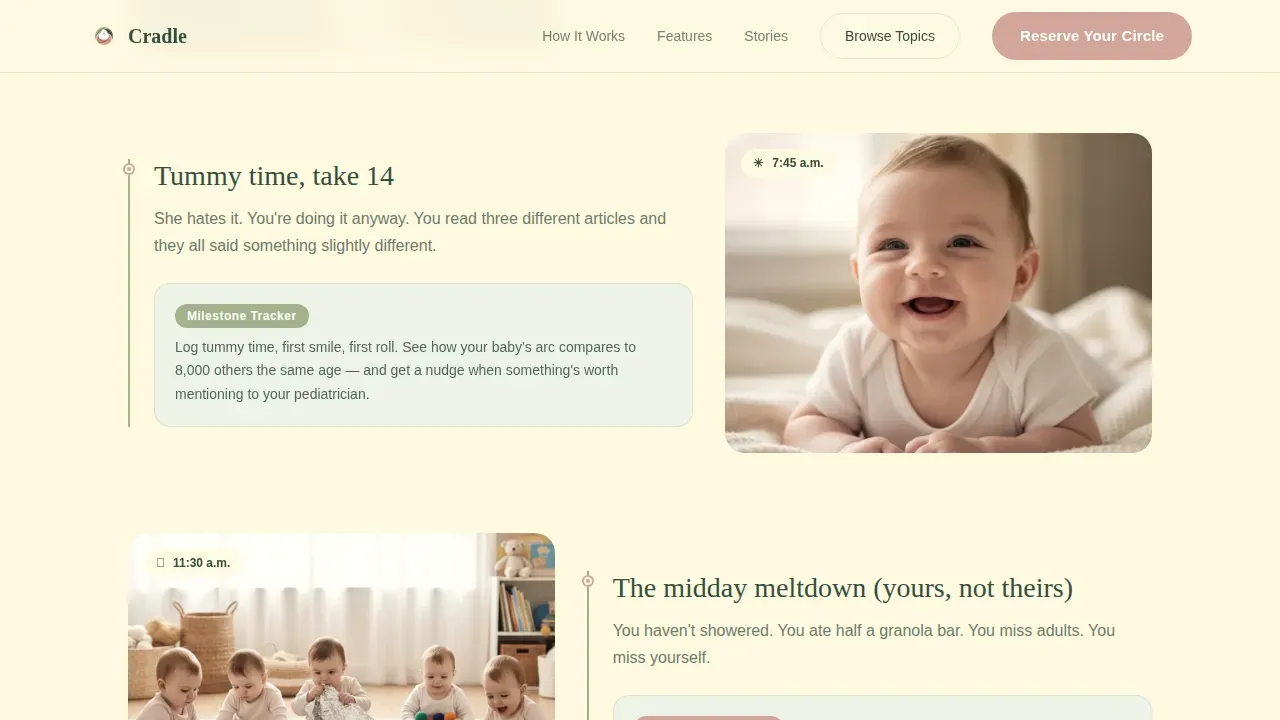
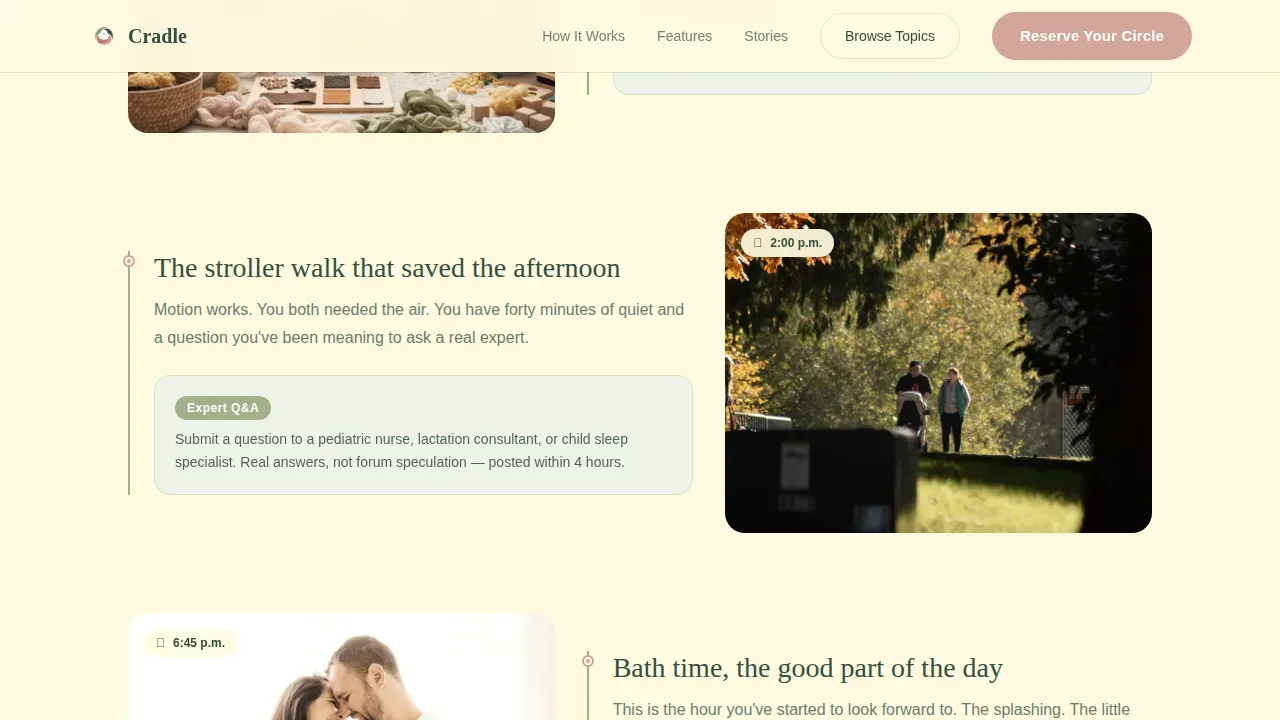
This is the structural heart of the template. The scroll carries the visitor through six moments in a real parent's day: the dawn feeding, morning tummy time, midday meltdown, afternoon stroller walk, evening bath, and midnight wake-up. Each moment is paired with a community feature that meets parents right there. The 2 a.m. live chat room appears at the midnight panel. The milestone tracker surfaces during the tummy time section. The local meetup finder appears alongside the stroller walk. The expert Q&A connects to the midday moment. The scroll does not feel like a feature list. It feels like a day parents recognize, with help already waiting.
Community Features Bento Grid
Following the Day-in-the-Life arc, the template presents four community features in a bento-style grid layout. The grid highlights the night chat room, the baby milestone tracker, the local meetup finder, and the curated expert Q&A. Each cell is visually distinct and easy to scan at a glance. Parents who visit the page on a phone can tap into any feature cell with a single thumb press.
Three-Archetype Testimonial Slider
Social proof in Cradle comes from a testimonial slider styled to the Template 2 pattern. Three member archetypes are represented: a first-time mother, a stay-at-home dad, and a grandparent raising a grandchild. Rotating between real-sounding voices builds trust quickly. Authentic testimonials from real parents build trust and foster a sense of community, and the slider format keeps this content compact without burying it.
Welcome Circle Reservation Form
The primary conversion point is the Welcome Circle reservation form. It asks for only three fields: first name, baby's age in months via a friendly slider from 0 to 12, and preferred session time (morning, afternoon, or evening). Visitors who fill out this interest form are taken to a calendar picker for the next free virtual new-parent meetup. A minimalist sign-up form with only essential fields reduces friction and increases the chance that parents actually submit. A secondary call to action, "Browse This Week's Topics," gives hesitant visitors a lower-commitment entry point so they can participate at their own pace.
Sticky Navigation and Scroll Animations
The template includes a sticky navigation bar that stays accessible as parents scroll through the full page. Scroll-triggered reveal animations are built using IntersectionObserver with a staggered timing pattern. The hero section uses a heroFade mosaic animation on load. These animation and navigation features are built with native CSS, keeping the site performant without importing heavy animation libraries.
Page sections overview
| Section | Purpose |
|---|---|
| Hero Mosaic Grid | Opens with nine candid photo squares and a centered empathic headline to create immediate emotional recognition |
| Day-in-the-Life Arc | Walks visitors through six timestamped parenting moments, each paired with a community feature |
| Community Features Grid | Presents the four core platform features (night chat, milestone tracker, meetup finder, expert Q&A) in a bento layout |
| Testimonial Slider | Rotates three member-archetype quotes to build trust through authentic social proof |
| Welcome Circle Form | Hosts the three-field interest form and calendar booking link for the free virtual meetup |
| Linear Footer | Repeats the primary call to action and provides contact information in a single-row layout |
Design & branding system
Cradle follows a Nurture & Care theme expressed through a botanical color system. The palette is drawn from nature: a nursery windowsill lined with small terra cotta pots, unhurried and alive. Typography reinforces warmth and clarity at every text size.
- Color roles: Soft sage (#A3B18A) washes section backgrounds. Warm linen (#FEFAE0) holds the primary canvas. Deep eucalyptus (#344E41) anchors all headlines and navigation. Dried rose (#D4A59A) is reserved exclusively for buttons and interactive moments, making every tappable element easy to find.
- Typography pairing: Fraunces, a variable serif with optical warmth, is used for all display headlines. DM Sans handles body copy and user interface elements for maximum legibility at small sizes. Together they give the site a warm editorial personality without sacrificing readability.
- Visual style: Photo assets are warm-toned, slightly desaturated, and shot in natural window light. No stock polish. Images read like pulls from a real parent's camera roll, which is what makes them land emotionally.
Mobile & speed optimization
Cradle is designed mobile-first because the primary users of a new-parent community are parents with one hand holding a baby and one thumb on a phone screen. Every layout decision starts at small viewport widths and expands outward. The interaction components are tuned for single-thumb use.
- Touch-first components: The baby age slider, session time picker, testimonial slider, and all call-to-action buttons are sized and spaced for comfortable thumb access on any phone screen.
- Lightweight animation approach: Scroll reveals use native IntersectionObserver rather than third-party animation libraries. Smooth scroll is handled with native CSS. The site avoids importing large JavaScript bundles that would slow first load on mobile connections.
- Responsive layout: The single-column flow template reflows cleanly across phone, tablet, and desktop widths. The bento grid and photo mosaic both adapt to narrower screens without losing visual impact.
How this template helps you convert
Cradle is not a generic landing page that happens to mention parenting. It is a page architecture designed around how parents make decisions when they are tired, skeptical, and pressed for time. The conversion strategy is layered into the scroll experience itself.
- Emotional recognition before the ask: The photo mosaic and Day-in-the-Life arc create multiple moments where a visitor thinks "that is exactly my life." By the time the Welcome Circle reservation form appears, the parent already feels understood. Empathic design earns trust faster than any promotional headline could. The page makes visitors feel seen first, then makes the ask.
- Minimal commitment, maximum clarity: The interest form requires only three fields. The calendar picker is connected directly to the next available free session. Users who are not ready to reserve can explore this week's topic board instead. Two paths forward decrease drop-off by matching the visitor's actual readiness level, whether they are excited to sign up or just beginning to look.
- Action-oriented language at every touchpoint: The primary call to action, "Reserve Your Welcome Circle," is welcoming and specific. The secondary path, "Browse This Week's Topics," gives curious parents a way to participate without full commitment. The footer repeats the primary call to action so visitors who scroll to the bottom still have a clear next step in front of them.
Other information about this template
Cradle sits within the Infant (0 to 1) Social Community niche inside the broader Kids & Family category. It is part of a template library built on a Single Column Flow structure, making it a practical choice for any organization or independent team that wants to create a focused, distraction-free site without building from scratch. Several real-world programs and context points are relevant for teams evaluating this template.
- The Cradle, a well-known adoption and family support organization, has built nurturing families and provided lifelong support to people whose lives have been touched by adoption. Open adoption allows birth parents to maintain a relationship with their child and the adoptive family. Adoption can be a positive experience for both birth parents and adoptive families when supported by a good agency. The Cradle provides counseling and support for birth parents throughout the adoption process, and many families who adopt through The Cradle maintain ongoing relationships with their child's birth parents. The Cradle also offers post-adoption support to help families navigate the complexities of adoption and emphasizes open communication about adoption within families. Adoption stories often highlight the emotional journeys of both birth parents and adoptive families, and The Cradle has a mutual consent registry that helps connect adoptees with their birth families. Adoption can provide a sense of belonging and identity for adoptees as they grow older.
- Exousia Ministries collaborates with 40 Indiana church congregations to launch the Caring Cradle program, which provides parenting education and resources for families. The Caring Cradle Initiative aims to empower congregations to create nurturing communities for expectant parents, infants, and toddlers across Indiana. Participating churches receive $9,500 in funding over two years to purchase infant and toddler products. The program includes the Partners for a Healthy Baby curriculum, designed to support the physical, social-emotional, and cognitive development of children.
- Stamford Cradle to Career offers a New Parent Resource Bundle Package that provides families with free resources available throughout the city. St. Joseph's Parenting Center equips parents with education and tools to foster healthy parenting patterns and decrease child abuse and neglect. The Healthy Savings card provides families with $10 every week to spend on fresh fruits and vegetables at participating stores.
- Website builders can help new parents create their sites in just a few hours using templates designed for their specific needs. Templates for parents-to-be websites can have sections for parenting tips, pregnancy calendars, and community forums. Templates can include features like online appointment booking for prenatal classes and integration with social media. The use of templates can help new parents quickly establish an online presence to connect with other parents and share experiences.
- This template can serve a wide range of community plans: prenatal support groups, postnatal meetup programs, grandparent-led playgroups, and any organization that wants to address the maternal and early childhood wellness needs of local families. Teams excited to launch a new parent community site will find the cradle nurturing new parent community landing page template a practical and emotionally resonant foundation to begin from.
Theme
Nurture & Care
Creative direction
Day-in-the-Life
Color system
Botanical
Style
Single Column Flow
Direction
Booking/Scheduling
Page Sections
Nine-square Photo Grid Mosaic Header
Day-in-the-life 24-hour Scroll Arc
Community Features Bento Grid
Three-archetype Testimonial Slider
Welcome Circle Reservation Form
Sticky Navigation and Scroll Animations
Related questions
Can I customize the color palette and typography?
How does the Welcome Circle reservation form work?
Is this template suitable for programs that also serve pregnant parents?
What makes this different from a general community landing page template?
Does the template support mobile users browsing with one hand?