Human Services Government Professional Website Template
The Mandate Community Hearth Human Services Federal Agency landing page template is a single-column flow built for federal human services work. It opens with a bold, serifed headline, moves through three data-anchored mission pillars, and closes with a dual lead-generation form. The design uses deep graphite, warm concrete, and an ember accent to project institutional authority with genuine human warmth.
by Rocket studio
Quick summary
The Mandate template is purpose-built for a human services federal agency that needs to earn trust before it asks for anything. It moves visitors through a declaration-evidence-proof rhythm, surfacing real outcome data at billboard scale, then anchors the page with a consultation form and an email subscribe path. The visual system feels like institutional architecture softened by a single lamp on the reception desk.
Who this template is for
This landing page is designed for professionals who work at the intersection of federal policy and ground-level service delivery. They are not casual browsers. They arrive with a specific problem and limited patience for vague language. The template speaks directly to that mindset by leading with outcomes, plain language, and clear next steps.
- State program administrators tracking grant compliance deadlines and interagency coordination
- Nonprofit directors seeking partnership frameworks for housing stability, mental health, or child welfare initiatives
- Congressional staffers and tribal liaisons researching benefit delivery, public health service reach, or opioid response coordination
What problem this template solves
Federal human services agencies often look the way bureaucracy feels: dense, cold, and hard to navigate. A web page that reflects those qualities turns away the very partners an agency needs. State administrators want to know whether an agency delivers. Nonprofit directors want to know whether a partnership is worth pursuing. Neither group has time for institutional hedging.
This template solves three specific presentation problems:
- It replaces vague mission language with data declarations that carry policy-document gravity, giving visitors something concrete to act on
- It gives medically vulnerable populations and their advocates a landing page that communicates urgency and competence without clinical distance
- It provides a structured lead-generation path that works for visitors at different readiness levels, a consultation form for those ready to engage and an email subscribe option for those who need more time
What you get with this template
You get a fully structured, single-column flow landing page designed specifically for human services federal agency context. Every section is sequenced to build trust before asking for a commitment. The design system, the typography choices, and the section order all serve one goal: convert a skeptical professional into an engaged partner.
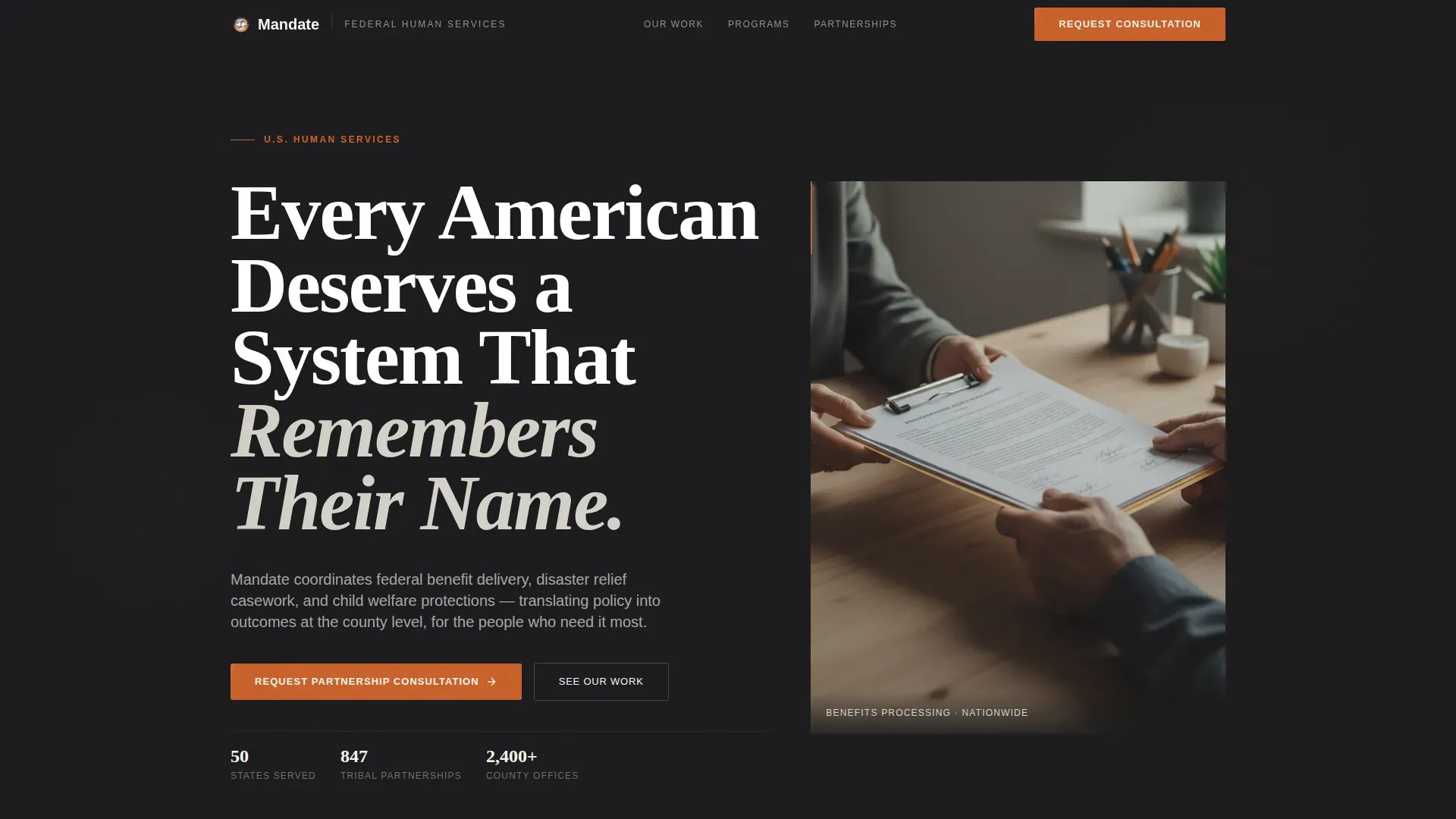
- A hero section with a giant serif headline, left-aligned layout, and a vertical photograph slot for an authentic caseworker image
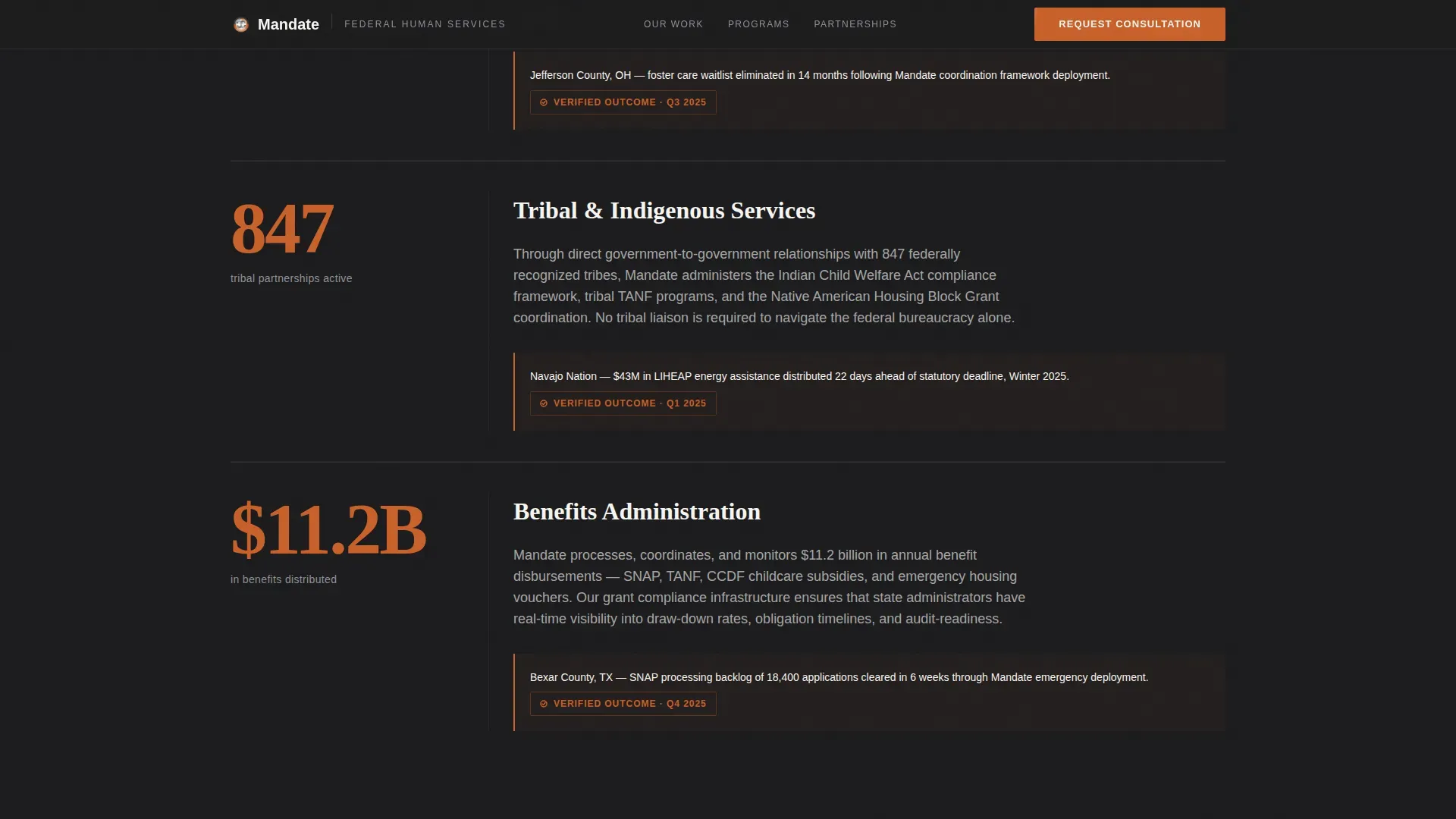
- Three mission pillar blocks, each anchored by a large ember-accented data point and followed by a narrative paragraph and a named real-world outcome
- A dual lead-generation anchor with a multi-field consultation form and a single-field email subscribe path
Feature list
This section covers the core built-in capabilities that make the Mandate template useful for health and human services agencies and their partners.
Giant Headline Left Hero Section
The hero opens with massive, serifed white type set against deep graphite. The headline occupies roughly sixty percent of the viewport width and is left-aligned with generous line spacing. To the right sits a vertical photograph slot sized for an authentic, unstaged image. The layout communicates authority and humanity without resorting to stock photography conventions. This is a strong first impression for visitors arriving from press releases, public affairs outreach, or external affairs referrals.
Ember-Accented Mission Pillar Blocks
Three stacked mission pillars each open with a single data point rendered in the ember accent color at billboard scale. The data point anchors a short narrative paragraph that provides context, and each pillar closes with a named proof statement such as a county, a restored program, or an eliminated waitlist. The rhythm of declaration, evidence, and proof repeats three times, building compounding trust. This structure is well suited to conveying public health outcomes, medicaid services reach, or child welfare impact without overstating or hedging.
Asymmetric Bento Grid Program Area Section
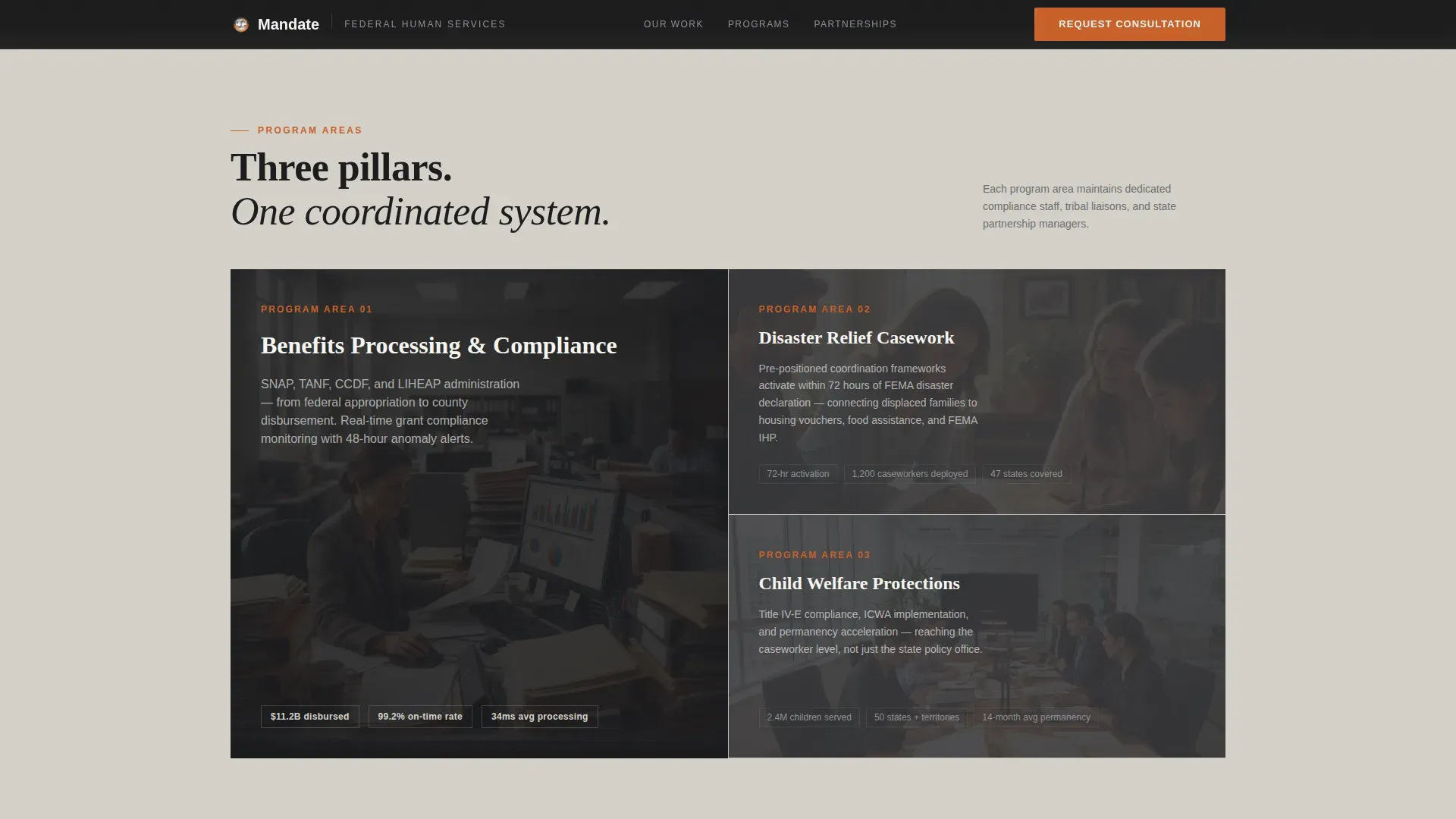
The program area section uses an asymmetric bento grid layout to present three core service domains: benefit application processing, disaster relief casework coordination, and child welfare protections. Each cell carries its own visual weight and can house a brief description of services, health outcomes data, or community living impact statements. The grid avoids the flat uniformity of equal-column layouts and gives each program area the visual breathing room it deserves.
Partnership Framework Split Layout
A dedicated split-layout section accommodates logos, affiliation marks, and framework descriptions for partner organizations. This section is designed for human services agencies that maintain formal relationships with local government bodies, tribal partners, nonprofit coalitions, and other partners across the public health service ecosystem. The layout separates visual credentials from explanatory copy, making it easy to scan and easy to trust.
Dual Lead Generation Form Anchor
The consultation form collects organization name, respondent role via a dropdown with options including state administrator, tribal liaison, nonprofit director, and congressional office, and a single open field asking what challenge the visitor is trying to solve. Alongside it, a secondary email subscribe field captures visitors not yet ready to commit to a full consultation. Form validation is built into the interaction layer. The form appears once after the mission pillars and again as the footer anchor.
Scroll-Triggered Animation and Counter System
The template includes medium-intensity scroll-triggered reveals and staggered data counter animations. As a visitor scrolls into the mission pillar section, the large ember-accented figures animate upward to their final values. Subtle parallax motion applies to background layers. The animation pacing is deliberate and does not compete with the content. It reinforces the sense that data is being surfaced in real time rather than presented as a static claim.
Page sections overview
| Section | Purpose |
|---|---|
| Hero Headline Left | Establish authority and humanity with a large serif headline and vertical image |
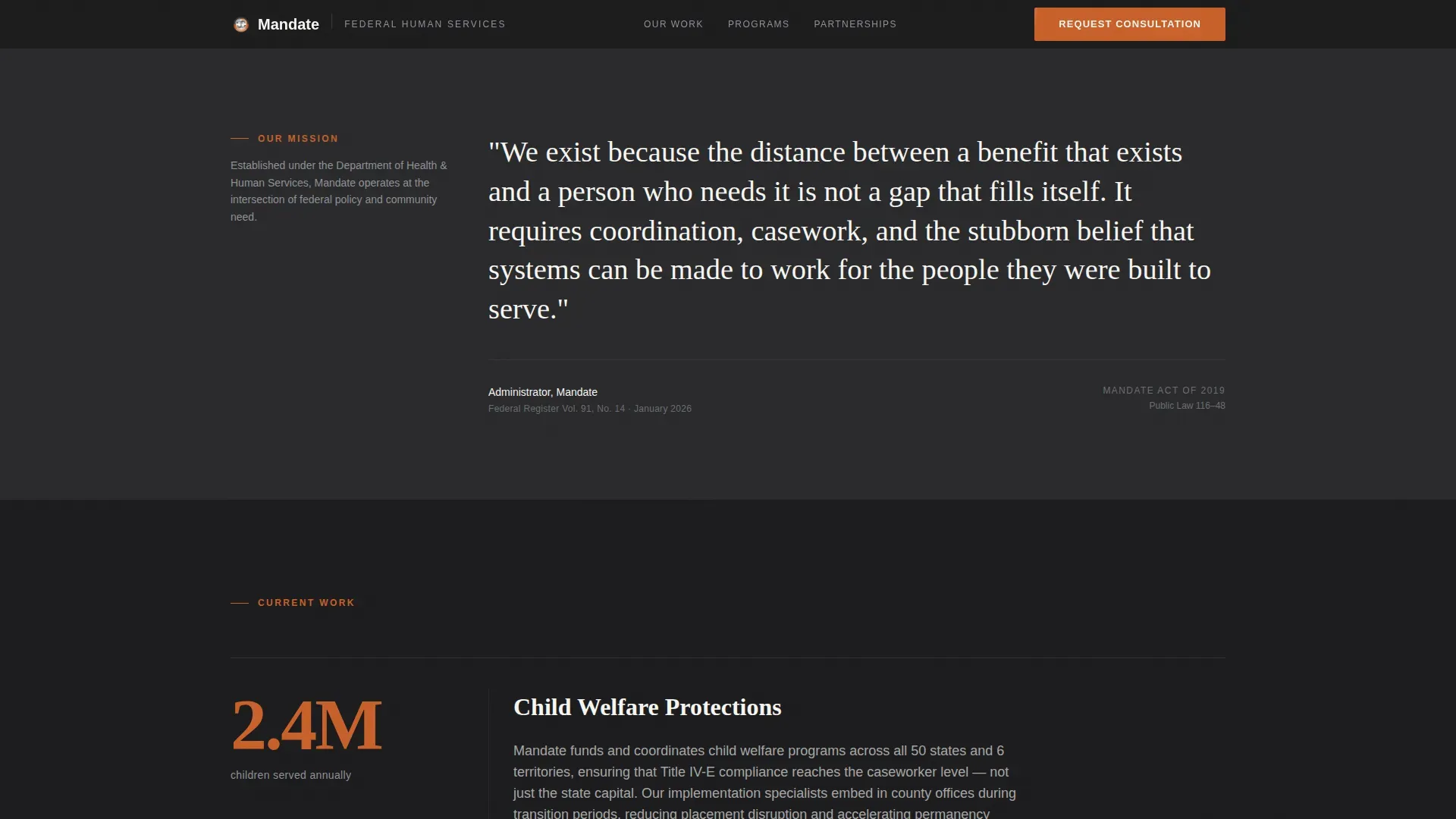
| Mission Statement Block | State the agency's reason for existing in plain, direct language |
| Pillar One: Benefits | Anchor benefit delivery impact with an ember data point and named proof |
| Pillar Two: Disaster Relief | Show disaster relief casework reach with a data declaration and county-level outcome |
| Pillar Three: Child Welfare | Communicate child welfare protection scale with a measurable proof statement |
| Program Areas Grid | Present three service domains in an asymmetric bento grid layout |
| Partnership Frameworks | Display partner logos and framework descriptions in a split layout |
| Consultation Form | Collect organization name, role, and challenge description for partnership leads |
| Email Subscribe Path | Capture email addresses from visitors not ready for a full consultation |
| Footer Linear Row | Provide navigation, contact information, and a final call to action anchor |
Design & branding system
The Mandate template uses a Monochrome Steel color system that pairs institutional structure with deliberate warmth. The palette was designed to feel like a government building lobby where someone thought to put a lamp on the reception desk. Typography follows a serif-plus-sans-serif pairing that balances policy-document gravity with readable body copy.
- Deep graphite (#1C1C1E) serves as the primary background, anchoring sections with authority; brushed steel (#6B6E73) handles secondary text and dividers; warm concrete (#D4D0C8) alternates section backgrounds for visual rhythm
- Ember (#C8602A) is reserved exclusively for calls to action and critical data points, ensuring high contrast and intentional scarcity of warm color across the page
- The serif typeface handles all display headlines, lending each data declaration the weight of a policy document, while the sans-serif body font keeps paragraphs readable and approachable
Mobile & speed optimization
The Mandate template is designed desktop-first, reflecting the primary audience of state administrators and congressional staffers working on workstations. However, the single-column flow structure adapts cleanly to smaller viewports without layout restructuring. Mobile fallback behavior is considered throughout the section sequencing.
- The single-column layout means stacking behavior on mobile is straightforward, with no complex grid reflows required for the hero or mission pillar sections
- Server components handle static content rendering, while client components manage the counter animations and form validation, keeping the interactive layer separated from the structural layer
- The bento grid program area section is built to reflow gracefully on narrower screens, preserving visual hierarchy without requiring a separate mobile layout
How this template helps you convert
The Mandate template converts because it earns the click before it asks for it. Every section is sequenced to reduce skepticism and raise readiness. The lead-generation form does not appear until the mission pillars have already made the case for the agency's impact.
- The hero headline and caseworker photograph establish emotional resonance and professional credibility before any ask is made, reducing the resistance a skeptical visitor would otherwise bring to a government landing page
- The three mission pillars present public health outcomes, dollar figures, and named proof statements at a scale that makes the consultation form feel like a logical next step rather than a cold request
- The dual form structure, consultation form plus email subscribe, gives visitors two commitment levels to choose from, capturing both high-readiness leads and lower-readiness prospects who are willing to stay connected
Other information about this template
The Mandate template sits within a broader context of how health and human services agencies present themselves online. Understanding that context helps you get more value from every section of this landing page.
- The U.S. Department of Health and Human Services (HHS) administers more than 100 programs departmentwide across multiple operating divisions and agencies within the U.S. public health service. The department of health context this template inhabits is one where the assistant secretary level sets policy direction and regional offices execute it, making clear communication between federal and local government essential.
- The template's plain language defaults reflect a widely recognized principle in federal communication: accessible writing reduces barriers for community members, medically vulnerable populations, and other professionals who may not speak the language of federal policymaking fluently. Plain language also supports the spirit of civil rights obligations tied to effective communication requirements.
- The Centers for Medicare and Medicaid Services (CMS) administers the medicare program and works with state governments to administer Medicaid. The cms website and associated medicaid services documentation are reference points that visitors to this template's page type often consult. The template's resource library slot and other resources section are designed to accommodate links to federal register notices, hhs programs guidance, and departmental appeals board decisions relevant to the agency's work.
- The health insurance marketplace and the children's health insurance program are two program areas that frequently generate inbound traffic from state administrators. The template's program areas grid is sized to accommodate these alongside benefit application processing and disaster relief casework.
- Indian health service delivers a comprehensive health services system for American Indians and Alaska Natives. Tribal liaisons are named as a dropdown option in the consultation form, recognizing the 847 tribal partnerships the template's mission pillar section references. This acknowledgment of the indian health service context is deliberate and reflects the full scope of federal human services reach.
- The template supports coverage of public health preparedness and public health emergencies because disaster relief casework is one of its three named program pillars. Agencies managing disease registry data, disease control coordination, or responses to adverse health effects from hazardous substances or toxic substances will find the mission pillar format well suited to communicating that work with appropriate gravity.
- From a healthcare research and strategic planning standpoint, the assistant secretary for planning and evaluation and the assistant secretary for public affairs both influence how health and human services agencies communicate externally. The template's press releases section slot and social media posts integration points in the footer are consistent with how external affairs and public affairs teams at the department of health typically distribute updates.
- The departmental appeals board, medicare hearings, and medicaid program adjudication processes are areas where state administrators and other professionals may need clear guidance. The template's open-field challenge descriptor in the consultation form is designed to surface these specific needs without requiring the agency to predict every possible use case in advance.
- The template acknowledges the role of the private sector, community groups, and healthcare organizations in the broader human services ecosystem. The partnership frameworks section accommodates logos and descriptions from a wide range of other partners beyond purely governmental affiliations.
- From a global affairs and federal perspective, the template's mission pillar format can be adapted to communicate interagency coordination on issues that have both domestic and international dimensions, such as disease prevention, health promotion, environmental justice, and the management of unplanned releases of toxic substances or hazardous substances that carry adverse health effects for community members.
- The mandate community hearth human services federal agency landing page template is built to support agencies that need to raise awareness about their work, demonstrate government efficiency, and build durable relationships with local government, state governments, and the broader network of human services agencies they serve. The design and structure make this possible without compromising the institutional credibility the audience expects.
- No-code platforms can help in the rapid development of applications for community health services, and this template is designed to be used without traditional programming skills. Non-technical staff at healthcare organizations, nonprofit organizations, and local government offices can adapt and deploy this template without relying on dedicated engineering resources. This makes it particularly accessible for smaller human services agencies with limited technical capacity.
- The web page structure follows best practices for community health service landing pages: services are clearly communicated, contact information and resources for immediate assistance are surfaced early, and calls to action guide visitors toward next steps. Visual elements, including the caseworker photograph and the ember-accented data counters, are included to make the page more engaging and to help community members and other professionals understand the scale and humanity of the work being done.
- Title II of the Americans with Disabilities Act (ADA) requires state and local governments to ensure their services, programs, and activities are accessible to people with disabilities. The final rule published by the Department of Justice on April 24, 2024, updates regulations for Title II regarding web content and mobile applications. State and local governments must follow Web Content Accessibility Guidelines (WCAG) Version 2.1, Level AA. Websites and mobile apps that are not physically accessible can create barriers for people with disabilities who need to access government services. Organizations using this template should review their own accessibility obligations and ensure their deployed version meets the requirements applicable to them.
- The Substance Abuse and Mental health Services Administration (SAMHSA) leads public health efforts to advance behavioral mental health at the national level. Agencies working in mental health program delivery, including those addressing opioid response and mental health crisis coordination, will find the mission pillar and program areas sections adaptable to communicating those specific health outcomes. Mental health is a core dimension of the human services work this template is designed to represent.
- The health care workforce is a recurring concern across human services administration. The Health Resources and Services Administration (HRSA) improves access to health care by strengthening the health care workforce and building healthy communities. Health resources planning and health care providers engagement are areas where the partnership frameworks section of this template can carry significant practical weight. Higher quality partnerships and higher quality program delivery depend on clear, credible communication, and this template is designed to support exactly that.
- The national center for health statistics and disease registry functions within the public health service infrastructure provide the kind of data that populates the mission pillar section most effectively. Agencies with access to current disease control figures, public health preparedness capacity metrics, or environmental justice outcome data will find the ember-accented data declaration format a strong vehicle for communicating those numbers to a professional audience.
- Financial management of grant compliance deadlines is a primary concern for state administrators. The template's consultation form open field is designed to surface financial management challenges, grant coordination questions, and program funding gaps as part of the initial engagement. This keeps the first conversation productive and relevant.
- The congress passed legislation context is relevant because many of the programs this template represents were authorized through specific statutory mandates. The template's mission statement section can reference the legislative authority behind the agency's work, giving it the well being context that connects federal policymaking to real community living outcomes at the county level.
Theme
Community Hearth
Creative direction
Vision & Mission
Color system
Monochrome Steel
Style
Single Column Flow
Direction
Lead Generation
Page Sections
Giant Headline Hero with Vertical Photo Slot
Ember-accented Mission Pillar Blocks
Asymmetric Bento Grid for Program Areas
Partnership Framework Split Layout
Dual Lead Generation Form Anchor
Scroll-triggered Counter Animation System
Related questions
Who is the primary audience for this landing page template?
Can I adapt the mission pillar data points to reflect my agency's actual figures?
Does the template support multiple lead capture paths?
Is the template suitable for agencies covering mental health and tribal health programs?
How does the scroll animation system work within the template?