Tribal Human Services Landing Page Template
Sovereignty is a sidebar companion landing page template built for tribal human services authorities. It guides enrolled members through five federally connected service areas using plain-language steps, a scroll-linked sidebar, and a workshop registration form. The design draws on a high-desert dawn palette and an educational guide structure that feels like sitting across the table from someone who already knows which form you need.
by Rocket studio
Quick summary
Sovereignty is a structured, single-page template designed for tribal human services offices. It organizes five service categories into a scrollable guide with a persistent sidebar, a workshop registration form, and a secondary PDF download path. Every section is written to feel like practical guidance rather than bureaucratic instruction, helping community members move from confusion to action.
Who this template is for
This template was developed for organizations that sit between tribal nations and the federal programs those nations must navigate. It is built for teams that serve people on the land every day and need a page that reflects that work honestly.
- Tribal enrollment officers processing new applicant cases and coordinating across service areas
- Grandmothers raising grandchildren, community health representatives, and other caregivers seeking emergency or ongoing assistance
- Tribal human services departments that want a clear, respectful digital front door for in-person workshop registration
What problem this template solves
Native peoples across this country face a well-documented gap between available federal programs and actual access. Historical trauma has eroded trust in outside systems. Many native communities have limited digital infrastructure. Rural distance means that a single unanswered question can cost a family a full day of travel. And the language used in most federal program materials assumes a level of bureaucratic fluency that few outside a government department can claim.
- Program descriptions written in plain language so participants understand eligibility before they arrive
- A structured service guide that reduces the back-and-forth often required to connect families with the right resources
- A workshop seat reservation system that signals real, in-person support rather than another online form to fill out alone
What you get with this template
The template delivers a complete, ready-to-adapt page covering five human services categories, a sticky sidebar navigation system, event registration, and a secondary download path. Everything is organized to support the decision making process a visitor goes through when they first land on the page and need to know where they belong.
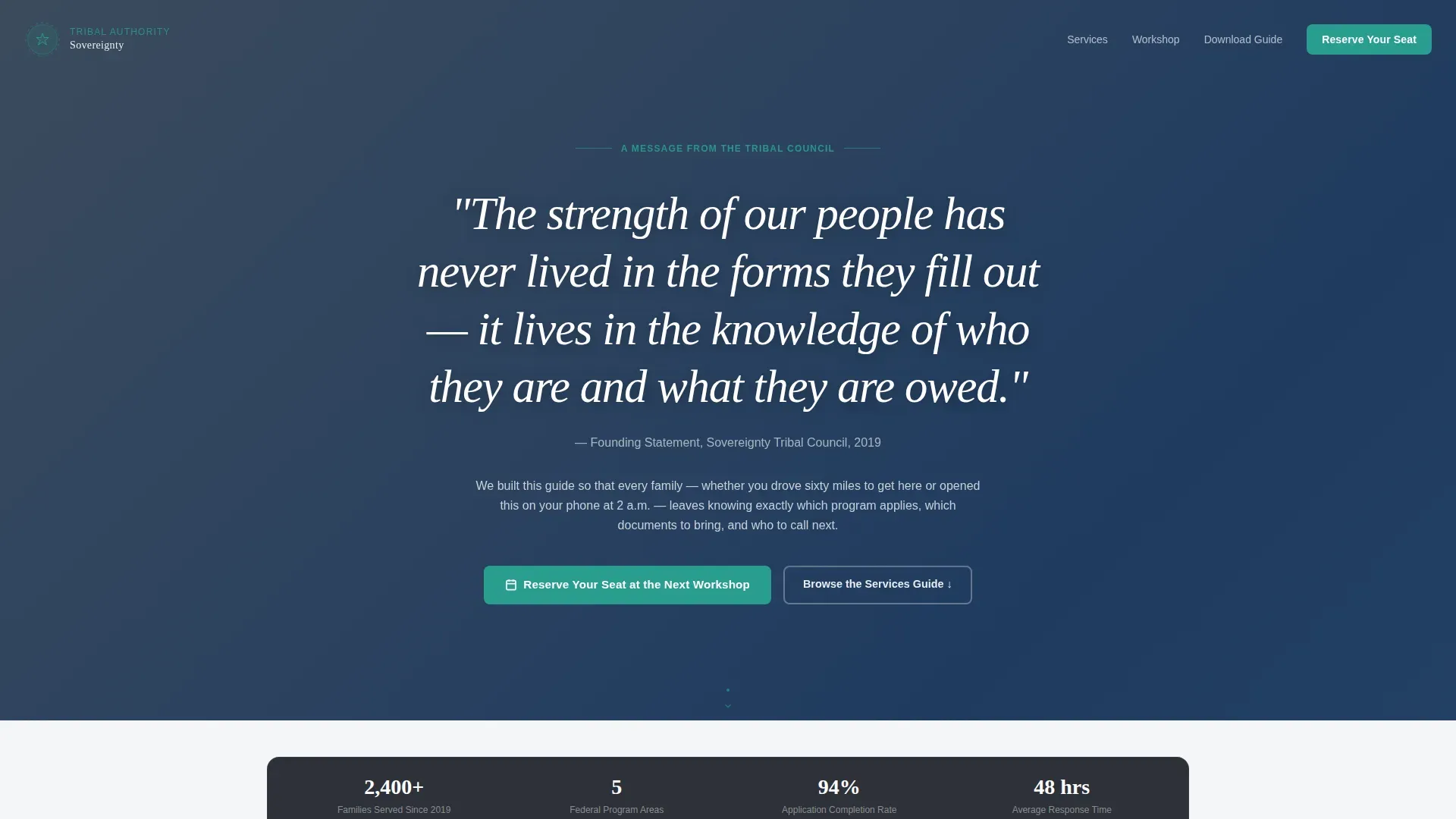
- A Quote/Manifesto hero section with a slow-breathing gradient, tribal seal placement, and a turquoise thread leading into the guide
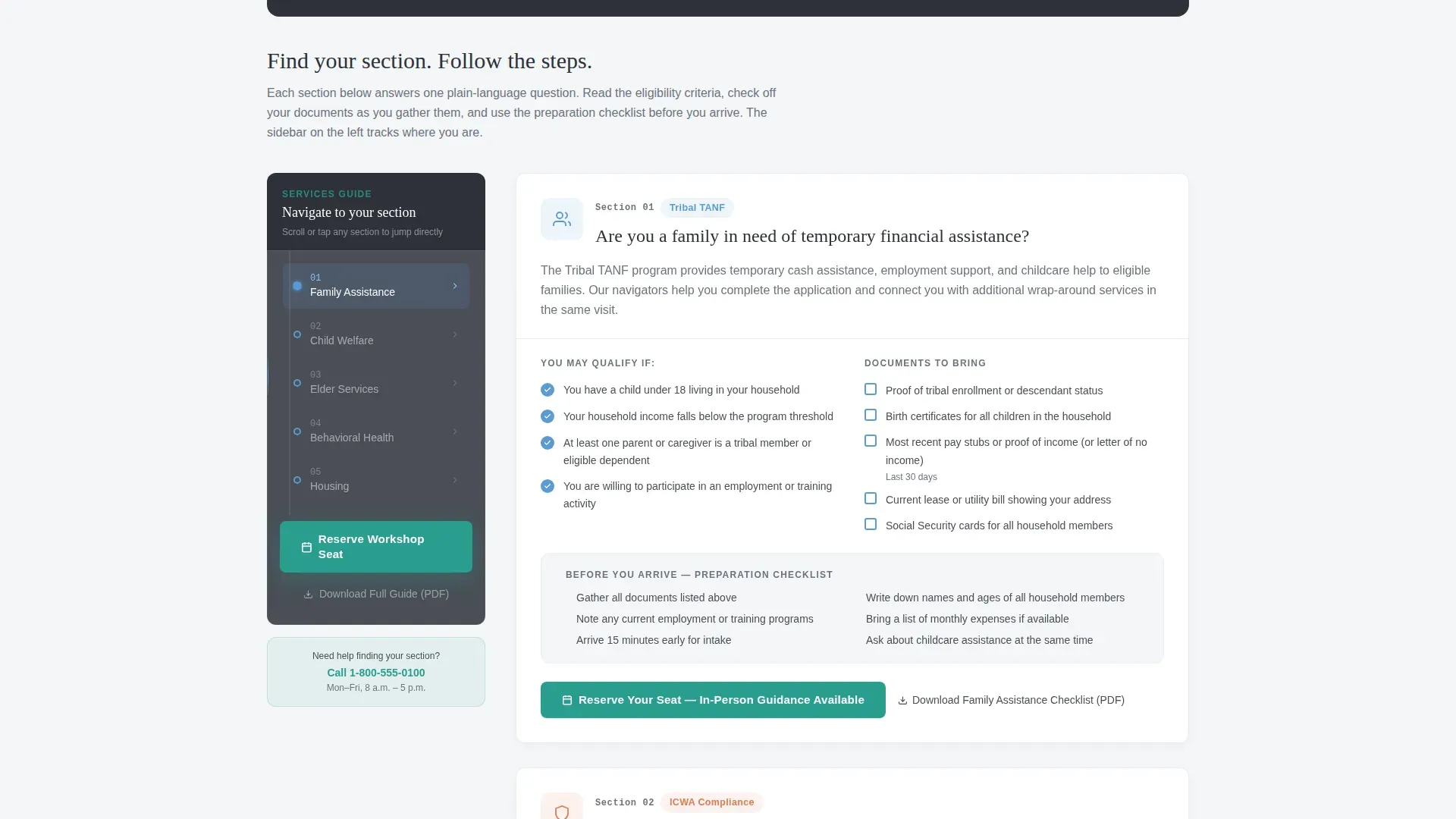
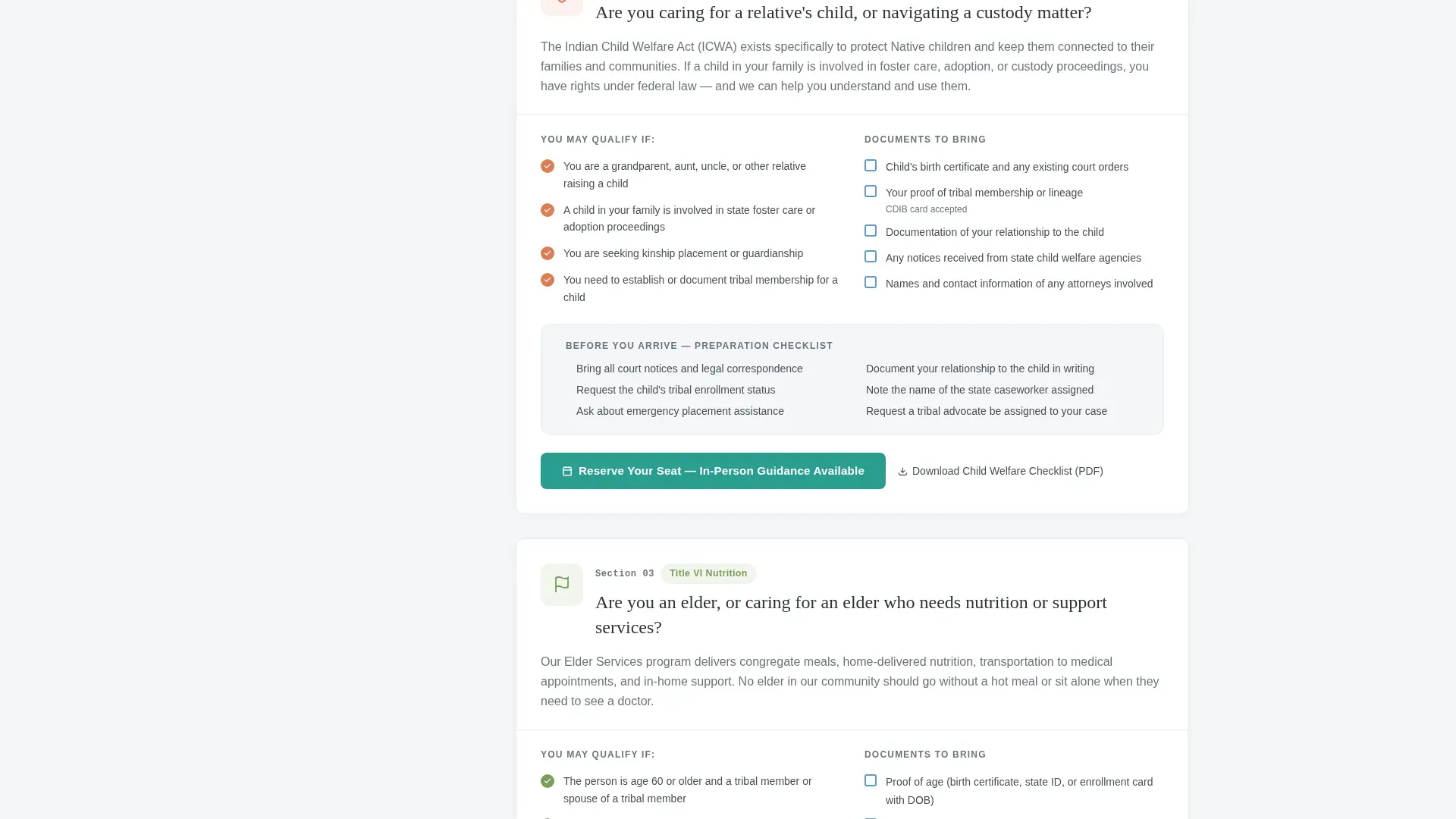
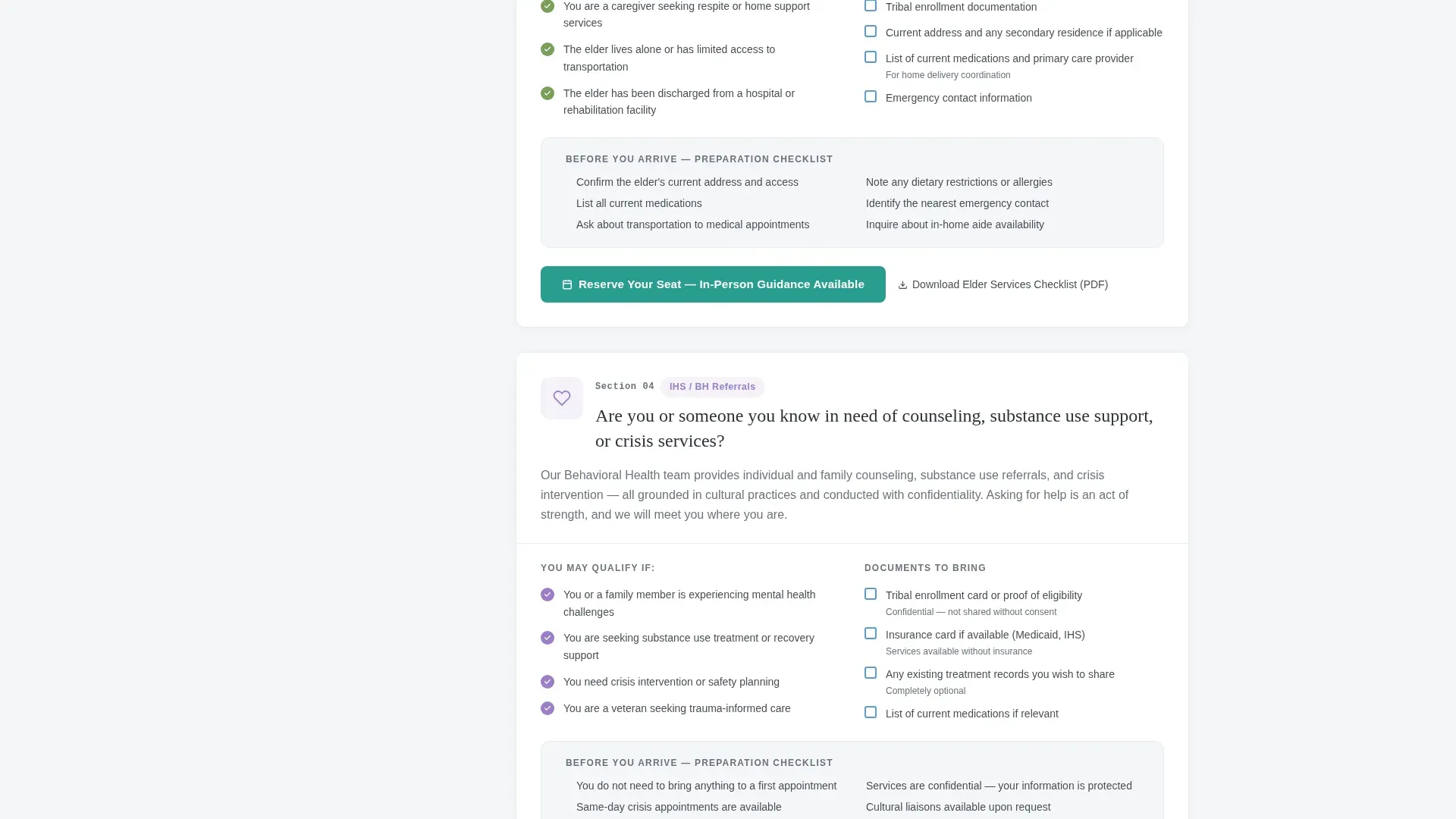
- Five fully structured service sections (Family Assistance, Child Welfare, Elder Services, Behavioral Health, Housing) each with eligibility criteria, document checklists, and a downloadable preparation checklist
- A workshop registration form collecting name, tribal enrollment number (optional), service area, preferred date, and a transportation assistance checkbox
Feature list
This template includes the following built-in capabilities developed from the source brief.
Scroll-Linked Sidebar Navigation
The persistent sidebar numbers all five service categories and uses progress dots that fill as the visitor scrolls. It collapses on mobile to preserve screen space. The sidebar acts as a living table of contents, always showing participants exactly where they are in the guide and what comes next. This orientation reduces friction for rural users who may be navigating the page on a limited connection.
Quote/Manifesto Hero Section
The header opens with white text on a slow-breathing gradient that shifts from mesa gray to deep sky blue. A tribal seal sits small and precise in the upper corner. A thin turquoise line extends downward from the manifesto text, inviting the visitor to follow it into the service guide below. No stock photography. No decorative imagery that does not belong. Just the founding statement and the thread.
Five-Section Service Guide
Each of the five sections (Family Assistance, Child Welfare, Elder Services, Behavioral Health, Housing) opens with a single plain-language question. Eligibility criteria follow in short sentences. Required documents appear as checkbox lists. A downloadable preparation checklist closes each section. This structure supports enrolled members and community members who need to know exactly what to bring and what to expect before they attend a workshop.
Workshop Registration Form
The primary call-to-action is "Reserve Your Seat at the Next Enrollment Workshop." The form appears as a floating sidebar button and inside each service section where in-person guidance is referenced. It collects full name, tribal enrollment number (optional, with a reassuring note), service area via dropdown, preferred workshop date from a short list, and a transportation assistance checkbox. That single checkbox signals that this program understands the real barriers facing participants.
Secondary PDF Download Path
Visitors who are not ready to register in person can download the full services guide as a PDF. This path captures only an email address and community name. It provides a lower-commitment option for community members who are still gathering information or who want to share the guide with a neighbor, an elder, or a school contact before committing to a workshop date.
Slate and Sky Color System
The visual system uses four intentional values. Mesa gray (#4A4E56) anchors sidebar backgrounds and primary text. Sky blue (#5B9BD5) marks active steps and progress indicators. Morning cloud white (#F4F6F8) fills content panels. Ceremonial turquoise (#2A9D8F) is reserved for calls-to-action and completion checkmarks. The palette is consistent and purposeful, never decorative.
Page sections overview
| Section | Purpose |
|---|---|
| Manifesto Hero | Opens with founding statement, tribal seal, and turquoise thread leading into the guide |
| Sidebar Navigation | Persistent numbered list of five service categories with scroll-linked progress dots |
| Family Assistance | Plain-language eligibility, document checklist, and downloadable preparation guide |
| Child Welfare Section | Covers Indian Child Welfare Act compliance pathways and caregiver eligibility criteria |
| Elder Services Section | Elder nutrition and related federal program eligibility with document requirements |
| Behavioral Health Section | Behavioral health referral pathway with plain-language eligibility and checklist |
| Housing Services Section | Housing assistance eligibility criteria, required documents, and preparation checklist |
| Workshop Registration | Event registration form with transportation checkbox and optional enrollment number field |
| PDF Download Path | Secondary email capture for visitors who want the full services guide before registering |
| Minimal Footer | Contact and community name footer following a clean, low-distraction pattern |
Design & branding system
The visual identity follows an Educational Guide theme rooted in a high-desert dawn aesthetic. Typography pairs Fraunces serif headings with DM Sans body text, giving the page a warm, legible voice that respects native american culture without appropriating it. The combination feels like a well-organized binder: clear, calm, and trustworthy.
- Color system: mesa gray (#4A4E56) for text and sidebar, sky blue (#5B9BD5) for active states, cloud white (#F4F6F8) for content panels, turquoise (#2A9D8F) for calls-to-action and checkmarks
- Typography: Fraunces for headings (warm serif authority), DM Sans for body copy (clean and readable at small sizes on rural mobile screens)
- Animation: medium intensity with a breathing gradient in the hero, scroll-linked sidebar progress indicators, and step fill animations tied to scroll position
Mobile & speed optimization
The template is designed desktop-first with a full mobile fallback. Many participants accessing tribal services live in rural areas where smartphones are the only available screen. The sidebar collapses on smaller screens without losing any navigation context. The registration form is built to be short and easy to complete on a smartphone, reflecting the fact that mobile optimization is necessary to ensure the registration process is seamless for people in the field.
- Sidebar collapses gracefully on mobile, preserving the numbered step structure without blocking content
- Registration and PDF download forms are minimal by design: only essential fields, fast to fill on any device
- Server Components handle static content areas for reliable load behavior; scroll tracking runs on the client side only where needed
How this template helps you convert
The page is built around a single primary goal: getting participants to reserve a workshop seat. Every layout decision supports that goal. The secondary PDF path exists to capture future attendees who need more time, not to dilute the primary conversion.
- The floating sidebar call-to-action button keeps the workshop registration option visible throughout the entire scroll experience, so participants never have to hunt for the next step
- The transportation assistance checkbox on the registration form removes a real barrier for rural participants and signals that the program is built by people who understand the land and the distance involved
- The downloadable preparation checklists inside each service section build confidence before the workshop, so participants arrive knowing what to bring, which increases the likelihood they complete enrollment on the day
Other information about this template
This template sits inside the Government and Public category, within the Human Services Government subcategory and the Human Services Tribal Authority niche. It was developed with the understanding that tribal sovereignty is the foundation, not a footnote, of every service interaction this page facilitates. Tribal sovereignty allows tribes to govern themselves and make decisions about their own social services. Tribal nations have unique legal and political relationships with the federal government, and this page is built to honor that context rather than flatten it.
The page recognizes that native peoples face real barriers rooted in historical trauma and intergenerational trauma. Access to resources for native communities is often limited due to systemic inequities developed over generations. Many native americans living in urban areas experience social isolation that compounds these barriers. The template's plain-language approach reflects the importance of building trust before asking for data, which is why the enrollment number field is optional and explained with care.
This template can support organizations working to promote human services across local communities where effective communication strategies are essential. Culturally relevant materials enhance the effectiveness of outreach efforts, and the guide structure here is designed to carry that relevance through every scroll step. Engaging tribal leaders in planning and implementation improves community buy-in, and the founding statement section is designed to carry exactly that leadership voice.
The page also recognizes the importance of in-person education for youth, elders, and every generation between. Workshop formats that begin with intention-setting and elevate tribal voices in the decision making process produce better outcomes. Follow-up communication after workshops maintains relationships. The PDF download path supports that follow-up by giving participants a shareable guide they can pass to a neighbor, a school contact, or a family member who could not attend.
Research from the national academies and related institutions, including the national academies press, has documented the importance of culturally grounded programs run by trained tribal liaisons in improving health outcomes for native americans. Public health literature consistently identifies the need for programs that address domestic violence, behavioral health, and housing insecurity together rather than in isolation, because these factors interact in ways that single-service programs cannot resolve alone. The template's five-section structure reflects that holistic understanding.
Rocket.new is the platform on which this template is built and deployed. It offers no-code tools for building production-ready apps and websites, with an AI-powered platform that allows users to integrate backend services seamlessly. The subscription model starts at $25 per month, making it accessible for small tribal departments and government offices with limited budgets. No deep coding skills are required to adapt this template for your nation's specific service areas, dates, and contact information.
- The template is categorized under Government and Public, Human Services Government, with an Educational Guide theme and Sidebar Companion template style
- Fraunces and DM Sans typography are pre-applied; color tokens use the Slate and Sky system
- The page includes tribal seal placement in the hero, a turquoise thread visual, and a minimal footer following a clean pattern
- Animation is set at medium intensity; scroll tracking and sidebar behavior require client-side rendering for the interactive components
- Downloadable preparation checklists per service section support the best practice of offering resource links that connect participants to official tribal enrollment forms and guides
- The template supports data collection only at the registration and PDF download steps, with minimal required fields to respect participant privacy and reduce friction
Theme
Educational Guide
Creative direction
Step-by-Step Guide
Color system
Slate & Sky
Style
Sidebar Companion
Direction
Event Registration
Page Sections
Scroll-linked Sidebar Navigation
Quote/manifesto Hero Section
Five-section Plain-language Service Guide
Workshop Registration Form
Secondary PDF Download Path
Slate and Sky Visual System
Related questions
Can I adapt the five service sections to match my nation's specific programs?
Does the registration form support transportation assistance requests?
Is the tribal enrollment number field required on the registration form?
How does the PDF download path work alongside the primary registration goal?
Can this template serve a department with participants spread across multiple rural communities?