Retirement Coaching Landing Page Template
Encore is an editorial-style retirement lifestyle coaching landing page built for practices that guide high-achieving professionals into their next chapter. With a monochrome steel palette, long-form case study narrative, and a lead-generation form that feels like an intake session, this template earns trust through storytelling before it ever asks for a click.
by Rocket studio
Quick summary
Encore is a single-page coaching template designed for retirement lifestyle practices. It blends magazine-editorial design with purposeful lead generation. Three scrollable case study sections guide readers through real client transformations, building trust before presenting the primary call to action: "Request Your Retirement Blueprint."
Who this template is for
This template is built for coaches, consultants, and advisory practices that help newly retired professionals find meaningful structure after long careers. It suits practices where credibility, empathy, and storytelling are the primary selling tools.
- Retirement lifestyle coaches serving senior executives and early-exit founders
- Couples and solo-retiree coaching practices that rely on narrative to build trust
- Consulting professionals who need a polished, lead-generating presence without a multi-page site
What problem this template solves
Many retirement coaches rely on generic service pages that list credentials and pricing. That approach fails an audience that is emotionally complex, financially sophisticated, and deeply skeptical of surface-level marketing.
- Prospective clients feel unseen when a page does not reflect the specific disorientation they are experiencing
- Practices lose qualified leads because the page earns no trust before asking for a commitment
- Coaches have no structured way to present proof of transformation through real client journeys
What you get with this template
You get a complete, single-page editorial layout that moves readers through a deliberate narrative arc. Every section is designed to resonate with a specific retired professional mindset before presenting a conversion path.
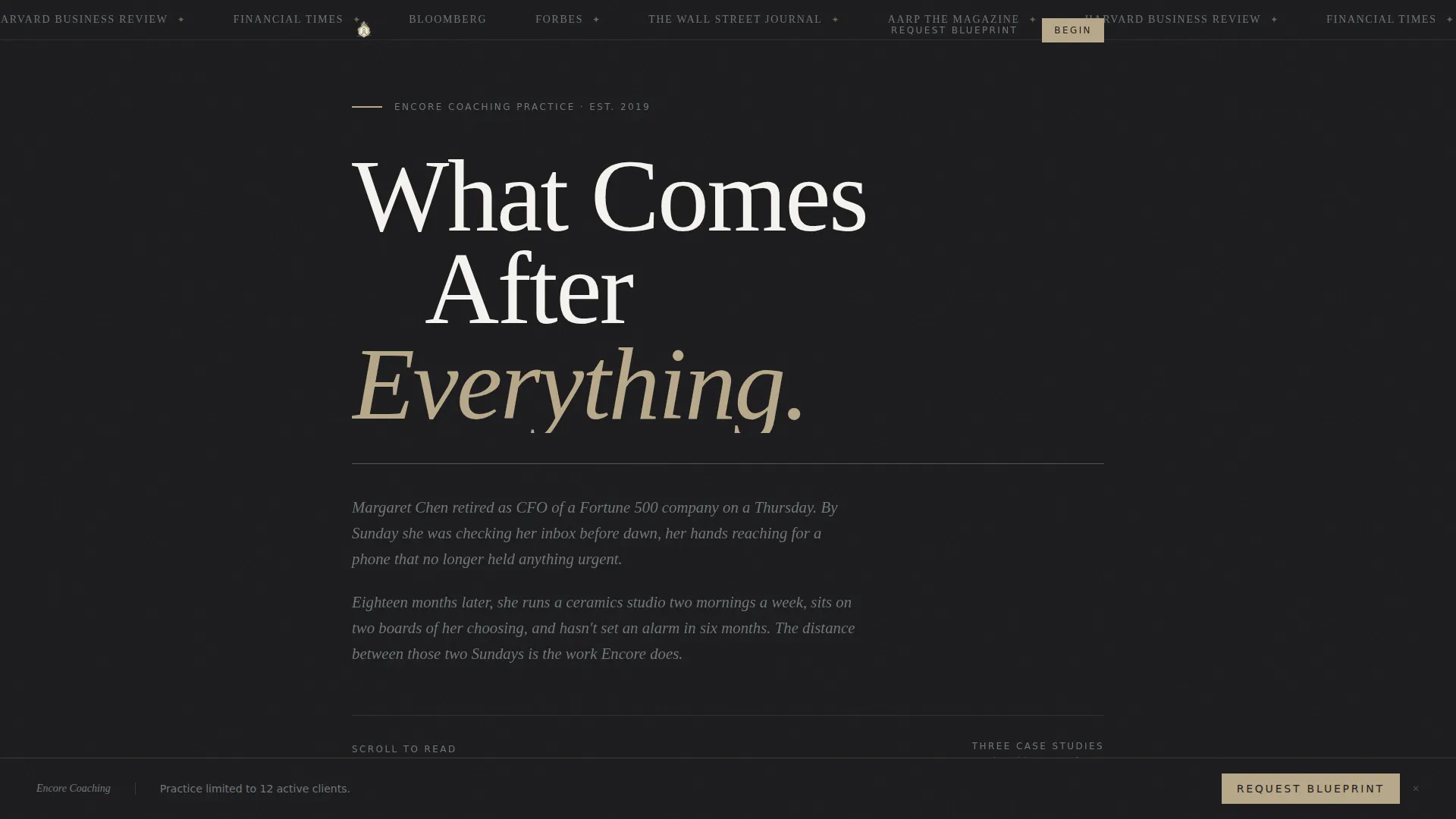
- A press mentions masthead banner featuring publication logo placement above the primary headline
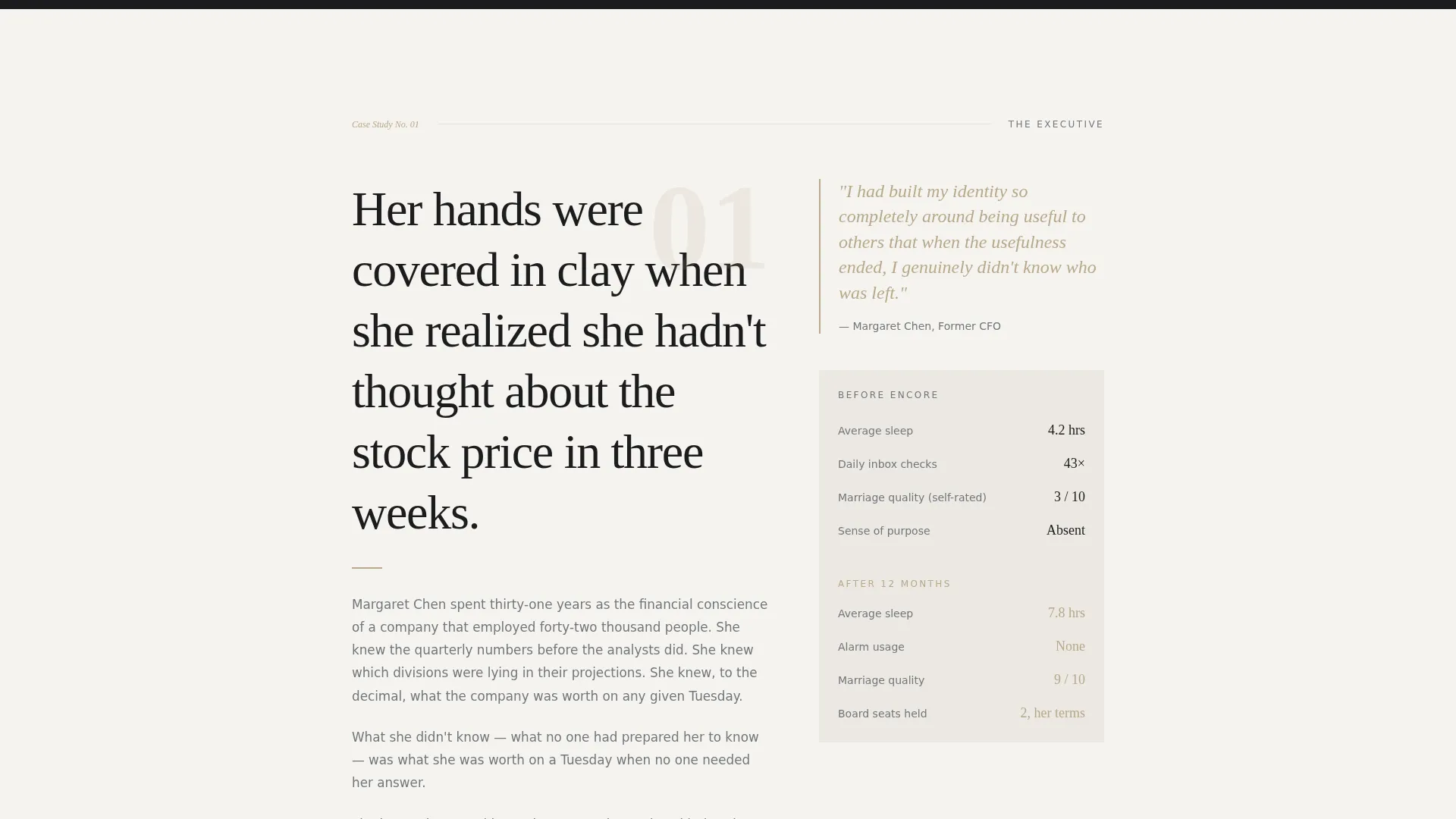
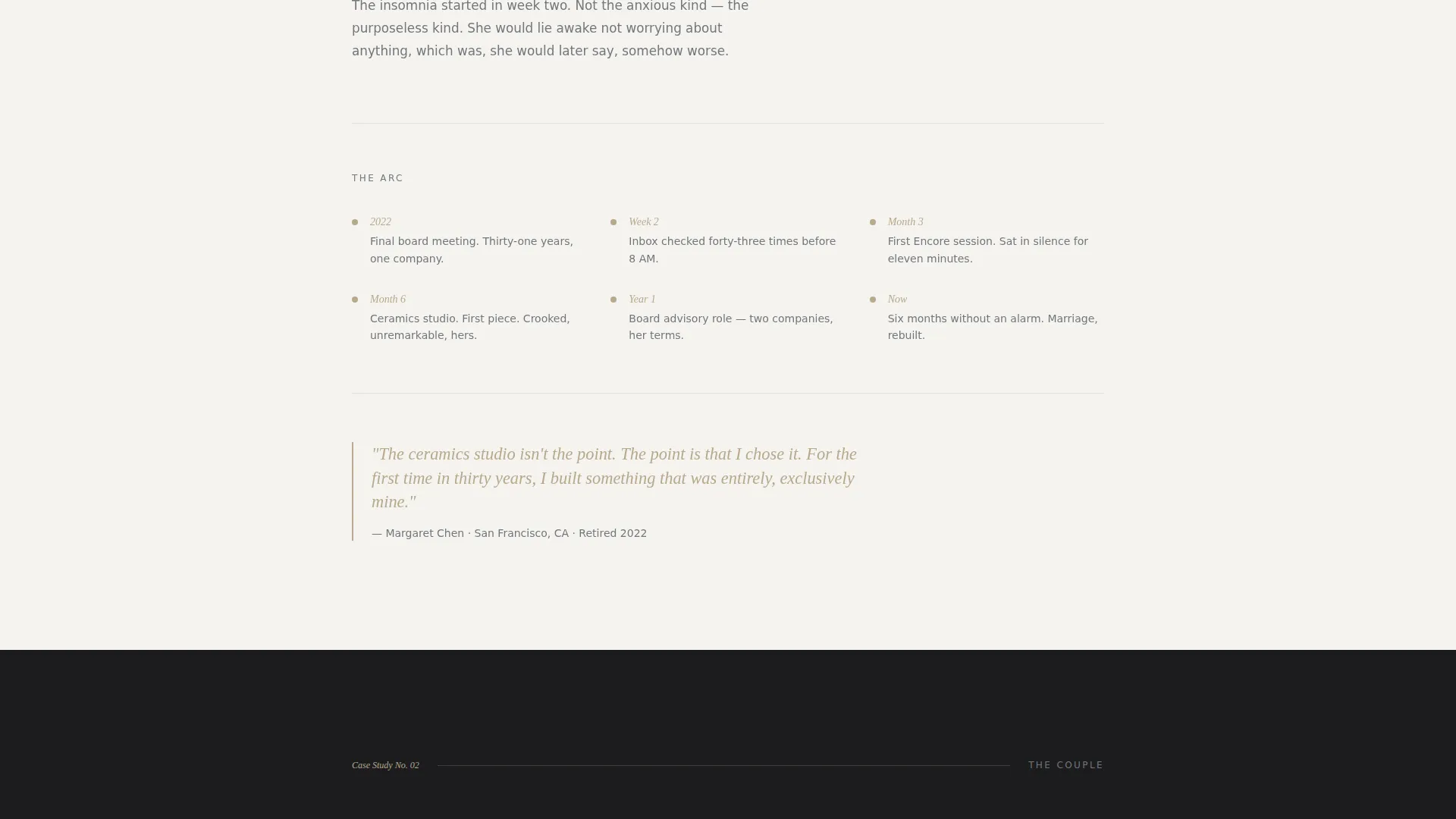
- Three sequenced case study sections formatted as long-form magazine profiles with pull quotes and timeline sidebars
- A dual lead-generation path: a primary intake-style form and a secondary downloadable PDF offer gated behind email
Feature list
This template includes purpose-built components that reflect the coaching practice described in the brief. Each feature serves both the editorial feel and the lead-generation goal.
Editorial Masthead Header
The header opens with a horizontal press mentions strip for publication logos, followed by a bold serif headline and a steel italic subhead. The layout is text-only by design, using whitespace and typographic authority in place of photography.
Alternating Case Study Sections
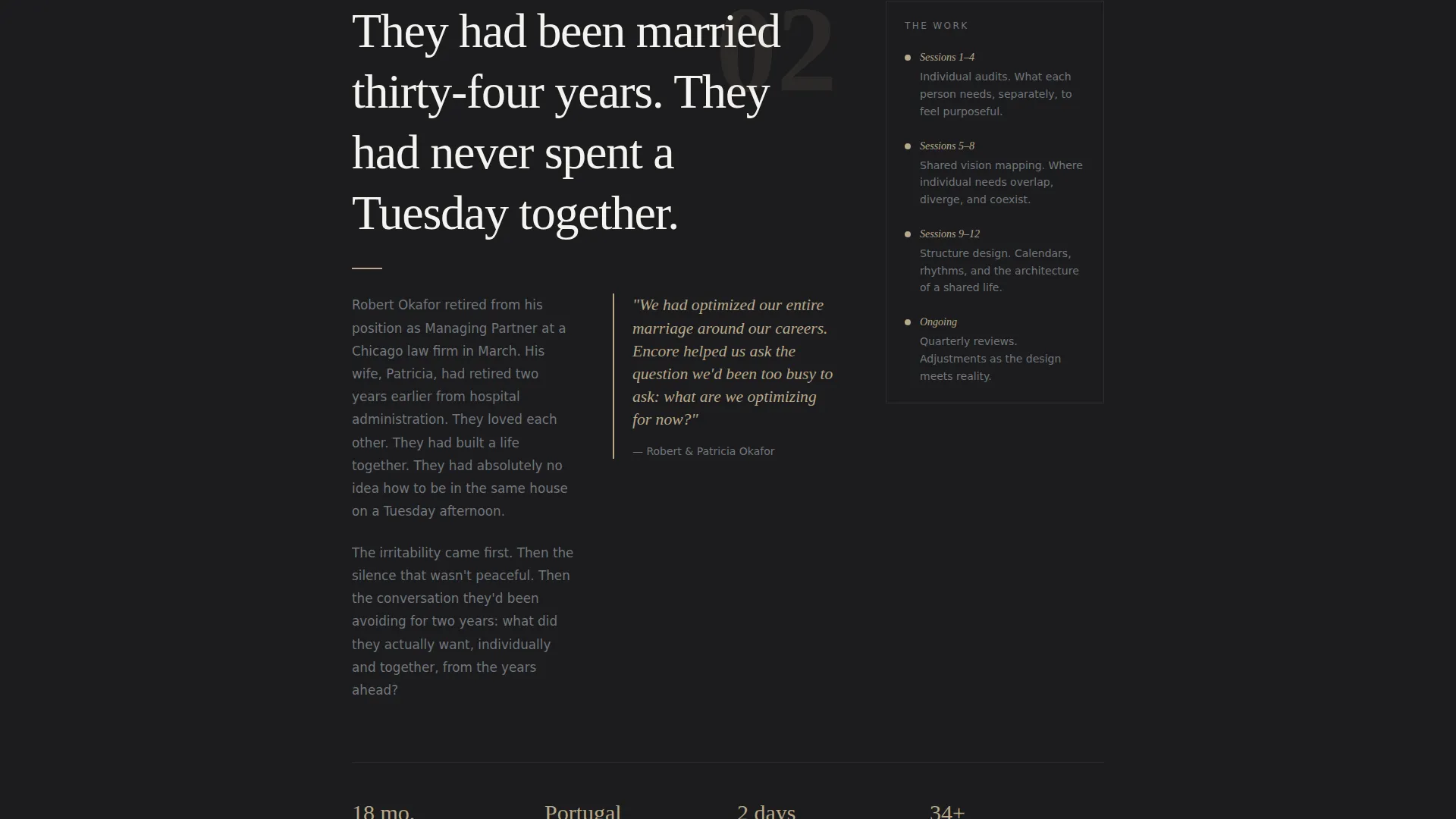
Three full-width editorial sections each profile a different client archetype: a retired executive, a couple adjusting to shared time, and an early-exit founder. Pull quotes and timeline sidebars break up body copy and create the feel of turning pages in a long-form feature.
Inline and Fixed-Bar Call to Action
The primary call to action appears first as an elegant inline text link after the second case study, then returns as a fixed bottom bar after the third. This phased approach lets trust build before the ask is made.
Intake-Style Lead Form
The form collects first name, retirement date or "already retired" status, and a single open-ended question. The question is phrased to feel like the opening of a real coaching session, which reduces friction and increases completion.
Gated PDF Secondary Path
A secondary conversion path offers a downloadable guide titled "The First 90 Days: A Structured Guide to Post-Career Life." It is gated behind email only, giving hesitant visitors a low-commitment first step.
Alternating Band Layout
Full-width section bands alternate between deep graphite and bright parchment backgrounds. This zigzag structure keeps the page visually dynamic and reinforces the editorial rhythm as readers scroll.
Page sections overview
| Section | Purpose |
|---|---|
| Press Mentions Banner | Establishes authority via publication logo strip |
| Masthead Headline | Sets the editorial frame with bold serif type |
| Steel Italic Subhead | Introduces a featured client transformation as a lede |
| Case Study One | Profiles a retired CFO with before-and-after narrative |
| Pull Quotes and Timeline | Breaks up narrative with editorial sidebar elements |
| Case Study Two | Profiles a couple navigating shared retirement life |
| Inline call to action Link | First conversion prompt after the second case study |
| Case Study Three | Profiles an early-exit founder's internal reckoning |
| Fixed Bottom Bar call to action | Persistent conversion prompt after the third case study |
| Intake Lead Form | Collects name, retirement status, and open question |
| PDF Download Offer | Secondary email-gated path for hesitant visitors |
Design & branding system
The visual identity uses a Monochrome Steel color system built around four values that recall a partner's desk at a professional firm. Every color decision is intentional and restrained.
- Deep graphite (#1C1C1E) and bright parchment (#F5F3EF) alternate as full-width section backgrounds, with steel (#71767B) used for body text on light bands and parchment on dark
- Muted gold (#B8A88A) appears sparingly as an accent reserved for pull quotes, bylines, and hover states, making each instance feel earned rather than decorative
- Typography is set in bold serif for headlines and steel italic for subheads, reinforcing the heavyweight magazine aesthetic throughout
Mobile & speed optimization
The layout is structured for readability across screen sizes. The alternating band system and single-column editorial flow adapt naturally to narrower viewports without sacrificing the premium feel.
- Full-width section bands reflow cleanly on mobile, preserving the graphite-to-parchment rhythm and typographic hierarchy
- The fixed bottom bar call to action is sized for thumb-friendly interaction on smaller screens
How this template helps you convert
The page is engineered to move a skeptical, high-achieving reader toward a qualified inquiry. Conversion is earned through proof, not pressure.
- Three sequential case studies build emotional recognition before any call to action appears, so readers arrive at the form already trusting the practice.
- The intake-style form question ("What's the hardest part of your next chapter?") is designed to feel like a coaching moment, not a marketing funnel, which increases the likelihood of honest, complete responses.
- The gated PDF offer captures email addresses from visitors who are not yet ready to speak with someone, creating a secondary pipeline that extends the reach of each page visit.
Other information about this template
This template suits practices operating in the retirement lifestyle and post-career coaching space. It is equally relevant to specialty consulting professionals who serve clients navigating identity, purpose, and relational shifts in later life.
- The page structure supports the aging-in-place consulting adjacency, since many clients exploring post-career purpose are also rethinking their living environment and daily routines
- The educational guide theme is built into the secondary conversion path, which positions the practice as a trusted resource before a prospect ever fills out the intake form
- The template is designed as a standalone landing page, not a multi-page site, making it straightforward to deploy as a focused campaign or primary web presence
Theme
Educational Guide
Creative direction
Case Study Narrative
Color system
Ink & Paper
Style
Zigzag/Alternating
Direction
Click-Through
Page Sections
Editorial Masthead with Press Mentions
Three-part Case Study Narrative
Phased Call-to-action System
Intake-style Lead Capture Form
Email-gated PDF Offer
Alternating Graphite and Parchment Bands
Related questions
Can I use this template without photography?
How do the two conversion paths work together?
Can I replace the case study content with my own client stories?
Is this template suitable for a solo coaching practice?
What makes the lead form feel different from a standard contact form?