Solar & Energy Installation Booking Website Template
The Charge trusted home battery storage landing page template is a warm, single-column landing page built for solar battery storage installers. It guides rural homeowners and hobby farmers through real family case studies, a draggable before-and-after hero, and a focused booking form that turns solar battery interest into confirmed home assessments.
by Rocket studio
Quick summary
Charge is a single-column landing page built for battery storage installers serving rural homeowners and off-grid families. The page uses a Pastoral Calm visual identity, real family case studies, and a draggable hero slider to build trust before asking for a commitment. Every section moves the visitor naturally toward booking a home assessment.
Who this template is for
This template is designed for licensed solar and battery storage installation businesses that serve residential clients in rural and suburban areas. It works well for any installer who wants to lead with proof rather than a sales pitch.
- Rural homeowners facing rising electricity bills and frequent grid outages
- Hobby farmers who need reliable backup power to protect livestock equipment and chest freezers
- Off-grid families and solar-equipped homeowners ready to add battery storage to their current system
What problem this template solves
Many battery storage installers lose potential clients because their landing page leads with specifications instead of outcomes. Visitors need to see real results before they trust a company with their home. This template solves that by leading with story-driven social proof and earning the booking click through demonstrated energy independence.
- No clear social proof above the fold means visitors leave before they reach the form
- Technical jargon about battery capacity and discharge rates pushes away non-specialist homeowners
- Generic contact forms fail to qualify leads by service area, home size, or energy use details
What you get with this template
You get a fully designed, single-page layout structured to move visitors from curiosity to commitment. Every section is ready to customize with your own case study details, crew photos, and solar harvest data.
- A draggable before-and-after hero slider with a headline and a first call-to-action above the fold
- Three narrative case study sections, each covering a problem, an installation, and a post-install outcome
- Two call-to-action blocks: a booking form with zip code, square footage slider, electricity provider dropdown, and visit window selector, plus a secondary solar calculator lead-capture path
Feature list
This landing page offers a focused set of interactive and visual features built specifically for solar battery storage businesses.
Draggable Before-and-After Hero Slider
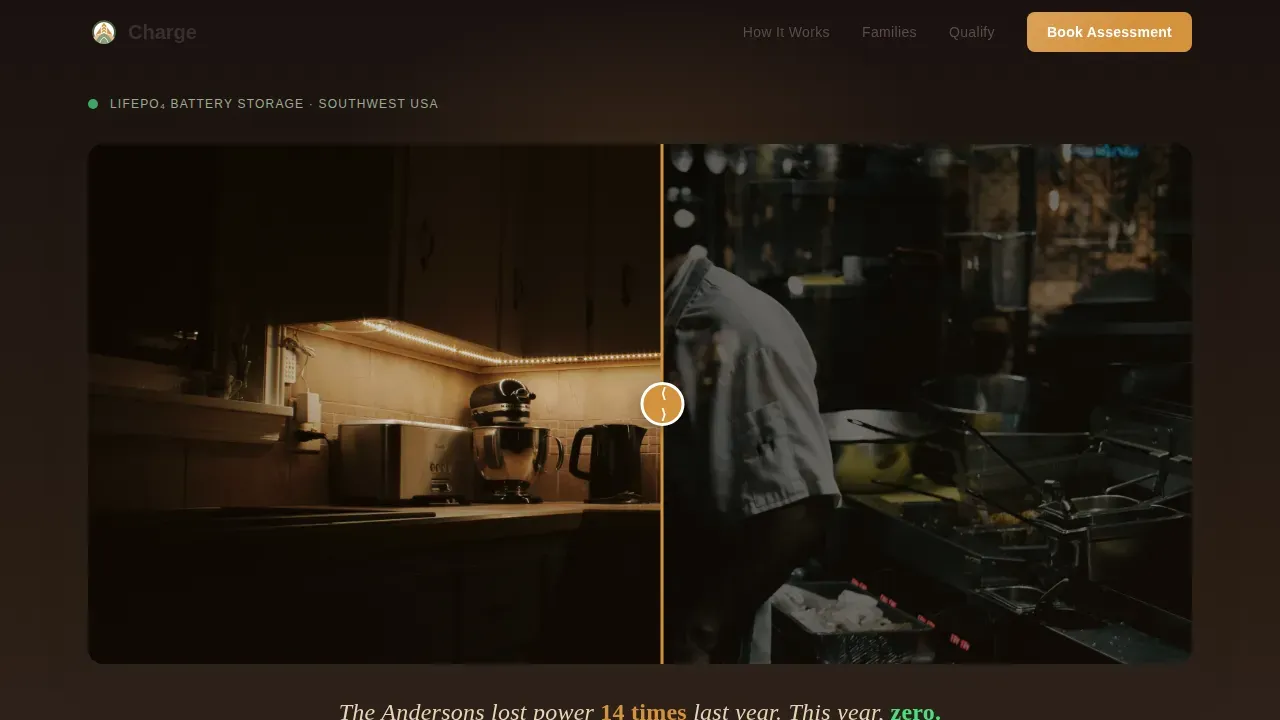
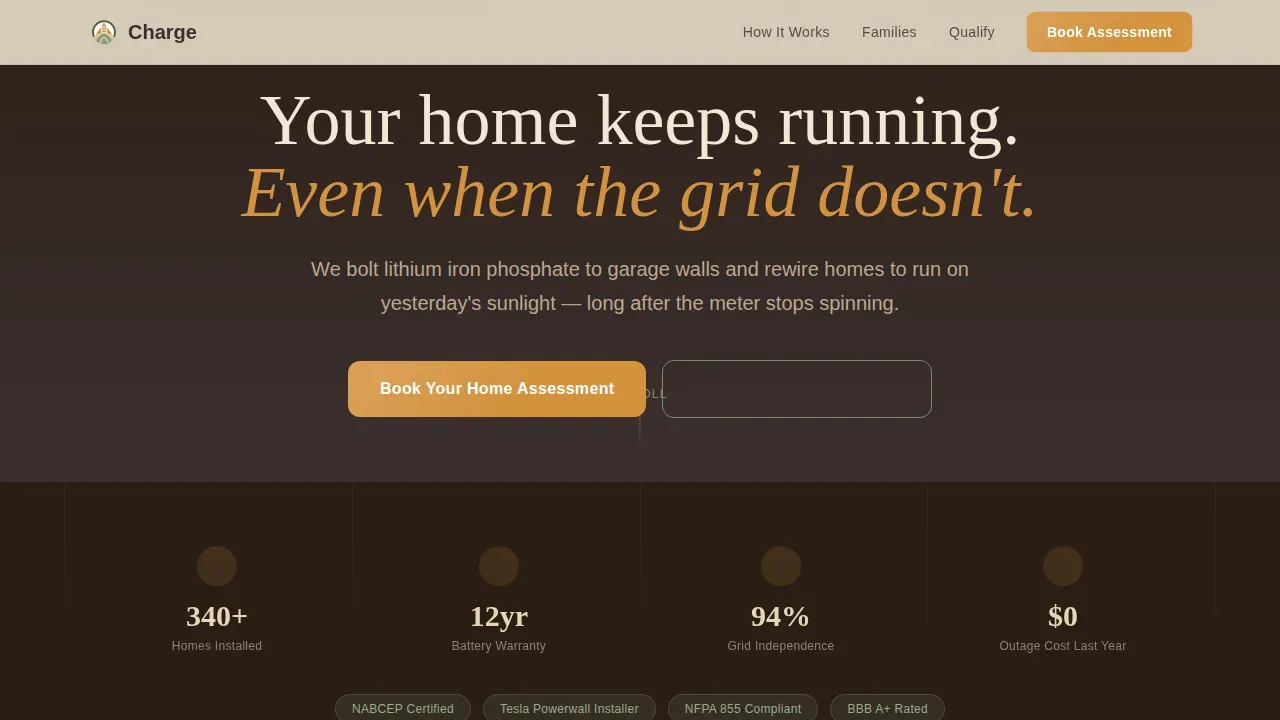
The hero section uses a side-by-side photo comparison with a draggable divider. Visitors can slide between a dark, outage-era kitchen and the same room glowing with reliable power from an installed battery system. The visual contrast communicates the core value proposition immediately.
Case Study Narrative Flow
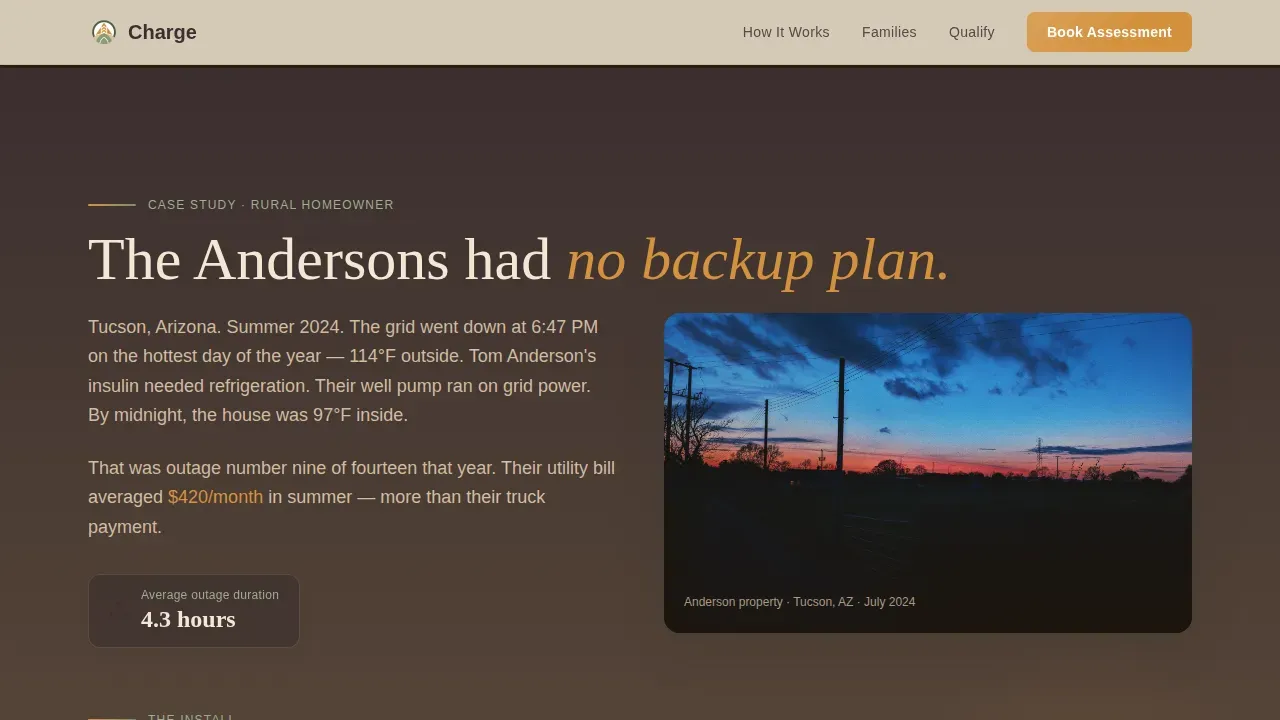
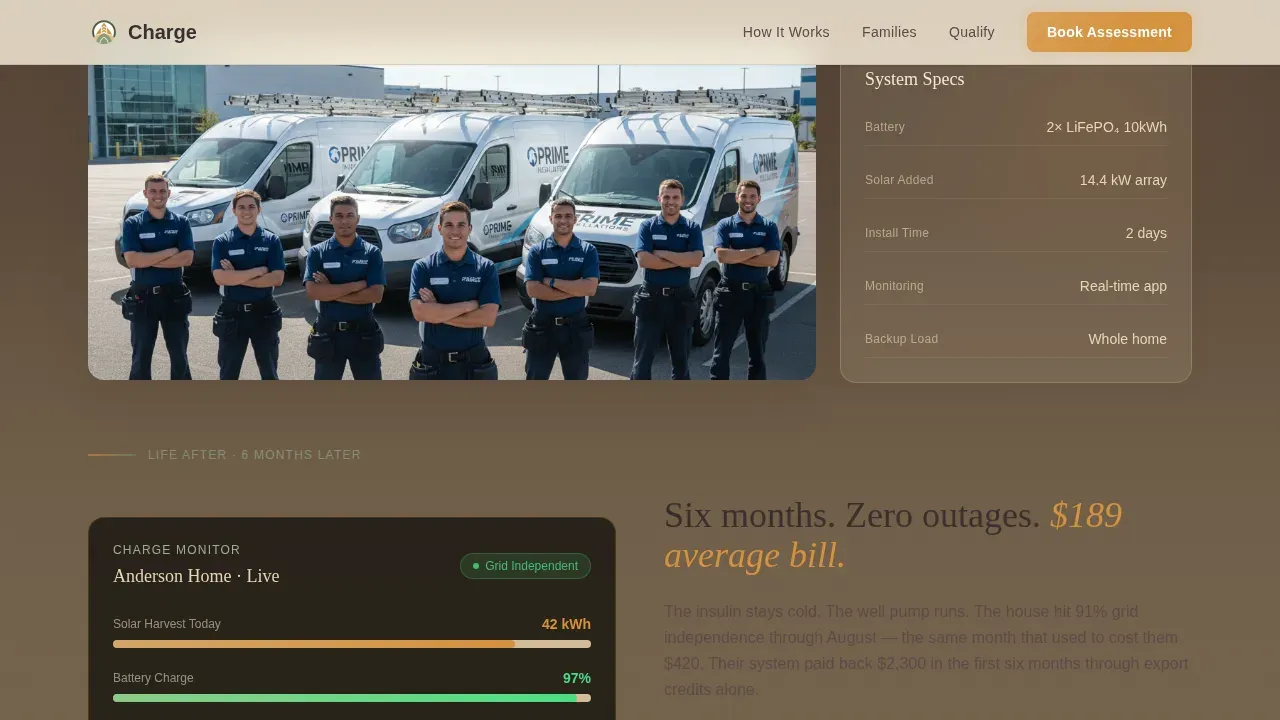
Three scroll sections advance through distinct family stories. Each case study covers the specific problem, the installation process with crew photos and equipment details, and the after state with dashboard screenshots showing solar harvest, battery cycles, and grid independence. Data is woven into the story rather than isolated in a separate section.
Booking Form with Lead Qualification
The primary call-to-action form asks for zip code first to confirm the service area instantly. It then collects home square footage via a range slider, current electricity provider from a dropdown, and preferred visit window. The form is concise and focused, keeping the path to a booked assessment simple.
Solar Calculator Secondary Path
A secondary call-to-action labeled "See If Your Roof Qualifies" links to a solar-exposure calculator. This path captures the same lead data through a utility tool rather than a direct commitment, giving hesitant visitors a lower-stakes way to engage and share their details.
Sunset Mesa Color System
The design uses sun-bleached sandstone for backgrounds, dusky sage for body text and section dividers, deep mesa shadow for headlines, and warm amber reserved for buttons and progress indicators. The palette and typography combine to give the page a golden-hour, desert-hillside warmth that supports trust and readability.
Scroll-Reveal Animation System
Section reveals are staggered as the visitor scrolls. Case study panels animate in sequence, and the square footage slider is interactive. The pacing mirrors the tone shift described in the brief: early sections feel grounded and serious, later sections open into brighter backgrounds as the narrative resolves toward energy independence.
Page sections overview
| Section | Purpose |
|---|---|
| Hero Before/After | Draggable slider with outage-versus-powered kitchen photos and opening headline |
| Anderson Case Study | Rural outage problem, install details, and zero-outage dashboard outcome |
| Booking Form Block | Zip, square footage, provider, and visit window lead form |
| Hobby Farmer Study | Freezer-loss fear, install story, and solar harvest data outcome |
| Off-Grid Case Study | Air conditioning reliability goal, install, and grid independence percentage |
| Solar Calculator Block | Secondary "See If Your Roof Qualifies" lead capture tool |
| Footer Arc Split | Logo and tagline left, navigation links right |
Design & branding system
The Pastoral Calm design system gives this page a warm, unhurried quality that feels trustworthy rather than salesy. Visual elements reflect a commitment to clean, honest energy and reinforce the installer's professionalism.
- Color palette: sandstone (#E8D5B7) backgrounds, sage (#7A8B6F) body text, mesa shadow (#3B2F2F) headlines, amber (#D4913D) buttons and call-to-action elements
- Typography: Fraunces serif for headlines to provide warmth and authority, DM Sans for body text to ensure clean readability across all devices
- Photography style: high-quality real installation photos, golden-hour outdoor conditions, and before-and-after kitchen imagery that ground the design in lived experience
Mobile & speed optimization
This template is built mobile-first, which is essential given that rural homeowners primarily reach service businesses through their phones. The single-column flow translates naturally to smaller screens without sacrificing any interactive features.
- The draggable slider, zip code field, square footage range input, and solar calculator all work within the mobile layout
- Server Components handle static content sections, while Client Components power interactive elements to support smooth performance across varying network conditions
- The layout is responsive and designed to provide a seamless experience across phones, tablets, and desktop screens
How this template helps you convert
This page is structured to earn trust progressively. Each section does a specific job before it asks for anything from the visitor.
- The hero slider and opening case study establish social proof immediately, so visitors understand the real-world impact of a solar battery installation before they read a single specification or price detail.
- The booking form appears first after the opening case study, then again after the second family story, so users who are ready to act at different points in the scroll both reach the form naturally without feeling pushed.
- The secondary solar calculator path gives hesitant visitors a way to engage and receive personalized insights without making a full commitment, widening the funnel while keeping lead quality high.
Other information about this template
The Charge template is built for solar and battery storage businesses ready to compete for high-intent residential leads. It covers the full range of needs a growing installation company faces when trying to scale its booking pipeline.
- Battery lifespan context built into the design: home battery systems can last 10 to 15 years, and the template gives installers space to share warranty details alongside case study outcomes
- The page design supports inclusion of battery capacity stated in kilowatt-hours (kWh) and power output stated in kilowatts (kW) within each case study's equipment section
- Cost transparency is supported: the template offers layout space to communicate price ranges and note that residential solar battery systems in the United States generally cost between $5,000 and $20,000 depending on size and capacity
- Government incentive callouts can be added, including the Federal Investment Tax Credit (ITC), which allows homeowners to claim 30% of the total system cost as a tax credit for solar battery storage
- Many states offer additional rebates, and the template provides natural spots to add these details within case study or call-to-action sections
- The design system and layout are ideal for businesses in the clean energy community that want to contribute to long-term grid independence for rural and suburban homeowners
- The Charge trusted home battery storage landing page template is listed in the Construction & Home, Solar & Energy Installation category on the platform
Theme
Pastoral Calm
Creative direction
Case Study Narrative
Color system
Sunset Mesa
Style
Single Column Flow
Direction
Booking/Scheduling
Page Sections
Draggable Before-and-after Hero Slider
Three-part Case Study Narrative Flow
Lead-qualifying Booking Form
Solar Calculator Lead Capture Path
Scroll-reveal Animation and Tone Progression
Sunset Mesa Design System
Related questions
Can I customize the case study families with my own clients?
Does the booking form support service area filtering by zip code?
What makes LiFePO4 battery chemistry worth highlighting on the page?
Can I add government incentive details to the page?
How does the secondary solar calculator path work?