Equalize — Compensation Benchmarking Landing Page Template
Benchmark is a comparison table landing page template built for creative industry compensation benchmarking. It shows talent teams what candidates actually accepted versus what companies guessed, using filterable salary data across roles, cities, and company sizes. The template blends a dark pitch-deck visual identity with high-interactivity components to turn compensation guesswork into confident, evidence-based hiring decisions.
by Rocket studio
Quick summary
Benchmark is a single-page recruitment landing page template purpose-built for salary benchmarking in the creative and media industry. It surfaces real compensation data across roles, cities, and company sizes so talent teams can stop losing senior creatives to better-paying competitors. The design feels like a pitch deck in a dim conference room: dark, focused, and built around the numbers that change hiring strategy.
Who this template is for
This template is built for HR and talent professionals who work with creative roles and need reliable, role-specific benchmarking data to write competitive offers. It is equally useful for founders who need to benchmark compensation without overspending, and for HR directors managing department-level pay reviews.
- Heads of Talent and Recruiting Directors at mid-size agencies losing senior creatives to larger competitors
- Startup founders writing offers for art directors, user experience leads, and brand strategists without overpaying
- HR directors at media companies conducting compensation planning across entire departments
What problem this template solves
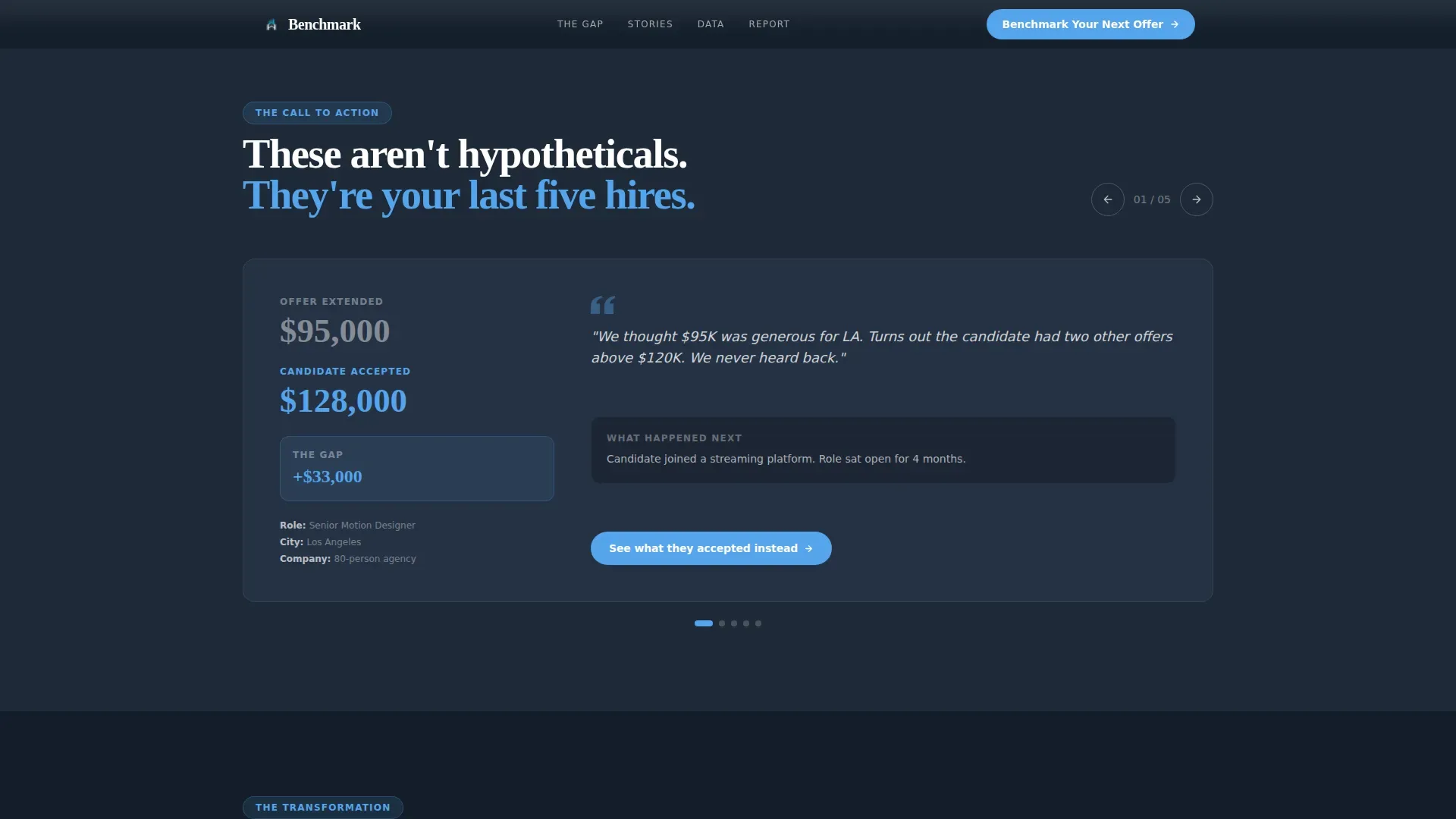
Talent teams in creative industries often rely on guesswork when setting salary ranges. That guesswork costs them candidates. A senior motion designer offered $95K takes $128K elsewhere, and the agency never knows why. This template presents that painful gap visually and immediately, then transitions the visitor toward a solution grounded in real salary data and structured compensation analysis.
- Hiring managers lack role-specific, city-level salary data to write competitive offers with confidence
- HR teams cannot identify pay gaps or uncover pay gaps across job levels without reliable external benchmarks
- Compensation decisions get made reactively, after losing candidates, instead of proactively through salary benchmarking
What you get with this template
The Benchmark template delivers a fully structured, section-led landing page that walks visitors through the problem, the evidence, and the solution in a single scroll. Every section is designed to carry the visitor from recognition of the hiring problem toward action. The page combines data-heavy comparison tables with animated counters, rejection story carousels, and a multi-step conversion form.
- A five-section Hero's Journey page layout: Hero, Gap Table, Rejection Stories, Interactive Benchmark Table, and Trust plus call-to-action section
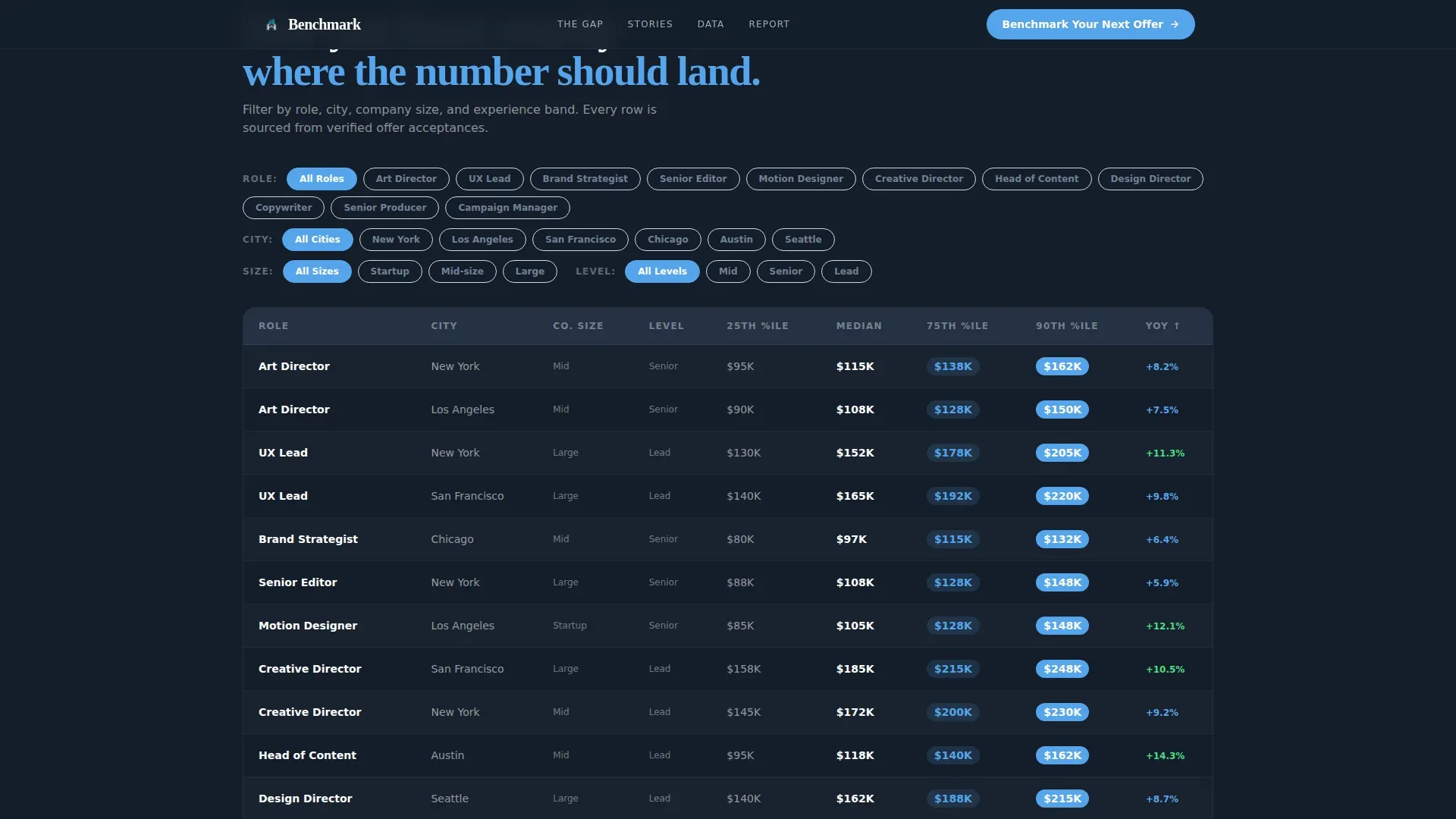
- A filterable salary table with rows that light up on interaction, filterable by role, city, company size, and experience band
- Two conversion paths: a three-step benchmark form and a gated PDF salary report download
Feature list
This template ships with a focused set of interactive and visual components, each prompt-grounded and specific to the compensation benchmarking use case.
Animated Salary Counter Hero
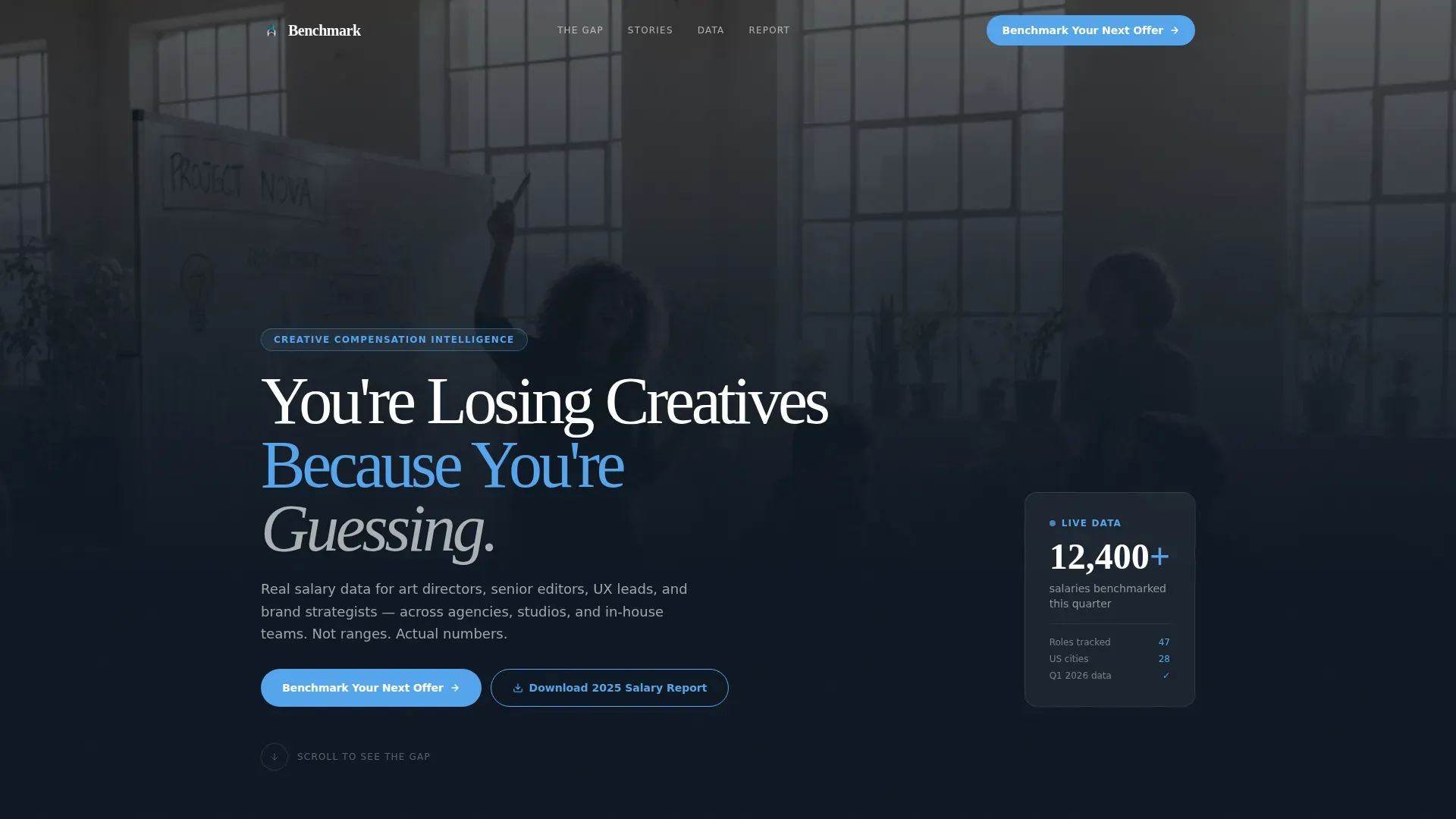
The Hero section opens with a candid team photo overlaid with bold sky-blue display type. Beneath the headline, an animated counter ticks upward in real time, showing the volume of salaries benchmarked this quarter. The counter lends live-data urgency and immediately establishes the platform's credibility with compensation benchmarking data at scale.
Guessed versus. Actual Gap Table
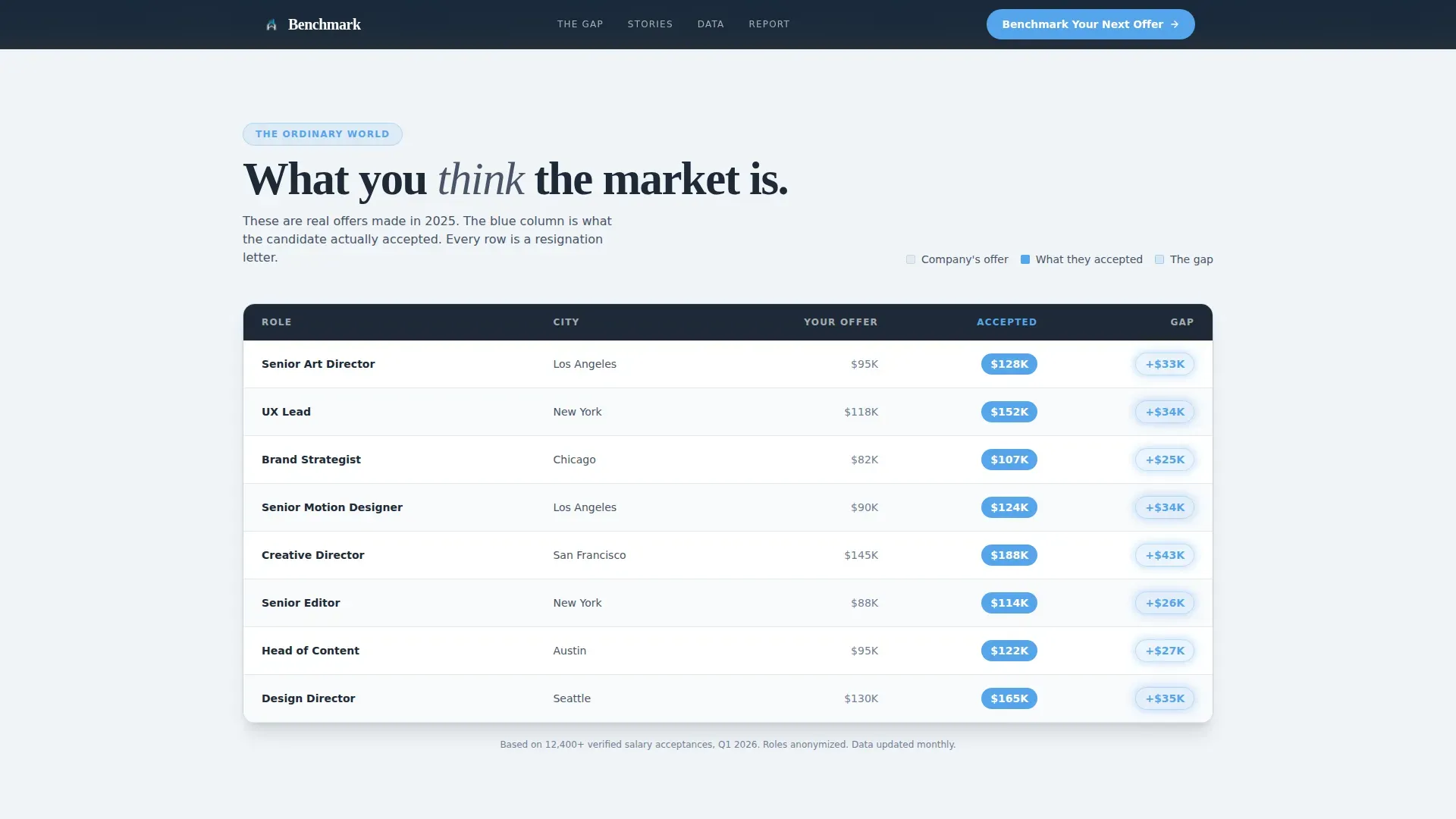
Section two presents a stark side-by-side comparison table showing what companies assumed the market rate was versus what candidates actually accepted. The salary gap is highlighted in sky blue, making the disconnect visceral and impossible to ignore. This is the Ordinary World moment: the visitor sees their own hiring pain reflected in real salary data.
Offer Rejection Story Carousel
A scrollable carousel surfaces anonymized offer-rejection stories tied to specific job title, city, and pay figure combinations. Each story is a brief, specific lost-candidate moment that builds empathy and urgency. The carousel reinforces why thorough compensation analysis and current salary surveys matter before a single offer goes out.
Interactive Filterable Benchmark Table
The core salary benchmarking tool of the page is a fully filterable data table. Visitors can filter by role, city, company size, and experience band. Rows light up on interaction, replacing anxiety with real-time compensation data. This is where compensation analysis becomes actionable rather than abstract.
Three-Step Benchmark Form
The primary call to action is a guided three-step form: role title and city first, then company size and budget range, then work email. Each step is intentional. The structure mirrors a real compensation planning workflow and reduces drop-off by keeping inputs contextual and low-friction at each stage.
Gated Salary Report Download
A secondary conversion path offers visitors the option to download a gated PDF salary report. This captures email and job title from visitors not yet ready to commit to the full benchmark form. It extends the reach of the compensation strategy offer without sacrificing lead quality.
Page sections overview
| Section | Purpose |
|---|---|
| Hero with Counter | Establish urgency with a candid team photo, bold headline, and animated salary volume counter |
| Guessed versus. Actual Table | Show the gap between assumed market rates and what candidates actually accepted |
| Rejection Story Carousel | Humanize the cost of bad offers through anonymized, role-specific lost-candidate stories |
| Interactive Benchmark Table | Let visitors filter salary data by role, city, company size, and experience band |
| Trust and call to action | Deliver social proof stats, the three-step benchmark form, and the gated PDF download path |
| Footer | Single-row linear footer with minimal navigation |
Design & branding system
The Benchmark template uses the Slate and Sky color system within a Startup Velocity theme. The visual language is intentionally editorial: dark, data-dense sections command attention, while sky-blue accents make key figures glow. The typography pairing of DM Sans for interface text and Fraunces for display headlines creates the weight of a published salary report inside a fast-loading landing page.
- Deep charcoal slate (#1E2A38) anchors headers and data-dense table sections; pale stratosphere white (#F0F4F8) opens up breathing space in background areas
- Sky blue (#56A5EC) fires across calls to action, gap highlights in tables, and interactive data points; mid-tone graphite (#4A5568) handles body text and table borders
- Fraunces display headlines carry editorial authority; DM Sans handles all interface, label, and body copy at high readability across sizes
Mobile & speed optimization
The Benchmark template is desktop-first by design. The data-heavy comparison tables and interactive benchmark grid are built for the focused, conference-room context in which talent and HR teams review compensation data. A solid mobile fallback is included, ensuring the page remains navigable and legible on smaller screens without compromising the desktop experience.
- Server Components handle static content sections for reliable load behavior; Client Components are scoped to the interactive table, animated counter, and multi-step form
- The carousel and filterable table are architected as isolated interactive components, keeping non-interactive sections lean
- Scroll reveal animations and table row highlight interactions are contained to client-side component boundaries
How this template helps you convert
Every section of this template is ordered to earn the click rather than demand it. The visitor moves from recognizing a painful hiring problem to seeing the evidence of what it costs, to interacting with the data that resolves it. By the time the primary call to action appears, the visitor has already seen the value of compensation benchmarking in action.
- The gap table and rejection stories show the real cost of guessing on salary ranges before a single form field appears, building trust through specificity and evidence
- The filterable benchmark table lets visitors experience the data before committing, making entering their own numbers feel like a natural next step rather than a cold form fill
- The gated PDF download path captures visitors who are researching compensation strategy but not yet ready to commit, widening the top of the funnel without diluting the primary conversion path
Other information about this template
This template is designed to support the full compensation analysis lifecycle, from initial salary benchmarking through to compensation planning and offer-stage decisions. It incorporates several evidence-backed principles relevant to HR teams working on pay equity and competitive pay in the creative sector.
- A compensation analysis is a structured review of how an organization pays its employees, measured against both internal data and external benchmarks. This template stages that process visually, from gap identification through data-driven resolution.
- Salary benchmarking is the systematic process of comparing internal salaries against market data to ensure competitive and fair pay. Benchmarking replaces subjective negotiations based on a candidate's salary history with objective, market-based salary ranges.
- Pay equity analysis digs into potential disparities across demographics, job level, and location. Regular salary benchmarking promotes pay equity by identifying and addressing pay gaps across roles, genders, and cities.
- Salary compression can occur when disclosing salary bands leads to smaller pay gaps between new hires and veterans. A well-structured compensation analysis template helps HR teams catch and address this early.
- Compensation benchmarking data is only useful if it reflects the labor market you are actually competing in. External salary benchmarks from labor market reports and salary surveys must be city-specific and role-specific to be accurate.
- High-quality candidates are 82% more likely to apply for jobs that list pay ranges. Transparency can reduce pay disparities by 20% and foster a culture of accountability across departments.
- Only 30% of U.S. workers said they were satisfied with their compensation in 2024. Employees who feel underpaid are 45% more likely to look for a new job, even when their base pay is at or above market rates.
- Pay transparency laws now mandate salary range disclosure in states including California, Colorado, and Washington. A rigorous, well-documented compensation analysis process helps organizations stay ahead of equal pay laws and transparency laws rather than reacting to them.
- Benchmarking salaries before budget setting allows organizations to plan salary adjustments that align with current market rates. A well-defined compensation strategy, grounded in benchmarking data, helps organizations allocate resources efficiently.
- The benchmark salary transparency compensation benchmarking landing page template is suited to teams running comprehensive compensation analysis across multiple creative roles simultaneously, including internal and external data review cycles.
- A free compensation analysis template or a free compensation tool can help HR teams start structuring salary data collection before adopting a full platform. This template supports that entry point by demonstrating the value of structured pay data through its interactive comparison design.
- Compensation analysis templates can include sections for employee data, current base salary, external salary benchmarks, and internal pay comparisons. Regularly updating a compensation analysis template helps ensure pay practices remain competitive and compliant with applicable regulations.
- A thorough compensation analysis follows a clear sequence from defining scope to communicating results. Documenting the process creates a reliable record of data sources, statistical methods, and remediation decisions for compliance checks.
- Real-time salary benchmarking tools automatically update benchmarks to reflect market changes. Choosing the right salary benchmarking tools is essential for effective compensation planning, especially in fast-moving creative labor markets.
- Internal equity analysis compares employees within the same company to ensure fair compensation based on similar roles, tenure, and performance. Combining internal compensation data with external data gives HR teams a complete picture for fair pay decisions.
- Compensation analysis supports several business goals including improving employee satisfaction, retaining top talent, and keeping pay structures consistent with company growth stage.
- Market competitiveness analysis involves reviewing total compensation against external sources like benchmark reports and salary surveys. This ensures that base pay, equity grants, and the full package remain competitive across every job level.
Theme
Startup Velocity
Creative direction
Hero's Journey
Color system
Slate & Sky
Style
Comparison Table
Direction
Recruitment/Hiring
Page Sections
Animated Salary Counter Hero Section
Guessed Versus. Actual Salary Gap Table
Offer Rejection Story Carousel
Filterable Interactive Benchmark Table
Three-step Benchmark Conversion Form
Gated PDF Salary Report Download
Related questions
What types of creative roles does this template present salary data for?
Can this template support both a primary and a secondary conversion path?
How does the template show the cost of not benchmarking salaries?
Is this template suitable for startup founders as well as large HR teams?
What is the visual style and layout approach of this template?