Co-op Housing Real Estate Professional Website Template
The Commune co-op housing landing page template helps housing cooperatives turn curious visitors into committed members. Built for co-op housing developers, it pairs an emotional before/after reveal layout with a five-question interactive quiz. Residents can find their co-op model match in minutes. The warm stone visual identity makes collective ownership feel grounded, affordable, and genuinely within reach.
by Rocket studio
Quick summary
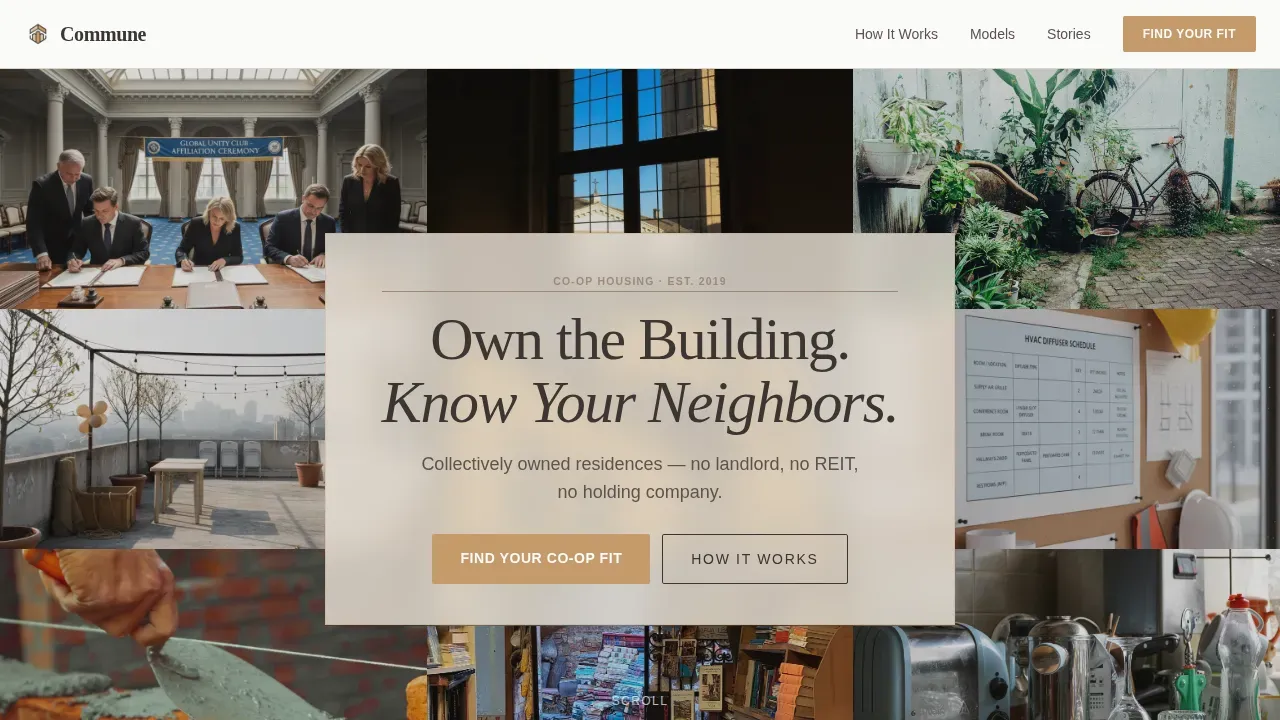
Commune is a single-page landing page template built for co-op housing developers. It uses a zigzag before/after reveal layout, a nine-tile photo grid mosaic hero, and a five-question interactive quiz to move prospective members from curiosity to action. The design is Luxe Minimal with a warm stone palette, making co-op ownership feel warm, stable, and real.
Who this template is for
This template is built for mission-driven housing cooperative developers who want a high-converting online presence without starting from scratch. It speaks directly to organizations helping people live collectively and build equity together.
- Co-op housing developers launching new-build, conversion, or retrofit programs
- Housing activists and community organizers ready to recruit members online
- Retiring couples and priced-out professionals who want to share resources and own collectively
What problem this template solves
Most people assume co-op housing is impossibly complex. They do not know how to purchase a share, what monthly costs cover, or how the co-op model differs from renting. A generic website fails to address these concerns clearly.
- Visitors leave without understanding what co-op ownership actually involves
- Developers lose warm leads because there is no guided path from interest to action
- The emotional case for co-op living goes unmade, and people default back to rent
What you get with this template
This template gives co-op housing developers a full single-page layout that builds trust, communicates benefits, and converts visitors into prospective members. Every section is purposeful and prompt-backed.
- A nine-tile photo grid mosaic hero with a fade-in headline that sparks an emotional connection immediately
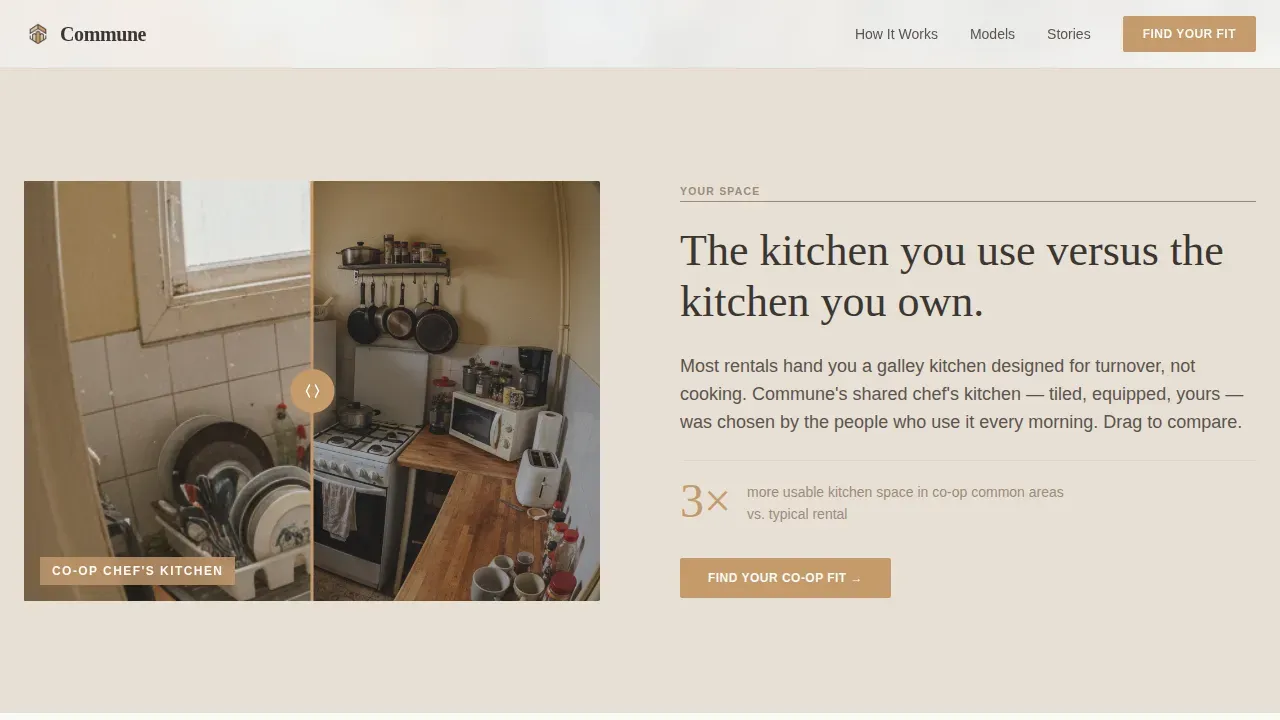
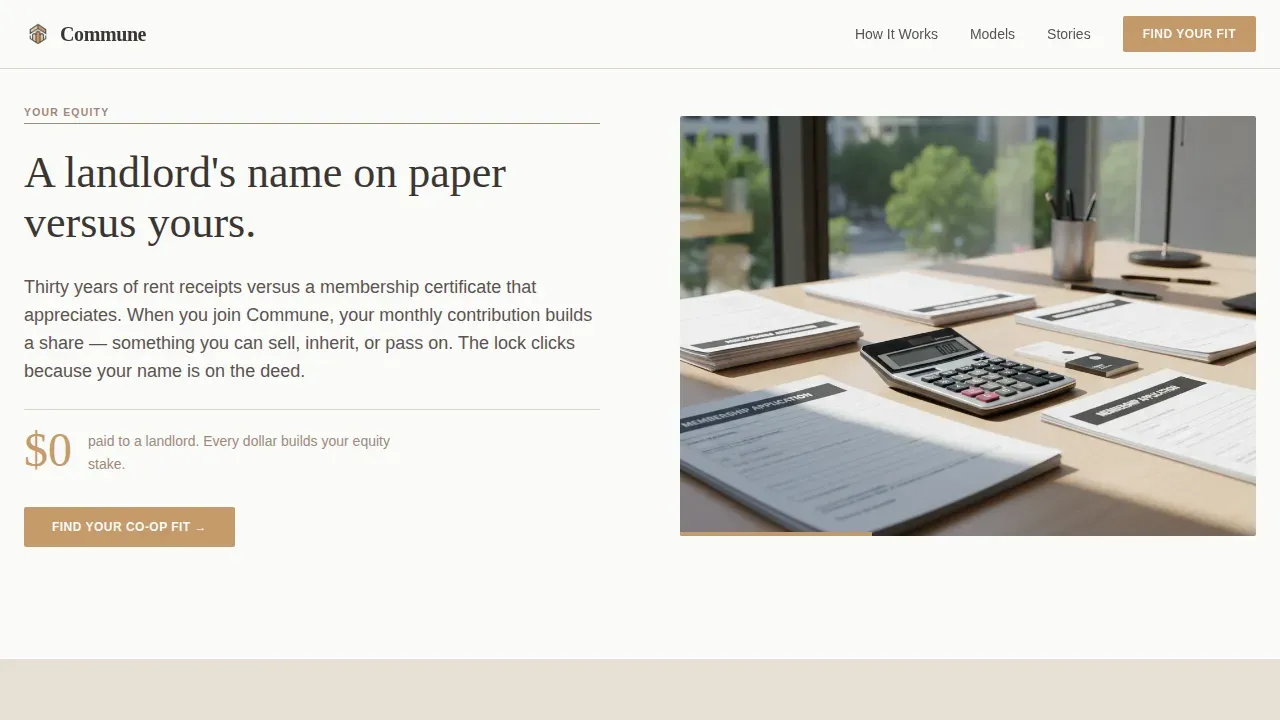
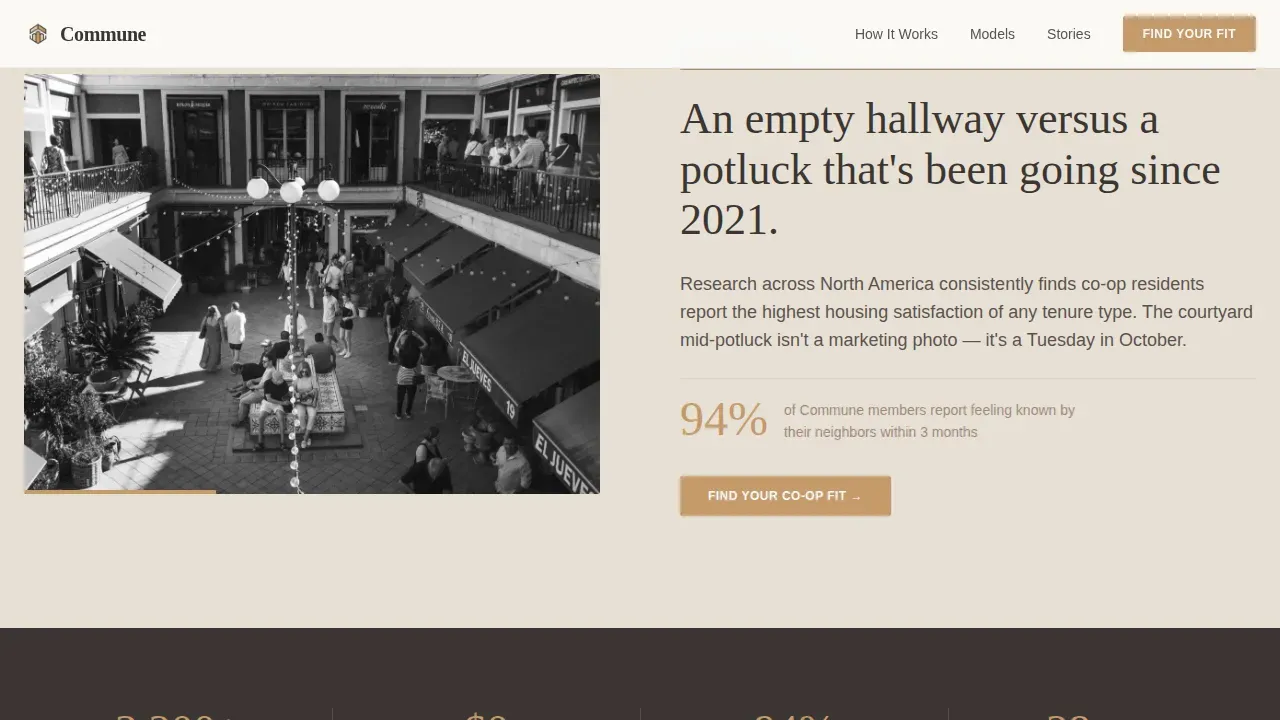
- Three before/after reveal sections with a draggable slider showing co-op life versus conventional housing
- A five-question interactive quiz that delivers a personalized co-op model match and a secondary call to action
Feature list
This template includes the following built-in features, each designed to help housing cooperatives tell their story and find the right members.
Nine-Tile Photo Grid Mosaic Hero
The hero fills the viewport with nine square image tiles arranged in a three-by-three grid. Each tile captures a fragment of co-op life: hands signing documents, a shared kitchen, a rooftop at golden hour. The headline "Own the Building. Know Your Neighbors." fades in over the center tile, forming an immediate emotional bond with potential residents.
Zigzag Before/After Reveal Sections
Three alternating sections pair conventional housing reality against the co-op alternative using a draggable slider. The sequence moves from personal space to shared space to financial freedom, helping visitors directly feel the contrast. This layout is the visual backbone of the community cohesion argument.
Interactive Five-Question Co-op Fit Quiz
The primary call to action, "Find Your Co-op Fit," leads into a multi-step assessment. Visitors answer questions about their current housing situation, neighborhood preference, household size, monthly contribution comfort, and top priority. Results match them to a co-op model: new-build, conversion, or retrofit. A secondary prompt invites them to book a Member Info Session.
Resident Testimonial Section
A social proof section features real member stories with photos, quotes, and co-op model context. Peer proof is consistently more persuasive than expert claims for communities considering collective living. These transformation stories help prospective members see themselves in the co-op.
How It Works Bento Layout
Three co-op models are presented in an asymmetric bento grid layout. Visitors can read how each model works, what the structure involves, and how costs are shared. This section directly reduces the complexity that makes many people hesitate to buy into a housing cooperative.
Arc Browser Split Footer
The footer uses a split layout: the Commune logo and tagline sit on the left, navigational links on the right, and social icons anchoring the bottom. It keeps the co-op's brand identity clear and consistent to the final scroll.
Page sections overview
| Section | Purpose |
|---|---|
| Photo Grid Hero | Spark emotional connection instantly |
| Before/After Reveals | Show co-op versus conventional housing |
| How It Works | Explain three co-op models |
| Resident Testimonials | Build trust through member stories |
| Co-op Fit Quiz | Guide visitors toward personalized action |
| Arc Split Footer | Close with brand clarity |
Design & branding system
The visual identity follows a Luxe Minimal theme using a warm stone color palette. Every color choice communicates stability, warmth, and permanence, qualities that map directly onto what a housing cooperative promises its members.
- Limestone (#E8E0D5) and white alternate as section backgrounds; charcoal mortar (#3B3633) carries all body text and headings
- Wet clay (#A0897B) handles secondary text and borders, giving the layout an unhurried, tactile quality
- Oxidized brass (#C49A6C) appears only on buttons, progress indicators, and interactive accents, drawing the eye toward every call to action
Mobile & speed optimization
The template is designed desktop-first with full mobile responsiveness across every section. The quiz component is built as a client-side interactive element, while static sections use a server-component approach to keep load times low.
- The before/after slider and quiz step transitions adapt cleanly to touch input on mobile devices
- The photo grid mosaic rescales gracefully so the emotional impact of the hero carries through on smaller screens
- Mobile responsiveness matters because a significant share of co-op housing website visitors browse on their phones
How this template helps you convert
A landing page for a housing cooperative needs to do more than inform. It needs to help prospective members find their place in the co-op story and take a concrete next step.
- The photo mosaic hero and fade-in headline form an immediate emotional pull, encouraging visitors to read further rather than bounce
- The before/after slider makes the benefits of co-op living tangible by showing the contrast directly, building confidence before the quiz appears
- The five-question quiz reduces co-op ownership from abstract ideology to a concrete, personalized recommendation, making it easy for people to take action and book a session
Other information about this template
This template is a strong fit for organizations that work across a range of co-op housing models. Understanding those models helps developers implement the right messaging for their audience.
- Limited equity cooperatives restrict the resale value of shares to protect long-term affordable housing access for future residents and shield the co-op from the speculative market
- Limited or zero-equity affordable housing cooperatives can access grants and government subsidies to make co-op shares more affordable for low-income tenants
- Members of a housing cooperative typically pay monthly fees that cover maintenance costs and operating costs, keeping finances transparent and predictable
- A housing cooperative is a legal entity, usually a non-profit corporation, where residents hold individual shares while the co-op corporation holds the title to units and common spaces
- The co-op model protects residents from eviction and gentrification by removing the building from conventional landlord control
- The coop structure supports democratic decision making: a resident-elected board can govern the property, set rules, and implement improvements directly
- Insurance, loan arrangements, and long-term maintenance programs are typically managed collectively, helping members secure stable housing for years
- Real-world cooperatives such as the Columbus United Cooperative in San Francisco helped low-income tenants purchase their units with public subsidy, demonstrating that the model works at scale
- This commune own together co op housing landing page template is designed to help developers communicate all of these benefits clearly and confidently to prospective members who are ready to find a better way to live
Theme
Luxe Minimal
Creative direction
Before/After Reveal
Color system
Warm Stone
Style
Zigzag/Alternating
Direction
Quiz/Assessment
Page Sections
Nine-tile Photo Grid Mosaic Hero
Zigzag Before/after Reveal Layout
Five-question Interactive Co-op Fit Quiz
Resident Testimonial Social Proof Section
How It Works Bento Grid
Arc Browser Split Footer
Related questions
What co-op housing models does this template support?
Can non-technical co-op teams manage and update this template?
How does the before/after slider work for visitors?
Does the quiz deliver a genuinely personalized result?
Is this template suitable for affordable housing cooperatives that rely on grants or subsidies?