Local Manufacturing Processes Comparison Website Template
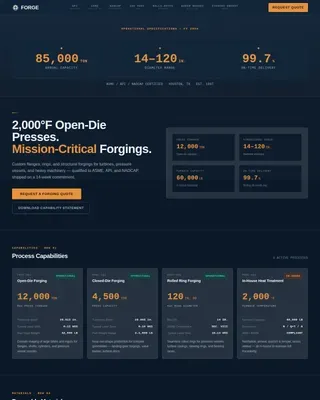
Forge is a dashboard-style deep drawing equipment comparison landing page built for manufacturing engineers and procurement managers. It presents press specifications inside an interactive data grid, walks visitors through tonnage force diagrams and tolerance cross-sections, and closes with a dual-path lead capture form. The dark engineering blueprint aesthetic signals serious industrial authority from the first scroll.
by Rocket studio
Quick summary
Forge is a single-page comparison template designed for deep drawing press manufacturers targeting capital equipment buyers. It leads with a cinematic full-bleed press photo, opens into a live specification data grid, and guides engineers through animated spec deep-dives before offering two conversion paths. Every design choice reinforces the credibility that industrial customers demand before a six-figure purchase.
Who this template is for
This template is built for manufacturers and sales teams in the precision metal forming space. It speaks the language of engineers who compare press specifications before committing budget, not marketers looking for generic product pages. The target audience includes buyers at every stage of a capital equipment shortlist.
- Manufacturing engineers evaluating hydraulic, mechanical, and servo-driven press options for automotive, aerospace, or medical applications
- Procurement managers building competitive shortlists and requesting formal spec sheets for capital equipment bids
- Plant directors replacing aging transfer presses that repeatedly miss tolerance on progressive draws
What problem this template solves
Industrial buyers researching heavy machinery rarely convert through a standard brochure page. They need actual numbers, side-by-side comparisons, and proof that the manufacturer welcomes scrutiny. Without a structured comparison format, visitors leave for a competitor who shows their data openly.
- Engineers lose confidence when a press manufacturer hides specifications behind a contact wall, making it harder to generate leads from serious buyers
- Procurement managers waste time chasing disconnected data sheets instead of comparing press models in one place
- Plant teams cannot justify capital spend without seeing tolerances, bed dimensions, stroke lengths, and cycle speeds in a single, scannable view
What you get with this template
The template delivers a complete, single-page conversion experience built around transparent specification comparison. Every section has a defined job, from the hero that establishes authority to the lead form that captures qualified demand. The page is designed to keep interested visitors engaged long enough to act.
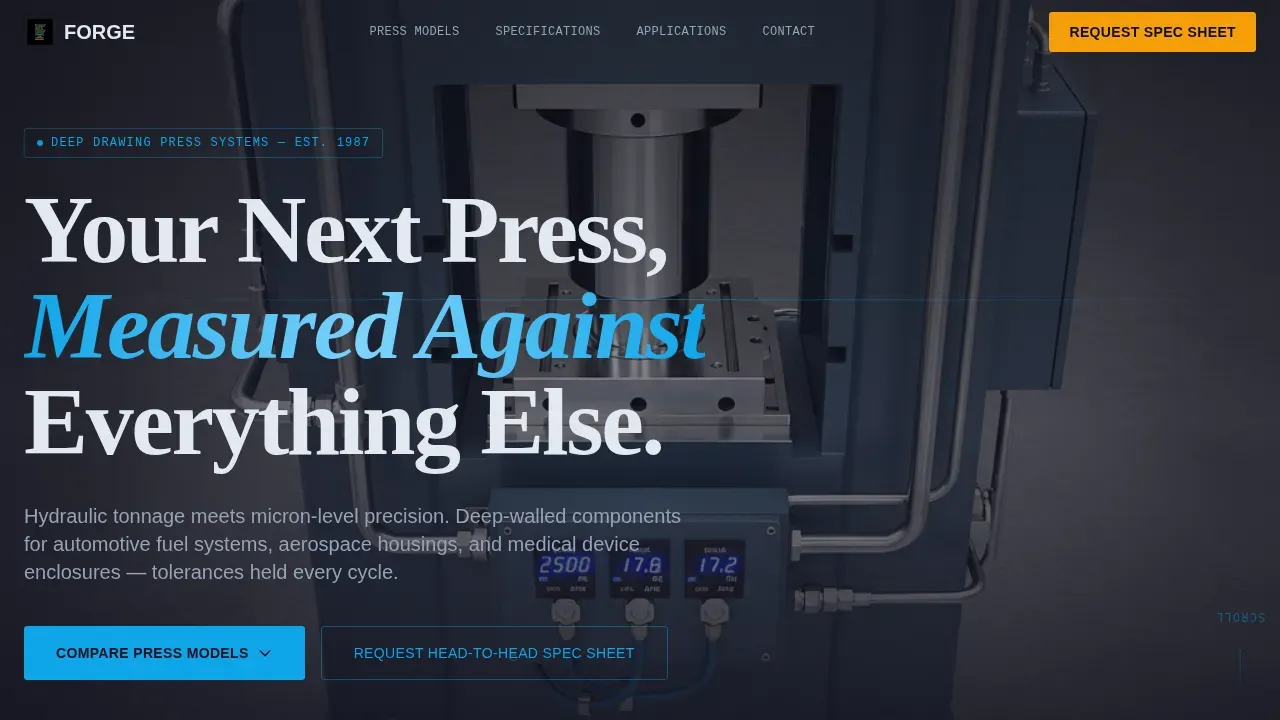
- A full-bleed cinematic hero with a blur-in headline and a stats bar that surfaces key performance figures immediately
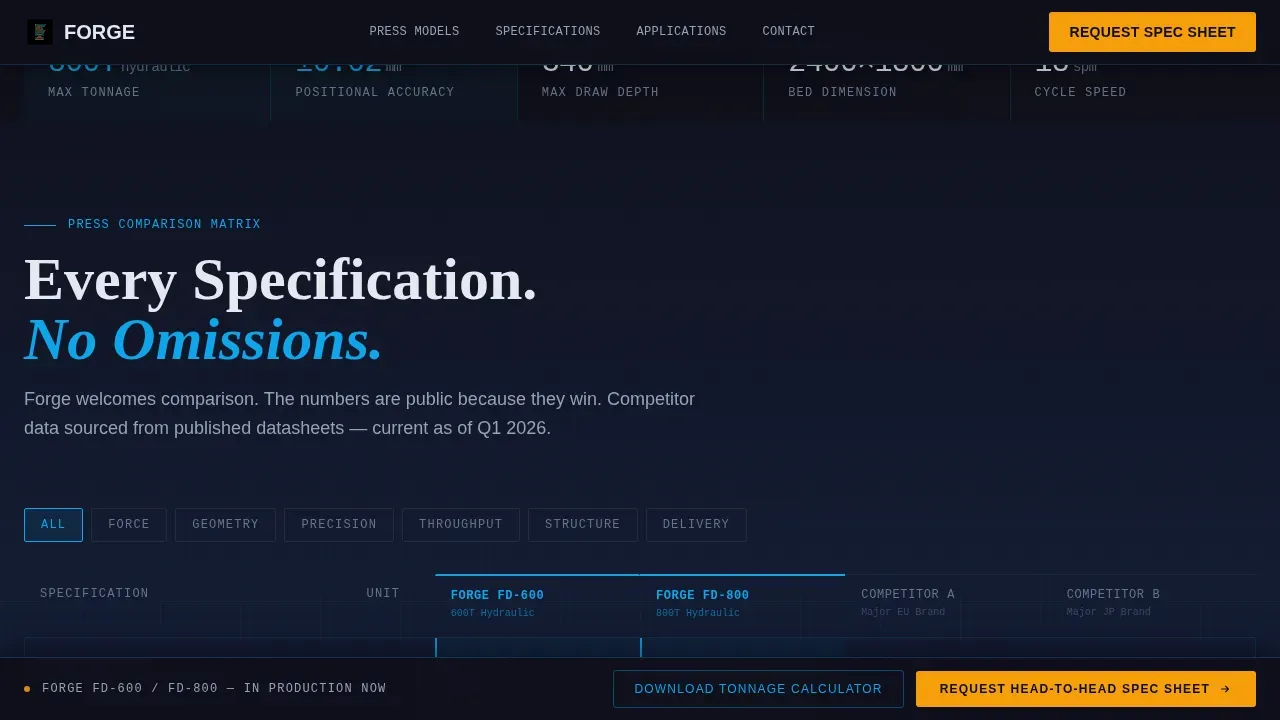
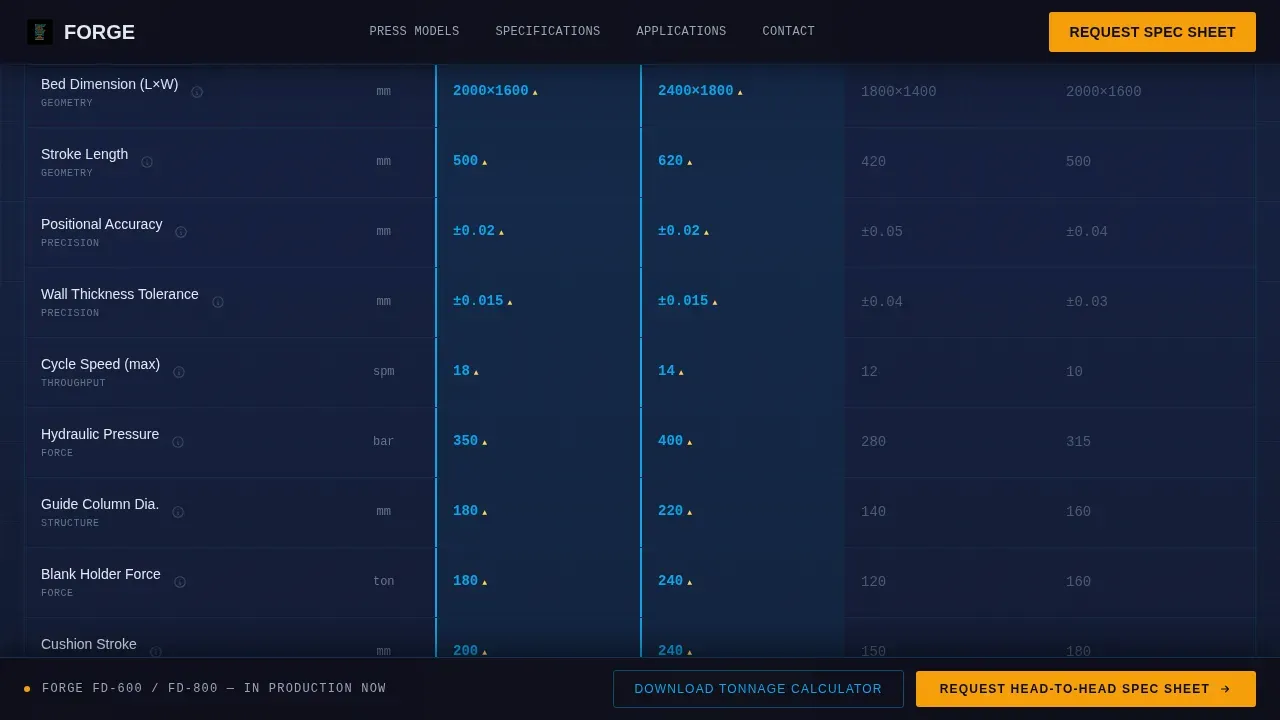
- An interactive comparison data grid arraying press models as columns with tonnage, stroke length, bed dimensions, draw depth, cycle speed, and positional accuracy as rows
- A dual-path lead capture form requesting a head-to-head spec sheet or a downloadable tonnage calculator behind a minimal email gate
Feature list
The Forge template is built around a small set of high-impact features. Each one exists because capital equipment buyers have specific requirements that a generic page cannot meet.
Cinematic Full-Bleed Hero Section
The header opens with a real press photo shot from inside the press bed looking upward. The ram is mid-descent, a half-formed stainless steel shell catches workshop light, and hydraulic lines frame the composition. A single headline fades in over the lower third, communicating the value proposition instantly. High-quality imagery like this helps customers evaluate operational quality before reading a single spec.
Interactive Specification Comparison Grid
The core of the page is a data grid with press models as columns and specification rows covering tonnage, stroke length, bed dimensions, draw depth capacity, cycle speed, and positional accuracy. Amber hover states fire on cells to highlight a spec advantage or a tonnage differential. This product comparison structure lets users compare different models of deep drawing equipment without leaving the page.
Animated Spec Deep-Dive Panels
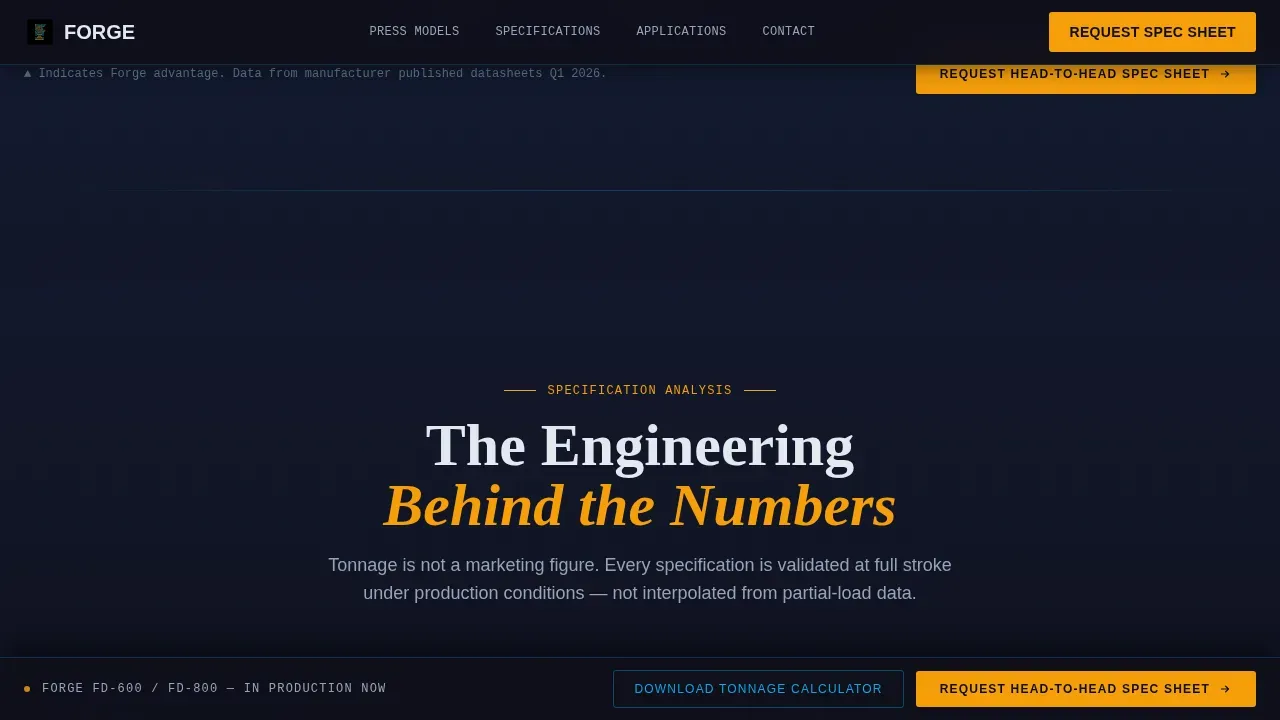
Below the grid, each specification row can expand spatially. A tonnage comparison becomes an animated force diagram. A tolerance comparison becomes a magnified cross-section showing wall-thickness uniformity at plus or minus 0.02 millimeters. Scroll-linked animations reveal deeper engineering detail as the user moves down the page, mirroring the layered architecture of the press itself.
Application Fit Bento Grid
A dedicated section presents automotive, aerospace, and medical use cases inside a bento-style card layout. Each card links the press capability to a real output, for example fuel system components, aerospace housings, or medical device enclosures. This section provides the social proof of industry relevance that prospective customers need to confirm the press fits their production context.
Dual-Path Lead Capture Form
The lead capture section offers two conversion paths. The primary call to action, "Request a Head-to-Head Spec Sheet," appears contextually inside the grid and again in a pinned bottom bar. The form asks for current press make and model, part geometry, material gauge range, and annual volume. A secondary path, "Download Tonnage Calculator," sits behind a minimal email gate for engineers still in the research phase. This dual structure serves visitors at different stages of the buying process.
Engineering Blueprint Dark Theme with Amber Callouts
The visual system uses a carbon fiber color palette across all sections. Structural black and machined graphite form the background. Blueprint cyan traces data container edges and grid lines. Status amber fires only on callouts, hover states, and tolerance wins. Consistent branding across every element, from the navigation bar to the footer, reinforces the CNC control panel aesthetic.
Page sections overview
| Section | Purpose |
|---|---|
| Hero with Stats Bar | Establishes press authority with cinematic photo and headline |
| Specification Data Grid | Side-by-side press model comparison with amber hover highlights |
| Spec Deep-Dive Panels | Animated force diagrams and tolerance cross-sections per row |
| Application Fit Bento | Automotive, aerospace, and medical use-case cards |
| Dual-Path Lead Capture | Spec sheet request form and tonnage calculator email gate |
| Pinned call to action Bar | Persistent bottom bar linking to head-to-head spec sheet request |
| Footer | Minimal developer-style footer with navigation links |
Design & branding system
The design language is an engineering blueprint dark theme intended to feel like a CNC control panel in a lights-out factory. Backgrounds stay in deep blacks and graphites. Cyan traces data container edges like markup on a technical drawing. Amber is reserved for moments that demand attention. Consistent quality across every pixel communicates that the manufacturer is as precise about their website as they are about their tolerances.
- Color system: structural black (#1A1A2E), machined graphite (#16213E), titanium mid-tone (#4A5568), blueprint grid cyan (#0EA5E9), status amber (#F59E0B)
- Typography: DM Sans for data and user interface elements, Fraunces for display headlines; both chosen for legibility at high information density
- Layout details: thin cyan grid lines separate sections like technical drawing markup; data cards cast subtle shadows as if floating above the blueprint surface; white space is used deliberately to draw attention to the most important elements without visual overload
Mobile & speed optimization
The template is built desktop-first because engineers and procurement managers compare press specifications at workstations. However, mobile responsiveness is included so that buyers researching on mobile devices during a plant visit or a trade show can still navigate the page. Mobile responsiveness is crucial for templates targeting engineering buyers who may research on-the-go.
- Desktop-first layout optimized for high-density specification grids; the comparison table scales and reflows for smaller screens without losing data integrity
- The navigation bar remains accessible on mobile devices, keeping the pinned call to action bar and key contact links within reach at all times
- Server Components handle static sections while Client Components manage the interactive grid, keeping the page functional across connection conditions and reducing the risk of connection failures on slower networks
How this template helps you convert
Successful landing pages are built around a single goal, and this page is built to generate leads from serious capital equipment buyers. The architecture earns the click by showing all data openly rather than hiding numbers behind a form wall.
- The comparison data grid establishes trust before the call to action appears. By the time a visitor reaches the lead capture form, they have already seen tonnage figures, tolerance specs, and application fit cards. Social proof built through open data is more persuasive than a testimonial alone.
- Two conversion paths serve different buyer readiness levels. Engineers deep in technical research can download the tonnage calculator with only an email. Buyers ready to shortlist can request a full head-to-head spec sheet with a short form. Multiple calls to action cater to different visitor preferences and stages in the buying process.
- The contextual call-to-action placement inside the grid, appearing after at least three specification rows, meets buyers at the moment of highest intent. A strong, prominent call to action at the right moment is the most reliable way to achieve lead capture in industrial sales.
Other information about this template
This section covers additional context about the template's technical construction, metalworking subject matter, and how the page situates itself among broader metal forming process comparisons relevant to the deep drawing industry.
- The forge precision deep drawing equipment comparison landing page template is built as a single-page experience using a dashboard and data grid layout, suitable for capital equipment manufacturers who need to present complex specification tables without requiring multiple page loads
- Metal stamping shapes flat metal sheets into desired forms using dies; deep drawing is a specialized metal stamping process where flat metal sheets are forced into a die cavity under high pressure to form deep-walled components with tight side walls and consistent quality across high volume runs
- Impact extrusion is a related metalworking technique where high pressure forces metal into a die to create seamless components; the impact extrusion process is well suited for simpler cylindrical shapes, while deep drawing handles more complex geometries requiring greater draw depth and taller side walls
- Impact extrusion and deep drawing each have advantages: impact extrusion produces durable parts quickly for mass production of small components such as aluminum tubes and closures, while deep drawing is the preferred method for forming deeper, more complex shapes requiring tight tolerance on side walls and consistent quality across high volumes
- Forging is a separate metalworking technique that starts with heating metal to a pliable state before applying compressive force; forging excels with high-strength metals and produces forged parts and forged components with enhanced mechanical properties due to refined grain structure, making forged parts suitable for applications bearing heavy loads such as landing gear and structural sub assemblies
- Casting involves pouring molten metal into a mold; molten metal casting is slower than metal stamping and produces parts that may require additional machining to achieve final dimensions, whereas stamped and drawn components often need minimal post-processing
- Choosing between deep drawing, impact extrusion, forging, and casting depends on other factors including part geometry, material gauge, required durability, annual volume, and cost; for high volume runs of complex geometries in stainless steel or aluminum, deep drawing is frequently the preferred method
- Common stamped materials include mild steel, stainless steel, and aluminum; aluminum is particularly suitable for lightweight sub assemblies in aerospace and automotive applications where heavy machinery must achieve weight targets without sacrificing strength
- The template's website builder flexibility means development teams can adapt the layout, adjust the data grid rows, or update the application fit cards to match specific requirements without restructuring the entire page
- Incorporating case studies and customer industry logos into the application fit cards is one example of how social proof can be embedded in the page to reassure prospective customers and interested visitors about production credibility
- 73 percent of buyers pay attention to manufacturing websites when making purchasing decisions; using white space effectively and keeping the navigation bar simple are two of the most important elements for retaining visitors who land on an industrial product page
- For high-volume simple parts, mechanical transfer presses are more cost-effective; for deep draws where depth exceeds diameter, hydraulic presses maintain constant tonnage throughout the entire stroke, which is one of the key features highlighted in the comparison grid
- Intricate designs requiring triple-action press configurations or servo-hydraulic drives with programmable recipes for specific parts are well suited to the expanded spec deep-dive panels, which can detail each action configuration and its impact on draw depth, side walls, and positional accuracy
Theme
Engineering Blueprint
Creative direction
Spatial & Architectural
Color system
Carbon Fiber
Style
Dashboard/Data Grid
Direction
Comparison/Versus
Page Sections
Full-bleed Cinematic Hero
Interactive Specification Data Grid
Animated Spec Deep-dive Panels
Application Fit Bento Grid
Dual-path Lead Capture Form
Engineering Blueprint Dark Theme
Related questions
Who is this landing page template designed for?
Does the template include press specification data, or do I supply it?
Can the dual-path lead capture form be customized?
Is this template suitable for manufacturers offering multiple metalworking processes?
How does the page handle buyers who are not yet ready to request a spec sheet?