Marine Manufacturing Complete Professional Website Template
Fairing is a zigzag landing page template built for marine surface treatment and finishing operations. It walks visitors through the hull treatment process station by station, from assessment to launch. A full-bleed header, alternating content panels, a gated coating spec guide download, and an inline antifouling selection chart work together to earn trust before asking for a lead.
by Rocket studio
Quick summary
Fairing is a single-page template for boatyards and hull finishing crews. It uses a Monochrome Steel visual identity, a spatial zigzag layout, and real technical detail to build credibility. The primary conversion path is a gated "Download the Coating Spec Guide" email capture. A secondary inline antifouling chart gives visitors immediate value before the form ever appears.
Who this template is for
This template is built for marine finishing businesses that need to communicate expertise quickly and convert cold traffic into qualified leads. It speaks directly to the people making coating decisions.
- Boatyard managers scheduling winter haul-outs and looking for a reliable coating crew
- Fleet operators losing performance to fouling growth on commercial or recreational hulls
- Private boat owners dealing with osmotic blistering, surface corrosion, or faded topside gloss
What problem this template solves
Marine finishing is a technical trade. Visitors arrive skeptical. They want proof of process before they pick up the phone or share their email. A generic service page cannot carry that weight.
- There is no structured way to walk a visitor through the full treatment process from bare substrate to final gloss
- Most service pages bury the technical detail that actually builds trust with boatyard professionals and fleet operators
- A single call-to-action with no supporting value rarely converts cold marine industry traffic
What you get with this template
You get a complete, production-ready landing page layout that treats every scroll section as a station in the yard. The layout earns the lead by giving away real coating knowledge first.
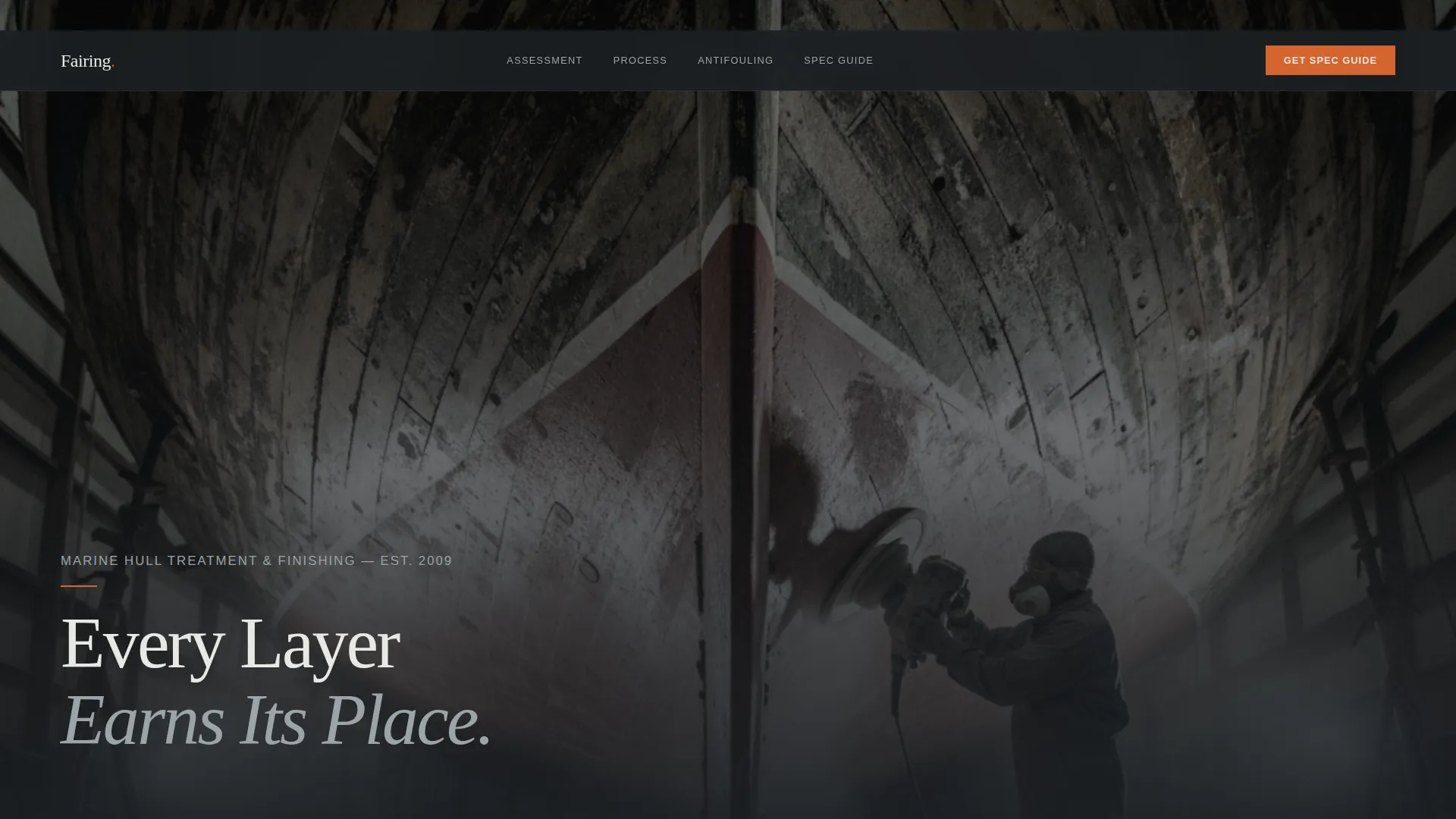
- A full-bleed photo header with a fade-in headline set over a dramatic hauled-vessel composition
- Alternating zigzag content panels that pair environment photography with close-up technical detail and annotation overlays
- A gated coating spec guide download with an expanding email capture form and an ungated inline antifouling comparison chart
Feature list
This template is designed around one idea: expertise shown, not claimed. Each built-in feature serves that purpose directly.
Full-Bleed Photo Header
The header uses a chest-height shot looking up at a hauled vessel's underbody, with scaffold rigging at the edges and a technician running an orbital sander along the waterline. Sanding dust catches a shaft of shed light. The headline "Every Layer Earns Its Place" fades in over the lower third, setting the tone before any body copy appears.
Zigzag Station-by-Station Layout
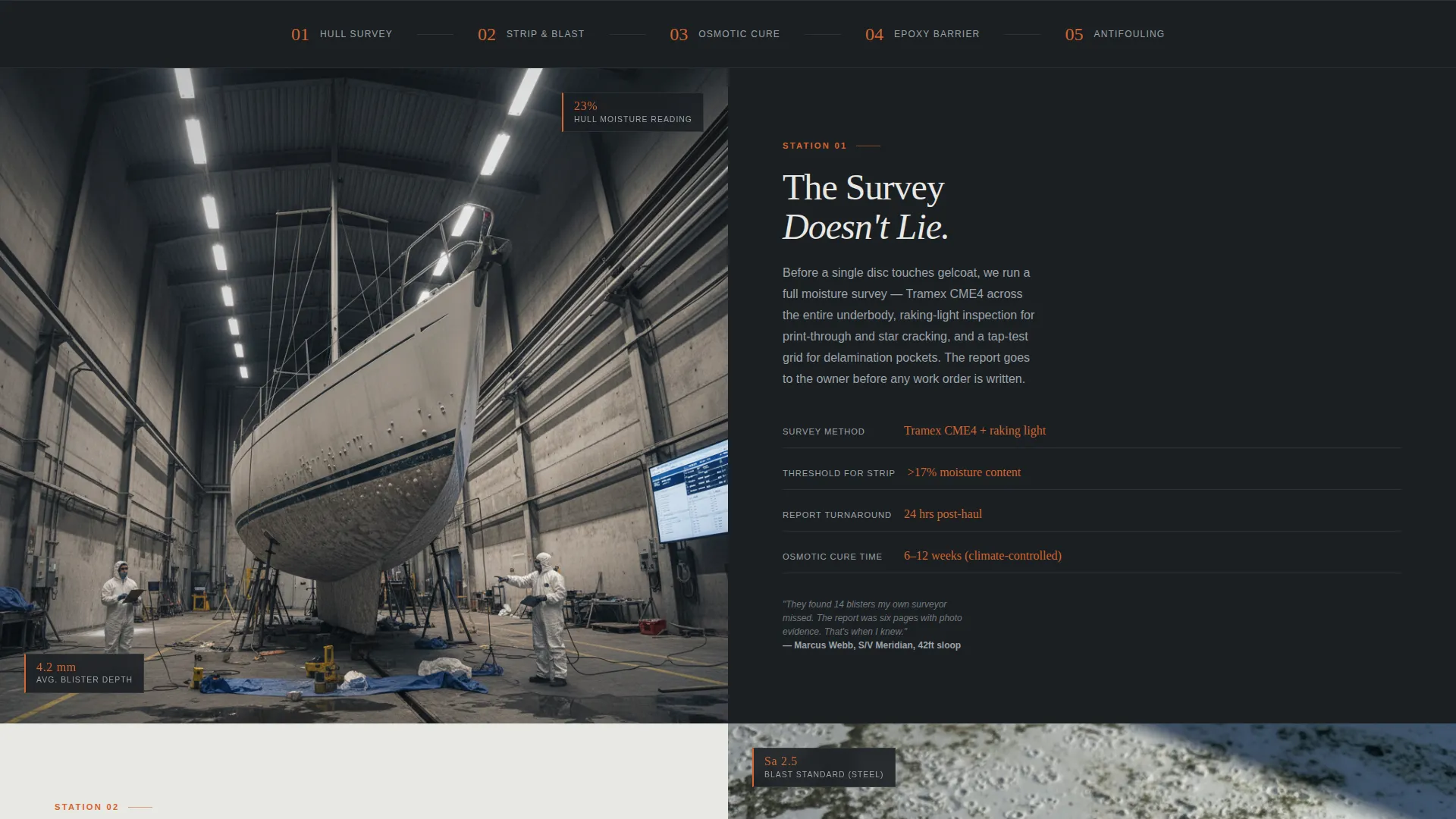
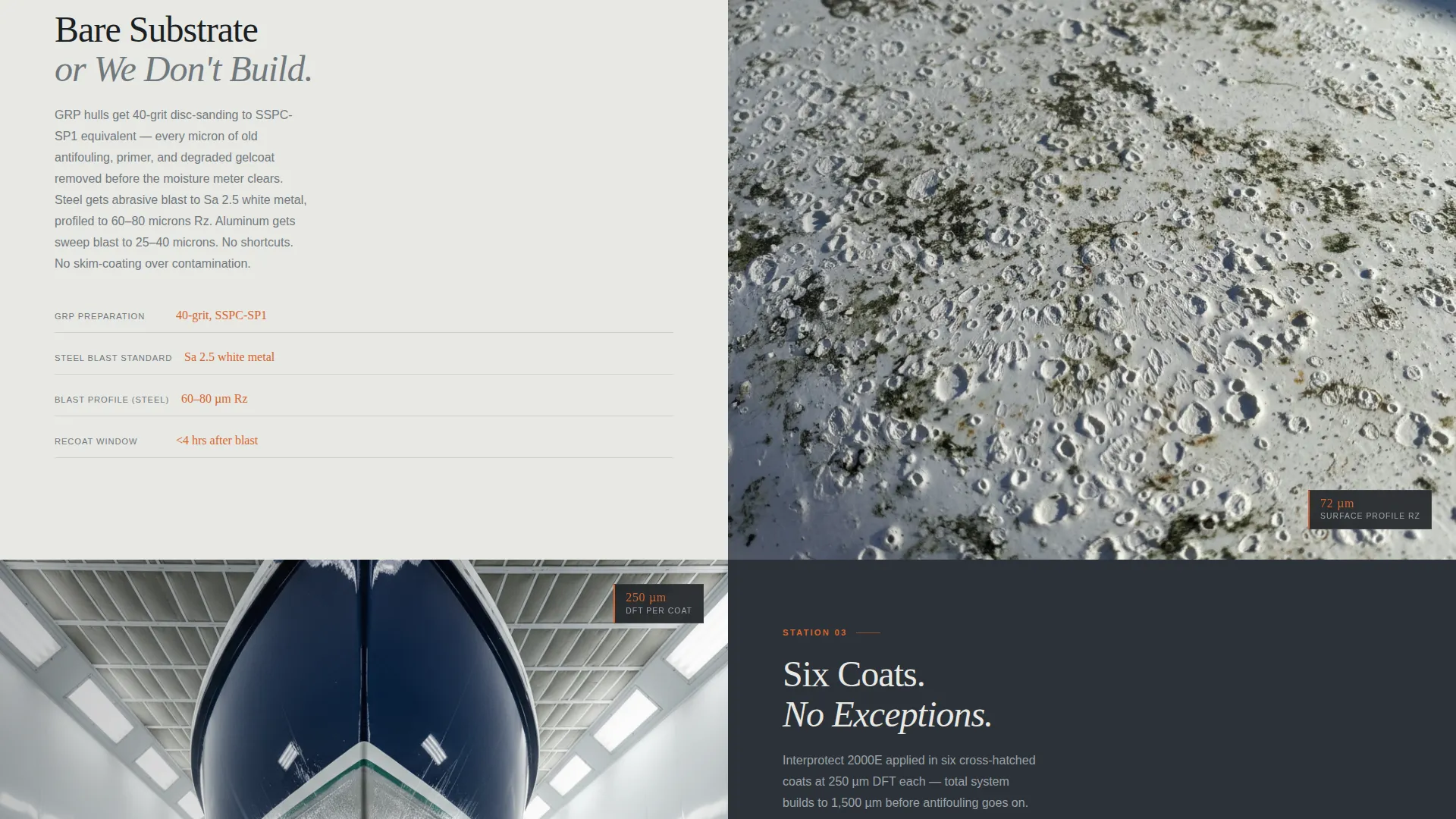
Each alternating panel represents one stage of the treatment process, from the blast bay through the spray booth to the curing shed. Left panels show the working environment; right panels show close-up technical detail. Panels swap sides with each section, creating a physical back-and-forth that mirrors walking between yard stations.
Technical Annotation Overlays
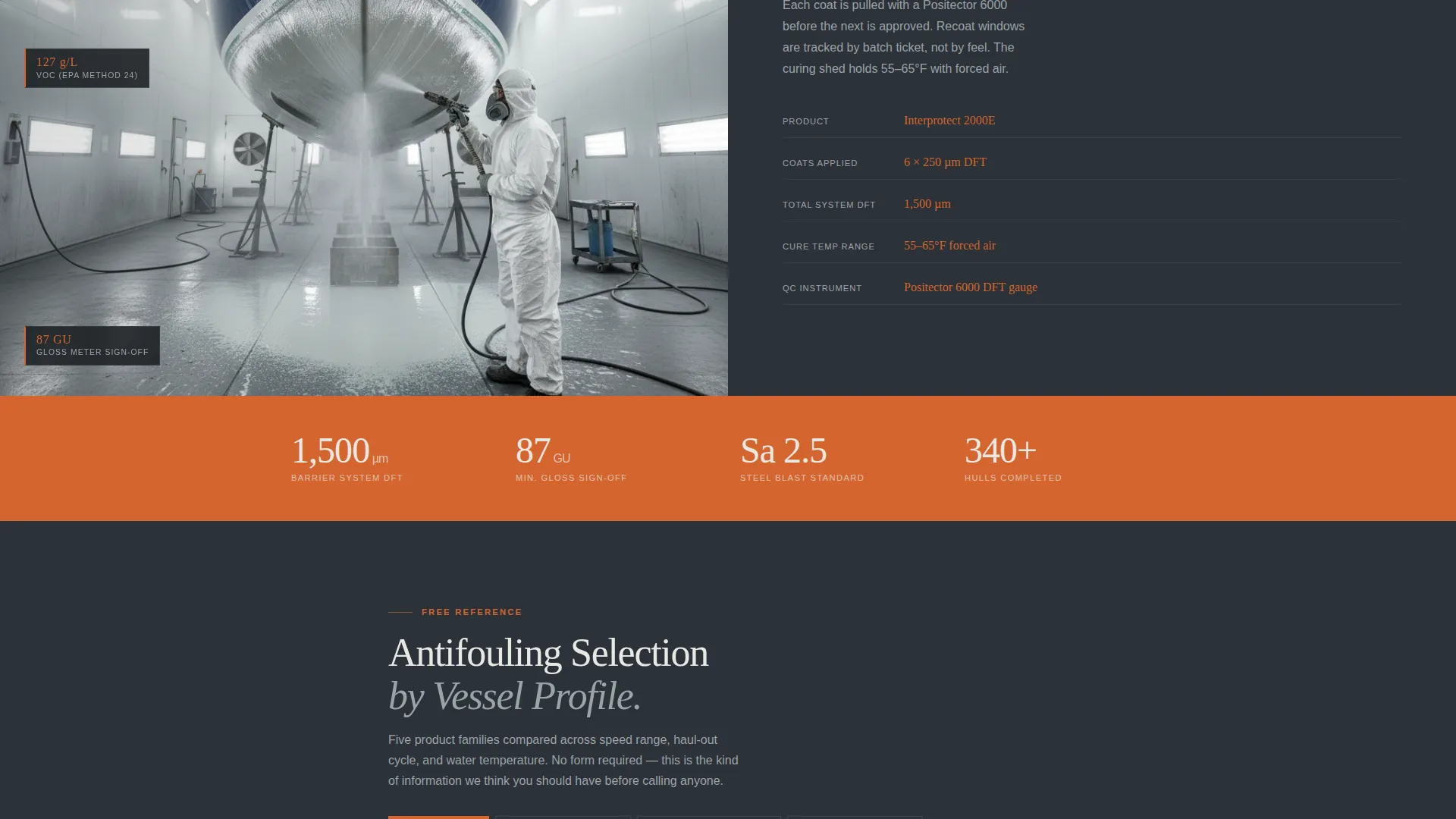
Specification callouts, including mil thickness, recoat windows, and VOC ratings, appear directly on the panel images as annotation-style overlays. This mirrors the way a marine surveyor marks up an inspection report and reinforces technical authority on every section of the page.
Gated Coating Spec Guide Download
The primary call-to-action is a single-field email capture that expands on click. The expanded form reveals two qualifier fields: vessel type (sail, power, or commercial) and hull material (GRP, steel, or aluminum). The gate is lightweight enough to reduce friction while still collecting useful lead context.
Inline Antifouling Selection Chart
An ungated comparison chart sits inline on the page and compares five antifouling product families across three criteria: speed range, haul-out cycle, and water temperature. Visitors get immediate, practical guidance without filling out any form.
Weld-Spark Orange call to action System
The accent color, weld-spark orange (#D4652F), is reserved exclusively for calls-to-action, specification callouts, and hover states. It appears sparingly, like a grinding spark against the steel-gray palette, drawing the eye exactly where the page needs attention.
Page sections overview
| Section | Purpose |
|---|---|
| Full-Bleed Header | Establish scale, craft, and headline tone |
| Hull Assessment Station | Open the process narrative with inspection detail |
| Blast Bay Panel | Show surface preparation environment and close-up substrate |
| Epoxy Barrier Station | Explain barrier coat application with spec annotations |
| Antifouling Selection Chart | Deliver ungated product comparison across five families |
| Spray Booth Panel | Show topside gloss environment and wet-edge detail |
| Curing Shed Station | Cover cure windows and final inspection process |
| Spec Guide Download | Present the gated email capture with expanding qualifier form |
| Footer | Close with contact and secondary navigation |
Design & branding system
The visual identity follows a Service Utility theme grounded in a Monochrome Steel color system. Every color choice is functional, not decorative, and reads like a working boatyard at first light.
- Four-color palette: cold-rolled steel (#71797E), dry-dock shadow (#1B1F23), primer dust white (#E8E8E4), and weld-spark orange (#D4652F) for calls to action and accents only
- Backgrounds alternate between dry-dock shadow and primer dust white; body text uses steel gray on light panels and primer white on dark panels
- Technical annotation overlays on images mimic surveyor markup, reinforcing the industrial precision of the brand
Mobile & speed optimization
The zigzag layout adapts cleanly to smaller screens. Alternating panels stack vertically in a logical sequence that preserves the station-by-station narrative without requiring horizontal scrolling.
- Panel images and annotation overlays reflow to maintain readability on phone and tablet viewports
- The expanding email capture form collapses to a single visible field on mobile, reducing visual weight until the visitor taps to engage
- The inline antifouling chart is structured to remain scannable at narrow widths without breaking its column logic
How this template helps you convert
The conversion strategy is built on a simple principle: give away real technical value at every scroll position, then ask for the email once trust is fully earned.
- The inline antifouling selection chart gives visitors immediate, ungated value so they arrive at the form already primed to trust the operation's expertise.
- The expanding form captures vessel type and hull material alongside the email address, qualifying the lead at the moment of conversion without adding a separate step.
Other information about this template
This template is categorized under Manufacturing and Industrial, with a Marine Manufacturing subcategory and a Marine Surface Treatment and Finishing niche focus. It is built specifically for businesses operating in the working boatyard environment.
- The template style is Zigzag/Alternating, the landing-page direction is Content/Resource, the header concept is Full-Bleed Photo, and the creative direction is Spatial and Architectural
- The color system is Monochrome Steel and the theme is Service Utility, making it well suited to trades where technical credibility carries more weight than decorative polish
- The Intersection Match Score for this template's category, subcategory, and niche combination is 13, indicating a tight alignment between the layout choices and the marine finishing industry context
Theme
Service Utility
Creative direction
Spatial & Architectural
Color system
Monochrome Steel
Style
Zigzag/Alternating
Direction
Content/Resource
Page Sections
Full-bleed Photo Header with Fade-in Headline
Zigzag Station-by-station Panel Layout
Technical Annotation Overlays on Images
Gated Coating Spec Guide Download
Inline Antifouling Selection Chart
Weld-spark Orange Accent System
Related questions
Who is the primary audience for this landing page template?
Can I customize the antifouling comparison chart for my own product range?
How does the gated download form work?
Does the template include the actual Coating Spec Guide document?
Is this template suitable for businesses finishing both fiberglass and steel hulls?