Underwater Welding Services Website Template
Fathom is a dark, industrial landing page template built for underwater welding services. It uses a modular card grid to walk visitors through each phase of a dive project, from initial survey to post-weld inspection. A wet-versus-dry welding comparison gives technical buyers the context they need to request a quote with confidence.
by Rocket studio
Quick summary
Fathom is a single-page template designed for commercial underwater welding contractors. Its Timeline Progression card grid makes a complex, invisible process legible to port authority directors, offshore operations managers, and marine salvage coordinators. The Charcoal and Amber color system signals industrial authority. Two conversion paths capture both ready buyers and engineers still in early research.
Who this template is for
This template is built for underwater welding and marine structural repair businesses that serve high-stakes, technically demanding clients. If your work happens below the waterline and your buyers need to trust you before they ever pick up a phone, Fathom is the right foundation.
- Underwater welding contractors serving port authorities, offshore platforms, and ship hull repair programs
- Marine structural services companies that handle both emergency and scheduled dive projects
- Dive operations teams that need to communicate process credibility to engineers and operations managers
What problem this template solves
Underwater welding is invisible work. The problem is that buyers cannot see what you do, cannot verify quality from the surface, and often cannot tell a capable contractor from an unqualified one. That gap creates hesitation, and hesitation kills contracts.
- Buyers struggle to evaluate underwater welding contractors without a clear view of process and methodology
- Technical decision-makers need wet welding versus dry hyperbaric welding comparisons before they can commit to a specification
- Emergency repair clients need to qualify a contractor fast, without reading a long proposal document
What you get with this template
Fathom gives you a structured, credibility-first landing page built around the operational reality of underwater welding projects. Every section is designed to close the trust gap between what you do and what your client can see.
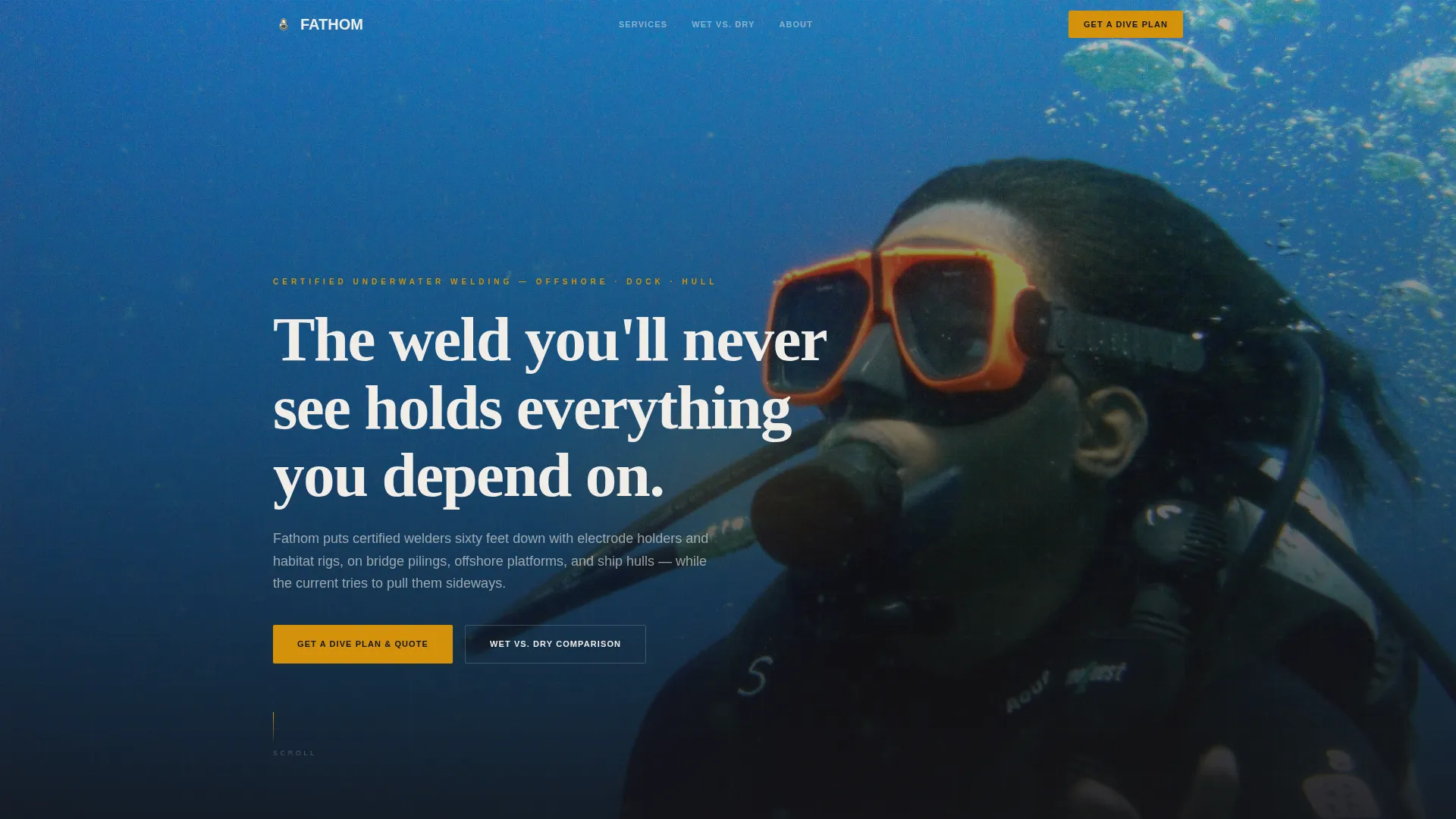
- A full-bleed hero section with atmospheric waterline photography and a single high-impact headline
- A modular card grid that maps each project phase, from dive survey through post-weld non-destructive testing inspection
- Two conversion paths: a scoped quote form and a downloadable comparison guide gated behind an email field
Feature list
This template delivers a focused set of built-in structural and visual components, each mapped directly to the operational flow of an underwater welding engagement.
Full-Bleed Waterline Hero
The header uses an above-waterline perspective shot looking down at a diver surfacing with an amber work light glowing below. A single line of knockout white text anchors the visual: "The weld you'll never see holds everything you depend on." The composition immediately communicates the stakes of the work.
Timeline Progression Card Grid
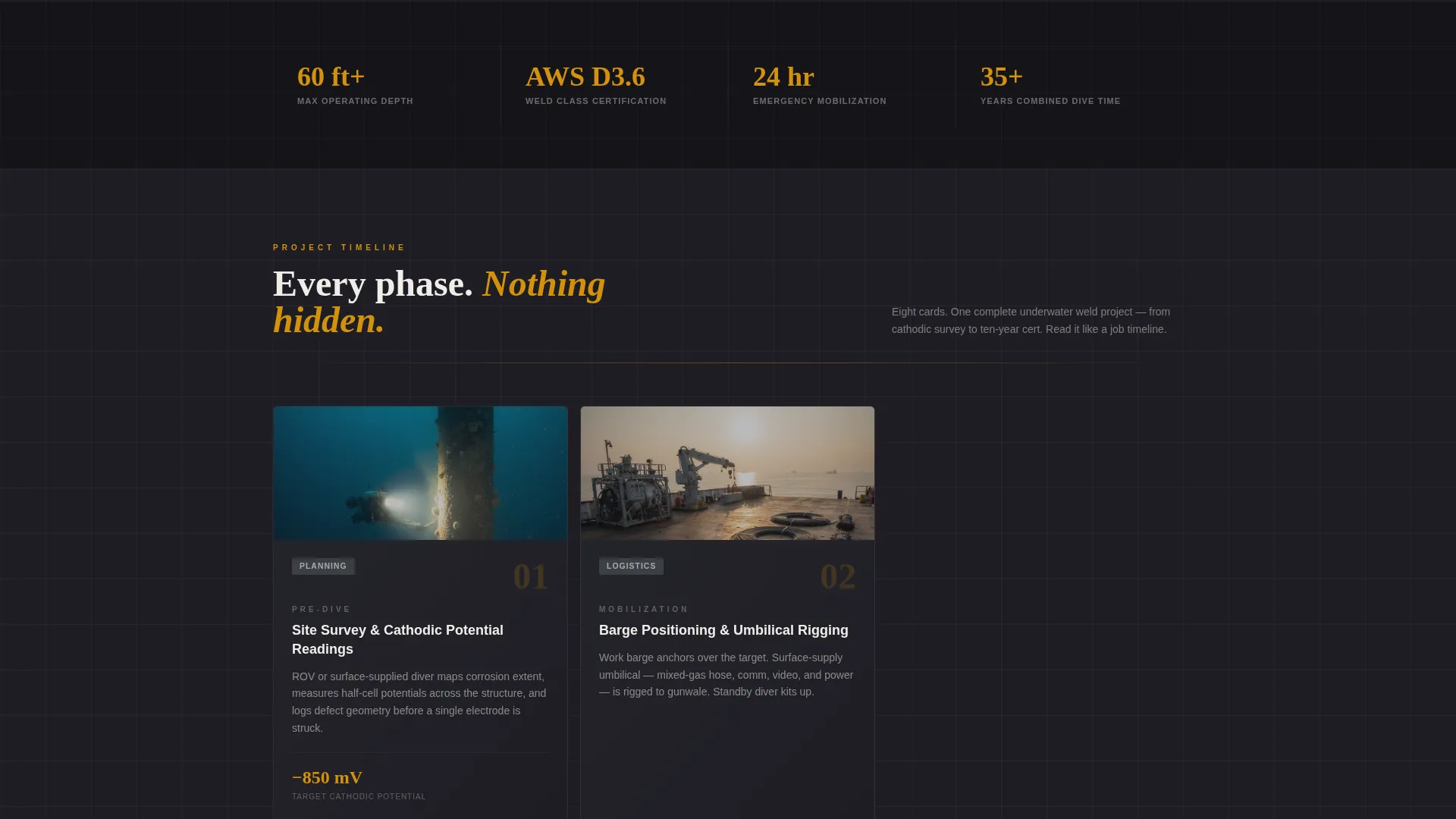
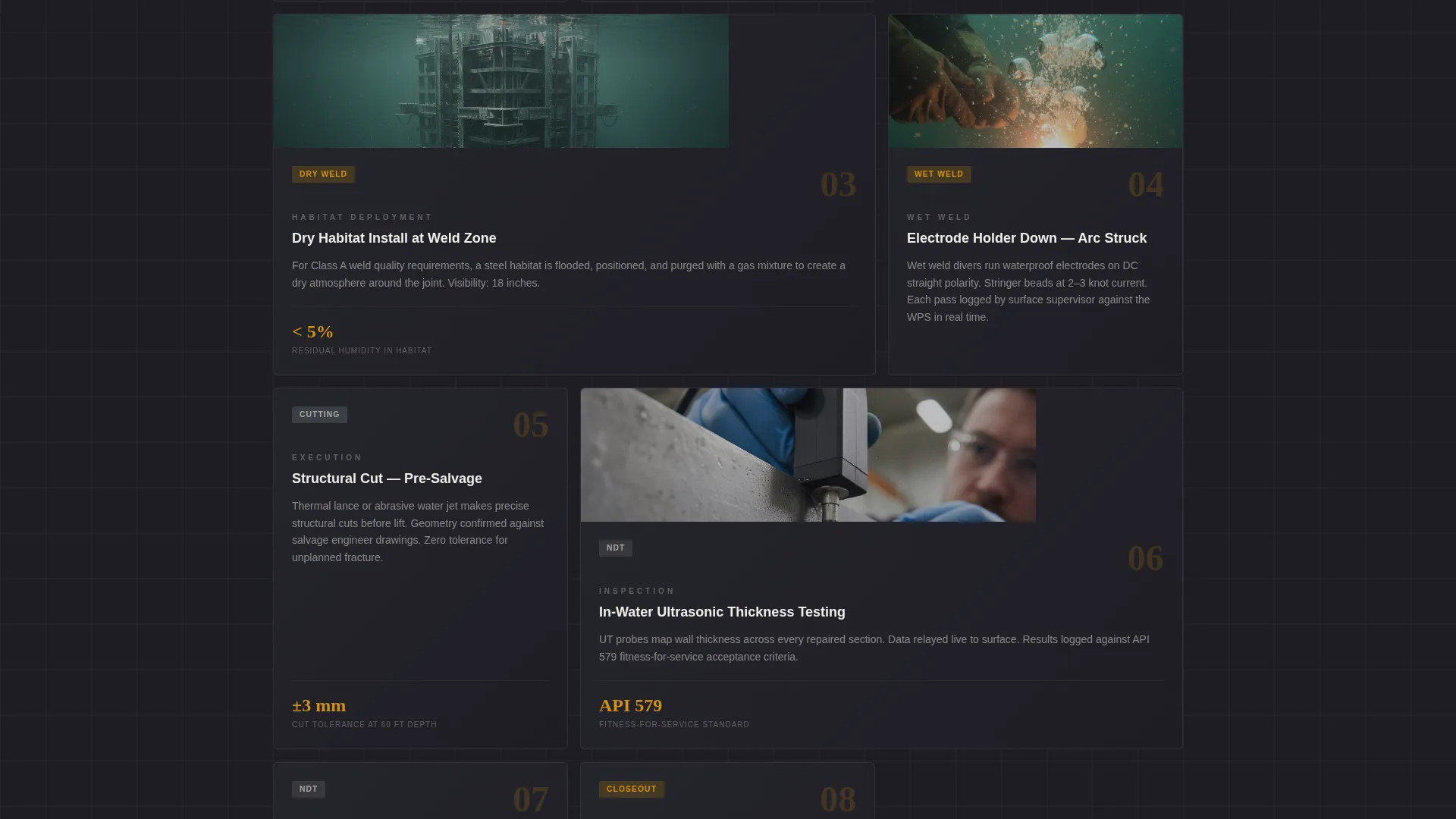
The core layout is a modular card grid where each card represents one phase of an underwater welding project. Cards advance left to right and top to bottom, moving from initial dive survey and cathodic potential readings through habitat deployment, weld execution, and final non-destructive testing inspection. The structure makes a hidden process visible and systematic.
Wet Welding versus. Dry Hyperbaric Comparison Cards
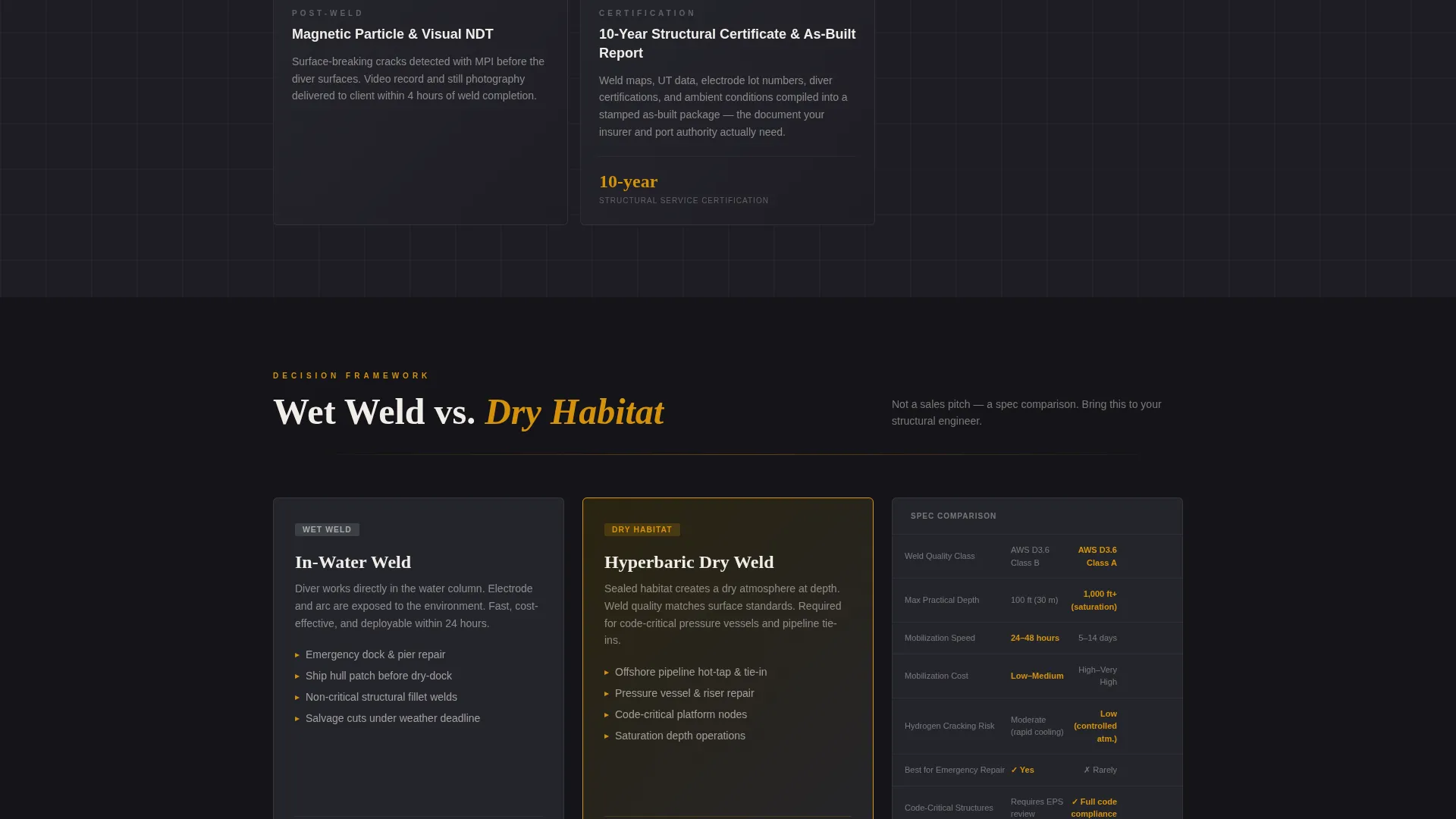
Interspersed within the grid, dedicated comparison cards put wet welding and dry hyperbaric welding side by side. The cards cover cost, depth limits, weld quality class, and mobilization speed. This gives technical buyers a decision framework rather than a sales pitch, which is far more effective with engineers and operations managers.
Scoped Lead Qualification Form
The primary call to action, "Get a Dive Plan and Quote," appears directly after the comparison cards. The form asks for structure type (pier, hull, pipeline, or platform), water depth range, and whether the job is emergency or scheduled. Three fields that qualify the lead and signal technical competence at the same time.
Gated Research Download
A secondary conversion path offers a downloadable PDF titled "Wet Weld versus. Dry Habitat: Which Spec Fits Your Structure?" It sits behind an email field, capturing engineers who are still in the specification research phase and are not yet ready to request mobilization.
Charcoal and Amber Visual System
The entire template is built on a four-tone palette: deep weld-slag charcoal (#1E1E24), wet steel gray (#3B3F45), caution-tape amber (#D4920B), and arc-flash white (#F0EDE8). Charcoal dominates backgrounds and card borders. Amber marks every actionable element. Arc-flash white keeps body text readable throughout.
Page sections overview
| Section | Purpose |
|---|---|
| Full-Bleed Hero | Establish stakes with waterline photography and a single defining headline |
| Dive Survey Cards | Show the planning and surface preparation phase of the project timeline |
| Habitat Deployment Cards | Detail the transition from surface prep to working at depth |
| Weld Execution Cards | Display the diver at depth with electrode holders and stinger equipment |
| Wet versus. Dry Comparison | Give buyers a side-by-side decision framework before the primary call to action |
| Quote Request Form | Capture qualified leads with three scoped fields after the comparison section |
| Post-Weld Inspection Cards | Show non-destructive testing and structural certification outcomes |
| Research Download Gate | Capture early-stage engineers with a gated PDF comparison guide |
Design & branding system
The Fathom template uses a Service Utility visual theme built around the experience of working on a dive barge at night. The palette is narrow, functional, and impossible to misread. Every color earns its place.
- Charcoal (#1E1E24) and wet steel gray (#3B3F45) dominate backgrounds, card borders, and structural surfaces throughout the page
- Caution-tape amber (#D4920B) marks every actionable element, including buttons, progress indicators, and highlighted specification callouts
- Arc-flash white (#F0EDE8) keeps body text consistently legible against dark backgrounds without adding clinical brightness
Mobile & speed optimization
The modular card grid adapts naturally to narrower screens. Each card in the timeline sequence is self-contained, so the layout reflows cleanly without losing the left-to-right project progression that gives the page its logic.
- Cards reflow into a single-column stack on smaller screens while preserving the phase-by-phase timeline order
- The full-bleed hero image is composed to retain its above-waterline and below-waterline split even at mobile crop ratios
- The lead qualification form reduces to a compact vertical stack with clearly labeled fields for structure type, depth range, and job urgency
How this template helps you convert
Fathom is structured around a Comparison and Versus conversion strategy. Visitors move through a trust-building sequence before they ever see a call to action.
- The timeline card grid builds operational credibility by showing every phase of an underwater welding project in sequence, so buyers understand the scope of work before they are asked to commit.
- The wet welding versus dry hyperbaric comparison cards give technical decision-makers the specification framework they need, positioning the quote request as a natural next step rather than a cold ask.
- The gated PDF download creates a second conversion path for engineers in the research phase, capturing leads who are evaluating specifications but are not yet ready to request a dive plan.
Other information about this template
Fathom is designed as a standalone landing page for underwater welding and marine structural repair services. It is well suited for contractors who operate across a range of marine environments, including bridge piling repair, offshore oil and gas platform maintenance, and ship hull structural work.
- The template style is Card Grid (Modular), making it straightforward to adapt individual phase cards to match your own project methodology or service scope
- The comparison card layout can be updated to reflect your specific wet welding and dry hyperbaric welding capabilities, depth certifications, and mobilization timelines
- The downloadable PDF conversion path is designed to be replaced with your own technical guide or specification document, keeping the lead capture flow intact
Theme
Service Utility
Creative direction
Timeline Progression
Color system
Charcoal & Amber
Style
Card Grid (Modular)
Direction
Comparison/Versus
Page Sections
Full-bleed Waterline Hero Section
Timeline Progression Card Grid
Wet Versus. Dry Hyperbaric Comparison Cards
Scoped Lead Qualification Form
Gated Research Download Path
Charcoal and Amber Design System
Related questions
Who is this landing page template built for?
Can I customize the wet welding versus dry hyperbaric comparison cards?
What information does the lead qualification form collect?
How does the gated PDF download path work?
Is this template appropriate for emergency underwater repair services?