Transparent Process Jute Farm Landing Page Template
The Fiber transparent process jute farm landing page template is a gallery-plus-detail landing page built for agricultural export businesses. It walks sourcing managers through an eight-stage crop cycle using click-to-expand cards, Agrarian Root typography, and a warm Sunset Mesa color system. The result is a transparent chain-of-custody story that earns buyer trust before the first call is made.
by Rocket studio
Quick summary
This template is designed for a jute farm that needs to convert B2B curiosity into spec sheet requests. It presents the full journey of jute fiber, from seedling nursery to container loading, through an interactive eight-stage gallery. Buyers check every step of the process before they reach the call to action, which means they arrive informed and ready to talk.
Who this template is for
Sourcing professionals and export-focused agricultural businesses will find this template built precisely for their workflows. It speaks to people who need evidence, not just promises, before they commit to a supplier.
- Textile sourcing managers who require traceable, organic-certified jute fiber and compliance documentation that meets international requirements
- Packaging companies looking to replace plastic with biodegradable hessian products sourced from a single, auditable farm
- Craft exporters who need consistent bale quality, reliable volume, and phytosanitary paperwork that clears customs without a phone call
What problem this template solves
Most farmers who grow natural fibres struggle to communicate the quality and traceability of their products to distant buyers. A generic product page cannot document the full value chain or show how each bale was handled from field to freight. Sourcing managers working in global textiles need more than a price list.
- Buyers cannot verify supply chain integrity from a standard brochure site, which stalls procurement decisions
- Farms with strong organic production practices and sustainable processes lack the tools to display that story in a format buyers can share with their own compliance teams
- The gap between farm-level transparency and buyer-level confidence costs both sides time and income
What you get with this template
This template provides a fully structured landing page that guides a B2B buyer through eight documented crop cycle stages before presenting a call to action. Every section is set up to carry real photography, real data, and real field notes from farm managers.
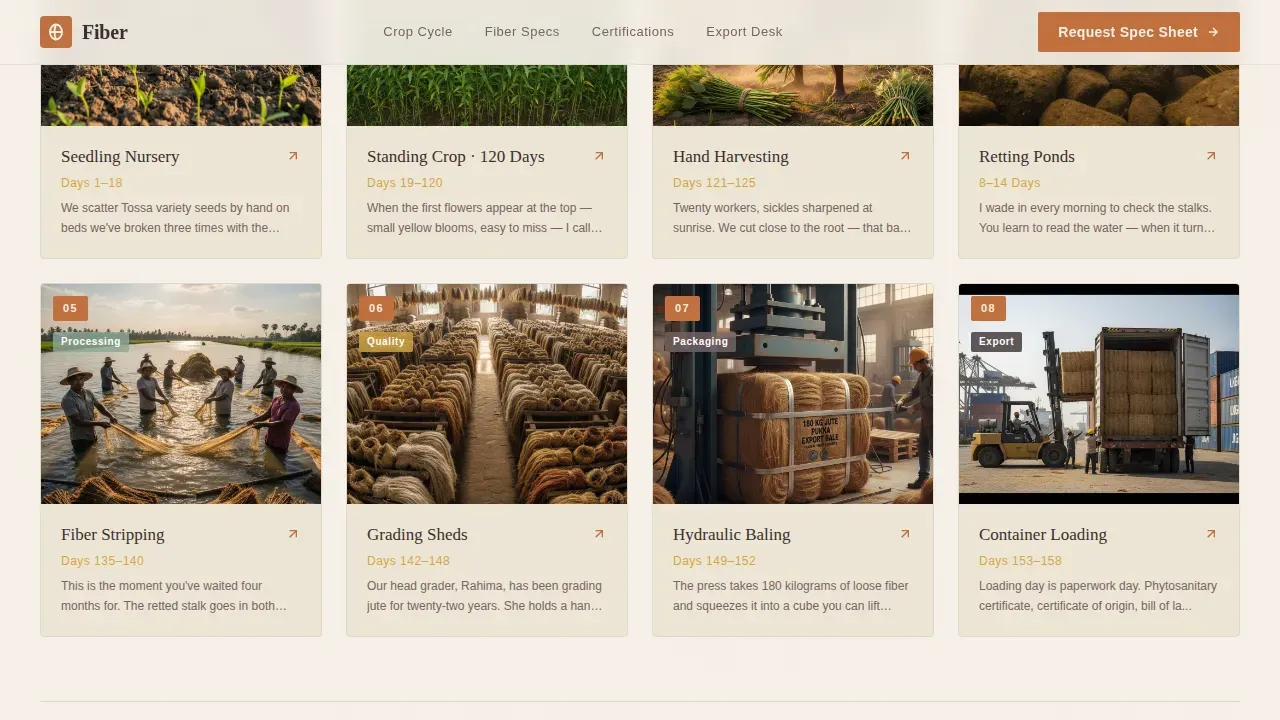
- An interactive crop cycle gallery with click-to-expand stage cards covering seedling nursery, standing crop at 120 days, hand-harvesting, retting ponds, fiber stripping, grading sheds, hydraulic baling, and container loading
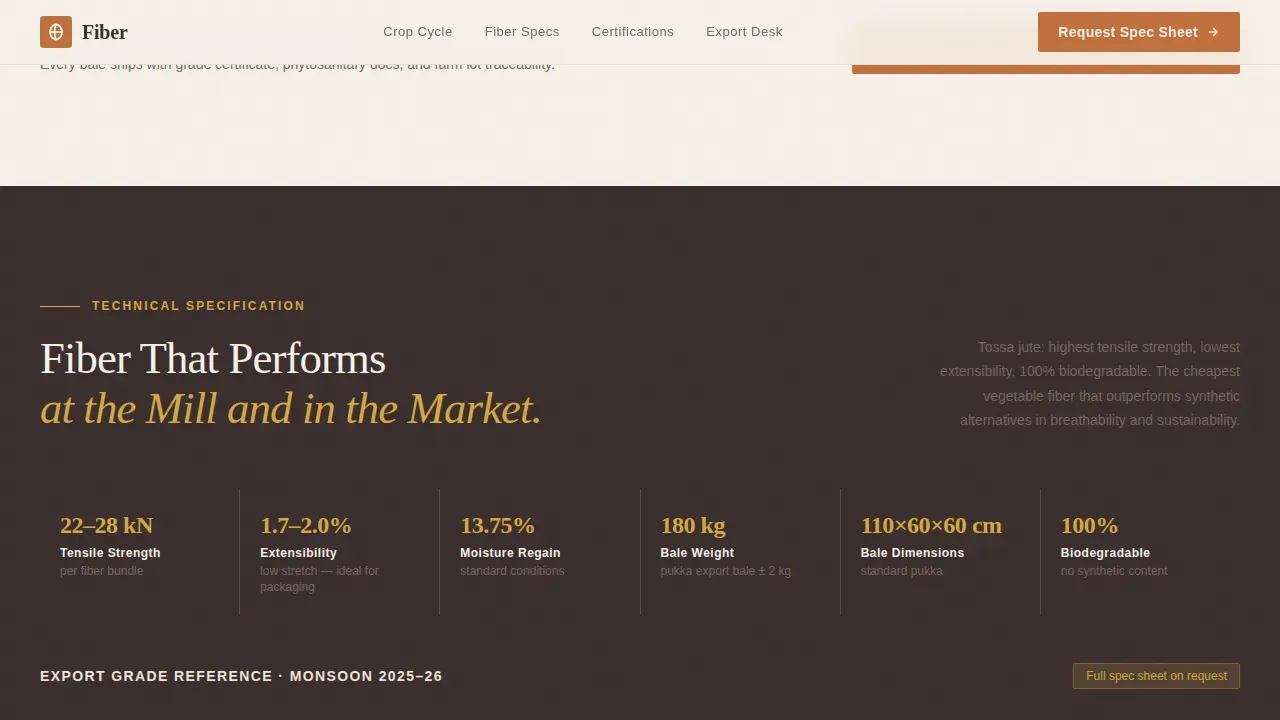
- A fiber specification preview strip displaying tensile strength data, bale dimensions, fiber grade breakdown, and free-on-board pricing tiers
- A trust strip section for certifications, export destinations, and tonnage shipped, followed by a dual call-to-action footer routing buyers to a product detail page
Feature list
This template ships with purpose-built tools that serve the specific requirements of agricultural export marketing. Each component is designed to make jute fiber credible to procurement professionals.
Eight-Stage Interactive Crop Cycle Gallery
The gallery is the core of this template. Each card represents one stage of jute production, from nursery seedlings to the loaded container. Clicking any card opens a detail panel with a close-up photograph, the exact duration of that stage, quality checkpoints performed, and a first-person field note from the farm manager. The scroll does not persuade through claims; it proves through documentation.
Click-Through Call-to-Action Architecture
The primary call to action, "Request This Season's Spec Sheet," appears first beneath the header and repeats after the final baling stage. Clicking it routes visitors to a one-page product detail that carries fiber grade breakdown, tensile strength data, bale dimensions, free-on-board pricing tiers, and a secondary button reading "Talk to Our Export Desk." The structure ensures buyers have completed half their due diligence before they make contact.
Fiber Specification Preview Strip
A dedicated technical data strip displays the information procurement teams need to check before opening a conversation. Fiber grade, tensile strength, bale dimensions, and pricing tiers are set out in a clean, scannable format. This section provides the kind of sourced, factual data that a company's compliance team can document and forward internally.
Half-Page Photo and Text Hero Header
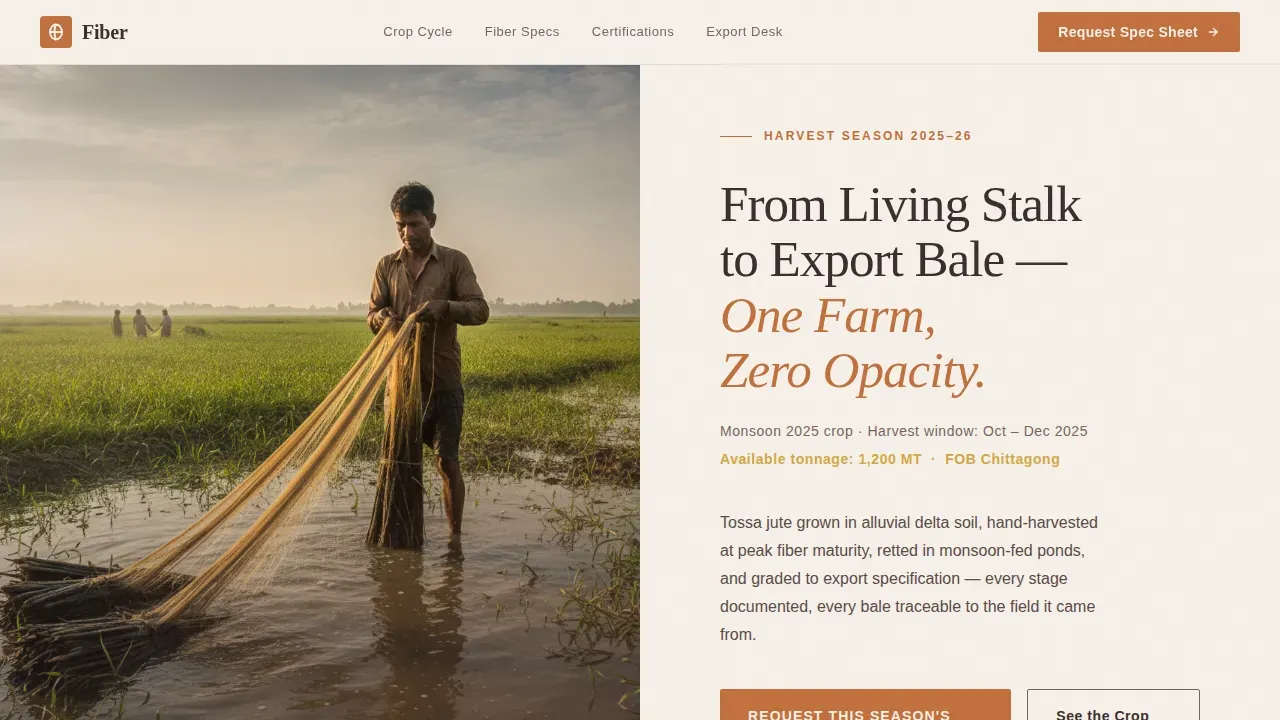
The header splits the screen: a wide-angle field photograph sits on the left, and a warm serif headline with harvest season data sits on the right. The headline, "From Living Stalk to Export Bale, One Farm, Zero Opacity," sets the tone of the entire page. Available tonnage for the current season is displayed immediately below the headline, giving volume-sensitive buyers the information they need at first glance.
Trust and Social Proof Strip
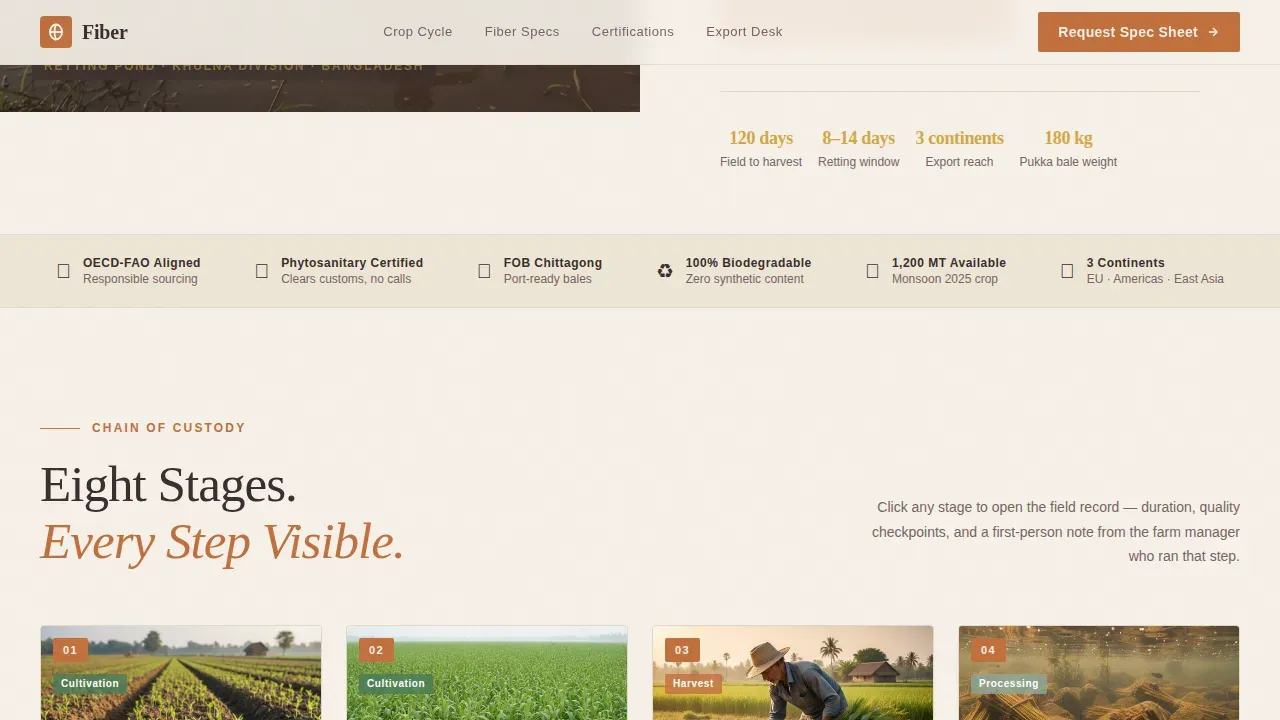
A dedicated section carries export certifications, destination continents reached, and total tonnage shipped. This strip gives buyers immediate evidence that the farm operates at commercial scale and meets the documentation requirements of international trade. Farm manager field notes woven into the gallery cards add a human voice to the compliance data.
Agrarian Root Typography and Sunset Mesa Color System
Typography uses Fraunces for serif headlines and DM Sans for body and interface text. The color system pairs terracotta, soil brown, jute gold, and monsoon white to create a visual identity that feels warm, unprocessed, and honest. These tools are provided in a cohesive design system that requires no additional branding work to use out of the box.
Page sections overview
| Section | Purpose |
|---|---|
| Hero Header | Introduces the farm with a split photo-and-text layout showing harvest season data and available tonnage |
| Crop Cycle Gallery | Eight interactive stage cards let buyers step through the full jute production process before committing |
| Fiber Spec Preview | Technical strip displaying grade breakdown, tensile strength, bale dimensions, and free-on-board pricing |
| Trust and Proof Strip | Certifications, export destinations, and shipped tonnage build confidence in commercial-scale supply |
| Call-to-Action Repeat | Dual call-to-action block routes buyers to the spec sheet and the export desk contact page |
| Linear Footer | Single-row footer carries company information and secondary navigation links |
Design & branding system
The visual identity follows an Agrarian Root theme. Every design decision is made to let editorial agricultural photography dominate while the color system and typography carry the brand voice of a farm that has nothing to hide.
- Color system: terracotta (#C2703E) anchors section dividers and hover states; deep alluvial soil (#3B2F2F) carries body text; dried jute gold (#D4A843) highlights data points and interactive elements; monsoon sky white (#F5F0E8) breathes across backgrounds so photography fills the space
- Typography: Fraunces warm serif is used for all headlines; DM Sans handles body text, labels, and interface elements throughout the page
- Animation: medium-weight GSAP scroll reveals bring gallery cards into view with staggered entrance; card expand and collapse is handled by client-side components while static content uses server rendering for stability
Mobile & speed optimization
The template is built desktop-first to match the workstation-based workflow of sourcing managers, but it is fully responsive across all screen sizes. Mobile visitors can open and close stage cards, read field notes, and reach the call to action without losing any functionality.
- Server components handle static content such as the hero header, trust strip, and footer, keeping the page light on initial load
- Client components manage gallery interactions including card expand, collapse, and detail panel rendering, so interactivity is limited to where it is required
- The staggered gallery entrance and scroll reveals are implemented with GSAP at medium intensity, balancing visual engagement with stable rendering across devices
How this template helps you convert
The template earns the click before it asks for one. By the time a sourcing manager reaches the call to action, they have already walked through eight documented stages of the jute supply chain. This sequencing is the conversion strategy.
- The hero header sets expectations immediately by naming the harvest season and the available tonnage, giving volume-sensitive buyers a reason to keep reading rather than bouncing to a competitor
- The interactive crop cycle gallery replaces abstract claims with documented evidence, allowing buyers to open each stage, check quality checkpoints, read field notes, and form their own judgment about the farm's production standards
- The dual call-to-action placement, once beneath the hero and once after the final gallery stage, meets buyers at the two moments when intent is highest, routing them to a detailed spec sheet rather than a generic contact form
Other information about this template
This template is designed to operate inside a growing global conversation about traceability and responsibility in natural fiber supply chains. The following context is useful for companies evaluating how this template fits their market positioning.
- Jute is classified among the world's most sustainable bast fibres. It is biodegradable and compostable, absorbs more carbon dioxide and releases more oxygen than many trees, and requires minimal herbicides or fertilizers compared to cotton, flax, or silk production
- Jute is cultivated during a season when most land would otherwise remain barren, making it an important source of income for farmers across South Asia. The plant is harvested 120 to 150 days after sowing, and the jute fiber is graded by color, texture, and length after drying
- After retting, the jute fibers are extracted often by hand using the Beat-Break-Jerk method. Natural bacteria in the water decompose the substances that bond the fibres to the woody stem. Ribbon retting, where only the bark of the jute plant is submerged, saves water and speeds up the process
- The Global Organic Textile Standard (GOTS) certifies sustainable jute fiber production. The Global Responsible Textile Standard (GRTS) is a voluntary sustainability standard that applies stringent social and environmental criteria to a set of responsible non-organic fibres, covering every stage of the textile value chain from certified responsible fibre to final labelled product
- GRTS allows companies to certify products made from responsibly sourced fibres using the same rigorous criteria as GOTS. It requires chain-of-custody traceability with physical segregation, a ban on highly hazardous pesticides including certain herbicides, and the prohibition of child and forced labor throughout the entire certified value chain
- GRTS is designed to support compliance with emerging legislation including the EU Corporate Sustainability Due Diligence Directive and the Ecodesign for Sustainable Products Regulation. It operates within the existing infrastructure of the Global Trace Base, which already offers data exchange capabilities
- GRTS aims to increase demand for non-GMO cotton, thereby supporting farmers and seed producers, and it will have its own logo distinct from the GOTS logo, contributing to clear market differentiation for certified products
- Initiatives such as the Farmer to Factory Jute Supply Chain model emphasize traceable, fair-priced jute fiber sourced directly from farms, making the value chain more transparent and the jute industry more sustainable for future generations
- The jute supply chain faces real challenges around seed quality and retting process consistency. Blockchain technology represents one potential solution being explored to help overcome these challenges and improve supply chain transparency
- This template supports companies that want to run workshops with their procurement teams or host training sessions around supplier onboarding and chain-of-custody documentation. The page structure and open layout provide a strong visual foundation for those sessions
- Progress in the jute industry depends on tools that make the full value chain visible to buyers in markets such as the European Union, Turkey, and other regions with growing demand for biodegradable packaging and sustainable textiles. This template is one of those tools
- The Agrarian Root theme, Sunset Mesa color system, and Transparent Process creative direction together form a comprehensive design language. These intersection attributes are absolutely aligned with the honest, unprocessed tone that jute fiber products require in international B2B markets
Theme
Agrarian Root
Creative direction
Transparent Process
Color system
Sunset Mesa
Style
Gallery + Detail
Direction
Click-Through
Page Sections
Eight-stage Interactive Crop Cycle Gallery
Click-through Spec Sheet Architecture
Fiber Specification Preview Strip
Half-page Split Hero Header
Trust Strip and Social Proof Section
Agrarian Root Design System
Related questions
Who is the primary audience for this template?
Can I customize the eight crop cycle stages for my own farm's process?
Does the template include the product detail page as well?
How does the template support compliance documentation needs?
Can this template be used for natural fibres other than jute?