Manufacturing Processes Professional Website Template
Filament is a dashboard and data grid landing page built for wire EDM (electrical discharge machining) manufacturers who need to earn B2B trust before asking for a quote. The layout walks procurement engineers through every production phase, from RFQ submission to shipping, using real metrics, tolerance classes, and material specs. The design feels as precise as the process it represents.
by Rocket studio
Quick summary
Filament is a single-page, data grid landing page template designed for precision wire EDM manufacturers. It opens with an exploded-view technical illustration of a cutting head, then scrolls into a sequential process grid that discloses real operational data, tolerances, turnaround windows, wire diameters, and surface finish values, before presenting a procurement-ready quote submission form.
Who this template is for
This template speaks directly to shops and suppliers operating in high-stakes precision manufacturing. It assumes the buyer is technical and skeptical, and it meets them with data rather than marketing language.
- Tooling engineers sourcing production-grade EDM inserts and mold components
- Mold shop owners quoting complex cavity work against tight deadlines
- Aerospace procurement teams who require documented process controls alongside finished parts
What problem this template solves
Most industrial landing pages ask for a quote before they have earned the visitor's confidence. Engineers who need ultra-tight tolerances arrive with specific questions: What materials do you run? What wire diameters? What surface finish can you hold? Generic pages don't answer those questions, so the visitor leaves.
- There is no visible process evidence, leaving buyers uncertain about shop capability
- Quote forms appear before any technical credibility has been established
- Procurement workflows are ignored, forcing buyers to request basic information by phone
What you get with this template
Filament delivers a complete, single-page layout structured around operational transparency. Every section adds another layer of shop-floor evidence before the conversion moment arrives.
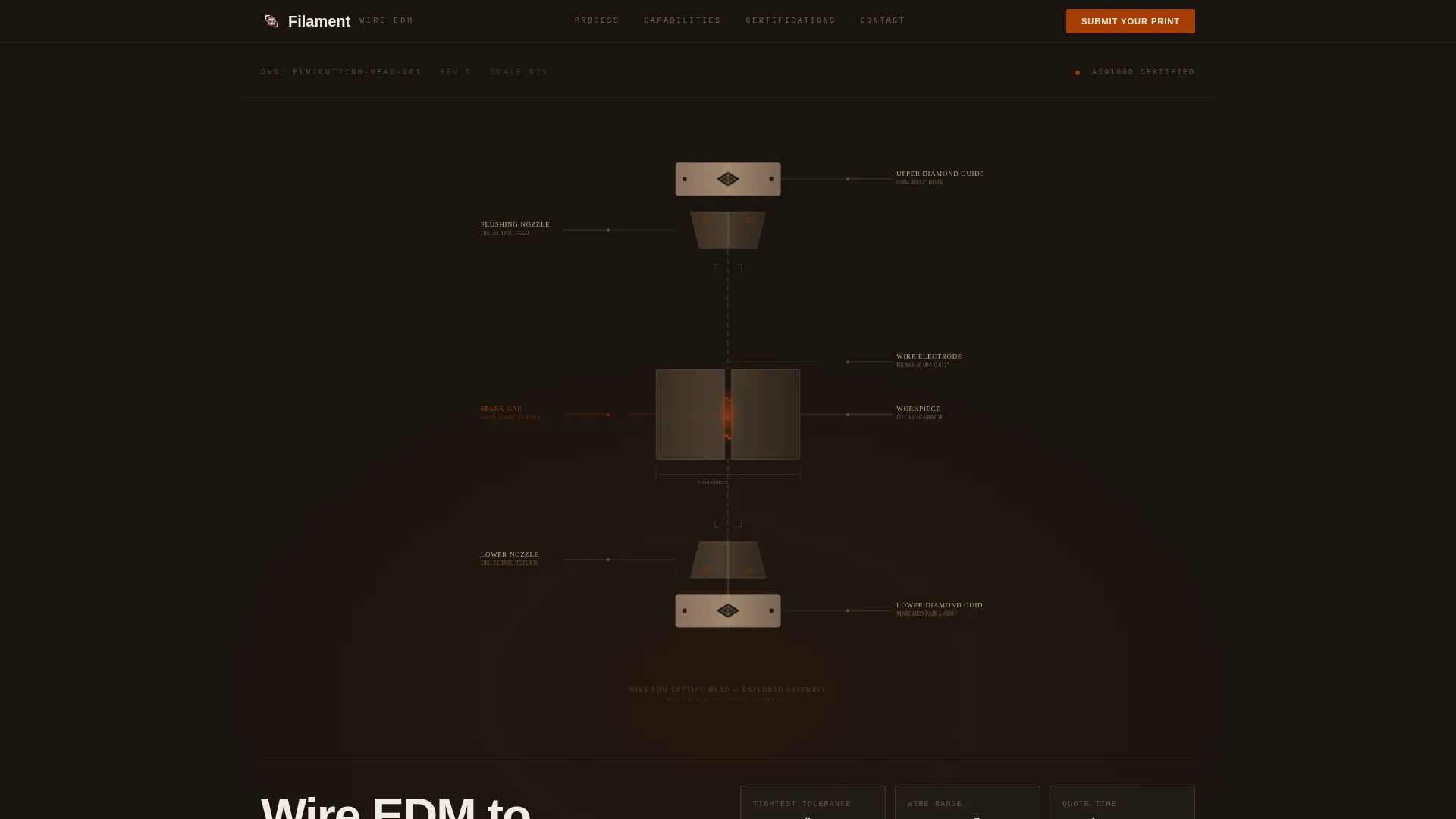
- An exploded-view header illustrating the wire EDM cutting head with labeled component callouts
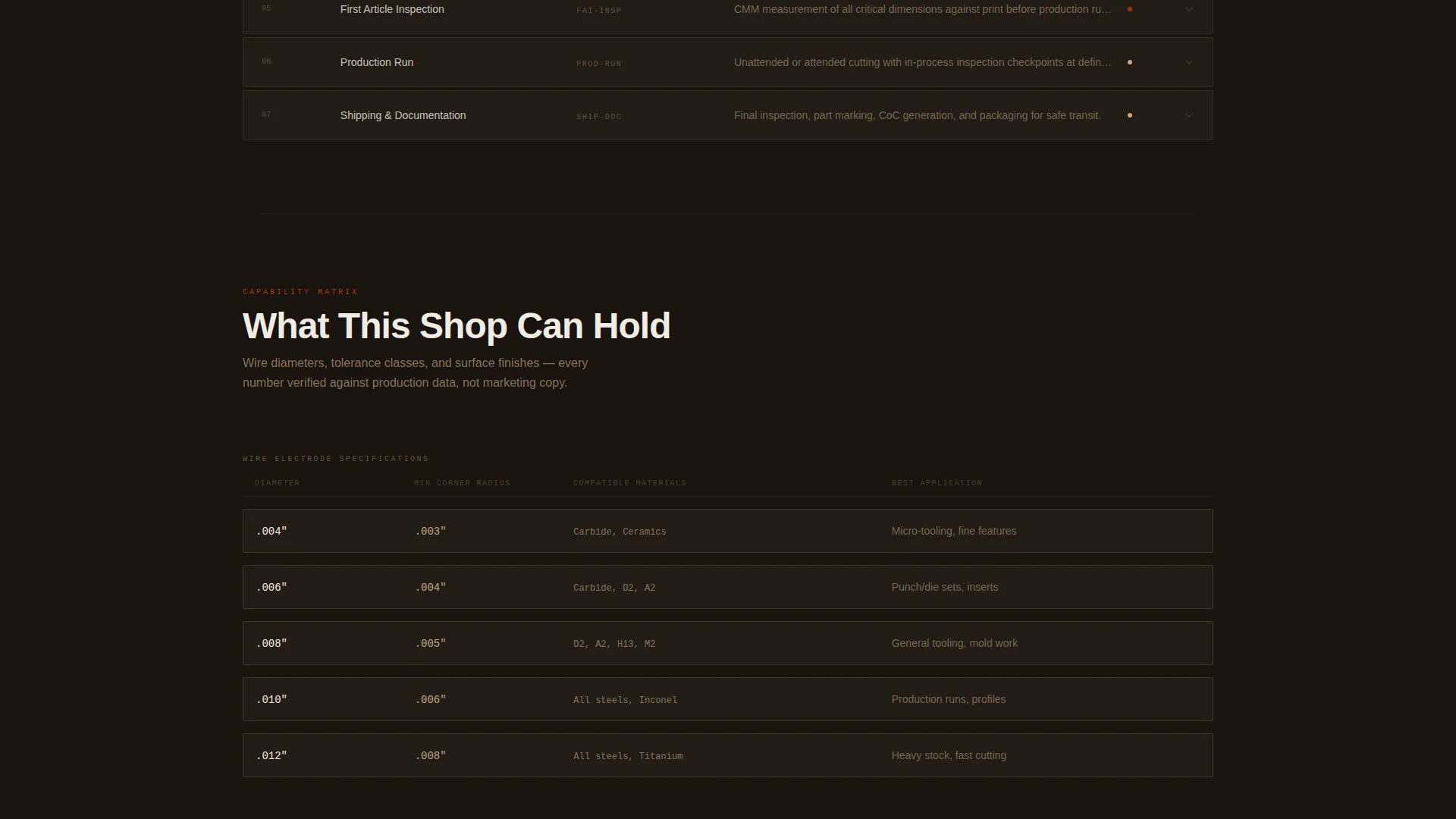
- A scrollable data grid covering seven production phases, each expandable to show real metrics
- A procurement-grade quote form accepting DXF, STEP, and PDF files with material, quantity, and tolerance selectors
Feature list
The following capabilities are built into this template's layout and interaction design.
Exploded View Technical Header
The header features a detailed technical illustration of a wire EDM cutting head deconstructed along a vertical axis. Component layers, upper diamond guide, flushing nozzle, tensioned wire electrode, spark gap, workpiece cross-section, and lower guide assembly, are separated with hairline callout labels. No photography. The machine describes itself through engineering anatomy.
Sequential Process Data Grid
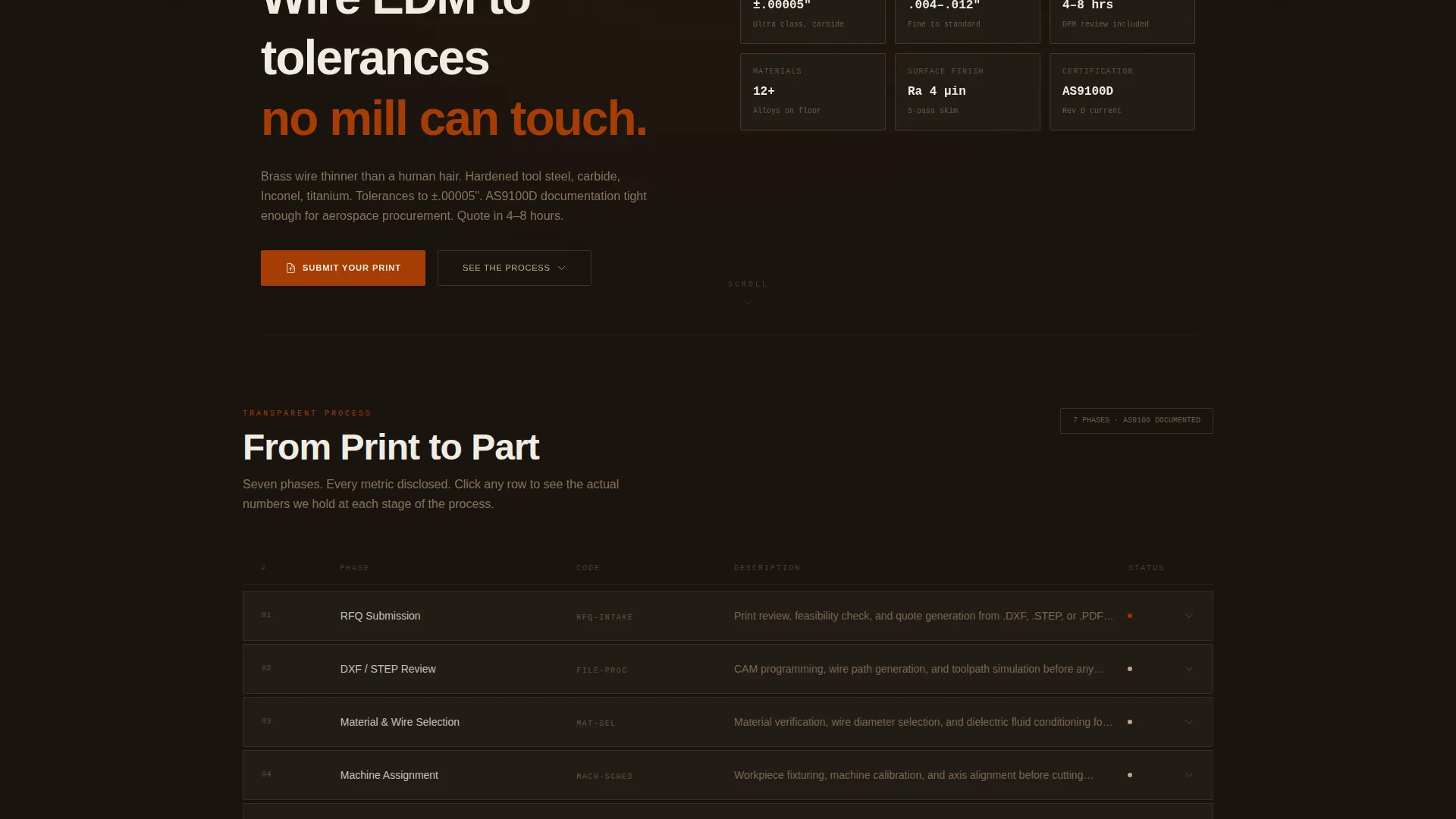
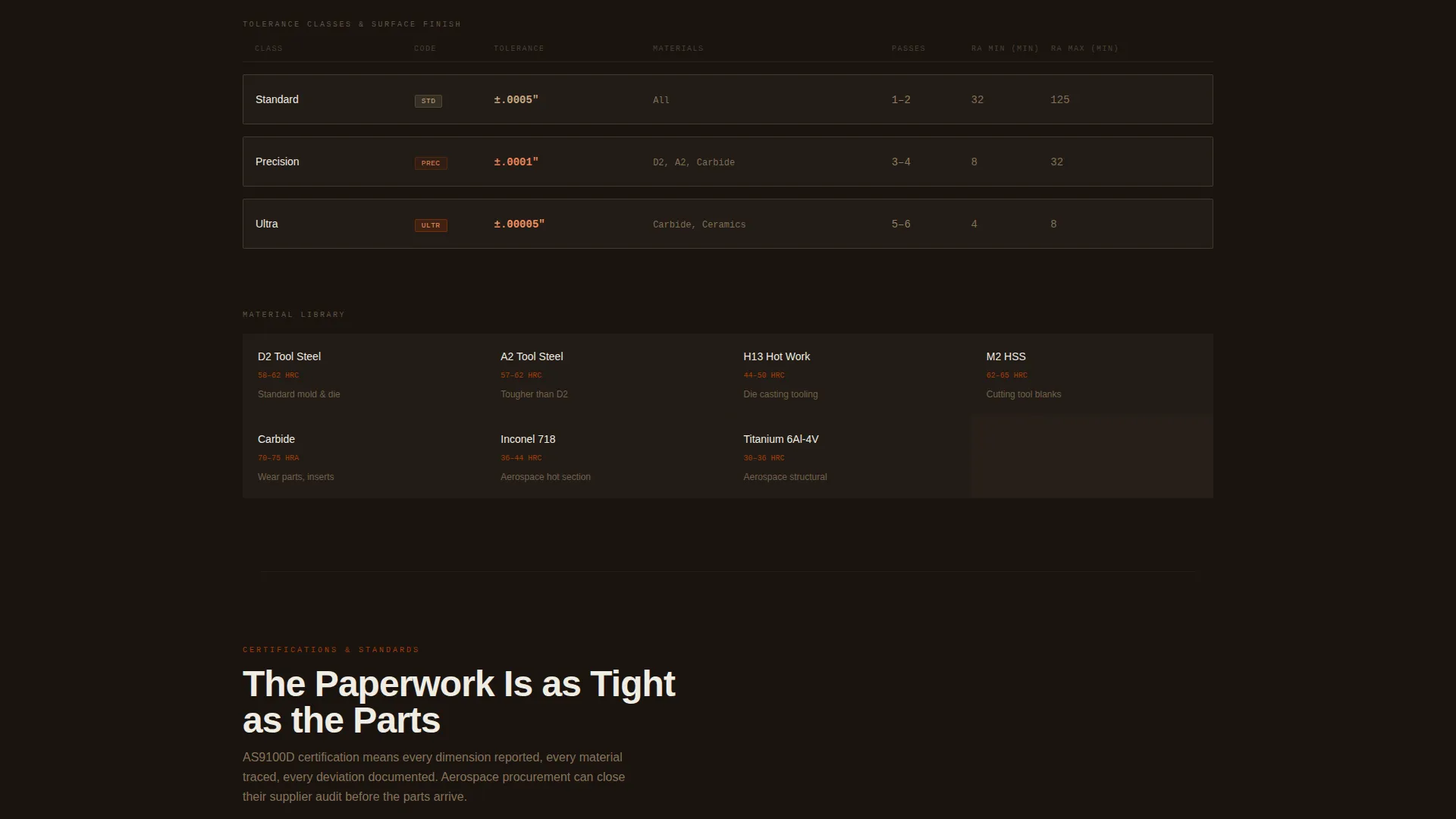
Below the header, the page shifts into a row-by-row data grid. Each row represents one production phase: RFQ submission, DXF review, material and wire selection, machine assignment, first-article inspection, production run, and shipping. Clicking a row expands it to reveal phase-specific metrics such as turnaround windows, tolerance ranges by material grade, wire diameter options from.004 inch to.012 inch, and surface finish Ra values per pass count.
Procurement-Ready Quote Form
The primary conversion form is engineered around real procurement workflows. It includes a file upload field accepting DXF, STEP, and PDF formats, a material dropdown covering D2, A2, carbide, Inconel, and titanium, a quantity tier selector for prototype, short-run, and production volumes, and a tolerance class radio button offering standard plus or minus.0005 inch, precision plus or minus.0001 inch, and ultra plus or minus.00005 inch.
Persistent "Submit Your Print" Call to Action
The primary call to action appears in a sticky top bar and again at the bottom of the data grid. This dual placement keeps the conversion path visible throughout the scroll without interrupting the data disclosure flow.
Secondary Capability Sheet Lead Path
A secondary opt-in labeled "Request Capability Sheet" captures email addresses from engineers still in the specification phase. This path converts visitors who are not yet ready to submit a file but want formal documentation of shop capabilities.
Fire and Earth Color System
Every interactive element burns in oxide red (#A63C06) on a forge-black (#1A1410) background. Ceramic tan (#C4A882) handles secondary text and divider lines. Spark white (#F0ECE3) is reserved for primary typography and card surfaces. The palette communicates industrial precision without any lifestyle imagery.
Page sections overview
| Section | Purpose |
|---|---|
| Sticky Top Bar | Keeps "Submit Your Print" always visible |
| Exploded View Header | Introduces cutting head anatomy with labeled callouts |
| RFQ Submission Row | Opens the process grid and sets buyer expectations |
| DXF Review Row | Shows how files are evaluated before quoting |
| Material and Wire Selection Row | Displays material grades and wire diameter options |
| Machine Assignment Row | Explains how jobs are matched to equipment |
| First-Article Inspection Row | Shows quality checkpoint metrics |
| Production Run Row | Covers run tolerances and surface finish Ra values |
| Shipping Row | Closes the process disclosure with delivery data |
| Quote Submission Form | Converts qualified buyers with structured file upload |
| Capability Sheet Opt-In | Captures early-stage leads with email-only entry |
Design & branding system
The visual identity follows a Service Utility theme built on a Fire and Earth color system. Every design decision reinforces the feeling of standing beside a running machine at two in the morning.
- Forge-black (#1A1410) backgrounds keep the data grid readable and industrial
- Oxide red (#A63C06) marks every button, toggle, and interactive filter with the color of a wire's plasma channel
- Ceramic tan (#C4A882) and spark white (#F0ECE3) separate data cells, card surfaces, and body text without visual noise
Mobile & speed optimization
The dashboard grid layout is structured to remain readable and navigable at smaller viewport sizes. Data-dense sections reflow cleanly so engineers can review specs on any device.
- Phase cards and metric expansions adapt to single-column layouts on narrow screens
- Form fields, file upload, and tolerance selectors remain fully accessible on mobile
- The sticky call-to-action bar maintains its position across viewport sizes
How this template helps you convert
Filament reverses the typical B2B landing page order. It earns submission by disclosing process before asking for anything.
- The exploded-view header establishes technical credibility immediately, before any copy makes a claim, so the engineer already trusts the shop's precision before reading a single paragraph.
- The sequential data grid functions as a self-guided shop floor tour. By the time the visitor reaches the quote form, they have already seen tolerances, wire specs, material options, and inspection checkpoints. The submission feels like a natural next step, not a leap of faith.
Other information about this template
This template is built specifically for the wire EDM niche inside the broader precision manufacturing and industrial manufacturing sector. It is a strong fit for any shop that competes on process transparency and documented capability rather than price alone.
- The template style is Dashboard and Data Grid, making it unusual among manufacturing landing pages that typically rely on simple image-and-text layouts
- The Transparent Process creative direction is the structural backbone of the page; every scroll interaction adds a new layer of operational evidence
- The header concept is Exploded View, a format borrowed from technical documentation and engineering drawings
- The Partnership and B2B landing page direction means every design choice prioritizes the procurement workflow over casual browsing
- This template sits at the intersection of the Manufacturing and Industrial category and the Wire EDM Equipment Manufacturer niche, serving a precise and underserved segment of industrial buyers
Theme
Service Utility
Creative direction
Transparent Process
Color system
Fire & Earth
Style
Dashboard/Data Grid
Direction
Partnership/B2B
Page Sections
Exploded View Technical Header
Sequential Process Data Grid
Procurement-ready Quote Form
Persistent Call-to-action Bar
Capability Sheet Lead Capture
Fire and Earth Visual Identity
Related questions
What type of business is this template built for?
Can I customize the material options and tolerance classes in the quote form?
What file formats does the quote form accept?
Do I need design experience to use this template?
What is the secondary lead capture path?