Rheumatologist Appointment Booking Landing Page
Flare is a hub and spoke landing page template built for rheumatology clinics. It guides visitors through condition-specific sections covering osteoarthritis, inflammatory arthritis, autoimmune disorders, gout, and fibromyalgia. Interactive symptom self-checks build trust as visitors scroll, and a clear booking form with three fields turns that trust into a confirmed consultation.
by Rocket studio
Quick summary
Flare is a single-page rheumatologist appointment booking template built around a hub and spoke layout with sticky anchor navigation. Visitors move through five condition-focused sections, each with interactive symptom toggles and a first-visit timeline. Every section closes with a direct booking call to action, making the path from symptom recognition to scheduled consultation feel natural and unhurried.
Who this template is for
This template is designed for rheumatology clinics that want their website to feel as reassuring as a well-run consultation. It works especially well for practices serving patients who are still trying to name what is wrong with them.
- Rheumatologists and clinic teams booking new patient consultations for joint and autoimmune conditions
- Medical practices treating conditions such as rheumatoid arthritis, lupus, gout, osteoarthritis, and fibromyalgia
- Clinics that want to educate visitors and convert them into booked appointments without feeling transactional
What problem this template solves
Most medical landing pages present a wall of credentials and a generic contact form. Patients with joint pain or undiagnosed autoimmune symptoms need more than that. They need to feel understood before they feel ready to book.
- Patients often delay appointments because they are unsure whether their symptoms are serious enough to warrant a specialist visit
- Generic clinic pages do not help visitors connect their specific symptoms to a named condition and a clear next step
- Without a guided path, many visitors leave before booking, even when they genuinely need care
What you get with this template
You get a fully structured landing page that walks visitors through five condition-specific sections, each built to answer real patient questions and reduce booking hesitation.
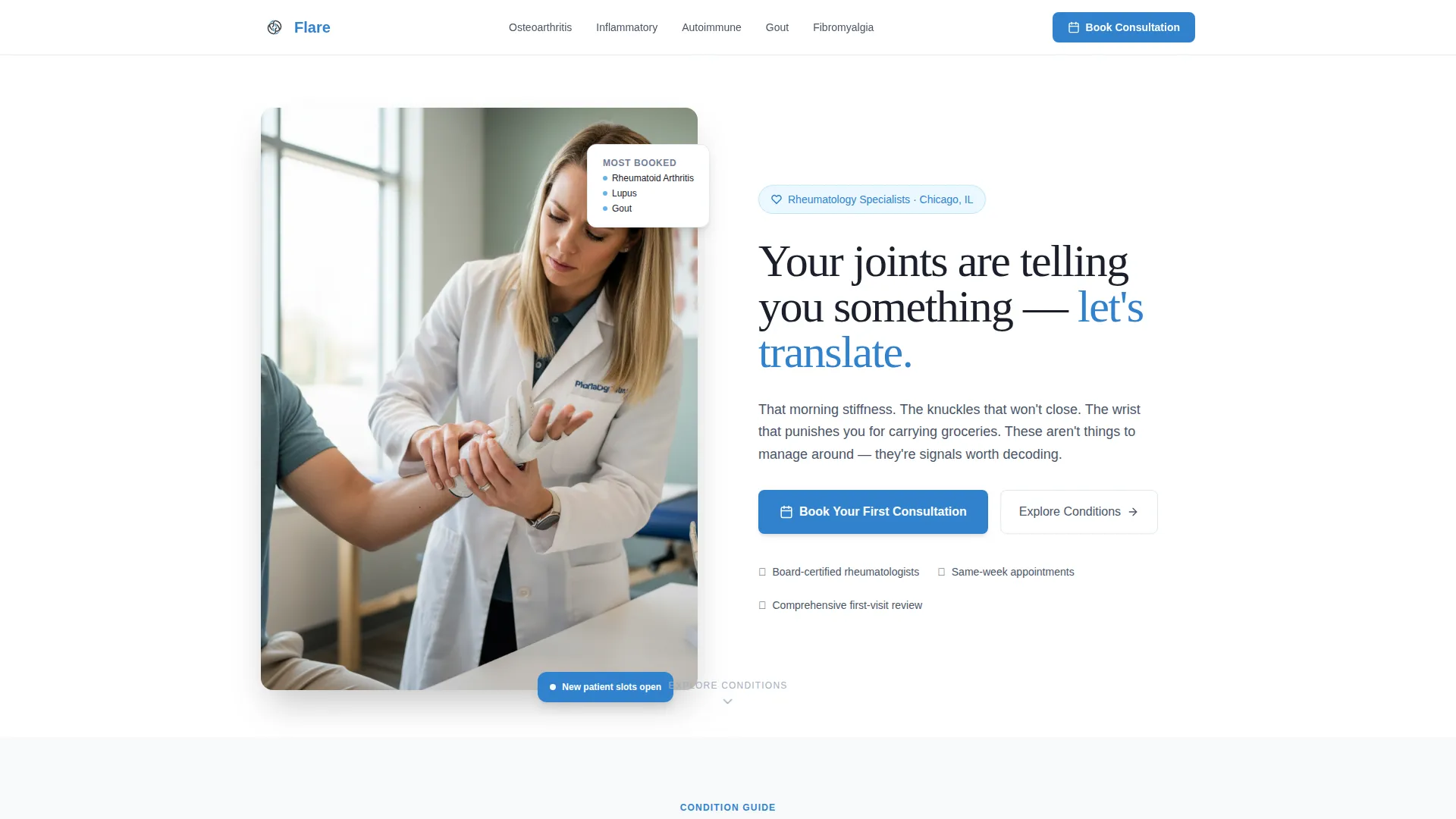
- A hero section with a cinematic exam-room photograph, a confident headline, and a sticky anchor navigation bar that keeps every spoke one click away
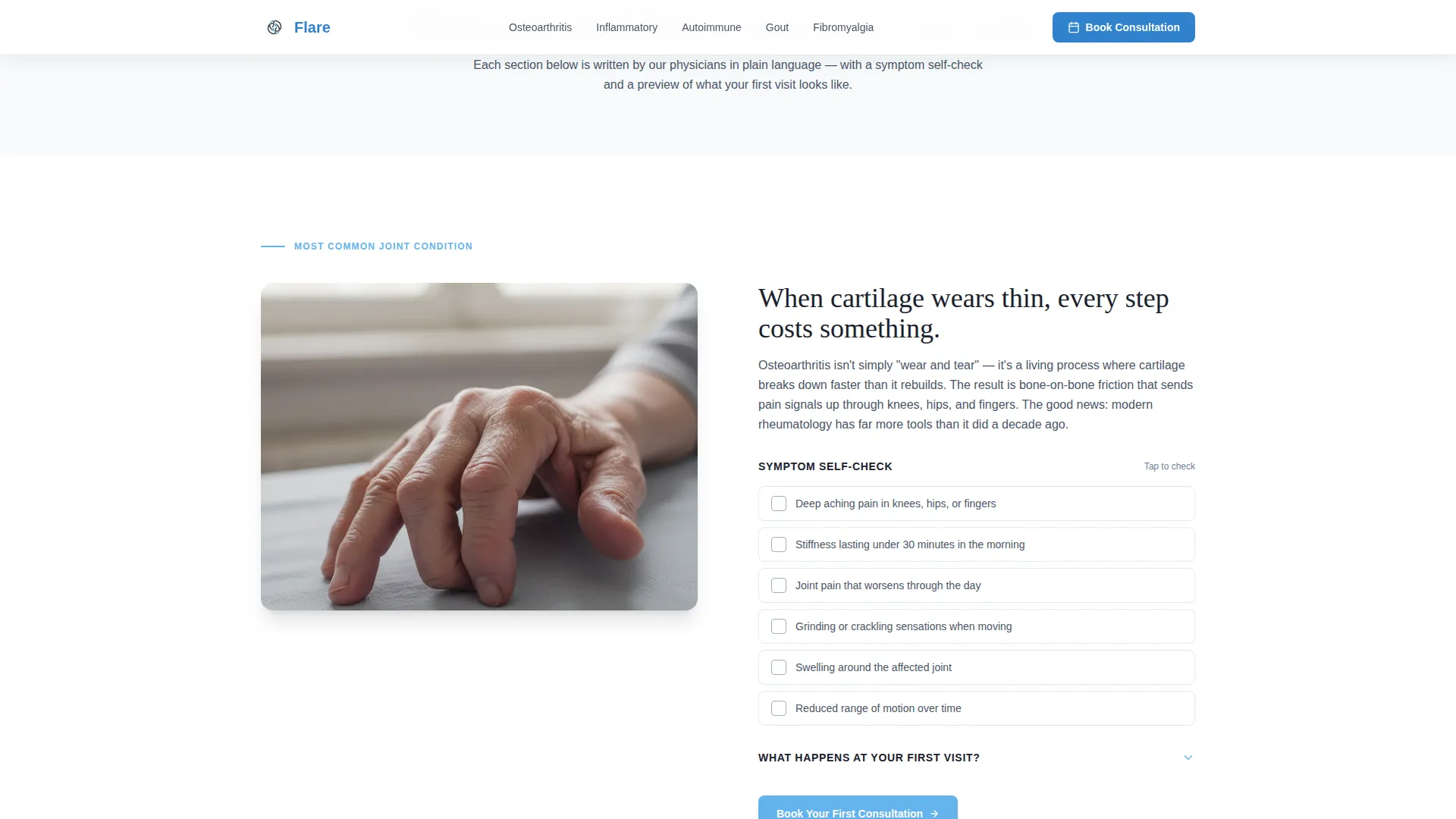
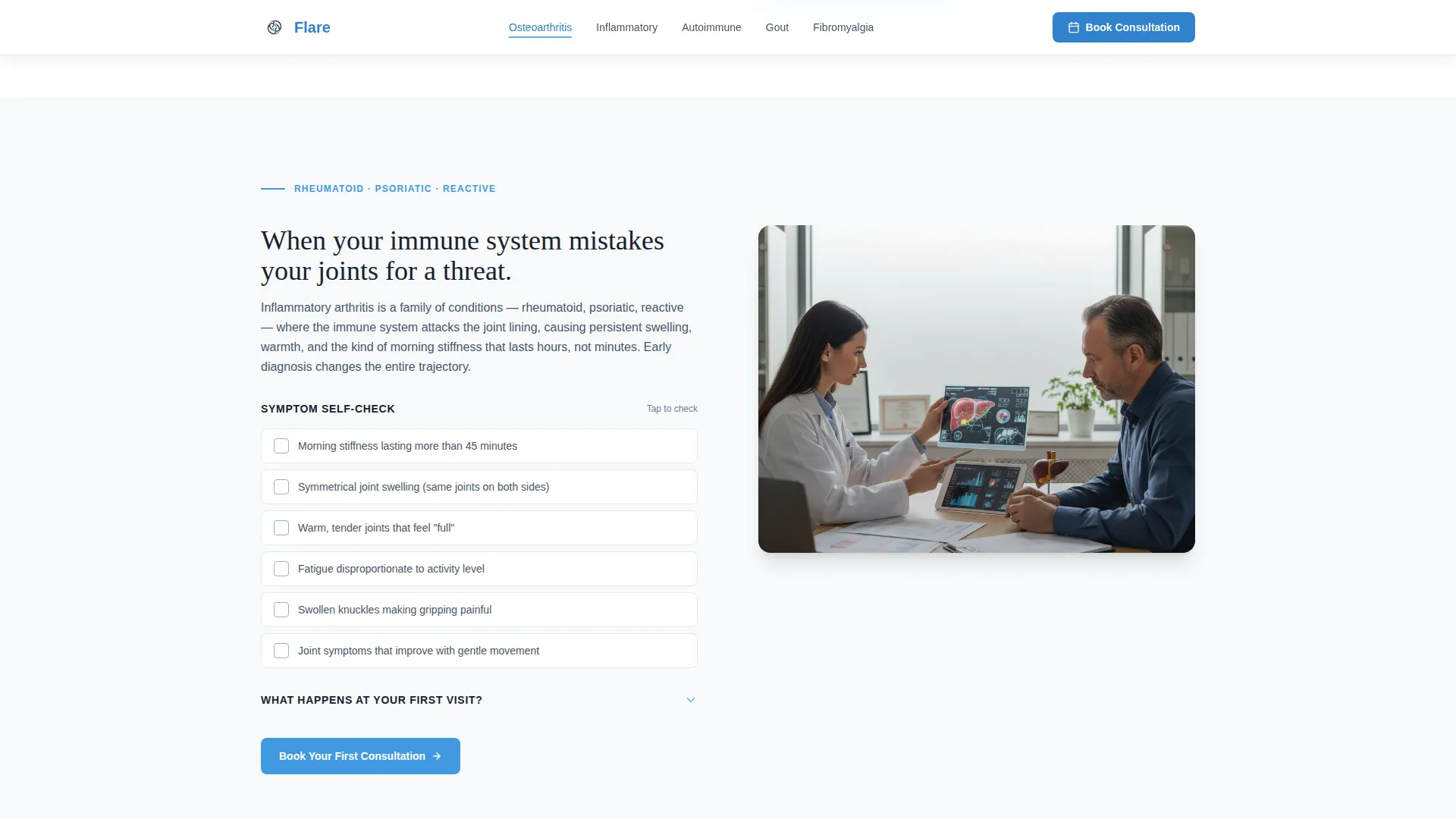
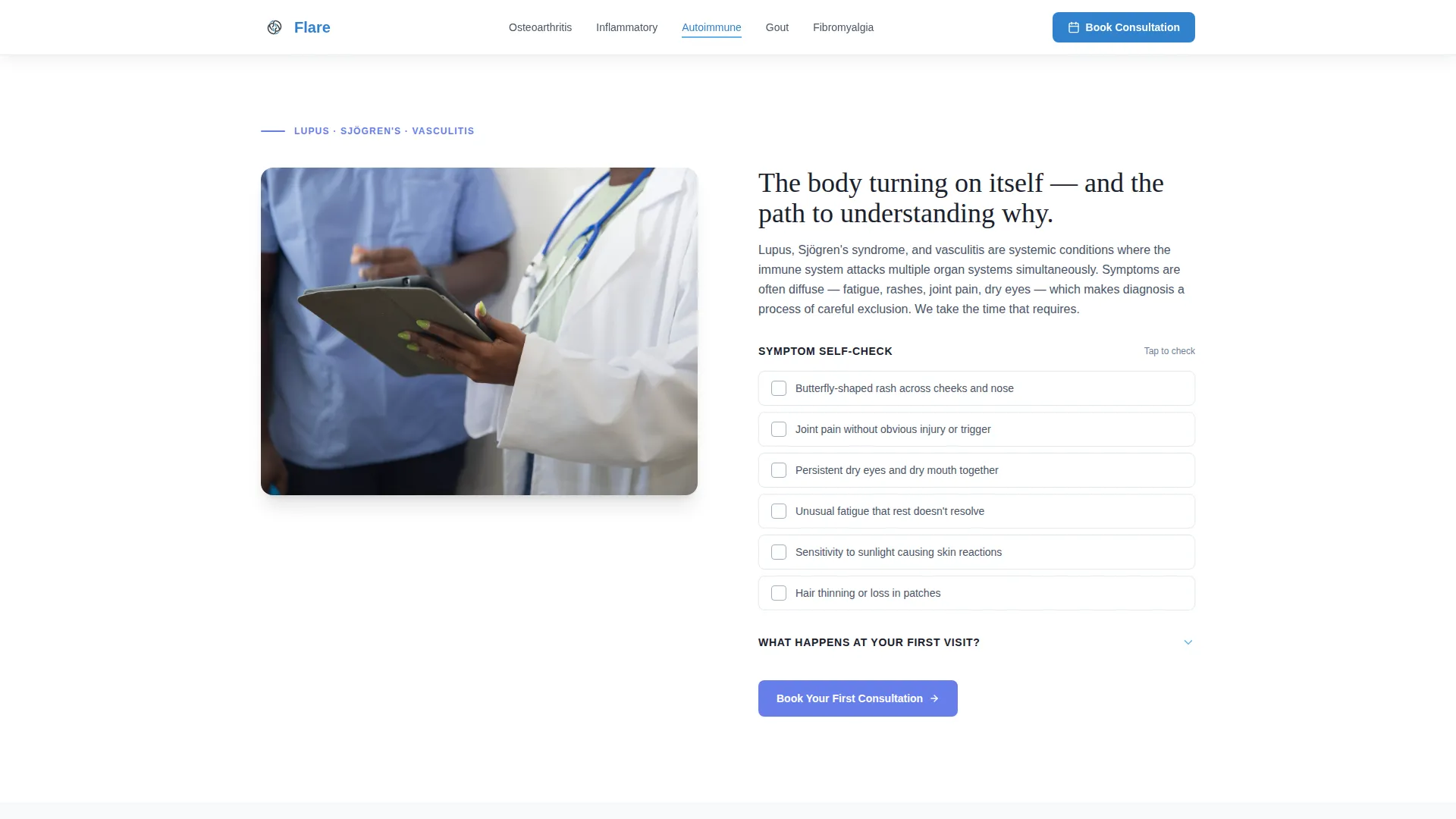
- Five condition hub sections covering osteoarthritis, inflammatory arthritis, autoimmune disorders, gout, and fibromyalgia, each with symptom self-check toggles and a first-visit timeline
- A three-field booking form at the hub and at the close of every spoke, plus a secondary email-gated guide download for visitors who are not yet ready to book
Feature list
This template is built around a set of purposeful components. Each one serves the goal of turning an uncertain visitor into a confident, booked patient.
Sticky Anchor Navigation Bar
A horizontal navigation bar pins to the top of the page as the visitor scrolls. Each link maps directly to one of the five condition spokes. The open-sky blue highlight updates as the active section changes, so visitors always know where they are and where they can go next.
Interactive Symptom Self-Check Toggles
Each condition section includes a set of yes or no toggle questions built around common symptoms for that condition. As visitors tap through, an internal tally accumulates. By the time a visitor has answered yes to several prompts, the booking button at the end of the section feels like the natural next step rather than a cold sales push.
Condition-Specific First-Visit Timelines
Every spoke section includes a timeline that explains what happens during a first consultation for that specific condition. This removes the uncertainty that often stops patients from booking. They know what to expect before they even arrive.
Three-Field Consultation Booking Form
The primary booking form appears at the hub and repeats at the close of each condition section. It collects a preferred location from a dropdown, a primary concern mapped to the five spoke conditions, and a preferred contact method including call, text, or patient portal. The form is short enough to complete in under a minute.
Secondary Guide Download Path
Visitors who are not yet ready to book can download a joint health guide by entering their email address. This secondary conversion path captures warm leads who may be in an earlier stage of their decision and keeps the clinic connected to them beyond the visit.
Patient Testimonials with Condition Context
The Patient Voices section presents testimonials that name specific conditions. A testimonial tied to a named diagnosis carries more weight than a generic five-star comment. Physician credentials and clinic differentiators appear alongside these social proof signals in the Why Flare section.
Page sections overview
| Section | Purpose |
|---|---|
| Hero with Nav | Establishes clinic tone, presents headline, and locks anchor navigation to the top of the page on scroll |
| Osteoarthritis Spoke | Guides visitors through OA symptoms, a self-check, and a first-visit timeline |
| Inflammatory Arthritis Spoke | Covers inflammatory arthritis with symptom toggles and visit expectations |
| Autoimmune Disorders Spoke | Addresses autoimmune symptoms and provides a condition-specific first-visit path |
| Gout Spoke | Explains gout presentation with a self-check and consultation timeline |
| Fibromyalgia Spoke | Walks through fibromyalgia symptoms and sets visit expectations |
| Why Flare Section | Presents physician credentials, clinic differentiators, and trust signals |
| Patient Voices | Displays testimonials tied to specific condition names for credibility |
| Book Consultation | Three-field booking form with a secondary guide download option |
| Footer | Linear single-row footer with essential clinic links |
Design & branding system
The visual identity follows a Medical Clarity theme built around a Slate and Sky color system. The palette feels like a modern rheumatology suite: cool, precise, and warm enough to stay approachable.
- Deep charcoal (#1A202C) for headlines, clinical slate (#4A5568) for body text and section dividers, open-sky blue (#63B3ED) for interactive elements and anchor nav highlights, and cloud white (#F7FAFC) for section backgrounds
- DM Sans handles body text for clean readability at all sizes; Fraunces provides the serif authority expected in physician-facing headlines
- The hero photograph uses exam-room depth of field with natural window light, both faces cropped so the viewer can project themselves into the scene
Mobile & speed optimization
The template is designed desktop-first with strong mobile support. Patients research rheumatology clinics on both devices, sometimes starting on a phone while waiting in a general practitioner's office.
- Scroll reveals animate section entries at a medium intensity, keeping the experience lively without distracting from the clinical tone
- The sticky anchor nav, symptom toggle interactions, and booking form are all built for touch use, so mobile visitors can self-check and book without friction
- The hero section is structured for fast initial rendering, with client-side toggle behavior loaded separately to keep the first view quick
How this template helps you convert
The conversion architecture in this template is layered deliberately. Each layer moves the visitor closer to booking without applying overt pressure.
- The symptom self-check toggles do the persuasive work passively. Each yes answer raises the visitor's awareness of their own need, so the booking call to action at the end of each spoke feels like a logical conclusion rather than a sales prompt.
- The repeated three-field booking form at every condition section means the visitor never has to scroll back to the top to take action. The form is always within reach, kept short, and mapped directly to the condition they just read about.
- The secondary guide download gives undecided visitors a low-commitment option. It keeps the clinic present in their decision process and provides a second opportunity to convert once they are ready.
Other information about this template
This template was built for United States-based rheumatology practices and uses English language copy, United States date formatting (MM/DD/YYYY), and United States dollar conventions where pricing or fee references apply. The localization is set up to reflect a domestic clinical audience.
- The footer follows a linear single-row pattern, keeping the page close with essential links and contact references without visual noise
- Animation intensity is set to medium, using scroll reveal transitions and toggle interactions without overwhelming the medical clarity tone
- The template supports a desktop-first layout priority with responsive behavior designed to serve patients who also research on mobile devices
Theme
Medical Clarity
Creative direction
Expert Panel
Color system
Slate & Sky
Style
Hub & Spoke (Anchor Nav)
Direction
Content/Resource
Page Sections
Sticky Anchor Navigation Bar
Interactive Symptom Self-check Toggles
Condition-specific First-visit Timelines
Three-field Consultation Booking Form
Secondary Guide Download Path
Patient Voices with Condition Context
Related questions
Who is this landing page template designed for?
What conditions does the template cover?
How does the symptom self-check feature work?
Can visitors get something without booking an appointment?
Is this template suitable for a clinic with multiple locations?