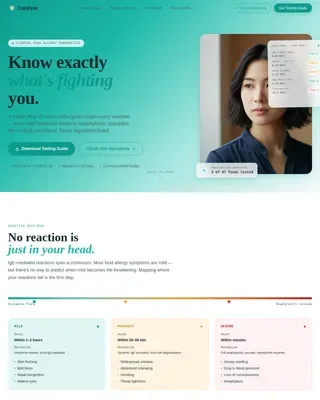
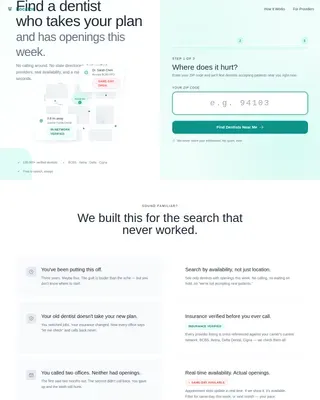
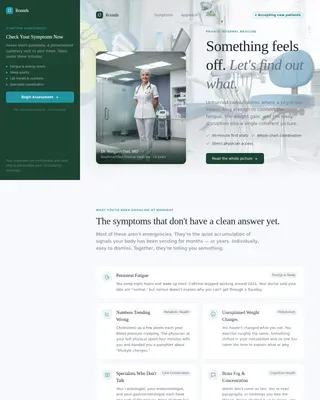
Guided Celiac Wellness Landing Page Template
The Thrive Guided Celiac Healing Assessment landing page template is built for digital health apps serving newly diagnosed celiac disease patients. It opens mid-conversation with a three-step assessment form, flows through clinical evidence and spoke feature sections, and closes with a personalized healing plan reveal. Every section is designed to build trust, reduce anxiety, and move visitors toward completing the quiz.
by Rocket studio
Quick summary
This is a hub and spoke, anchor-navigated landing page template built for a celiac disease digital therapy app. It skips the typical hero image and drops visitors directly into a guided three-step assessment. Clinical statistics anchor the scroll, spoke sections address key care needs, and a personalized results screen delivers the conversion. The whole experience is built to feel warm, medically credible, and easy to navigate.
Who this template is for
This template is made for founders, product teams, and health marketers building digital tools for people living with celiac disease. It works especially well when your audience includes patients who are newly post-diagnosis and overwhelmed, or people who have followed a gluten free diet for months and still feel unwell. If your app delivers guided protocols, symptom tracking, or meal planning for celiac disease management, this template fits your funnel directly.
- Celiac disease app founders targeting newly diagnosed patients in their twenties and thirties
- Health marketers serving exhausted parents decoding gluten free labels and long-misdiagnosed sufferers
- Digital health teams building quiz-first funnels that deliver personalized assessment results
What problem this template solves
People living with celiac disease face a storm of conflicting information after diagnosis. The internet contains a vast amount of information about celiac disease, but not all of it is valid or useful. A newly diagnosed person searching for understanding of their symptoms at midnight needs calm, step-by-step guidance, not another pamphlet full of generic advice. This template solves the conversion problem for apps that offer real structured support by leading with empathy and clinical evidence before asking for an email address.
- Visitors arrive anxious and skeptical; the quiz format meets them where they are and earns attention before making any ask
- Generic landing pages lose health-aware audiences fast; this template builds trust through clinical statistics and outcome-focused headlines grounded in the realities of celiac disease symptoms
- Without a clear assessment funnel, apps struggle to demonstrate their value; this template makes the value obvious within the first scroll depth
What you get with this template
You get a fully structured, single-page hub and spoke layout with anchor navigation, a multi-step assessment form in the header position, and five content spoke sections. Every section is pre-wired with the visual identity and copy structure described in the brief. The template is ready to populate with your own celiac disease app content, patient testimonials, and protocol details without needing to build the architecture from scratch.
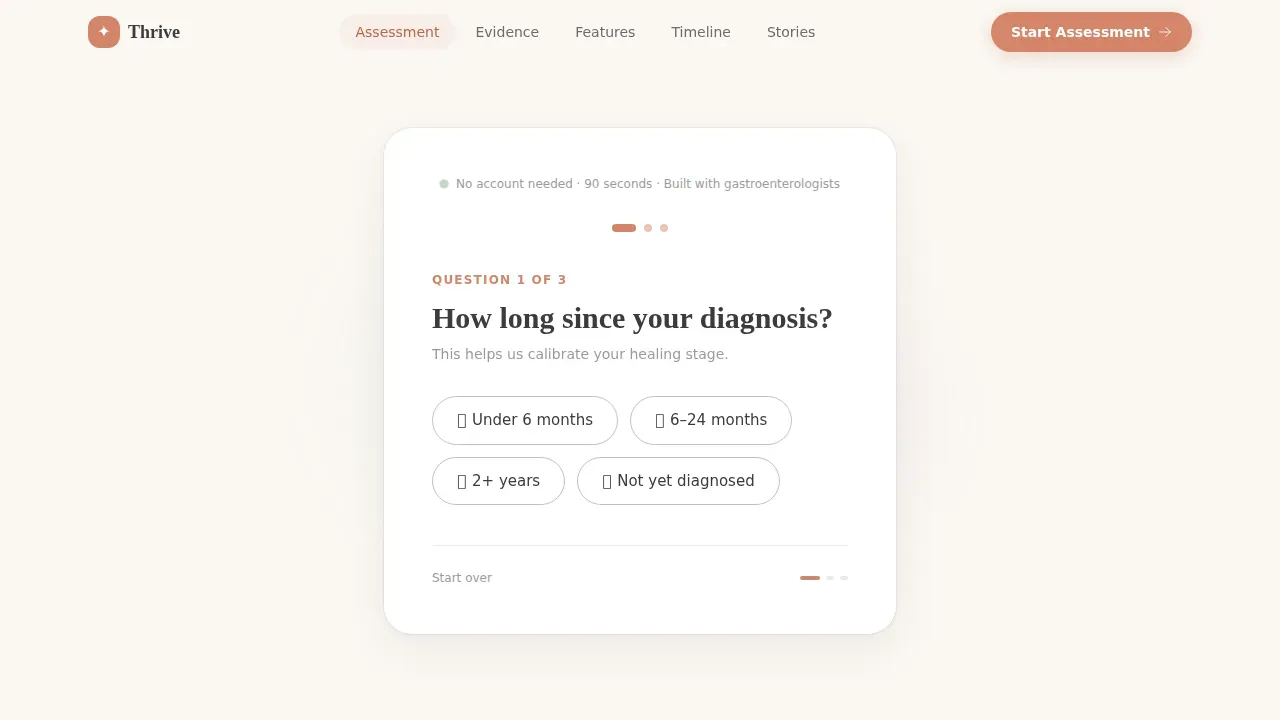
- Multi-step assessment header form with animated step transitions, terracotta progress indicators, and a personalized results screen including an email capture field
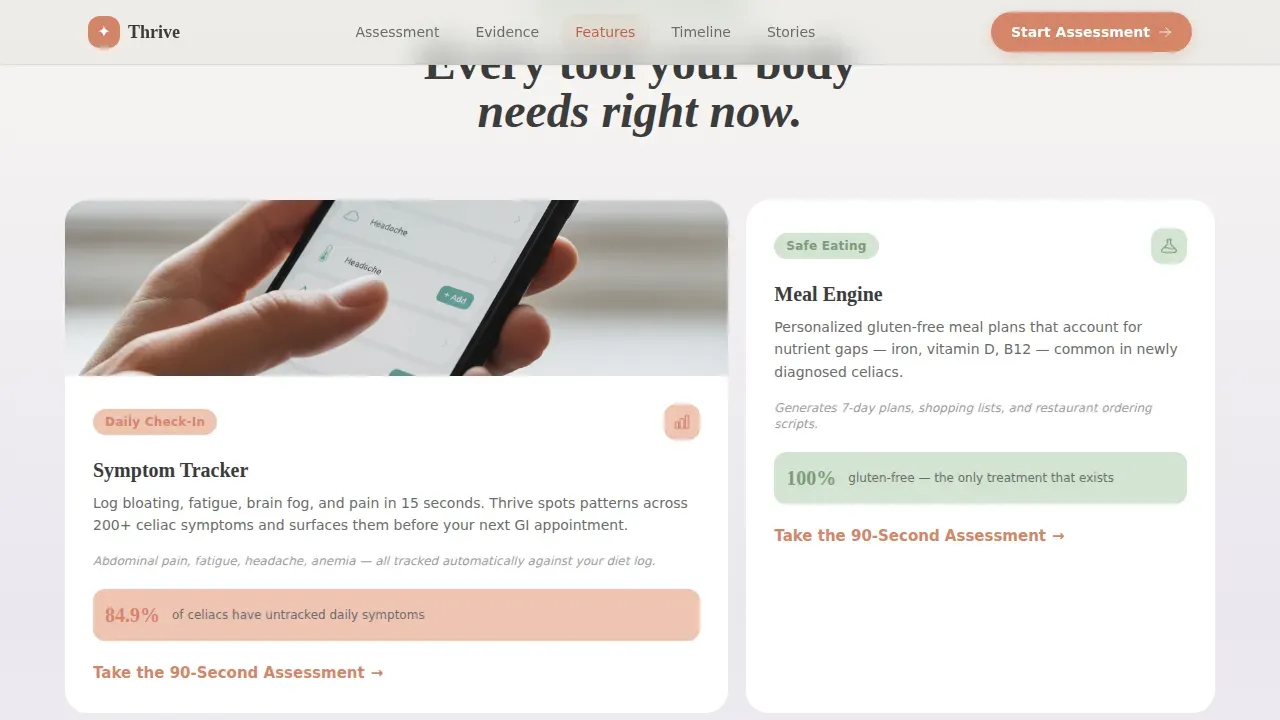
- Five anchor-linked spoke sections covering Symptom Tracker, Meal Engine, Gut-Healing Timeline, Label Scanner, and Community, each ending with a soft terracotta call-to-action link
- Stats Impact section with large-format clinical numerals, Testimonials section, and a How It Works section previewing the 30-day healing arc
Feature list
This template includes the following built-in design and structural features, grounded in the project brief.
Three-Step Assessment Header Form
The header skips a traditional hero and opens directly inside a guided assessment. Visitors answer soft pill-shaped button questions about their celiac disease diagnosis timeline. Each tap animates the next question forward. A reassuring line beneath the form confirms no account is required and that the assessment was built with gastroenterologists. Terracotta progress dots at the top of the form keep each step visible and oriented.
Personalized Results Screen
After completing all three assessment steps, visitors see a results screen that identifies their celiac disease stage and previews a recommended 30-day protocol. A single email capture field framed as "Send my plan to my inbox" serves as the primary conversion point. This approach makes understanding your healing path feel like the natural next step rather than a hard sell.
Stats-First Impact Section
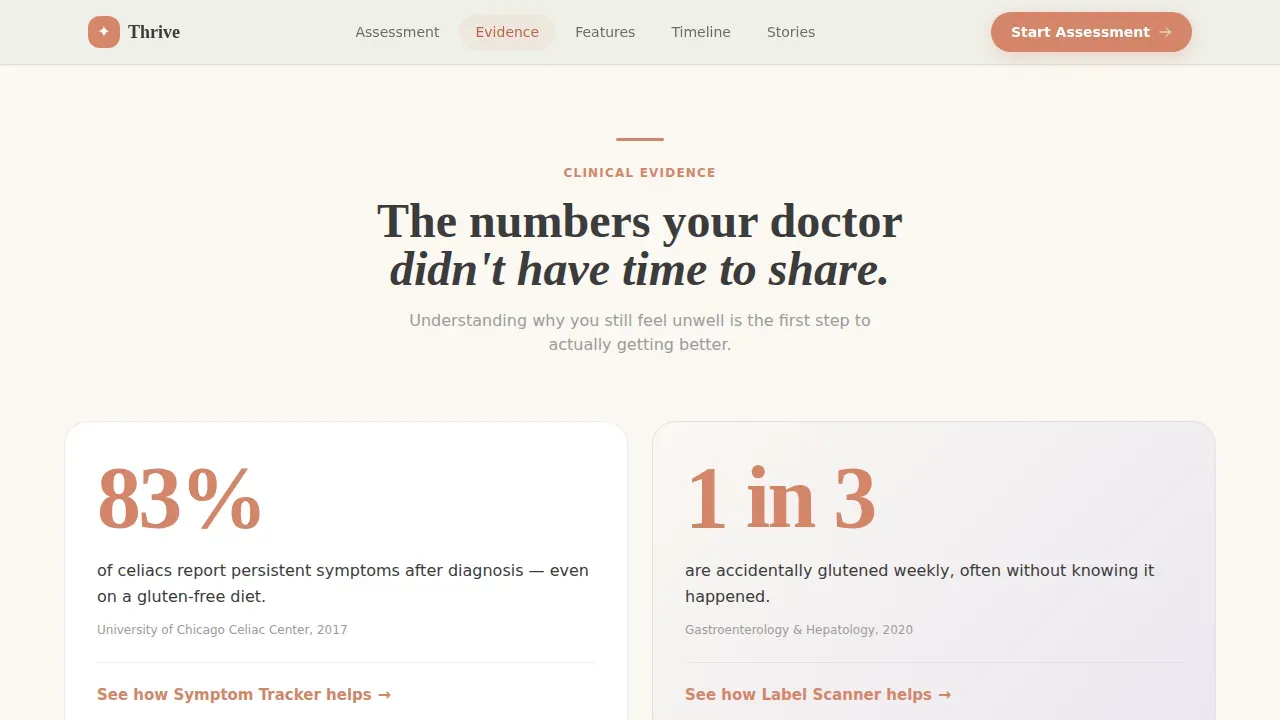
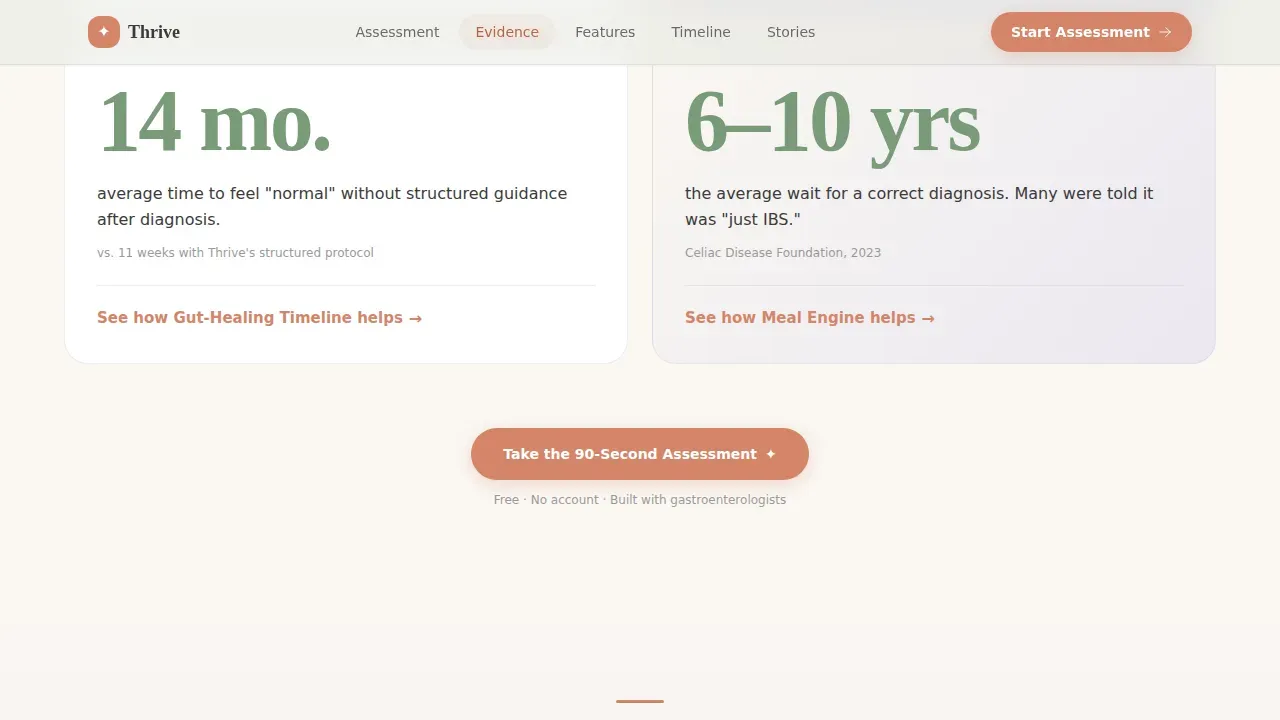
The scroll opens not with product features but with large-format clinical numerals in sage. Evidence-backed statistics anchor the severity of life with celiac disease: persistent symptoms after diagnosis, accidental gluten contamination rates, and the gap between unguided and guided recovery timelines. Each statistic is visually linked to its corresponding spoke section, making the scroll feel like a journey from problem to solution.
Hub and Spoke Anchor Navigation
A sage-colored navigation rail anchors the page at every scroll depth. It links directly to the five spoke sections: Symptom Tracker, Meal Engine, Gut-Healing Timeline, Label Scanner, and Community. Visitors can jump to any section without losing context. Each spoke section ends with a soft terracotta anchor link returning users to the assessment, ensuring no matter where curiosity takes them, the first step back to the quiz is one tap away.
Testimonials and Social Proof Section
A dedicated testimonials section displays real patient voice quotes with specific health outcomes. Social proof grounded in patient experience demonstrates improvements in quality of life and helps skeptical visitors connect with the experience of others living with celiac disease. Trust-building elements like these are essential for converting health-aware audiences who need to see evidence before they act.
How It Works Protocol Preview
A visual How It Works section outlines the 30-day healing arc built into the app. It gives visitors a preview of the structured protocol before they commit. This section is designed to increase confidence and reduce the hesitation that comes with understanding a new celiac disease management approach.
Page sections overview
| Section | Purpose |
|---|---|
| Assessment Header Form | Opens quiz funnel at step one with animated pill-button questions |
| Stats Impact Block | Anchors celiac disease problem with large-format clinical evidence numerals |
| Symptom Tracker Spoke | Shows how the app tracks ongoing celiac disease symptoms over time |
| Meal Engine Spoke | Demonstrates gluten free meal planning built around safe foods |
| Gut-Healing Timeline Spoke | Previews the structured recovery arc from diagnosis to feeling well |
| Label Scanner Spoke | Addresses gluten contamination risk at the grocery aisle level |
| Community Spoke | Highlights peer connection for people managing celiac disease daily |
| Testimonials Section | Displays patient outcome quotes that build trust and credibility |
| How It Works Section | Visual 30-day protocol preview that increases conversion confidence |
| Page Footer | Horizontal flow footer with navigation and email sign links |
Design & branding system
The visual identity follows a Healing Space theme built on the Cloud Canvas color system. The palette was designed to feel like clean cotton sheets in a sunlit recovery room: breathable, unmedicated, and quietly reassuring. Typography pairs DM Sans for body text with Fraunces, a warm serif, for display headings that carry clinical authority without feeling cold. Every color and type choice reinforces the emotional message that this is a safe, credible place for people navigating celiac disease.
- Linen white (#FAF7F2) and lavender-gray (#C4BCCF) hold backgrounds and card surfaces; sage (#A3B9A2) anchors the navigation rail and statistical numerals to signal safety at every scroll depth
- Warm terracotta (#D4856A) is reserved for call-to-action buttons, progress dots, and soft anchor links, creating a reliable visual cue that guides users toward the next step
- Charcoal (#3B3B3B) text on light backgrounds keeps body copy grounded and easy to read, while generous whitespace around the assessment form keeps the experience calm and focused
Mobile & speed optimization
Over 60% of health-related searches happen on mobile devices. Many people managing celiac disease check ingredient labels, track symptoms, and search for gluten free guidance directly from their phones, often in grocery aisles or late at night. This template is built mobile-first, meaning the layout, assessment form, and spoke navigation are all structured to work cleanly on small screens before scaling up to desktop.
- The multi-step assessment form is designed for thumb-friendly pill-shaped button taps, with large touch targets and generous spacing between answer options
- Anchor navigation sits in a sage rail that stays accessible at every scroll depth on mobile, making it easy to jump between spoke sections without losing your place
- The Stats Impact numerals and spoke section cards are structured to stack cleanly on narrow viewports, keeping clinical evidence and feature content readable without horizontal scrolling
How this template helps you convert
This template is built around a quiz-first conversion strategy. It earns the visitor's attention and trust before asking for anything. The assessment form in the header position is the primary conversion tool, and every section below supports it by layering evidence, empathy, and social proof.
- The assessment form opens the conversation at step one before visitors can be distracted by features or pricing; completing all three steps feels like a natural first step toward understanding their celiac disease symptoms rather than a form submission
- Clinical statistics in the Stats Impact section make the problem feel undeniable, so visitors arrive at each spoke section already motivated to find a solution, and the soft terracotta anchor links at the end of each spoke return them to the quiz with a single tap
- The personalized results screen and email capture at the end of the assessment deliver value before asking for contact details, making it easy and acceptable for even skeptical visitors to share their email address and receive their healing plan
Other information about this template
This template is designed specifically for the celiac disease digital health niche and reflects the realities of life after a celiac disease diagnosis. The following notes cover practical context that buyers and teams may find useful when evaluating or implementing this template.
- A guided celiac healing assessment, like the one this template is built around, is a comprehensive evaluation designed to determine whether intestines have healed after adopting a gluten free diet; it covers symptom history, dietary adherence, and potential nutrient deficiencies including iron deficiency
- The assessment structure in this template mirrors clinical best practices: it includes a dietary review detailing the strictness of cross-contamination avoidance, a lifestyle and risk audit to identify gluten sources in the kitchen, and symptom and history tracking to review how celiac disease symptoms have evolved over time
- Blood markers for iron deficiency, normalization of celiac disease serologies, and signs of villous atrophy resolution are the kinds of outcomes a real assessment team, including a dietitian and gastroenterologist, would monitor; the template is designed to surface these care categories as spoke sections and assessment result signals
- Celiac disease is an autoimmune condition triggered by dietary gluten in genetically predisposed people; it affects approximately 1% of the global population and is often misdiagnosed because its symptoms overlap with irritable bowel syndrome and other gastrointestinal disorders
- Celiac disease can present with classic gastrointestinal symptoms such as chronic diarrhea, abdominal pain, and weight loss, but also with non-classical signs including fatigue, iron deficiency anemia, joint pain, and skin conditions like dermatitis herpetiformis
- A diagnosis of celiac disease typically involves serologic tests for antibodies, and a definitive diagnosis is made through examination of duodenal biopsy specimens; genetic testing for HLA-DQ2 and HLA-DQ8 can also be useful in ambiguous cases
- The only currently accepted therapy for celiac disease is the gluten free diet, which requires strict avoidance of wheat, rye, and barley products; as little as 50 mg of gluten can trigger symptoms in sensitive individuals, and adherence can be hard due to cost, social isolation, and risk of accidental contamination
- Nutritional deficiencies, particularly iron deficiency, can arise from a gluten free diet that is not properly managed; refractory celiac disease can occur in patients who do not respond to a gluten free diet after 12 months
- Joining a national support group can help people with celiac disease and gluten sensitivity stay updated with credible information; support groups with a professional advisory board vet new findings and help navigate the overwhelming volume of information available online
- Evaluating the credibility of information about celiac disease requires checking the date and the evidence presented; the Celiac Disease Foundation offers a Symptoms Assessment Tool to help users understand their symptoms and take the first step toward a diagnosis
- The Thrive guided celiac healing assessment landing page template is suggested for teams who want a clinically grounded, empathy-led funnel that is ready to download and adapt for their celiac disease app without building the layout from scratch
- This template can support gluten sensitivity audiences as well, since the assessment questions and spoke content can be adapted for people who are sensitive to gluten but have not received a formal celiac disease diagnosis
Theme
Healing Space
Creative direction
Stats-First Impact
Color system
Cloud Canvas
Style
Hub & Spoke (Anchor Nav)
Direction
Quiz/Assessment
Page Sections
Three-step Assessment Header Form
Personalized Results Screen
Stats-first Impact Section
Hub and Spoke Anchor Navigation
Testimonials and Social Proof Section
How It Works Protocol Preview
Related questions
Who is this landing page template designed for?
Does the template include the quiz logic and results screen?
Can I adapt the spoke sections to match my app's features?
Is this template mobile-friendly for users checking it in grocery stores?
What design files or assets come with this template?